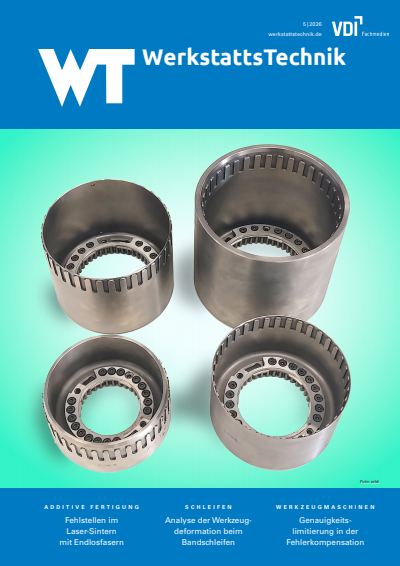
Broaching is a key technology for manufacturing the safety-critical connection between turbine disk and blade. While offering, for instance, high process stability, geometric accuracy and productivity, these advantages are offset by high tool costs...
Particularly important for increasing the resource efficiency of technical components are not only lightweight design but also innovative manufacturing technologies, and process chains with closed material cycles. Using the example of a demonstrator...
The production of circular connectors must combine ecological sustainability with high productivity. Cold forging offers almost complete material utilization compared to currently used machining processes and significantly reduces the CO₂...
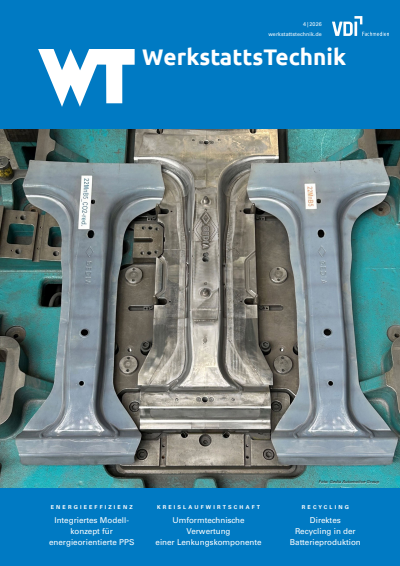
When manufacturing metal sheet components with multiple forming operations in progressive dies, not every forming process is performed with optimal process parameters, which may negatively affect the quality of the components. This work focuses on...
A newly developed test setup enables the experimental-numerical determination of the effective heat transfer coefficient (HTC) depending on various influences for the forging of EN AW-6082. The HTC was determined as a function of temperature,...
Hot bulk metal forming places special demands on process monitoring due to high energy inputs and short cycle times. A multi-sensory method is presented that synchronously records structure-borne and airborne sound signals, decomposes them into...
In bulk forming processes, the contact conditions are inhomogeneously distributed and change throughout the process, resulting in local variations of lubrication. However, current friction models assume constant lubricant behaviour, whereby...
To reduce friction and wear during the forming of aluminum sheet, tool surfaces made of a cast material (EN-GJS-700–2) were chemically oxidized and electrochemically phosphated. The phosphated coatings reduced the coefficient of friction by up to...
A process for analysing the manufacturability of stress-adapted components made of metal and fibre-reinforced hybrid structures using an industrial robot is being investigated. The use of an industrial robot makes it possible to circumvent previous...
Thin-walled precision components including bipolar and electrolyzer plates are key to the transformation towards sustainable energy usage and storage. Conventional forming technologies for these metallic components, however, are limited in...
The study investigates the potential of high-precision brushing (“flakkotieren”) for automated finish machining of forming tools. In a first step, a parameter study was conducted to identify the influence of selected process and tool parameters...
Complex components with free-form surfaces are a key part of tool and mold making, usually produced by machining, in particular 5-axis milling. Spherical tools, such as ball-end mills, offer high profile accuracy and low surface roughness, though...
Different material properties may induce slight deviations in surface condition, component temperature, and friction surface and thus significantly impair the bond of rotary friction welded steel-aluminium alloy joints. The effects of different...
Carbon fiber reinforced plastics (CFRP) are being applied in a wider range of industrial fields. They are not only used for free-formed surfaces, but increasingly also for profiles, tubes, and bars. When cutting other materials to length, such as...
Hybrid fibre composite-metal components are suitable for use as drive shafts, axles, or tension-compression rods and have enormous potential in a wide range of industries due to their high degree of lightweight construction. This article presents...
Hybrid manufacturing combines additive and conventional manufacturing processes to efficiently produce complex metal components with high dimensional accuracy. An optimized process chain with selective laser melting and mechanical post-processing is...
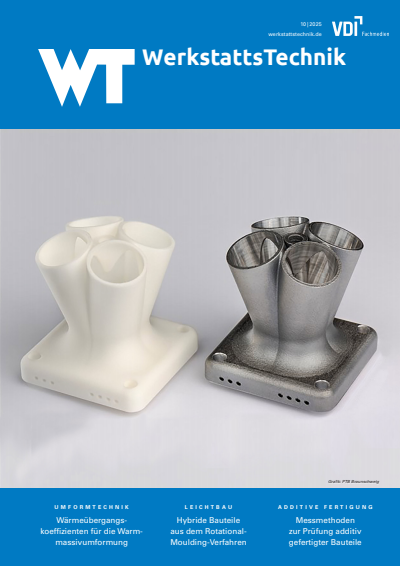
The quality assurance of additively manufactured components poses a particular challenge. The design flexibility of the process makes it possible to create any free-form surfaces or internal geometry elements. Against this backdrop, cost-effective...
As the automotive industry moves towards electromobility, new fields of application are opening up for some materials. Technical pure aluminum materials such as EN AW-1050A H24 are of increasing interest in industrial applications, as their...