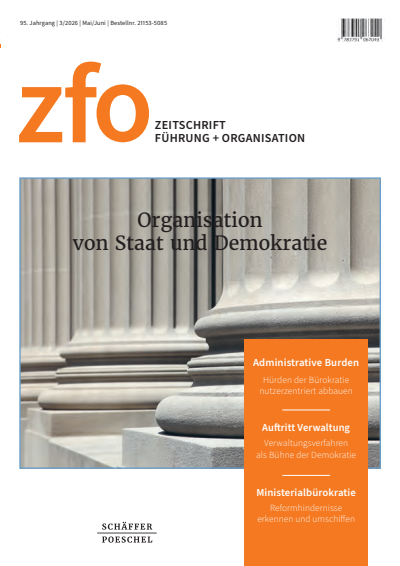
This article examines the phenomenon of administrative burden. The concept addresses the various negative impacts that users may experience when utilizing administrative services. As a result of administrative burden, public services are sometimes...
Schäffer-Poeschel, Stuttgart 2026
Authors: |
Article
No access
Page 130 - 135
The paper examines how administrative procedures can be designed in times of democratic crisis to strengthen constitutional values and democracy itself. Starting point is the interpretation of administrative procedures as stages on which citizens...
Schäffer-Poeschel, Stuttgart 2026
Authors: |
Article
No access
Page 136 - 141
Reform proposals for ministries often fail because they only consider the concrete organizational structures, not their external conditions. The example of ministerial bureaucracy shows that central problems are determined by external conditions...
Schäffer-Poeschel, Stuttgart 2026
Authors: |
Article
No access
Page 142 - 144
Schäffer-Poeschel, Stuttgart 2026
Authors:
Article
No access
Page 145 - 148
Public administration in Germany traditionally relies on Weber’s bureaucratic principles, ensuring legality and reliability but limiting flexibility under dynamic conditions. Agile approaches (Kanban, Scrum, Design Thinking) can supplement this by...
Schäffer-Poeschel, Stuttgart 2026
Authors: |
Article
No access
Page 149 - 154
The StaGe procedure (standardized risk assessment) is a validated screening tool for mental risk assessment in public administration. It measures job demands and resources through an employee survey. Data from 1,930 employees across 34...
Schäffer-Poeschel, Stuttgart 2026
Authors: |
Article
No access
Page 155 - 159
A key finding from the study on students’ perception of business succession is the discrepancy between the recognized relevance of succession and the actual willingness to take over a business. Although business succession is theoretically...
Schäffer-Poeschel, Stuttgart 2026
Authors:
Article
No access
Page 160 - 166
Usually action forces have to provide services under high pressure, sometimes under great danger and at considerable risk. This requires command, immediate implementation, precision, efficiency, and effectiveness, which are expressed in leadership...
Schäffer-Poeschel, Stuttgart 2026
Authors: | |
Article
No access
Page 167 - 171
This paper examines how paradoxes can trigger downward spirals in organizations. Paradoxes, understood as contradictory but connected elements, can, if mismanaged, create deviation-reinforcing action loops that cause destructive patterns and...