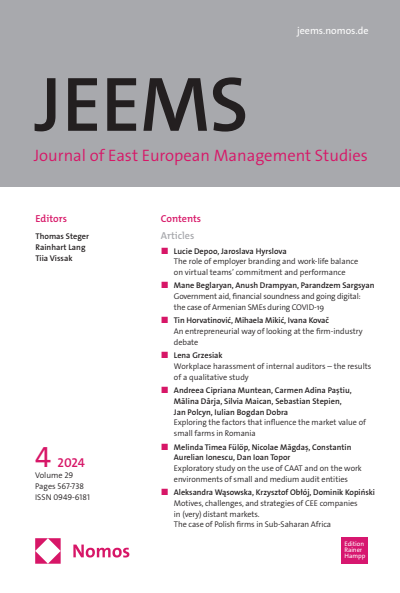
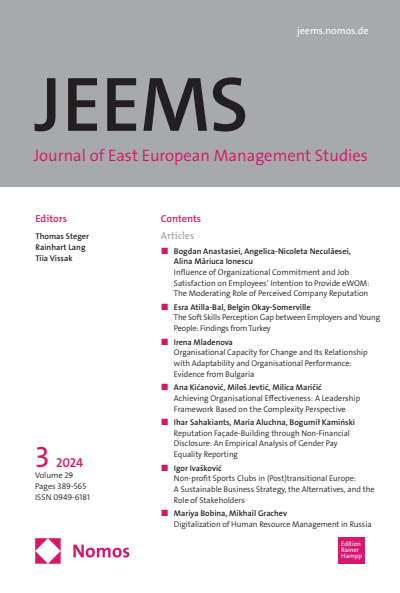
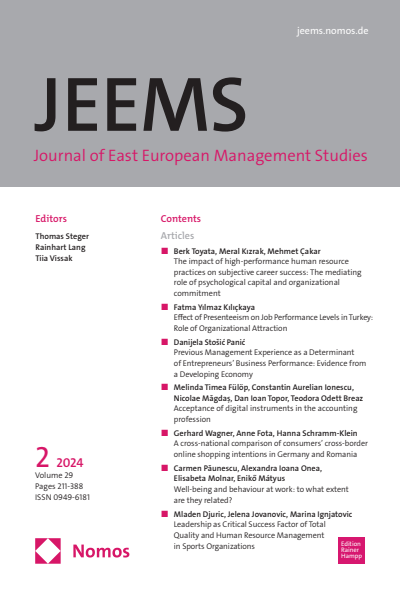
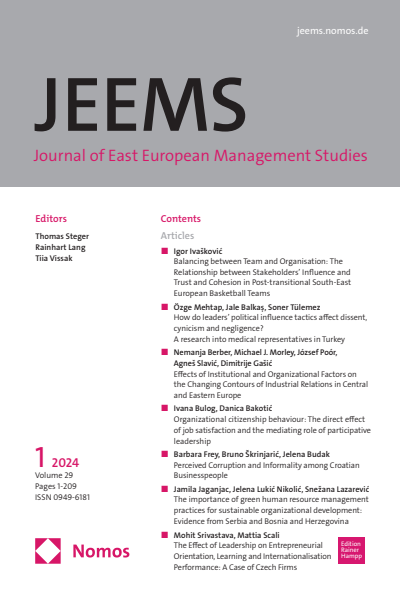
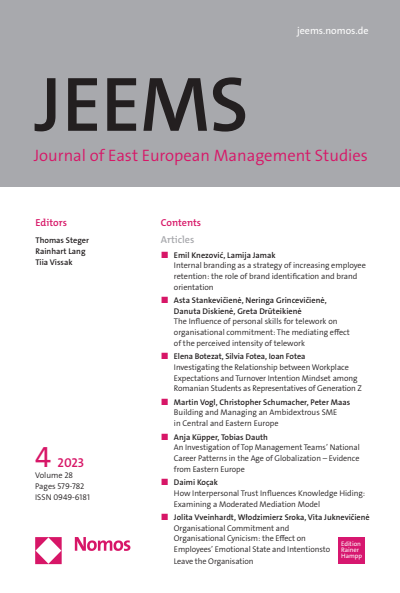
The Journal of East European Management Studies aims to promote dialogue and cooperation among scholars seeking to examine,explore and explain the behaviour and practices of management within the transforming societies of Central and Eastern Europe.The theoretical interests of the journal areorganisational and management change,Central and East European societies (including those on the fringes of Europe) undergoing processes of transition or transformation, andscientific issues of business, management and organisation that arise in such contexts.The JEEMS aims to attract social scientific contributions from scholars of any nation and region, but particularly wishes to encourageauthors from those countries directly experiencing transformational change. Its potential readership is international, comprising academicsand practitioners with an involvement or interest in the management of change in transforming societies in Central and Eastern Europe.
The key question concerning the HRM in MNCs is the extent of global standardization versus localization of HRM-practices. The present study analyses whether the Finnish companies operating in Estonia apply a clear strategical approach to their IHRM...
The process of systemic change in Poland has brought about major changes in corporate governance. The enforcement of new laws has created a culture of compliance that has shaped capital groups and the management ethos of the groups, spurring them to...
Social capital is a valuable resource that can be raised and destroyed, and its level in society is path dependent and related to society's "collective memory" of experience with power structures. Social capital is found both on the network as well...
In this paper we compare the leadership behaviour of managers in Austria and the Czech Republic, employing the Vroom/Yetton situational leadership model. The model applies a methodology that is close-to-action in contrast to the collection of...
The paper defines crucial adjustment instruments of the Slovak business sector in the course of its accession to the European Union. Analysis of these instruments is illustrated with a sample of 110 Slovak manufacturing firms. Analysis shows that...