AI-based assistance systems are increasingly being used in manufacturing companies. However, the associated efficiency benefits can only be achieved if the systems are used effectively by employees. The effects on employees‘ work tasks,...
Resilience arises from the trusting and agile cooperation of people in order to overcome everyday and crisis situations in value creation networks. Against the background of increasing dynamics and complexity in industrial ecosystems, this article...
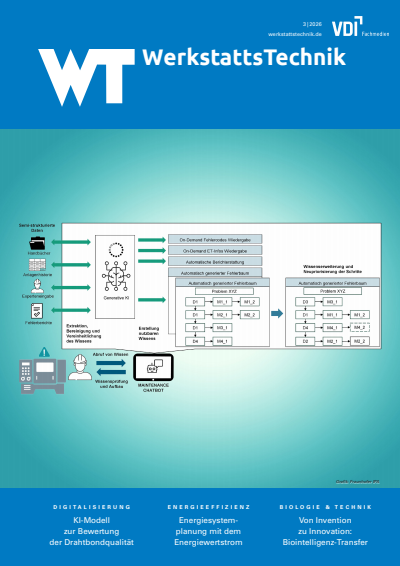
Knowledge retention is challenging for companies. Since most knowledge is encoded as text, large language models offer a promising solution for preservation and utilization. A system based on the approach of retrieval augmented generation has been...
Neuroergonomics and neuroadaptive systems offer innovative approaches to accurately capture and leverage mental states for shaping human-centred digitalized technologies and workplaces. Understanding cognitive processes and states is becoming...
Work science is expected to contribute to the innovation of the working society as part of the digital transformation. To this end, research is done on new paradigms and methods of work design. Complementary strategies for the rationalization and...
The intuitive, acceptable design of human-robot interaction (HRI) is key for a successful introduction of robots in industrial and other contexts. This paper presents an approach to standardize HRI design knowledge and facilitate its application...
Increasing market requirements, complex existing systems, and digitalization are making AI launches more challenging. Systematic technology management (TM) addresses people, technology, and organization (PTO) holistically. Brownfield approaches...
This paper deals with the sustainable implementation of radical transformations in the production environment and develops an innovative solution approach according to which these transformations are implemented. The summary finding such...
This article examines how Agile Sprintlearning contributes to meeting the changing requirements for practical educational programs in the digital age. The elements of agile learning and their impact on self-regulated, productive, active, situational...
The use of external AI value-added services promises many advantages for industrial production systems but presents companies with particular challenges in terms of data protection, know-how protection and reliability of unverified results. This...
Digital twins (DTs) hold significant potential for process optimization and predictive maintenance though facing technical, organizational, and methodological challenges. This article analyzes key obstacles and presents proven measures for...
The cross-company orchestration of software-defined value networks requires standardized modelling. This is provided by the asset administration shell with its metamodel and standardized submodels. This article analyzes the capacity of the the asset...
As an essential resource in production, people must be adequately supported in their work. Empathic technical systems, which are researched in the Fraunhofer flagship project „Emotion“, create new possibilities for supporting them. Based on an...
Enabled by digitalization, Industry 4.0 was born, facilitating the production of small batch sizes under conditions that stimulate competitiveness. Small-scale, demand-orientated value creation enables manufacturing capacities to be offered as a...
Virtual commissioning is an established method in mechanical and plant engineering. Collision detection is necessary to map physical behavior in a real-time simulation for virtual commissioning. The design of real-time collision models is complex...
Automated guided vehicles (AGVs) are essential for the automated transportation of goods in industrial applications. However, conventional AGVs are reaching their limits, which is why autonomous mobile robots (AMRs) are being used as a more flexible...
The increasing complexity and demand for customized aircraft have a significant impact on production planning in the aviation industry. To achieve more flexibility in the production system and to take industrial requirements into account at an early...
In the engineering process of production machines, increasingly fast-changing requirements are set on simulation and related control systems. The X-in-the-Loop (XiL) configurations, which have been established through software tools, provide...
Material flow simulation is used for validation and optimization in all phases of the life cycle of factory systems. Data acquisition is complex and influences the simulation results. At the same time, properties of production elements are modeled...
Extending the product life cycle is a fundamental objective of sustainable product development. The update factory is a holistic approach for implementing product updates on an industrial scale as a contribution to a circular economy. This article...