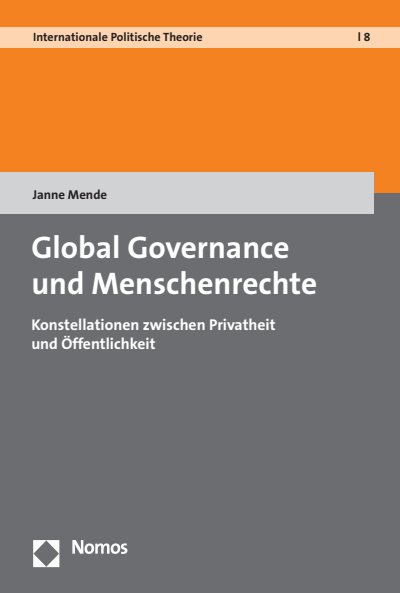
Global Governance und Menschenrechte
Konstellationen zwischen Privatheit und Öffentlichkeit- Autor:innen:
- Reihe:
- Internationale Politische Theorie, Band 8
- Verlag:
- 2020
Zusammenfassung
Globalisierung und Global Governance führen dazu, dass private Akteure an öffentlichen Regulierungs- und Entscheidungsprozessen beteiligt sind. Insbesondere Unternehmen erfahren einen Zuwachs an Macht, die weit über bloße wirtschaftliche Kennzahlen hinausgeht. Vielmehr kommt Unternehmen auch eine politische und normative Macht zu. Dieses Buch untersucht die daraus entstehenden Möglichkeiten und Herausforderungen. Besonders deutlich zeigen sich diese im internationalen Menschenrechtsregime. Die politische und normative Macht privater Akteure verändert das öffentliche Menschenrecht und die Global-Governance-Akteure selbst. Diese Entwicklung erfordert auch eine neue Perspektive auf Privatheit und Öffentlichkeit. Das Buch entwickelt daher eine Perspektive auf die hybriden, gesellschaftlichen Rollen von Unternehmen. Diese gesellschaftlichen Rollen formen eine dritte Sphäre, die zwischen und gleichzeitig jenseits von Privatheit und Öffentlichkeit liegt.
Publikation durchsuchen
Bibliographische Angaben
- Auflage
- 1/2020
- Copyrightjahr
- 2020
- ISBN-Print
- 978-3-8487-5715-2
- ISBN-Online
- 978-3-8452-9847-4
- Verlag
- Nomos, Baden-Baden
- Reihe
- Internationale Politische Theorie
- Band
- 8
- Sprache
- Deutsch
- Seiten
- 338
- Produkttyp
- Monographie
Inhaltsverzeichnis
- Titelei/Inhaltsverzeichnis Kein Zugriff Seiten 1 - 12
- Einleitung Kein Zugriff
- I Privatheit, Öffentlichkeit und Global Governance Kein Zugriff
- II Global Governance und internationale Menschenrechte Kein Zugriff
- III Unternehmerische Verantwortung für Menschenrechte Kein Zugriff
- IV Unternehmerische Verantwortung für moderne Sklaverei Kein Zugriff
- a) Das Private, das Öffentliche und das Gesellschaftliche Kein Zugriff
- b) Geschlechterverhältnisse Kein Zugriff
- c) Die Legitimität normativer und politischer Macht Kein Zugriff
- d) Offene Normativität Kein Zugriff
- 1 Konturen Internationaler Politischer Theorie Kein Zugriff
- 2 Privatheit in den Internationalen Beziehungen und der Politischen Theorie Kein Zugriff
- 3 Privatheit in der Internationalen Politischen Theorie Kein Zugriff
- 4 Verdoppelung und Überkreuzung des Privaten Kein Zugriff
- 5 Ausblick Kein Zugriff
- Die Privatheit der Privatsphäre Kein Zugriff
- Introduction Kein Zugriff
- Definitions of Global Governance Kein Zugriff
- The Multiplicity of Global Governance Kein Zugriff
- The Role of States Kein Zugriff
- The Role of Nonstate Actors Kein Zugriff
- The Role of International Institutions Kein Zugriff
- Analytical and Critical Perspectives on Global Governance Kein Zugriff
- Conclusion Kein Zugriff
- 1.1 Libertärer Paternalismus Kein Zugriff
- 1.2 Global Governance Kein Zugriff
- 1.3 Grundlagen der Perspektivenverschränkung Kein Zugriff
- 2.1 Das bessere Leben Kein Zugriff
- 2.2 Freiheit und Heteronomie Kein Zugriff
- 3.1 Die Akteurskonstellation Kein Zugriff
- 3.2 Der Startpunkt der Legitimität Kein Zugriff
- 4.1 Governing Nudges Kein Zugriff
- 4.2 Nudging Governance Kein Zugriff
- Fazit Kein Zugriff
- 1.1 The Idea of Human Rights Kein Zugriff
- 1.2 The Institutionalization of Human Rights Kein Zugriff
- 1.3 The Application of Human Rights Kein Zugriff
- 2.1 Dynamic Pluralism Kein Zugriff
- 2.2 Awareness of Power and Inequalities Kein Zugriff
- 2.3 Contextual Universalism Kein Zugriff
- 2.4 Open Normativity Kein Zugriff
- Conclusion Kein Zugriff
- 1 Einleitung Kein Zugriff
- 2 Das häusliche Private im Menschenrecht: Frauenmenschenrechte Kein Zugriff
- 3 Das globale Private im Menschenrecht: Privatisierung und Global Governance Kein Zugriff
- a) Eindeutige Trennung: Kein Zugriff
- b) Diffundierende Auflösung: Kein Zugriff
- c) Verschiebung der Trennlinie: Kein Zugriff
- d) Vermittlung von Privatheit und Öffentlichkeit Kein Zugriff
- 1 Einleitung Kein Zugriff
- 2 Öffentliches Völkerrecht und nichtstaatliche Akteure Kein Zugriff
- 3 Soft Law und transnationales Recht Kein Zugriff
- 4 Unternehmerische Verantwortung für Menschenrechte Kein Zugriff
- 5 Die Legitimität nichtstaatlicher Akteure Kein Zugriff
- 1 Genesis Kein Zugriff
- 2 Content Kein Zugriff
- 3 Impact Kein Zugriff
- 1 Einleitung Kein Zugriff
- 2 Das Konzept menschenrechtlicher Verantwortung Kein Zugriff
- 3 Corporate Social Responsibility Kein Zugriff
- 4.1 Unternehmerische Verantwortung für Menschenrechte Kein Zugriff
- 4.2 Staatliche Verantwortung für Menschenrechte Kein Zugriff
- 5 Die Ecuador-Initiative Kein Zugriff
- 5.1 Die politische Konfrontation zwischen verbindlicher und unverbindlicher Verantwortung Kein Zugriff
- 6 Konklusion: Diffusion menschenrechtlicher Verantwortung Kein Zugriff
- 6.1 Produktiv komplementäre Verantwortung Kein Zugriff
- 6.2 Unternehmen als gesellschaftliche Akteure Kein Zugriff
- 6.3 Diffusion statt Dichotomien Kein Zugriff
- 1.1 Externe Effekte Kein Zugriff
- 1.2 Selbstinteresse Kein Zugriff
- 1.3 Gemeinwohl Kein Zugriff
- 1.4 Legitimität Kein Zugriff
- 2.1 Gesellschaftliche Verantwortung Kein Zugriff
- 2.2 Pluralismus im transnationalen Recht Kein Zugriff
- 2.3 Komplementäre Verantwortung Kein Zugriff
- Ausblick Kein Zugriff
- Which Business? Controversies about the Scope of Application of a Future Treaty on Business and Human Rights Kein Zugriff
- Einleitung Kein Zugriff
- 1) Schuldknechtschaft und Vertragssklaverei: Kein Zugriff
- 2) Hausarbeit: Kein Zugriff
- 3) Besitzsklaverei und herkunftsbasierte Sklaverei: Kein Zugriff
- 4) Rituelle und religiöse Sklaverei: Kein Zugriff
- 5) Zwangsarbeit und Menschenhandel: Kein Zugriff
- 6) Kinderarbeit: Kein Zugriff
- Definitionen moderner Sklaverei Kein Zugriff
- a) Die Erweiterung von Sklaverei-Definitionen Kein Zugriff
- b) Die Dekonstruktion von Sklaverei-Definitionen Kein Zugriff
- Ein offenes Fazit Kein Zugriff
- 1.1 Key Documents Kein Zugriff
- 1.2 Interim Conclusion: Definitions of Modern Slavery Kein Zugriff
- 2.1 Slavery as Homogenous Concept Kein Zugriff
- 2.2 Slavery as Absolute Evil Kein Zugriff
- 2.3 The Emotionalization of Slavery Kein Zugriff
- 2.4 Repressive Policies Kein Zugriff
- 2.5 Slavery as Powerlessness Kein Zugriff
- 2.6 Interim Conclusion: Slavery as Detached Phenomenon Kein Zugriff
- 3.1 The Practical Dimension: Civil Society Strategies Kein Zugriff
- 3.2 The Conceptual Dimension: Delineation and Normativity Kein Zugriff
- 3.3 The Framework Dimension: Human Rights Kein Zugriff
- 4 Conclusion: Modern Slavery as Embedded Concept Kein Zugriff
- 1.1 Modern Slavery as Relation Kein Zugriff
- 1.2 Modern Slavery as Structure Kein Zugriff
- 1.3 Modern Slavery: A Pathway Kein Zugriff
- 2.1 The Power of Business Kein Zugriff
- 2.2 Internal and External Realms of Business Agency Kein Zugriff
- 2.3 Public and Private Business Roles Kein Zugriff
- 2.4 Business Responsibility: A Pathway Kein Zugriff
- 3.1 Narrow Business Responsibility for Modern Slavery as Relation Kein Zugriff
- 3.2 Broad Business Responsibility for Modern Slavery as Structure Kein Zugriff
- 4 Strengths and Limits Kein Zugriff
- 5 Conclusion Kein Zugriff
- Schriftenverzeichnis Kein Zugriff Seiten 337 - 338
Literaturverzeichnis (355 Einträge)
Es wurden keine Treffer gefunden. Versuchen Sie einen anderen Begriff.
- References Google Scholar öffnen DOI: 10.5771/9783845298474
- Barnett, M., & Finnemore, M. (2005). The power of liberal international organizations. In M. N. Barnett & R. Duvall (Eds.), Power in global governance (pp. 161–184). Cambridge, New York: Cambridge University Press. Google Scholar öffnen DOI: 10.5771/9783845298474
- Barnett, M., & Sikkink, K. (2008). From international relations to global society. In C. Reus-Smit & D. Snidal (Eds.), The Oxford handbook of international relations (pp. 62–83). Oxford, New York: Oxford University Press. Google Scholar öffnen DOI: 10.5771/9783845298474
- Barnett, M. N., & Duvall, R. (Eds.). (2005). Power in global governance. Cambridge studies in international relations: Vol. 98. Cambridge, New York: Cambridge University Press. Google Scholar öffnen DOI: 10.5771/9783845298474
- Best, J., & Gheciu, A. (2014). Theorizing the public as practices: Transformations of the public in historical context. In J. Best & A. Gheciu (Eds.), The return of the public in global governance (pp. 15–44). Cambridge: Cambridge University Press. Google Scholar öffnen DOI: 10.5771/9783845298474
- Brand, U., Brunnengräber, A., Schrader, L., Stock, C., & Wahl, P. (2000). Global Governance: Alternative zur neoliberalen Globalisierung? (1st ed.). Münster: Westfälisches Dampfboot. Google Scholar öffnen DOI: 10.5771/9783845298474
- Brühl, T., & Rittberger, V. (2001). From international to global governance: Actors, collective decision-making, and the United Nations in the world of the twenty-first century. In V. Rittberger (Ed.), Global governance and the United Nations system (pp. 1–47). Tokyo, New York: United Nations University Press. Google Scholar öffnen DOI: 10.5771/9783845298474
- Brysk, A. (2005). Human rights and private wrongs: Constructing global civil society. Global horizons. New York: Routledge. Google Scholar öffnen DOI: 10.5771/9783845298474
- Çağlar, G., Prügl, E., & Zwingel, S. (Eds.). (2013). Feminist strategies in international governance. Routledge global institutions: Vol. 70. London: Routledge. Google Scholar öffnen DOI: 10.5771/9783845298474
- Commission on Global Security, Justice & Governance. (2015). Confronting the crisis of global governance: Report of the Commission on Global Security, Justice & Governance. The Hague, Washington, D.C.: The Hague Institute for Global Justice and the Stimson Center. Google Scholar öffnen DOI: 10.5771/9783845298474
- Cutler, A. C., Haufler, V., & Porter, T. (1999). Private authority and international affairs. In A. C. Cutler, V. Haufler, & T. Porter (Eds.), Private authority and international affairs (pp. 3–27). Albany: State University of New York Press. Google Scholar öffnen DOI: 10.5771/9783845298474
- Fuchs, D. (2005). Understanding business power in global governance. Baden-Baden: Nomos. Google Scholar öffnen DOI: 10.5771/9783845298474
- Hall, R. B., & Biersteker, T. J. (2002). The emergence of private authority in the international system. In R. B. Hall & T. J. Biersteker (Eds.), The emergence of private authority in global governance (pp. 3–22). Cambridge, New York: Cambridge University Press. Google Scholar öffnen DOI: 10.5771/9783845298474
- Hurd, I. (1999). Legitimacy and authority in international politics. International Organization, 53(2), 379–408. https://doi.org/10.1162/002081899550913 Google Scholar öffnen DOI: 10.5771/9783845298474
- Keohane, R. O. (2005). Global governance and democratic accountability. In R. Wilkinson (Ed.), The Global Governance Reader (pp. 120–137). London, New York: Routledge. Google Scholar öffnen DOI: 10.5771/9783845298474
- Mende, J. (2016). Global Governance und libertärer Paternalismus: Akteure, Normativität und Legitimität. Zeitschrift für Praktische Philosophie, 3(1), 557–596. Google Scholar öffnen DOI: 10.5771/9783845298474
- Näsström, S. (2010). Democracy counts: Problems of equality in transnational democracy. In C. Jönsson & J. Tallberg (Eds.), Democracy beyond the nation state? Transnational actors in global governance: Patterns, explanations, and implications (pp. 197–217). Basingstoke: Palgrave Macmillan. Google Scholar öffnen DOI: 10.5771/9783845298474
- Peters, A., Koechlin, L., Förster, T., & Zinkernagel, G. F. (Eds.). (2009). Non-state actors as standard setters. Cambridge, New York: Cambridge University Press. Google Scholar öffnen DOI: 10.5771/9783845298474
- Rittberger, V., & Zangl, B. (2010). International organization: Polity, politics and policies. Basingstoke u.a.: Palgrave Macmillan. Google Scholar öffnen DOI: 10.5771/9783845298474
- Rosenau, J. N. (1992). Governance, order, and change in world politics. In J. N. Rosenau & E. O. Czempiel (Eds.), Governance without government: Order and change in world politics (pp. 1–29). Cambridge, New York: Cambridge University Press. Google Scholar öffnen DOI: 10.5771/9783845298474
- Rosenau, J. N. (1995). Governance in the twenty-first century. Global Governance: A Review of Multilateralism and International Organizations, 1(1), 13–43. Google Scholar öffnen DOI: 10.5771/9783845298474
- Rosenau, J. N., & Czempiel, E. O. (Eds.). (1992). Governance without government: Order and change in world politics. Cambridge, New York: Cambridge University Press. Google Scholar öffnen DOI: 10.5771/9783845298474
- Ruggie, J. G. (2004). Reconstituting the global public domain: Issues, actors, and practices. European Journal of International Relations, 10(4), 499–531. https://doi.org/10.1177/1354066104047847 Google Scholar öffnen DOI: 10.5771/9783845298474
- Sassen, S. (2006). Territory, authority, rights: From medieval to global assemblages. Princeton: Princeton University Press. Retrieved from http://lib.myilibrary.com/detail.asp?id=215885 Google Scholar öffnen DOI: 10.5771/9783845298474
- The Commission on Global Governance. (1995). Our global neighborhood: The report of the Commission on Global Governance. Oxford: Oxford University Press. Google Scholar öffnen DOI: 10.5771/9783845298474
- Zürn, M. (2013). Globalization and global governance. In W. Carlsnaes, T. Risse, & B. A. Simmons (Eds.), Handbook of international relations (2nd ed., pp. 401–425). London: Sage. Google Scholar öffnen DOI: 10.5771/9783845298474
- Zürn, M. (2017). The social origins of silent majorities: Paper for the workshop: Beyond representative democracy? Design and legitimacy of non-majoritarian institutions, Berlin, 5–7 October 2017. Google Scholar öffnen DOI: 10.5771/9783845298474
- References Google Scholar öffnen DOI: 10.5771/9783845298474
- Acharya A (2004) How ideas spread: Whose norms matter? Norm localization and institutional change in Asian regionalism. International Organization 58(02): 239–275. Google Scholar öffnen DOI: 10.5771/9783845298474
- Adami R (2017) Intersectional dialogue: Analyzing power in reaching a Universal Declaration of Human Rights in 1948 on conflicting grounds. Journal of Human Rights 17(3): 357–366. Google Scholar öffnen DOI: 10.5771/9783845298474
- Ake C (1987) The African context of human rights. Africa Today 34(1/2): 5–12. Google Scholar öffnen DOI: 10.5771/9783845298474
- Al-Hibri AY (1999) Is Western patriarchal feminism good for Third World/minority women? In: Cohen J, Howard M and Nussbaum MC (eds) Is multiculturalism bad for women? Princeton: Princeton University Press, pp. 41–46. Google Scholar öffnen DOI: 10.5771/9783845298474
- American Anthropological Association EB (1947) Statement on human rights. American Anthropologist 49(4/1): 539–543. Google Scholar öffnen DOI: 10.5771/9783845298474
- An-Na’im AA (1999) The cultural mediation of human rights: The Al-Arqam Case in Malaysia. In: Bauer JR and Bell D (eds) The East Asian challenge for human rights: Cambridge, New York: Cambridge University Press, pp. 147–168. Google Scholar öffnen DOI: 10.5771/9783845298474
- An-Na’im AA and Deng FM (eds) (1990) Human rights in Africa: Cross-cultural perspectives. Washington, D.C.: The Brookings Institution. Google Scholar öffnen DOI: 10.5771/9783845298474
- Asmal K, Chidester D and Lubisi C (2005) Legacy of freedom: The ANC’s human rights tradition. Africans’ claims in South Africa, the Freedom Charter, the Women’s Charter and other human rights landmarks of the African National Congress. Johannesburg: Ball. Google Scholar öffnen DOI: 10.5771/9783845298474
- Barreto J-M (ed) (2013) Human rights from a third world perspective: Critique, history and international law. Newcastle-upon-Tyne, Ann Arbor: Cambridge Scholars Publishing. Google Scholar öffnen DOI: 10.5771/9783845298474
- Bauer JR and Bell D (eds) (1999) The East Asian challenge for human rights. Cambridge, New York: Cambridge University Press. Google Scholar öffnen DOI: 10.5771/9783845298474
- Bhabha HK (1994) The location of culture. London, New York: Routledge. Google Scholar öffnen DOI: 10.5771/9783845298474
- Bhambra GK (2009) Rethinking modernity: Postcolonialism and the sociological imagination. Basingstoke, Hampshire, New York, NY: Palgrave Macmillan. Google Scholar öffnen DOI: 10.5771/9783845298474
- Bhambra GK (2014) Connected sociologies. London: Bloomsbury. Google Scholar öffnen DOI: 10.5771/9783845298474
- Bhambra GK (2015) On the Haitian revolution and the society of equals. Theory, Culture & Society 32(7–8): 267–274. Google Scholar öffnen DOI: 10.5771/9783845298474
- Bielefeldt H (2000) „Western“ versus „Islamic“ human rights conceptions? A critique of cultural essentialism in the discussion on human rights. Political Theory 28(1): 90–121. Google Scholar öffnen DOI: 10.5771/9783845298474
- Bielefeldt H (2007) Ideengeschichte(n) der Menschenrechte. In: Janz N and Risse T (eds) Menschenrechte: Globale Dimensionen eines universellen Anspruchs. Baden-Baden: Nomos, pp. 177–186. Google Scholar öffnen DOI: 10.5771/9783845298474
- Brotton J (2002) The Renaissance Bazaar: from the Silk Road to Michelangelo. Oxford: Oxford University Press. Google Scholar öffnen DOI: 10.5771/9783845298474
- Buck-Morss S (2000) Hegel and Haiti. Critical Inquiry 6(4): 821–865. Google Scholar öffnen DOI: 10.5771/9783845298474
- Burke E (1790) Reflections on the revolution in France, and on the proceedings in certain societies in London relative to that event. London: J. Dodsley. Google Scholar öffnen DOI: 10.5771/9783845298474
- Carozza PG (2003) From conquest to constitutions: Retrieving a Latin American tradition of the idea of human rights. Human Rights Quarterly 25: 281–313. Google Scholar öffnen DOI: 10.5771/9783845298474
- Chakrabarty D (2008) Provincializing Europe: Postcolonial thought and historical difference. Princeton: Princeton University Press. Google Scholar öffnen DOI: 10.5771/9783845298474
- Chan J (1999) A Confucian perspective on human rights for contemporary China. In: Bauer JR and Bell D (eds) The East Asian challenge for human rights: Cambridge, New York: Cambridge University Press, pp. 212–239. Google Scholar öffnen DOI: 10.5771/9783845298474
- Chowdhry G (2005) Postcolonial interrogations of child labor: Human rights, carpet trade, and Rugmark in India. In: Chowdhry G and Nair S (eds) Power, postcolonialism and international relations: Reading race, gender and class. London: Routledge, pp. 225–253. Google Scholar öffnen DOI: 10.5771/9783845298474
- Comaroff JL and Comaroff J (1997) Postcolonial politics and discourses of democracy in southern Africa: An anthropological reflection on African political modernities. Journal of Anthropological Research 35(2): 123–146. Google Scholar öffnen DOI: 10.5771/9783845298474
- Conrad S and Randeria S (2002) Geteilte Geschichten: Europa in einer postkolonialen Welt. In: Conrad S and Randeria S (eds) Jenseits des Eurozentrismus: Postkoloniale Perspektiven in den Geschichts- und Kulturwissenschaften. Frankfurt am Main, New York: Campus, pp. 9–49. Google Scholar öffnen DOI: 10.5771/9783845298474
- Cousin G (2011) Rethinking the concept of ‘western’. Higher Education Research & Development 30(5): 585–594. Google Scholar öffnen DOI: 10.5771/9783845298474
- Deitelhoff N (2009) The discoursive process of legalization: Charting islands of persuasion in the ICC case. International Organization 63(1): 33–65. Google Scholar öffnen DOI: 10.5771/9783845298474
- Derrida J (1992) The other heading: Memories, responses, and responsibilities. In: The other heading: Reflections on today’s Europe. Bloomington: Indiana University Press, pp. 4–83. Google Scholar öffnen DOI: 10.5771/9783845298474
- Dohrmann JA (2007) Ursprung und Entwicklung der Menschenrechte in Indien. In: Janz N and Risse T (eds) Menschenrechte: Globale Dimensionen eines universellen Anspruchs. Baden-Baden: Nomos, pp. 113–143. Google Scholar öffnen DOI: 10.5771/9783845298474
- Donnelly J (1998) Human rights: A new standard of civilization? International Affairs 74(1): 1–23. Google Scholar öffnen DOI: 10.5771/9783845298474
- Douzinas C (2007) Human rights and empire: The political philosophy of cosmopolitanism. Milton Park, Abingdon: Routledge-Cavendish. Google Scholar öffnen DOI: 10.5771/9783845298474
- Glendon MA (2003) The forgotten crucible: The Latin American influence on the universal human rights idea. Harvard Human Rights Journal 16: 27–40. Google Scholar öffnen DOI: 10.5771/9783845298474
- Gouges Od (2012 [1791]) Déclaration des droits de la femme et de la citoyenne. Paris: Ed. Mille et une nuits. Google Scholar öffnen DOI: 10.5771/9783845298474
- Hall S (1992) The West and the rest: Discourse and power. In: Hall S and Grieben B (eds) Formations of modernity: Cambridge: Polity Press, pp. 185–227. Google Scholar öffnen DOI: 10.5771/9783845298474
- Hall S (2000) Conclusion: The multi-cultural question. In: Hesse B (ed.) Un/settled multiculturalisms: Diasporas, entanglements, transruptions. London: Zed Books, pp. 209–241. Google Scholar öffnen DOI: 10.5771/9783845298474
- Hastrup K (2003) Representing the common good: The limits of legal language. In: Wilson RA and Mitchell JP (eds) Human rights in global perspective: Anthropological studies of rights, claims and entitlements. London, New York: Routledge, pp. 16–32. Google Scholar öffnen DOI: 10.5771/9783845298474
- Hoover J (2013) Rereading the Universal Declaration of Human Rights: Plurality and contestation, not consensus. Journal of Human Rights 12(2): 217–241. Google Scholar öffnen DOI: 10.5771/9783845298474
- Hopgood S (2013) The endtimes of human rights. Ithaca: Cornell University Press. Google Scholar öffnen DOI: 10.5771/9783845298474
- Hunt LA (2008) Inventing human rights: A history. New York: W.W. Norton. Google Scholar öffnen DOI: 10.5771/9783845298474
- Huntington SP (2002) The clash of civilizations and the remaking of world order. London: The Free Press. Google Scholar öffnen DOI: 10.5771/9783845298474
- Ignatieff M and Gutmann A (eds) (2003) Human rights as politics and idolatry. Princeton: Princeton University Press. Google Scholar öffnen DOI: 10.5771/9783845298474
- Jensen SLB (2016) The making of international human rights: The 1960s, decolonization and the reconstruction of global values. New York, NY: Cambridge University Press. Google Scholar öffnen DOI: 10.5771/9783845298474
- Joas H (2013) The sacredness of the person: A new genealogy of human rights. Washington, D.C.: Georgetown University Press. Google Scholar öffnen DOI: 10.5771/9783845298474
- Kapur R (2006) Human rights in the 21st century: Take a walk on the dark side. Sydney Law Review 28: 665–687. Google Scholar öffnen DOI: 10.5771/9783845298474
- Karan PP (2005) The non-Western world: Environment, development, and human rights. New York: Taylor & Francis. Google Scholar öffnen DOI: 10.5771/9783845298474
- Kennedy D (2012) The international human rights regime: Still part of the problem? In: Dickinson R, Katselli E, Murray C and Pedersen OW (eds) Examining critical perspectives on human rights: Cambridge: Cambridge University Press, pp. 19–34. Google Scholar öffnen DOI: 10.5771/9783845298474
- Kingsbury B (1998) Sovereignty and inequality. European Journal of International Law 9(4): 599–625. Google Scholar öffnen DOI: 10.5771/9783845298474
- Klotz A and Lynch C (2007) Strategies for research in constructivist international relations. Armonk, London: M.E. Sharpe. Google Scholar öffnen DOI: 10.5771/9783845298474
- Kuhrt A (1983) The Cyrus Cylinder and Achaemenid imperial policy. Journal for the Study of the Old Testament 8(25): 83–97. Google Scholar öffnen DOI: 10.5771/9783845298474
- Lauren PG (2011) The evolution of international human rights: Visions seen. Philadelphia: University of Pennsylvania Press. Google Scholar öffnen DOI: 10.5771/9783845298474
- Lustick I (1996) History, historiography, and political science: Multiple historical records and the problem of selection bias. American Political Science Review 90(3): 605–618. Google Scholar öffnen DOI: 10.5771/9783845298474
- Mayer A (2017) Redefining rights: OIC attempts to reshape values in the UN human rights system. In: Chase AT (ed.) Routledge handbook on human rights and the Middle East and North Africa: London, New York: Routledge, Taylor & Francis Group. Google Scholar öffnen DOI: 10.5771/9783845298474
- Mbaya E-R (1999) Demokratieprinzip und Menschenrechte im afrikanischen Kontext. In: Brunkhorst H, Köhler WR and Lutz-Bachmann M (eds) Recht auf Menschenrechte: Menschenrechte, Demokratie und internationale Politik. Frankfurt am Main: Suhrkamp, pp. 314–344. Google Scholar öffnen DOI: 10.5771/9783845298474
- Mbembe A (2003) Necropolitics. Public Culture 15(1): 11–40. Google Scholar öffnen DOI: 10.5771/9783845298474
- McDonald M (1991) Should communities have rights? Reflections on liberal individualism. Canadian Journal of Law and Jurisprudence 4(2): 217–237. Google Scholar öffnen DOI: 10.5771/9783845298474
- Mende J (2015a) Privatheit und Global Governance in der Internationalen Politischen Theorie. Zeitschrift für Politische Theorie 6(2): 207–222. Google Scholar öffnen DOI: 10.5771/9783845298474
- Mende J (2015b) The imperative of indigeneity: Indigenous human rights and their limits. Human Rights Review 16(3): 221–238. Google Scholar öffnen DOI: 10.5771/9783845298474
- Mende J (2016a) A human right to culture and identity? The ambivalence of group rights. London: Rowman & Littlefield International. Google Scholar öffnen DOI: 10.5771/9783845298474
- Mende J (2016b) Collective identity. In: Tiedemann P (ed.) Right to identity: Stuttgart, Stuttgart: Franz Steiner Verlag; Nomos, pp. 129–150. Google Scholar öffnen DOI: 10.5771/9783845298474
- Mende J (2017) Privatisierung oder Diffusion von Verantwortung? Die Entwicklung wirtschaftlicher Verantwortung für Menschenrechte. Politische Vierteljahresschrift Sonderheft 52: Politik und Verantwortung(hrsg. v. Daase, Christopher; Junk, Julian; Kroll, Stefan; Rauer, Valentin): 409–435. Google Scholar öffnen DOI: 10.5771/9783845298474
- Mende J (2018) Normative and contextual feminism: Lessons from the debate around female genital mutilation/cutting. Gender Forum. An Internet Journal for Gender Studies 17(68): 47–69. Google Scholar öffnen DOI: 10.5771/9783845298474
- Menke C and Pollmann A (2007) Philosophie der Menschenrechte: Zur Einführung. Hamburg: Junius. Google Scholar öffnen DOI: 10.5771/9783845298474
- Morsink J (1999) The Universal Declaration of Human Rights: Origins, drafting, and intent. Philadelphia: University of Pennsylvania Press. Google Scholar öffnen DOI: 10.5771/9783845298474
- Moyn S (2012) The last utopia: Human rights in history. Cambridge, Ann Arbor, Michigan: Harvard University Press; ProQuest. Google Scholar öffnen DOI: 10.5771/9783845298474
- Mutua M (2008) Human rights: A political and cultural critique. Pennsylvania: University of Pennsylvania Press. Google Scholar öffnen DOI: 10.5771/9783845298474
- Nair S (2005) Human rights and postcoloniality: Representing Burma. In: Chowdhry G and Nair S (eds) Power, postcolonialism and international relations: Reading race, gender and class. London: Routledge, pp. 254–283. Google Scholar öffnen DOI: 10.5771/9783845298474
- Näsström S (2010) Democracy counts: Problems of equality in transnational democracy. In: Jönsson C and Tallberg J (eds) Transnational actors in global governance: Patterns, explanations, and implications. Basingstoke: Palgrave Macmillan, pp. 197–217. Google Scholar öffnen DOI: 10.5771/9783845298474
- Nesiah V (2010) From Berlin to Bonn to Baghdad: A space for infinite justice. In: Charlesworth H and Coicaud J-M (eds) Fault lines of international legitimacy: Cambridge: Cambridge University Press, pp. 146–172. Google Scholar öffnen DOI: 10.5771/9783845298474
- Nkrumah K (1962) Towards colonial freedom: Africa in the struggle against world imperialism. London: Panaf. Google Scholar öffnen DOI: 10.5771/9783845298474
- Othman N (1999) Grounding human rights arguments in non-western culture: Shari’a and the citizenship rights of women in a modern Islamic state. In: Bauer JR and Bell D (eds) The East Asian challenge for human rights: Cambridge, New York: Cambridge University Press, pp. 169–192. Google Scholar öffnen DOI: 10.5771/9783845298474
- Panikkar R (1982) Is the notion of human rights a Western concept? Diogenes 30(120): 75–102. Google Scholar öffnen DOI: 10.5771/9783845298474
- Peters J and Wolper A (eds) (1995) Women’s rights, human rights: International feminist perspectives. New York: Routledge. Google Scholar öffnen DOI: 10.5771/9783845298474
- Pinheiro PS (2014) Interview with Paulo Sérgio Pinheiro: „Besides human rights, I don’t see a solution for serving the victims“. SUR – International Journal On Human Rights 11(20): 91–95. Google Scholar öffnen DOI: 10.5771/9783845298474
- Pollis A and Schwab P (1980) Human rights: A Western construct with limited applicability. In: Pollis A and Schwab P (eds) Human rights: Cultural and ideological perspectives. New York: Praeger. Google Scholar öffnen DOI: 10.5771/9783845298474
- Pritchard S (2001) Der völkerrechtliche Minderheitenschutz: Historische und neuere Entwicklungen. Berlin: Duncker & Humblot. Google Scholar öffnen DOI: 10.5771/9783845298474
- Rajagopal B (2006) Counter-hegemonic international Law: Rethinking human rights and development as a Third World strategy. Third World Quarterly 27(5): 767–783. Google Scholar öffnen DOI: 10.5771/9783845298474
- Reus-Smit C (2001) Human rights and the social construction of sovereignty. Review of International Studies 27(4): 519–538. Google Scholar öffnen DOI: 10.5771/9783845298474
- Said EW (1978) Orientalism. New York: Pantheon Books. Google Scholar öffnen DOI: 10.5771/9783845298474
- Scott D (2004) Conscripts of modernity: The tragedy of colonial enlightenment. Durham, N.C.: Duke University Press. Google Scholar öffnen DOI: 10.5771/9783845298474
- Sen AK (1999) Development as freedom. New York: Anchor Books. Google Scholar öffnen DOI: 10.5771/9783845298474
- Sen AK (2007) Identity and violence: The illusion of destiny. New York: Norton. Google Scholar öffnen DOI: 10.5771/9783845298474
- Sharma A (2004) Hinduism and human rights: A conceptual approach. New Delhi: Oxford University Press. Google Scholar öffnen DOI: 10.5771/9783845298474
- Sharma A (2006) Are human rights Western? A contribution to the dialogue of civilizations. New Delhi: Oxford University Press. Google Scholar öffnen DOI: 10.5771/9783845298474
- Sikkink K (2017) Evidence for hope: Making human rights work in the 21st century. Princeton: Princeton University Press. Google Scholar öffnen DOI: 10.5771/9783845298474
- Spivak GC (1988) In other worlds: Essays in cultural politics. New York: Routledge. Google Scholar öffnen DOI: 10.5771/9783845298474
- Spivak GC (1994) Can the subaltern speak? In: Williams P and Chrisman L (eds) Colonial discourse and post-colonial theory: A reader. New York: Columbia University Press, pp. 66–111. Google Scholar öffnen DOI: 10.5771/9783845298474
- Spivak GC (2004) Righting wrongs. South Atlantic Quarterly 103(2–3): 523–581. Google Scholar öffnen DOI: 10.5771/9783845298474
- Stapleton J (ed) (1995) Group rights: Perspectives since 1900. Bristol: Thoemmes. Google Scholar öffnen DOI: 10.5771/9783845298474
- Tatsuo I (1999) Liberal democracy and Asian orientalism. In: Bauer JR and Bell D (eds) The East Asian challenge for human rights: Cambridge, New York: Cambridge University Press, pp. 27–59. Google Scholar öffnen DOI: 10.5771/9783845298474
- Waltz S (2002) Reclaiming and rebuilding the history of the Universal Declaration of Human Rights. Third World Quarterly 23(3): 437–448. Google Scholar öffnen DOI: 10.5771/9783845298474
- Wiredu K (1990) An Akan perspective on human rights. In: An-Na’im AA and Deng FM (eds) Human rights in Africa: Cross-cultural perspectives. Washington, D.C.: The Brookings Institution, pp. 243–260. Google Scholar öffnen DOI: 10.5771/9783845298474
- Wollstonecraft M (1792) A vindication of the rights of woman: With strictures on political and moral subjects. London: J. Johnson. Google Scholar öffnen DOI: 10.5771/9783845298474
- Yasuaki O (1999) Toward an intercivilizational approach to human rights. In: Bauer JR and Bell D (eds) The East Asian challenge for human rights: Cambridge, New York: Cambridge University Press, pp. 103–123. Google Scholar öffnen DOI: 10.5771/9783845298474
- Zakaria F and Lee KY (1994) Culture is destiny: A conversation with Lee Kuan Yew. Foreign Affairs 73(2): 109–126. Google Scholar öffnen DOI: 10.5771/9783845298474
- Zhang J (2007) Ist das Menschenrechtsbild in China konfuzianisch oder universal? Fortschritte und Probleme in Theorie und Praxis der Menschenrechte. In: Janz N and Risse T (eds) Menschenrechte: Globale Dimensionen eines universellen Anspruchs. Baden-Baden: Nomos, pp. 101–111. Google Scholar öffnen DOI: 10.5771/9783845298474
- References Google Scholar öffnen DOI: 10.5771/9783845298474
- Agustín LM (2007) Sex at the margins: Migration, labour markets and the rescue industry. London, New York: Zed Books. Google Scholar öffnen DOI: 10.5771/9783845298474
- Akurang-Parry KO (2010) Transformations in the feminization of unfree domestic labor: A study of Abaawa or prepubescent female servitude in modern Ghana. International Labor and Working-Class History 78(1): 28–47. Google Scholar öffnen DOI: 10.5771/9783845298474
- Albuquerque C de (2010) Chronicle of an announced birth: The coming into life of the Optional Protocol to the International Covenant on Economic, Social and Cultural Rights – the missing piece of the International Bill of Human Rights. Human Rights Quarterly 32(1): 144–178. Google Scholar öffnen DOI: 10.5771/9783845298474
- Allain J (ed) (2013) The legal understanding of slavery: From the historical to the contemporary. Oxford: Oxford University Press. Google Scholar öffnen DOI: 10.5771/9783845298474
- Aradau C (2008) Rethinking trafficking in women: Politics out of security. Basingstoke: Palgrave Macmillan. Google Scholar öffnen DOI: 10.5771/9783845298474
- Bales K (2005) New slavery: A reference handbook. Santa Barbara: ABC-CLIO. Google Scholar öffnen DOI: 10.5771/9783845298474
- Bales K (2013) Slavery in its contemporary manifestations. In: Allain J (ed.) The legal understanding of slavery: From the historical to the contemporary. Oxford: Oxford University Press, pp. 281–303. Google Scholar öffnen DOI: 10.5771/9783845298474
- Bales K and Robbins PT (2001) ‘No one shall be held in slavery or servitude’: A critical analysis of international slavery agreements and concepts of slavery. Human Rights Review 2(2): 18–45. Google Scholar öffnen DOI: 10.5771/9783845298474
- Barrientos S, Kothari U and Phillips N (2013) Dynamics of unfree labour in the contemporary global economy. The Journal of Development Studies 49(8): 1037–1041. Google Scholar öffnen DOI: 10.5771/9783845298474
- Beare ME (1999) Illegal migration: Personal tragedies, social problems, or national security threats? In: Williams P (ed.) Illegal immigration and commercial sex: The new slave trade. London, Portland: Frank Cass, pp. 11–41. Google Scholar öffnen DOI: 10.5771/9783845298474
- Bernstein E and Schaffner L (eds) (2004) Regulating sex: Sexual freedom and the politics of intimacy. New York, London: Routledge. Google Scholar öffnen DOI: 10.5771/9783845298474
- Bhukuth A (2005) Child Labour and Debt Bondage: A Case Study of Brick Kiln Workers in Southeast India. Journal of Asian and African Studies 40(4): 287–302. Google Scholar öffnen DOI: 10.5771/9783845298474
- Brace L (2004) The politics of property: Labour, freedom and belonging. Edinburgh: Edinburgh University Press. Google Scholar öffnen DOI: 10.5771/9783845298474
- Brass T (2013) Debating Capitalist Dynamics and Unfree Labour: A Missing Link? The Journal of Development Studies 50(4): 570–582. Google Scholar öffnen DOI: 10.5771/9783845298474
- Breman J (2010) Neo-bondage: A fieldwork-based account. International Labor and Working-Class History 78(1): 48–62. Google Scholar öffnen DOI: 10.5771/9783845298474
- Brysk A (2011) Sex as slavery? Understanding private wrongs. Human Rights Review 12(3): 259–270. Google Scholar öffnen DOI: 10.5771/9783845298474
- Brysk A (2012) Rethinking trafficking: Human rights and private wrongs. In: Brysk A and Choi-Fitzpatrick A (eds) From human trafficking to human rights: Reframing contemporary slavery. Philadelphia: University of Pennsylvania Press, pp. 73–85. Google Scholar öffnen DOI: 10.5771/9783845298474
- Brysk A and Choi-Fitzpatrick A (eds) (2012a) From human trafficking to human rights: Reframing contemporary slavery. Philadelphia: University of Pennsylvania Press. Google Scholar öffnen DOI: 10.5771/9783845298474
- Brysk A and Choi-Fitzpatrick A (2012b) Introduction: Rethinking trafficking. In: Brysk A and Choi-Fitzpatrick A (eds) From human trafficking to human rights: Reframing contemporary slavery. Philadelphia: University of Pennsylvania Press, pp. 1–10. Google Scholar öffnen DOI: 10.5771/9783845298474
- Choi-Fitzpatrick A (2012) Rethinking trafficking: Contemporary slavery. In: Brysk A and Choi-Fitzpatrick A (eds) From human trafficking to human rights: Reframing contemporary slavery. Philadelphia: University of Pennsylvania Press, pp. 13–24. Google Scholar öffnen DOI: 10.5771/9783845298474
- Choi-Fitzpatrick A (2017) What slaveholders think: How contemporary perpetrators rationalize what they do. New York: Columbia University Press. Google Scholar öffnen DOI: 10.5771/9783845298474
- Chuang JA (2015) Giving as governance? Philanthrocapitalism and modern-day slavery abolitionism. UCLA Law Review 62: 1516–1556. Google Scholar öffnen DOI: 10.5771/9783845298474
- Cockayne J, Grono N and Panaccione K (2016) Slavery and the limits of international criminal justice. Journal of International Criminal Justice 14(2): 253–267. Google Scholar öffnen DOI: 10.5771/9783845298474
- Craig G, Gaus A, Wilkinson M, et al. (2007) Contemporary slavery in the UK: Overwiew and key issues. York: Joseph Rowntree Foundation. Google Scholar öffnen DOI: 10.5771/9783845298474
- Crane A (2013) Modern slavery as a management practice: Exploring the conditions and capabilities for human exploitation. Academy of Management Review 38(1): 49–69. Google Scholar öffnen DOI: 10.5771/9783845298474
- Cullen H (2013) Contemporary international legal norms on slavery. In: Allain J (ed.) The legal understanding of slavery: From the historical to the contemporary. Oxford: Oxford University Press, pp. 304–321. Google Scholar öffnen DOI: 10.5771/9783845298474
- Datta MN and Bales K (2013) Slavery in Europe: Part 1: Estimating the dark figure. Human Rights Quarterly 35(4): 817–829. Google Scholar öffnen DOI: 10.5771/9783845298474
- Deitelhoff N and Wolf KD (2013) Business and human rights: How corporate norm violators become norm entrepreneurs. In: Risse T, Ropp SC and Sikkink K (eds) The persistent power of human rights: From commitment to compliance. New York: Cambridge University Press, pp. 222–238. Google Scholar öffnen DOI: 10.5771/9783845298474
- Ehrenreich B and Hochschild AR (eds) (2004) Global woman: Nannies, maids, and sex workers in the new economy. New York: Metropolitan Books/Holt. Google Scholar öffnen DOI: 10.5771/9783845298474
- Eide A, Krause C and Rosas A (eds) (1995) Economic, social and cultural rights: A textbook. Dordrecht: Martinus Nijhoff. Google Scholar öffnen DOI: 10.5771/9783845298474
- Engerman SL (2000) Slavery at different times and places. The American Historical Review 105(2): 480–484. Google Scholar öffnen DOI: 10.5771/9783845298474
- Ercelawn A and Nauman M (2004) Unfree labor in South Asia: Debt bondage at brick kilns in Pakistan. Economic and Political Weekly 39(22): 2235–2242. Google Scholar öffnen DOI: 10.5771/9783845298474
- Festa L (2010) Humanity without feathers. Humanity: An International Journal of Human Rights, Humanitarianism, and Development 1(1): 3–27. Google Scholar öffnen DOI: 10.5771/9783845298474
- Gold S, Trautrims A and Trodd Z (2015) Modern slavery challenges to supply chain management. Supply Chain Management: An International Journal 20(5): 485–494. Google Scholar öffnen DOI: 10.5771/9783845298474
- Goodhart ME (ed) (2016) Human rights: Politics and practice. Oxford: Oxford University Press. Google Scholar öffnen DOI: 10.5771/9783845298474
- Greene SE (2009) Modern Trokosi and the 1807 abolition in Ghana: Connecting past and present. The William and Mary Quarterly 66(4): 959–974. Google Scholar öffnen DOI: 10.5771/9783845298474
- Gupta R (2016) Defining modern slavery out of existence: who benefits? Open Democracy(03. February 2016) (accessed 19 November 2018). Google Scholar öffnen DOI: 10.5771/9783845298474
- Hall S (1992) The West and the rest: Discourse and power. In: Hall S and Grieben B (eds) Formations of modernity: Cambridge: Polity Press, pp. 185–227. Google Scholar öffnen DOI: 10.5771/9783845298474
- Hathaway JC (2008) The human rights quagmire of ‘human trafficking’. Virginia Journal of International Law 49(1): 1–59. Google Scholar öffnen DOI: 10.5771/9783845298474
- Haynes DF (2014) The celebritization of human trafficking. The Annals of the American Academy of Political and Social Sciences 653(1): 25–45. Google Scholar öffnen DOI: 10.5771/9783845298474
- Hebert L (2012) The sexual politics of U.S. inter/national security. In: Brysk A and Choi-Fitzpatrick A (eds) From human trafficking to human rights: Reframing contemporary slavery. Philadelphia: University of Pennsylvania Press, pp. 86–106. Google Scholar öffnen DOI: 10.5771/9783845298474
- Herzfeld B (2002) Slavery and gender: Women’s double exploitation. Gender and Development 10(1): 50–55. Google Scholar öffnen DOI: 10.5771/9783845298474
- Hickey R (2013) Seeking to understand the definition of slavery. In: Allain J (ed.) The legal understanding of slavery: From the historical to the contemporary. Oxford: Oxford University Press, pp. 220–241. Google Scholar öffnen DOI: 10.5771/9783845298474
- Kapur R (2004) Erotic justice: Postcolonialism, law, sexuality. London: GlassHouse. Google Scholar öffnen DOI: 10.5771/9783845298474
- Keck ME and Sikkink K (1998) Activists beyond borders: Advocacy networks in international politics. Ithaca: Cornell University Press. Google Scholar öffnen DOI: 10.5771/9783845298474
- Kempadoo K (2012) Introduction: From moral panic to global justice: Changing perspectives on trafficking. In: Kempadoo K, Sanghera J and Pattanaik B (eds) Trafficking and prostitution reconsidered: New perspectives on migration, sex work, and human rights. Boulder: Paradigm Publishers. Google Scholar öffnen DOI: 10.5771/9783845298474
- Kempadoo K (2015) The modern-day white (wo)man’s burden: Trends in anti-trafficking and anti-slavery campaigns. Journal of Human Trafficking 1(1): 8–20. Google Scholar öffnen DOI: 10.5771/9783845298474
- Kempadoo K, Sanghera J and Pattanaik B (eds) (2012) Trafficking and prostitution reconsidered: New perspectives on migration, sex work, and human rights. Boulder: Paradigm Publishers. Google Scholar öffnen DOI: 10.5771/9783845298474
- Kopytoff I and Miers S (1977) African ‘slavery’ as an institution of marginality. In: Miers S and Kopytoff I (eds) Slavery in Africa: Historical and anthropological perspectives. Madison: University of Wisconsin Press, pp. 3–83. Google Scholar öffnen DOI: 10.5771/9783845298474
- Krennerich M (2013) Soziale Menschenrechte: Zwischen Recht und Politik. Schwalbach/Ts.: Wochenschau-Verlag. Google Scholar öffnen DOI: 10.5771/9783845298474
- Landman T (2018a) Hidden in plain sight: A cross-national analysis of modern slavery prevalence. Rights Lab Working Paper, University of Nottingham. Google Scholar öffnen DOI: 10.5771/9783845298474
- Landman T (2018b) Out of the shadows: Trans-disciplinary research on modern slavery. Peace Human Rights Governance 2(2): 143–162. Google Scholar öffnen DOI: 10.5771/9783845298474
- Lawrance BN (2010) From child labor ‘problem’ to human trafficking ‘crisis’: Child advocacy and anti-trafficking legislation in Ghana. International Labor and Working-Class History 78(1): 63–88. Google Scholar öffnen DOI: 10.5771/9783845298474
- Lindquist J (2013) Beyond anti-anti-trafficking. Dialectical Anthropology 37(2): 319–323. Google Scholar öffnen DOI: 10.5771/9783845298474
- Lively A (2000) Masks: Blackness, race, and the imagination. Oxford, New York: Oxford University Press. Google Scholar öffnen DOI: 10.5771/9783845298474
- Lott TL (1998) Early Enlightenment conceptions of the rights of slaves. In: Lott TL (ed.) Subjugation and bondage: Critical essays on slavery and social philosophy. Lanham: Rowman & Littlefield, pp. 99–129. Google Scholar öffnen DOI: 10.5771/9783845298474
- Mende J (2016) A human right to culture and identity? The ambivalence of group rights. London: Rowman & Littlefield International. Google Scholar öffnen DOI: 10.5771/9783845298474
- Mende J and Drubel J (2019) Business Responsibility for Modern Slavery: At the Junction Human Rights Review 21(3):313–335. Google Scholar öffnen DOI: 10.5771/9783845298474
- Miers S (2000) Contemporary forms of slavery. Canadian Journal of African Studies 34(3): 714–747. Google Scholar öffnen DOI: 10.5771/9783845298474
- Miers S (2003) Slavery: A question of definition. Slavery & Abolition 24(2): 1–16. Google Scholar öffnen DOI: 10.5771/9783845298474
- Moravcsik J (1998) Slavery and the ties that do not bind. In: Lott TL (ed.) Subjugation and bondage: Critical essays on slavery and social philosophy. Lanham: Rowman & Littlefield, pp. 171–186. Google Scholar öffnen DOI: 10.5771/9783845298474
- O’Connell Davidson J (2006) Will the real sex slave please stand up? Feminist Review(83): 4–22. Google Scholar öffnen DOI: 10.5771/9783845298474
- O’Connell Davidson J (2008) Trafficking, modern slavery and the human security agenda. Human Security Journal 6: 8–15. Google Scholar öffnen DOI: 10.5771/9783845298474
- O’Connell Davidson J (2010) New slavery, old binaries: Human trafficking and the borders of ‘freedom’. Global Networks. A Journal of Transnational Affairs 10(2): 244–261. Google Scholar öffnen DOI: 10.5771/9783845298474
- O’Connell Davidson J (2012) Absolving the state: The trafficking-slavery metaphor. Global Dialogue 14(2): 31–41. Google Scholar öffnen DOI: 10.5771/9783845298474
- O’Connell Davidson J (2014) The making of modern slavery: Whose interests are served by the new abolitionism? British Academy Review 24: 28–31. Google Scholar öffnen DOI: 10.5771/9783845298474
- O’Connell Davidson J (2015) Modern slavery: The margins of freedom. Basingstoke u.a.: Palgrave Macmillan. Google Scholar öffnen DOI: 10.5771/9783845298474
- Patterson O (1982) Slavery and social death: A comparative study. Cambridge: Harvard University Press. Google Scholar öffnen DOI: 10.5771/9783845298474
- Peterson MJ (1992) Whalers, cetologists, environmentalists, and the international management of whaling. International Organization 46(01): 147. Google Scholar öffnen DOI: 10.5771/9783845298474
- Quirk J (2006) The anti-slavery project: Linking the historical and contemporary. Human Rights Quarterly 28(3): 565–598. Google Scholar öffnen DOI: 10.5771/9783845298474
- Quirk J (2007) Trafficked into slavery. Journal of Human Rights 6(2): 181–207. Google Scholar öffnen DOI: 10.5771/9783845298474
- Quirk J (2012) Uncomfortable silences: Contemporary slavery and the ‘lessons’ of history. In: Brysk A and Choi-Fitzpatrick A (eds) From human trafficking to human rights: Reframing contemporary slavery. Philadelphia: University of Pennsylvania Press, pp. 25–43. Google Scholar öffnen DOI: 10.5771/9783845298474
- Quirk J (2013) Defining slavery in all its forms: Historical inquiry as contemporary instruction. In: Allain J (ed.) The legal understanding of slavery: From the historical to the contemporary. Oxford: Oxford University Press, pp. 253–278. Google Scholar öffnen DOI: 10.5771/9783845298474
- Raymond JG and Hughes D (2001) Sex trafficking of women in the United States: International and domestic trends. Amherst: Coalition Against Trafficking in Women. Google Scholar öffnen DOI: 10.5771/9783845298474
- Research Network on the Legal Parameters of Slavery (2012) Bellagio-Harvard Guidelines on the Legal Parameters of Slavery. Available at: http://www.law.qub.ac.uk/schools/SchoolofLaw/FileStore/Filetoupload,651854,en.pdf (accessed 2 April 2017). Google Scholar öffnen DOI: 10.5771/9783845298474
- Ruf UP (1999) Ending slavery: Hierarchy, dependency, and gender in Central Mauritania. Bielefeld: Transcript. Google Scholar öffnen DOI: 10.5771/9783845298474
- Sikkink K (2017) Evidence for hope: Making human rights work in the 21st century. Princeton: Princeton University Press. Google Scholar öffnen DOI: 10.5771/9783845298474
- Skinner EB (2009) The fight to end global slavery. World Policy Journal 26(2): 33–41. Google Scholar öffnen DOI: 10.5771/9783845298474
- Smith HM (2011) Sex trafficking: Trends, challenges, and the limitations of international law. Human Rights Review 12(3): 271–286. Google Scholar öffnen DOI: 10.5771/9783845298474
- Spivak GC, Danius S and Jonsson S (1993) An Interview with Gayatri Chakravorty Spivak. Boundary 2 20(2): 24–50. Google Scholar öffnen DOI: 10.5771/9783845298474
- Steinfeld RJ (2001) Coercion, contract, and free labor in the nineteenth century. Cambridge: Cambridge University Press. Google Scholar öffnen DOI: 10.5771/9783845298474
- Sutton A (1994) Slavery in Brazil: A link in the chain of modernisation. The case of Amazonia. London: Anti-Slavery International. Google Scholar öffnen DOI: 10.5771/9783845298474
- Weissbrodt D and Anti-Slavery International (2002) Abolishing slavery and its contemporary forms. New York, Geneva: United Nations Pub. Google Scholar öffnen DOI: 10.5771/9783845298474
- Weitzer R (2007) The Social construction of sex trafficking: Ideology and institutionalization of a moral crusade. Politics & Society 35(3): 447–475. Google Scholar öffnen DOI: 10.5771/9783845298474
- Weitzer R (2011) Legalizing prostitution: From illicit cice to lawful business. New York: New York University Press. Google Scholar öffnen DOI: 10.5771/9783845298474
- Wong WH (2011) Is trafficking slavery? Anti-Slavery International in the twenty-first century. Human Rights Review 12(3): 315–328. Google Scholar öffnen DOI: 10.5771/9783845298474
- References Google Scholar öffnen DOI: 10.5771/9783845298474
- Abrahamsen R and Williams MC (2014) Publics, practices and power. In: Best J and Gheciu A (eds) The return of the public in global governance: Cambridge: Cambridge University Press, pp. 243–256. Google Scholar öffnen DOI: 10.5771/9783845298474
- Ad Hoc Committee on Slavery (1951) Report of the Ad Hoc Committee on Slavery: E/1988. Google Scholar öffnen DOI: 10.5771/9783845298474
- Addo MK (ed) (1999) Human rights standards and the responsibility of transnational corporations. The Hague: Kluwer. Google Scholar öffnen DOI: 10.5771/9783845298474
- Akurang-Parry KO (2010) Transformations in the feminization of unfree domestic labor: A study of Abaawa or prepubescent female servitude in modern Ghana. International Labor and Working-Class History 78(1): 28–47. Google Scholar öffnen DOI: 10.5771/9783845298474
- Allain J (2013) Slavery in international law: Of human exploitation and trafficking. Boston, Mass.: Martinus Nijhoff Publishers. Google Scholar öffnen DOI: 10.5771/9783845298474
- Allain J and Hickey R (2012) Property and the definition of slavery. International and Comparative Law Quarterly 61(04): 915–938. Google Scholar öffnen DOI: 10.5771/9783845298474
- Bakker F de, Groenewegen P and Den Hond F (2005) A bibliometric analysis of 30 years of research and theory on corporate social responsibility and corporate social performance. Business & Society 44(3): 283–317. Google Scholar öffnen DOI: 10.5771/9783845298474
- Bales K (2005) New slavery: A reference handbook. Santa Barbara: ABC-CLIO. Google Scholar öffnen DOI: 10.5771/9783845298474
- Bales K (2016) Blood and earth: Modern slavery, ecocide, and the secret to saving the world. New York: Spiegel & Grau. Google Scholar öffnen DOI: 10.5771/9783845298474
- Barrientos S (2011) ‘Labour chains’: Analysing the role of labour contractors in global production networks. Manchester: Brooks World Poverty Institute. Google Scholar öffnen DOI: 10.5771/9783845298474
- Barrientos S, Kothari U and Phillips N (2013) Dynamics of unfree labour in the contemporary global economy. Journal of Development Studies 49(8): 1037–1041. Google Scholar öffnen DOI: 10.5771/9783845298474
- Becker W and Ulrich P (2010) Corporate Governance and Controlling: Begriffe und Wechselwirkungen. In: Keuper F and Neumann F (eds) Corporate governance, risk management und compliance: Innovative Konzepte und Strategien. Wiesbaden: Gabler, pp. 5–28. Google Scholar öffnen DOI: 10.5771/9783845298474
- Bobbio N (1997) The great dichotomy: Public/private. In: Democracy and dictatorship: The nature and limits of state power. Oxford: Polity Press, pp. 1–21. Google Scholar öffnen DOI: 10.5771/9783845298474
- Bofinger P (2003) Grundzüge der Volkswirtschaftslehre: Eine Einführung in die Wissenschaft von Märkten. München: Pearson Studium. Google Scholar öffnen DOI: 10.5771/9783845298474
- Bowen HR (2013) Social responsibilities of the businessman: Introduction by Jean-Pascal Gond. Foreword by Peter Geoffrey Bowen. University of Iowa Press. Google Scholar öffnen DOI: 10.5771/9783845298474
- Brysk A (2012) Rethinking trafficking: Human rights and private wrongs. In: Brysk A and Choi-Fitzpatrick A (eds) From human trafficking to human rights: Reframing contemporary slavery. Philadelphia: University of Pennsylvania Press, pp. 73–85. Google Scholar öffnen DOI: 10.5771/9783845298474
- Campbell T (2012) Corporate social responsibility: Beyond the business case to human rights. In: Cragg W (ed.) Business and human rights: Cheltenham: Edward Elgar Pub, pp. 47–73. Google Scholar öffnen DOI: 10.5771/9783845298474
- Carroll AB (2008) A history of corporate social responsibility: Concepts and practices. In: Crane A (ed.) The Oxford handbook of corporate social responsibility: Oxford: Oxford University Press, pp. 19–46. Google Scholar öffnen DOI: 10.5771/9783845298474
- Chesney T, Evans K, Gold S, et al. (2019) Understanding labour exploitation in the Spanish agricultural sector using an agent based approach. Journal of Cleaner Production 214: 696–704. Google Scholar öffnen DOI: 10.5771/9783845298474
- Choi-Fitzpatrick A (2012) Rethinking trafficking: Contemporary slavery. In: Brysk A and Choi-Fitzpatrick A (eds) From human trafficking to human rights: Reframing contemporary slavery. Philadelphia: University of Pennsylvania Press, pp. 13–24. Google Scholar öffnen DOI: 10.5771/9783845298474
- Choi-Fitzpatrick A (2017) What slaveholders think: How contemporary perpetrators rationalize what they do. New York, NY: Columbia University Press. Google Scholar öffnen DOI: 10.5771/9783845298474
- Ciliberti F, Groot G de, Haan J de, et al. (2009) Codes to coordinate supply chains: SMEs’ experiences with SA8000. Supply Chain Management: An International Journal 14(2): 117–127 (accessed 23 July 2018). Google Scholar öffnen DOI: 10.5771/9783845298474
- Cragg W (2012) Ethics, enlightened self-interest, and the corporate responsibility to respect human rights. Business Ethics Quarterly 22(1): 9–36. Google Scholar öffnen DOI: 10.5771/9783845298474
- Craig G, Gaus A, Wilkinson M, et al. (2007) Contemporary slavery in the UK: Overwiew and key issues. York: Joseph Rowntree Foundation. Google Scholar öffnen DOI: 10.5771/9783845298474
- Crane A (2013) Modern slavery as a management practice: Exploring the conditions and capabilities for human exploitation. Academy of Management Review 38(1): 49–69. Google Scholar öffnen DOI: 10.5771/9783845298474
- Crane A, Lebaron G, Allain J, et al. (2017) Governance gaps in eradicating forced labor: From global to domestic supply chains. Regulation & Governance 35(online first). Google Scholar öffnen DOI: 10.5771/9783845298474
- Crane A, Matten D and Moon J (2008a) Corporations and citizenship. Cambridge: Cambridge University Press. Google Scholar öffnen DOI: 10.5771/9783845298474
- Crane A, McWilliams A, Matten D, et al. (2008b) The corporate social responsibility agenda. In: Crane A (ed.) The Oxford handbook of corporate social responsibility: Oxford: Oxford University Press, pp. 4–15. Google Scholar öffnen DOI: 10.5771/9783845298474
- Crouch C (2010) CSR and changing mode of governance: Towards corporate noblesse oblige? In: Utting P and Marques JC (eds) Corporate social responsibility and regulatory governance: Towards inclusive development? Houndmills, Basingstoke, Hampshire: Palgrave Macmillan. Google Scholar öffnen DOI: 10.5771/9783845298474
- Cutler AC, Haufler V and Porter T (1999) Private authority and international affairs. In: Cutler AC, Haufler V and Porter T (eds) Private authority and international affairs: Albany: State University of New York Press, pp. 3–27. Google Scholar öffnen DOI: 10.5771/9783845298474
- Deva S (2013) Treating human rights lightly: A critique of the consensus rhetoric and the language employed by the Guiding Principles. In: Deva S and Bilchitz D (eds) Human rights obligations of business: Beyond the corporate responsibility to respect? Cambridge: Cambridge University Press, pp. 78–103. Google Scholar öffnen DOI: 10.5771/9783845298474
- Distelhorst G, Locke RM, Pal T, et al. (2015) Production goes global, compliance stays local: Private regulation in the global electronics industry. Regulation & Governance 9(3): 224–242. Google Scholar öffnen DOI: 10.5771/9783845298474
- Dottridge M (2005) Types of forced labour and slavery-like abuse occuring in Africa today: A Preliminary Classification. Cahiers d'Études Africaines 45(179/180): 689–712. Google Scholar öffnen DOI: 10.5771/9783845298474
- Drubel J (2019) Regulation by visibility: New forms of global social governance. Global Social Policy 19(3): 188–206. Google Scholar öffnen DOI: 10.5771/9783845298474
- Epstein EM (1973) Dimensions of corporate power, part 1. California Management Review 16(2): 9–23. Google Scholar öffnen DOI: 10.5771/9783845298474
- Epstein EM (1974) Dimensions of corporate power, part 2. California Management Review 16(4): 32–47. Google Scholar öffnen DOI: 10.5771/9783845298474
- Fransen L and Lebaron G (2018) Big audit firms as regulatory intermediaries in transnational labor governance. Regulation & Governance(online first). Google Scholar öffnen DOI: 10.5771/9783845298474
- Freeman RE (2010) Strategic management: A stakeholder approach. Cambridge: Cambridge University Press. Google Scholar öffnen DOI: 10.5771/9783845298474
- Friedman M (2007) The social responsibility of business is to increase its profits: The New York Times Magazine. 13. September 1970. Reprint. In: Zimmerli WC, Holzinger M and Richter K (eds) Corporate ethics and corporate governance: Berlin: Springer. Google Scholar öffnen DOI: 10.5771/9783845298474
- Fuchs D (2004) The role of business in global governance. In: Schirm SA (ed.) New rules for global markets: Public and private governance in the world economy. Houndmills, Basingstoke, Hampshire, New York: Palgrave Macmillan, pp. 133–154. Google Scholar öffnen DOI: 10.5771/9783845298474
- Fuchs D (2005) Understanding business power in global governance. Baden-Baden: Nomos. Google Scholar öffnen DOI: 10.5771/9783845298474
- Galtung J (1969) Violence, Peace, and Peace Research. Journal of Peace Research 6(3): 167–191. Google Scholar öffnen DOI: 10.5771/9783845298474
- George RT de (2011) Business ethics. New Delhi: Dorling Kindersley, licensees of Pearson Education in South Asia. Google Scholar öffnen DOI: 10.5771/9783845298474
- Göbel T (2010) Decent work and transnational governance: Multi-stakeholder Initiatives' impact on labour rights in global supply chains. Germany: Nomos. Google Scholar öffnen DOI: 10.5771/9783845298474
- Gold S and Schleper MC (2017) A pathway towards true sustainability: A recognition foundation of sustainable supply chain management. European Management Journal 35(4): 425–429. Google Scholar öffnen DOI: 10.5771/9783845298474
- Gold S, Trautrims A and Trodd Z (2015) Modern slavery challenges to supply chain management. Supply Chain Management: An International Journal 20(5): 485–494 (accessed 22 July 2018). Google Scholar öffnen DOI: 10.5771/9783845298474
- Gond J-P and Moon J (eds) (2012) Corporate social responsibility: Volume 1. London: Routledge. Google Scholar öffnen DOI: 10.5771/9783845298474
- Greene SE (2009) Modern Trokosi and the 1807 abolition in Ghana: Connecting past and present. The William and Mary Quarterly 66(4): 959–974. Google Scholar öffnen DOI: 10.5771/9783845298474
- Haake H and Seuring S (2009) Sustainable procurement of minor items – exploring limits to sustainability. Sustainable Development 17(5): 284–294. Google Scholar öffnen DOI: 10.5771/9783845298474
- Hardtke A (2010) Das CSR-Universum. In: Hardtke A and Kleinfeld A (eds) Gesellschaftliche Verantwortung von Unternehmen: Von der Idee der Corporate Social Responsibility zur erfolgreichen Umsetzung. Wiesbaden: Gabler, pp. 13–70. Google Scholar öffnen DOI: 10.5771/9783845298474
- Harvey D (2006) The limits to capital. London, New York: Verso. Google Scholar öffnen DOI: 10.5771/9783845298474
- Hathaway JC (2008) The human rights quagmire of “human trafficking”. Virginia Journal of International Law 49(1): 1–59. Google Scholar öffnen DOI: 10.5771/9783845298474
- Haynes K, Murray A and Dillard J (eds) (2013) Corporate social responsibility: A research handbook. Abingdon: Routledge. Google Scholar öffnen DOI: 10.5771/9783845298474
- Helpman E (2011) Understanding global trade. Cambridge: The Belknap Press of Harvard University Press. Google Scholar öffnen DOI: 10.5771/9783845298474
- Herzfeld B (2002) Slavery and gender: Women’s double exploitation. Gender and Development 10(1): 50–55. Google Scholar öffnen DOI: 10.5771/9783845298474
- HRC (2008) Protect, respect and remedy: a framework for business and human rights: Report of the Special Representative of the Secretary-General on the issue of human rights and transnational corporations and other business enterprises, John Ruggie. A/HRC/8/5. Geneva: Human Rights Council. Google Scholar öffnen DOI: 10.5771/9783845298474
- ILO (1930) Forced labour: Report I, second discussion. International Labour Conference, 14th Session. Google Scholar öffnen DOI: 10.5771/9783845298474
- ILO (2003) Fundamental rights at work and international labour standards. Geneva: International Labor Office. Google Scholar öffnen DOI: 10.5771/9783845298474
- ILO (2012) ILO global estimate of forced labour: Results and methodology. Geneva: International Labour Office. Google Scholar öffnen DOI: 10.5771/9783845298474
- Joyner BE and Payne D (2002) Evolution and implementation: A study of values, business ethics and corporate social responsibility. Journal of Business Ethics 41(4): 297–311. Google Scholar öffnen DOI: 10.5771/9783845298474
- Kelling NK, Sauer PC, Gold S, et al. (2020) The role of institutional uncertainty for social sustainability of companies and supply chains. Journal of Business Ethics(online first). Google Scholar öffnen DOI: 10.5771/9783845298474
- Kobrin SJ (2009) Private political authority and public responsibility: Transnational politics, transnational firms, and human rights. Business Ethics Quarterly 19(03): 349–374. Google Scholar öffnen DOI: 10.5771/9783845298474
- Kurucz EC, Colbert BA and Wheeler D (2008) The business case for corporate social responsibility. In: Crane A (ed.) The Oxford handbook of corporate social responsibility: Oxford: Oxford University Press, pp. 83–112. Google Scholar öffnen DOI: 10.5771/9783845298474
- Lawrance BN (2010) From child labor ‘problem’ to human trafficking ‘crisis’: Child advocacy and anti-trafficking legislation in Ghana. International Labor and Working-Class History 78(1): 63–88. Google Scholar öffnen DOI: 10.5771/9783845298474
- League of Nations (1926) Slavery Convention. Google Scholar öffnen DOI: 10.5771/9783845298474
- Landman T (2018) Hidden in plain sight: A cross-national analysis of modern slavery prevalence. Rights Lab Working Paper, University of Nottingham. Google Scholar öffnen DOI: 10.5771/9783845298474
- Lebaron G and Ayers AJ (2013) The rise of a ‘new slavery’? Understanding African unfree labour through neoliberalism. Third World Quarterly 34(5): 873–892. Google Scholar öffnen DOI: 10.5771/9783845298474
- Lebaron G and Phillips N (2018) States and the political economy of unfree labour. New Political Economy 24(1): 1–21. Google Scholar öffnen DOI: 10.5771/9783845298474
- Lerche J (2007) A global alliance against forced labour? : Unfree labour, neo-liberal globalization and the International Labour Organization. Journal of Agrarian Change 7(4): 425–452. Google Scholar öffnen DOI: 10.5771/9783845298474
- Levy DL and Kaplan R (2008) Corporate social responsibility and theories of global governance: Strategic contestation in global issue arenas. In: Crane A (ed.) The Oxford handbook of corporate social responsibility: Oxford: Oxford University Press, pp. 432–451. Google Scholar öffnen DOI: 10.5771/9783845298474
- Lockett A, Moon J and Visser W (2006) Corporate social responsibility in management research: Focus, nature, salience and sources of influence. Journal of Management Studies 43(1): 115–136. Google Scholar öffnen DOI: 10.5771/9783845298474
- Lukes S (2005) Power: A radical view. Basingstoke: Palgrave Macmillan. Google Scholar öffnen DOI: 10.5771/9783845298474
- Lund-Thomsen P and Lindgreen A (2014) Corporate social responsibility in global value chains: Where are we now and where are we going? Journal of Business Ethics 123(1): 11–22. Google Scholar öffnen DOI: 10.5771/9783845298474
- Lusk M and Lucas F (2009) The challenge of human trafficking and contemporary slavery. Journal of Comparative Social Welfare 25(1): 49–57. Google Scholar öffnen DOI: 10.5771/9783845298474
- Massey DB (1995) Spatial divisions of labour: Social structures and the geography of production. Basingstoke: Macmillan. Google Scholar öffnen DOI: 10.5771/9783845298474
- McGrath S (2012) Many chains to break: The multi-dimensional concept of slave labour in Brazil. Antipode 45(4): 1005–1028. Google Scholar öffnen DOI: 10.5771/9783845298474
- Mende J (2016) A human right to culture and identity? The ambivalence of group rights. London: Rowman & Littlefield International. Google Scholar öffnen DOI: 10.5771/9783845298474
- Mende J (2019) The concept of modern slavery: Definition, critique, and the human rights frame. Human Rights Review 20(2): 229–248. Google Scholar öffnen DOI: 10.5771/9783845298474
- Mende J (2020a) The public, the private, and the business-societal: A threefold approach to business responsibility for human rights. In: Brysk A and Stohl M (eds) Research agendas for human rights: Cheltenham: Edward Elgar Publishing, forthcoming. Google Scholar öffnen DOI: 10.5771/9783845298474
- Mende J (2020) Business authority in global governance: Beyond public and private. WZB Berlin Social Science Center Discussion Paper SP IV 2020–103. Google Scholar öffnen DOI: 10.5771/9783845298474
- Mezzadra S and Neilson B (2013) Border as method, or, the multiplication of labor. Google Scholar öffnen DOI: 10.5771/9783845298474
- Miers S (2000) Contemporary forms of slavery. Canadian Journal of African Studies 34(3): 714–747. Google Scholar öffnen DOI: 10.5771/9783845298474
- Miers S (2003) Slavery: A question of definition. Slavery & Abolition 24(2): 1–16. Google Scholar öffnen DOI: 10.5771/9783845298474
- Moon J (2002) The social responsibility of business and new governance. Government and Opposition 37(03): 385–408. Google Scholar öffnen DOI: 10.5771/9783845298474
- Moravcsik J (1998) Slavery and the ties that do not bind. In: Lott TL (ed.) Subjugation and bondage: Critical essays on slavery and social philosophy. Lanham: Rowman & Littlefield, pp. 171–186. Google Scholar öffnen DOI: 10.5771/9783845298474
- Mosley L (2011) Labor rights and multinational production. Cambridge, New York: Cambridge University Press. Google Scholar öffnen DOI: 10.5771/9783845298474
- Muchlinski P (2001) Human rights and multinationals: Is there a problem? International Affairs 77(1): 31–48. Google Scholar öffnen DOI: 10.5771/9783845298474
- New S (2020) Modern slavery and supply chain transparency. In: Choi T-M (ed.) The Oxford handbook of supply chain management: Oxford: Oxford University Press, forthcoming. Google Scholar öffnen DOI: 10.5771/9783845298474
- New SJ (2015) Modern slavery and the supply chain: The limits of corporate social responsibility? Supply Chain Management: An International Journal 20(6): 697–707 (accessed 22 July 2018). Google Scholar öffnen DOI: 10.5771/9783845298474
- O’Connell Davidson J (2015) Modern slavery: The margins of freedom. Basingstoke u.a.: Palgrave Macmillan. Google Scholar öffnen DOI: 10.5771/9783845298474
- Ollus N (2015) Regulating forced labour and combating human trafficking: The relevance of historical definitions in a contemporary perspective. Crime, Law and Social Change 63(5): 221–246. Google Scholar öffnen DOI: 10.5771/9783845298474
- Peterson VS (2003) A critical rewriting of global political economy: Integrating reproductive, productive, and virtual economies. London, New York: Routledge. Google Scholar öffnen DOI: 10.5771/9783845298474
- Preuss L (2009) Ethical sourcing codes of large UK-based corporations: Prevalence, content, limitations. Journal of Business Ethics 88(4): 735–747 (accessed 22 July 2018). Google Scholar öffnen DOI: 10.5771/9783845298474
- Quirk J (2012) Uncomfortable silences: Contemporary slavery and the ‘lessons’ of history. In: Brysk A and Choi-Fitzpatrick A (eds) From human trafficking to human rights: Reframing contemporary slavery. Philadelphia: University of Pennsylvania Press, pp. 25–43. Google Scholar öffnen DOI: 10.5771/9783845298474
- Ramasastry A (2015) Corporate social responsibility versus business and human rights: Bridging the gap between responsibility and accountability. Journal of Human Rights 14(2): 237–259. Google Scholar öffnen DOI: 10.5771/9783845298474
- Rasche A (2015) The corporation as a political actor: European and North American perspectives. European Management Journal 33(1): 4–8. Google Scholar öffnen DOI: 10.5771/9783845298474
- Research Network on the Legal Parameters of Slavery (2012) Bellagio-Harvard Guidelines on the Legal Parameters of Slavery. Available at: http://www.law.qub.ac.uk/schools/SchoolofLaw/FileStore/Filetoupload,651854,en.pdf (accessed 2 April 2017). Google Scholar öffnen DOI: 10.5771/9783845298474
- Scherer AG and Palazzo G (2008) Globalization and corporate social responsibility. In: Crane A (ed.) The Oxford handbook of corporate social responsibility: Oxford: Oxford University Press, pp. 413–431. Google Scholar öffnen DOI: 10.5771/9783845298474
- Scherer AG and Palazzo G (2011) The new political role of business in a globalized world: A review of a new perspective on CSR and its implications for the firm, governance, and democracy. Journal of Management Studies 48(4): 899–931. Google Scholar öffnen DOI: 10.5771/9783845298474
- Scholte JA (2005) Globalization: A critical introduction. New York: Palgrave Macmillan. Google Scholar öffnen DOI: 10.5771/9783845298474
- Schrempf-Stirling J and Palazzo G (2016) Upstream corporate social responsibility: The evolution from contract responsibility to full producer responsibility. Business & Society 55(4): 491–527 (accessed 22 July 2018). Google Scholar öffnen DOI: 10.5771/9783845298474
- Schwarz K and Allain J (2020) Antislavery in domestic legislation: An empirical analysis of national prohibition globally. Google Scholar öffnen DOI: 10.5771/9783845298474
- Standing G (2000) Global labour flexibility: Seeking distributive justice. Basingstoke [u.a.]: Macmillan [u.a.]. Google Scholar öffnen DOI: 10.5771/9783845298474
- Stevenson M and Cole R (2018) Modern slavery in supply chains: A secondary data analysis of detection, remediation and disclosure. Supply Chain Management: An International Journal 23(2): 81–99 (accessed 22 July 2018). Google Scholar öffnen DOI: 10.5771/9783845298474
- Stiller S and Gold S (2014) Socially sustainable supply chain management practices in the Indian seed sector: A case study. Supply Chain Forum: An International Journal 15(1): 52–67 (accessed 23 July 2018). Google Scholar öffnen DOI: 10.5771/9783845298474
- Storper M and Walker R (1989) The capitalist imperative: Territory, technology, and industrial growth. Oxford, UK, New York, NY, USA: B. Blackwell. Google Scholar öffnen DOI: 10.5771/9783845298474
- Sylwester JG (2014) Fishers of men: The neglected effects on environmental depletion on labor trafficking in the Thai fishing industry. Pacific Rim Law & Policy Journal 23(2). Google Scholar öffnen DOI: 10.5771/9783845298474
- Taylor M (ed) (2008a) Global economy contested: Power and conflict across the international division of labor. London, New York: Routledge. Google Scholar öffnen DOI: 10.5771/9783845298474
- Taylor M (2008b) Power, conflict and the production of the global economy: oo. In: Taylor M (ed.) Global economy contested: Power and conflict across the international division of labor. London, New York: Routledge, pp. 11–31. Google Scholar öffnen DOI: 10.5771/9783845298474
- Taylor N (2014) Theorising capitalist diversity: The uneven and combined development of labour forms. Capital & Class 38(1): 129–141. Google Scholar öffnen DOI: 10.5771/9783845298474
- United Nations (1956) Supplementary Convention on the Abolition of Slavery, the Slave Trade, and Institutions and Practices Similar to Slavery. New York: United Nations. Google Scholar öffnen DOI: 10.5771/9783845298474
- United Nations (1969) Vienna Convention on the law of the treaties. Vienna: United Nations. Google Scholar öffnen DOI: 10.5771/9783845298474
- United Nations (2000) United Nations Convention Against Transnational Organized Crime and the Protocols thereto. Google Scholar öffnen DOI: 10.5771/9783845298474
- United Nations (2011) Guiding Principles on Business and Human Rights: Implementing the United Nations “Protect, Respect and Remedy” Framework. New York, Geneva: United Nations. Google Scholar öffnen DOI: 10.5771/9783845298474
- United Nations Secretary General (1953) Slavery, The Slave Trade, And Other Forms Of Servitude. Report to the UN Economic and Social Council. E/2357. New York: United Nations. Google Scholar öffnen DOI: 10.5771/9783845298474
- United States of America (2000) Victims of Trafficking and Violence Protection Act. Washington, D.C. Google Scholar öffnen DOI: 10.5771/9783845298474
- van der Linden M (2008) The ‘globalization’ of labour and working-class history and its consequences. In: Lucassen J (ed.) Global labour history: A state of the art. Bern, Switzerland, New York: Peter Lang, pp. 13–38. Google Scholar öffnen DOI: 10.5771/9783845298474
- Wettstein F (2009) Multinational corporations and global justice: The human rights obligations of a quasi-governmental institution. Stanford: Stanford Business Books. Google Scholar öffnen DOI: 10.5771/9783845298474
- Wettstein F (2012) Silence as complicity: Elements of a corporate duty to speak out against the violation of human rights. Business Ethics Quarterly 22(1): 37–61. Google Scholar öffnen DOI: 10.5771/9783845298474
- Wood S (2012) The case for leverage-based corporate human rights responsibility. Business Ethics Quarterly 22(1): 63–98. Google Scholar öffnen DOI: 10.5771/9783845298474
- Yawar SA and Seuring S (2017) Management of social issues in supply chains: A literature review exploring social issues, actions and performance outcomes. Journal of Business Ethics 141(3): 621–643 (accessed 22 July 2018). Google Scholar öffnen DOI: 10.5771/9783845298474
- Young IM (2006) Responsibility and global justice: A social connection model. Social Philosophy and Policy 23(1): 102–130. Google Scholar öffnen DOI: 10.5771/9783845298474
- Schriftenverzeichnis Google Scholar öffnen DOI: 10.5771/9783845298474
- Erstveröffentlichungsnachweise und Quellenangaben der einzelnen Beiträge: Google Scholar öffnen DOI: 10.5771/9783845298474
- I Privatheit, Öffentlichkeit und Global Governance Google Scholar öffnen DOI: 10.5771/9783845298474
- Mende, Janne (2015): Privatheit und Governance in der Internationalen Politischen Theorie, in: Zeitschrift für Politische Theorie (Sonderheft Internationale Politische Theorie, hrsg. v. Nicole Deitelhoff, Christian Volk), Jg. 6, Nr. 2, S. 207–222. DOI: 10.3224/zpth.v6i2.22878 (peer-reviewed) Google Scholar öffnen DOI: 10.5771/9783845298474
- Mende, Janne (2014): Die Privatheit der Privatsphäre, in: Zeitschrift für Kritische Theorie, Jg. 20, Nr. 38/39, S. 230–234 Google Scholar öffnen DOI: 10.5771/9783845298474
- Mende, Janne (2020): Global Governance, in: Scott N. Romaniuk/Manish Thapa/Péter Marton (Hrsg.): The Palgrave Encyclopedia of Global Security Studies, Basingstoke/New York: Palgrave Macmillan, Cham. DOI: 10.1007/978–3–319–74336–3_220 Google Scholar öffnen DOI: 10.5771/9783845298474
- Mende, Janne (2016): Global Governance und libertärer Paternalismus: Akteure, Normativität und Legitimität, in: Zeitschrift für Praktische Philosophie (Themen¬schwerpunkt: Libertärer Paternalismus, hrsg. v. Johannes Drerup, Aaron Voloj Dessauer), Jg. 3, Nr. 1, S. 557–596. DOI: 10.22613/zfpp/3.1.16 (peer-reviewed) Google Scholar öffnen DOI: 10.5771/9783845298474
- II Global Governance und internationale Menschenrechte Google Scholar öffnen DOI: 10.5771/9783845298474
- Mende, Janne (2019): Are Human Rights Western – And Why Does it Matter? A Perspective from International Political Theory, in: Journal of International Political Theory, online first: https://journals.sagepub.com/doi/10.1177/1755088219832992. DOI: 10.1177/1755088219832992 (peer-reviewed) Google Scholar öffnen DOI: 10.5771/9783845298474
- Mende, Janne (2016): Öffentlicher Menschenrechtsschutz, privater Menschenrechtsbruch. Alte und neue Antagonismen in Zeiten der Globalisierung und Global Governance, in: Karl-Rudolf Korte (Hrsg.): Politik in unsicheren Zeiten: Kriege, Krisen und neue Antagonismen, Baden-Baden: Nomos, S. 278–292 Google Scholar öffnen DOI: 10.5771/9783845298474
- Mende, Janne (2016): Die Bedeutung und Legitimität nichtstaatlicher Akteure im Menschenrecht, in: Kritische Justiz, Vierteljahresschrift für Recht und Politik, Jg. 49, Nr. 4, S. 2–9. DOI: 10.5771/0023–4834–2016–4–431 Google Scholar öffnen DOI: 10.5771/9783845298474
- break-after Google Scholar öffnen DOI: 10.5771/9783845298474
- III Unternehmerische Verantwortung für Menschenrechte Google Scholar öffnen DOI: 10.5771/9783845298474
- Mende, Janne (2018): The UN Guiding Principles on Business and Human Rights, in: Arbeitskreis Menschenrechte im 20. Jahrhundert der Fritz-Thyssen-Stiftung (Hrsg.): Quellen zur Geschichte der Menschenrechte, online: https://www.geschichte-menschenrechte.de/business-human-rights/ Google Scholar öffnen DOI: 10.5771/9783845298474
- Mende, Janne (2017): Die Entwicklung unternehmerischer Verantwortung für Menschenrechte: Privatisierung oder Diffusion?, in: Politische Vierteljahresschrift, Sonderheft 52: Politik und Verantwortung. Analysen zum Wandel politischer Entscheidungs- und Rechtfertigungspraktiken, hrsg. v. Christopher Daase, Valentin Rauer, Stefan Kroll, Julian Junk, S. 409–435 (peer-reviewed) Google Scholar öffnen DOI: 10.5771/9783845298474
- Mende, Janne (2017): Unternehmen als gesellschaftliche Akteure: Die unternehmerische Verantwortung für Menschenrechte zwischen privater und öffentlicher Sphäre, in: MenschenRechtsMagazin, Jg. 22, Nr. 1, S. 5–17 Google Scholar öffnen DOI: 10.5771/9783845298474
- Wiederabdruck in: Julia Druschel/Nikolaus Goldbach/Franziska Paulmann/ Carolina Vestena (Hrsg.) (2020): Interdisziplinäre Perspektiven auf Soziale Menschenrechte, Baden-Baden: Nomos, S. 77–98 Google Scholar öffnen DOI: 10.5771/9783845298474
- Mende, Janne (2018): Which Business? Controversies about the Scope of Application of a Future Treaty on Business and Human Rights, Völkerrechtsblog. International Law & International Legal Thought, online: https://voelkerrechtsblog.org/which-business/. DOI: 10.17176/20180730–093114–0 Google Scholar öffnen DOI: 10.5771/9783845298474
- IV Unternehmerische Verantwortung für moderne Sklaverei Google Scholar öffnen DOI: 10.5771/9783845298474
- Mende, Janne (2016): Moderne Sklaverei: Unschärfen eines Begriffs, in: Blätter für deutsche und internationale Politik, Jg. 61, Nr. 9, S. 33–36 (stark erweiterte und überarbeitete Fassung in diesem Buch) Google Scholar öffnen DOI: 10.5771/9783845298474
- Mende, Janne (2019): The Concept of Modern Slavery: Definition, Critique, and the Human Rights Frame, in: Human Rights Review, Jg. 20, Nr. 2, S. 229–248. DOI: 10.1007/s12142–018–0538-y (peer-reviewed) Google Scholar öffnen DOI: 10.5771/9783845298474
- Mende, Janne/Drubel, Julia (2020): At the Junction: Two Models of Business Responsibility for Modern Slavery, in: Human Rights Review, Jg. 21, Nr. 3, S. 313-335, online: https://link.springer.com/article/10.1007/s12142-020-00596-9. DOI: 10.1007/s12142–020–00596–9 (peer-reviewed) Google Scholar öffnen DOI: 10.5771/9783845298474