, to see if you have full access to this publication.
Edited Book No access
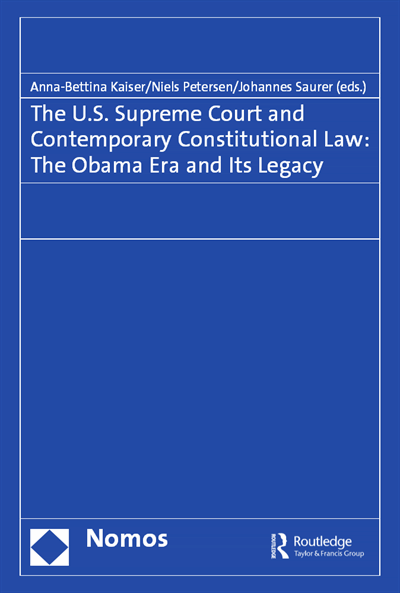
The U.S. Supreme Court and Contemporary Constitutional Law: The Obama Era and Its Legacy
- Editors:
- | |
- Publisher:
- 2018
Summary
The book explores the changes in U.S. constitutional law in the years of the Obama presidency. It illustrates that the U.S. Supreme Court has shaped, through several landmark judgments, the content of U.S. constitutional doctrine across different legal fields. The book brings together renowned constitutional law scholars from the US and Europe to reconstruct, analyze and explain these developments and their continuing significance.
Keywords
Search publication
Bibliographic data
- Edition
- 1/2018
- Copyright Year
- 2018
- ISBN-Print
- 978-3-8487-4796-2
- ISBN-Online
- 978-3-8452-8949-6
- Publisher
- Nomos, Baden-Baden
- Language
- English
- Pages
- 312
- Product Type
- Edited Book
Table of contents
ChapterPages
- Titelei/Inhaltsverzeichnis No access Pages 1 - 6
- Authors: | |
- I. Context No accessAuthors: | |
- II. Taking stock: The constitutional legacy of the Obama era No accessAuthors: | |
- III. Comparative Approach No accessAuthors: | |
- IV. Outlook No accessAuthors: | |
- Authors:
- I. Introduction No accessAuthors:
- II. The Political Cases No accessAuthors:
- Authors:
- A. Abortion No accessAuthors:
- B. Death Penalty No accessAuthors:
- C. Marriage Equality No accessAuthors:
- IV. Courts in the Executive Era No accessAuthors:
- Authors: | |
- I. Introduction No accessAuthors: | |
- II. Theoretical Background No accessAuthors: | |
- III. The Politics of Nomination and Confirmation No accessAuthors: | |
- IV. Judicial Behavior on the Bench No accessAuthors: | |
- V. Conclusion No accessAuthors: | |
- Authors:
- I. No accessAuthors:
- II. No accessAuthors:
- III. No accessAuthors:
- Authors:
- I. Obama’s critique of Citizens United in his State of the Union Address of 2010: inappropriate but essentially true No accessAuthors:
- II. Citizens United – rightly decided on its specific facts but mainly for the wrong reasons No accessAuthors:
- III. Money is not speech – and therefore paying for speech does not have to be protected equally strong as speaking No accessAuthors:
- IV. Corporations are not persons – and therefore do not necessarily have to be entitled to the same speech rights as persons in every respect No accessAuthors:
- V. Anti-corruption and equalization – different only in degree, not in kind No accessAuthors:
- VI. How much equalization is compatible with free speech rights? Balancing and categorical rules do not exclude each other No accessAuthors:
- VII. The original meaning of “abridging the freedom of speech” No accessAuthors:
- VIII. Europe and Germany No accessAuthors:
- IX. Conclusion No accessAuthors:
- Authors:
- I. Introduction No accessAuthors:
- Authors:
- A. United States v. Comstock: Constraining the Necessary and Proper Clause? No accessAuthors:
- B. NFIB v. Sebelius: The Obamacare Case No accessAuthors:
- C. Shelby County v. Holder: Federalism and Voting Rights No accessAuthors:
- D. Arizona v. United States: Preemption No accessAuthors:
- III. Expanding or Taming Congress’s Powers? No accessAuthors:
- IV. Conclusion No accessAuthors:
- Authors:
- Authors:
- A. Unauthorized Immigration in the United States No accessAuthors:
- B. The Role of the Federal and State Governments in Setting Immigration Policy No accessAuthors:
- Authors:
- Authors:
- 1. Arizona’s Attempt to Change Federal Enforcement Policies No accessAuthors:
- 2. The Supreme Court’s Opinion No accessAuthors:
- 3. The Preemptive Power of Prosecutorial Discretion No accessAuthors:
- B. United States v. Texas No accessAuthors:
- III. Drawing the Connections No accessAuthors:
- Authors:
- I. International Trends No accessAuthors:
- II. Why due process? No accessAuthors:
- III. Conclusion No accessAuthors:
- Authors:
- Authors:
- A. The rights revolution and the conservative backlash No accessAuthors:
- B. Originalism as a promise of neutrality No accessAuthors:
- C. The “king of the originalists” No accessAuthors:
- D. Obama’s presidency and the need to react to originalism No accessAuthors:
- E. The future of originalism No accessAuthors:
- Authors:
- A. “A well regulated Militia” No accessAuthors:
- B. Which history? No accessAuthors:
- C. Texts or Precedents? No accessAuthors:
- D. Disguised activism No accessAuthors:
- E. Limiting the new right No accessAuthors:
- Authors:
- A. Absence of precedents No accessAuthors:
- B. The living constitution is alive No accessAuthors:
- C. Formalism has found a new form No accessAuthors:
- D. Originalism in theory and originalism in practice No accessAuthors:
- E. Interdisciplinary issues No accessAuthors:
- Authors:
- Introduction No accessAuthors:
- Authors:
- A. Protection of For-Profit Corporations No accessAuthors:
- Authors:
- 1. Substantial Burden No accessAuthors:
- 2. Least Restrictive Means No accessAuthors:
- Authors:
- A. Constitutional or Statutory Protection No accessAuthors:
- B. Religion vs. Integration/ Religion vs. Individual Rights No accessAuthors:
- III. Conclusion No accessAuthors:
- Authors:
- I. Introduction No accessAuthors:
- II. U.S. Constitutional Law: Privacy Lost No accessAuthors:
- III. A Widening Transatlantic Gap: The CJEU and the hyper-constitutionalization of privacy No accessAuthors:
- IV. The Institutional Dimension of Transatlantic Data Flow Regulation Between Under- and Over-Constitutionalization No accessAuthors:
- V. Conclusion No accessAuthors:
- Authors:
- I. Introduction No accessAuthors:
- II. Challenges, Political and Legal No accessAuthors:
- Authors:
- A. Treaty Clause of the U.S. Constitution and Trade Priorities and Accountability Act of 2015 No accessAuthors:
- B. Legislative Debate on ISDS: Unsuccessful Contestation No accessAuthors:
- C. The Role of ‘Obama’s Court’ No accessAuthors:
- Authors:
- A. A Mixed Agreement No accessAuthors:
- B. Rule of Law No accessAuthors:
- C. Democratic Deficit No accessAuthors:
- D. Autonomy of EU law No accessAuthors:
- V. Different Functions of the German Federal Constitutional Court and the U.S. Supreme Court No accessAuthors:
- Authors:
- I. Introduction No accessAuthors:
- Authors:
- A. The beginnings of transnational public law litigation No accessAuthors:
- B. Between hubris and provincialism No accessAuthors:
- C. Consequences of Kiobel No accessAuthors:
- Authors:
- A. Floodgates and the challenges of municipal civil redress No accessAuthors:
- B. Unwarranted judicial interference No accessAuthors:
- Authors:
- A. International law can accommodate extraterritorial jurisdiction No accessAuthors:
- B. International law depends on domestic mechanisms No accessAuthors:
- C. Comity and foreign relations No accessAuthors:
- V. Conclusions No accessAuthors:
- Authors:
- I. Who “owns” a court? No accessAuthors:
- II. A Human Factor No accessAuthors:
- III. Raw numbers? No accessAuthors:
- IV. Urgent Calls to Understand the Institution No accessAuthors:
- V. A Good Court? No accessAuthors:
- Authors:
- A. A Court’s Independence No accessAuthors:
- B. The Standing of Constitutional Courts No accessAuthors:
- C. Embedded constitutionalism No accessAuthors:
- VII. Courts that deserve the Label No accessAuthors:
- Authors:
- Introduction No accessAuthors:
- I. Structure No accessAuthors:
- II. Style No accessAuthors:
- Authors:
- A. Historical Argument No accessAuthors:
- B. Textual Argument No accessAuthors:
- C. Doctrinal Argument No accessAuthors:
- D. Ethical Argument No accessAuthors:
- UNITED STATES SUPREME COURT No access
- UNITED STATES FEDERAL COURTS No access
- EUROPEAN COURT OF HUMAN RIGHTS No access
- EUROPEAN COURT OF JUSTICE No access
- GERMAN FEDERAL CONSTITUTIONAL COURT No access
- GERMAN FEDERAL ADMINISTRATIVE COURT No access
- OTHER No access
- Contributors No access Pages 311 - 312