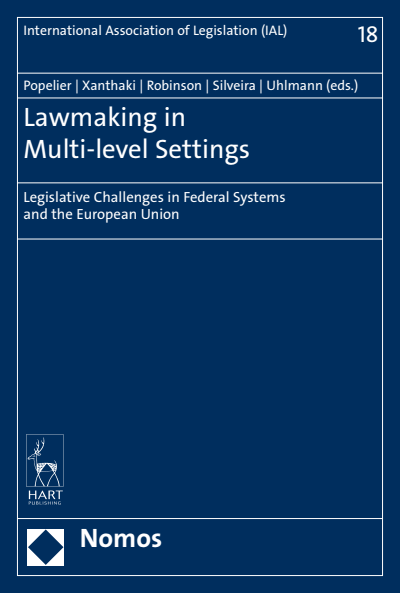
Lawmaking in Multi-level Settings
Legislative Challenges in Federal Systems and the European Union- Editors:
- | | | |
- Series:
- International Association of Legislation (IAL) / Deutsche Gesellschaft für Gesetzgebung (DGG), Volume 18
- Publisher:
- 2019
Summary
Law making is difficult enough in a simple national setting but even harder in multi-level settings such as federal states or the EU. At the central level, laws must respect the autonomy and diversity of the component units, yet be effective, coherent, simple and accessible. At the decentralized level, law makers must, within a given time, implement in their own legislative framework laws drawn up at the central level.
The challenges are discussed in this volume of selected papers from the International Association of Legislation’s 2018 Conference at Antwerp University. It covers all multi-tiered systems, but a major focus is on the EU, where the tension between autonomy and efficacy is most evident.
Part I examines the topic at the broadest level, including all types of multi-tiered systems. Part II focuses on the EU perspective and Part III on the perspective of the Member States.
The authors are experts in various disciplines and practitioners, ensuring a multi-disciplinary approach.
Search publication
Bibliographic data
- Edition
- 1/2019
- Copyright Year
- 2019
- ISBN-Print
- 978-3-8487-5957-6
- ISBN-Online
- 978-3-7489-0086-3
- Publisher
- Nomos, Baden-Baden
- Series
- International Association of Legislation (IAL) / Deutsche Gesellschaft für Gesetzgebung (DGG)
- Volume
- 18
- Language
- English
- Pages
- 317
- Product Type
- Edited Book
Table of contents
- Titelei/Inhaltsverzeichnis No access Pages 1 - 8
- Introduction to Lawmaking in Multi-Level Settings No access Pages 9 - 14Authors: | | | |
- Authors: |
- Authors: |
- 1. Multi-level Systems No accessAuthors: |
- 2. Upper and Lower Level No accessAuthors: |
- Authors: |
- Authors: |
- 1.1. Hierarchical Systems No accessAuthors: |
- 1.2. Non-hierarchical Systems No accessAuthors: |
- Authors: |
- 2.1. Co-legislator No accessAuthors: |
- 2.2. Execution No accessAuthors: |
- 2.3. Implementation No accessAuthors: |
- Authors: |
- 3.1. Predominantly Upper Level No accessAuthors: |
- 3.2. Predominantly Lower Level No accessAuthors: |
- 3.3. Both Upper and Lower Level No accessAuthors: |
- 3.4. Hybrid Systems No accessAuthors: |
- Authors: |
- 1. Effectiveness and Quality No accessAuthors: |
- 2. Autonomy and Quality No accessAuthors: |
- Authors: |
- Authors: |
- 1.1. Notification, Reporting, Oversight and Permission Requirements No accessAuthors: |
- 1.2. Enforcement and Sanctioning Instruments No accessAuthors: |
- 2. Participation in the Lawmaking Process No accessAuthors: |
- 3. Coordination Instruments No accessAuthors: |
- V. Conclusion No accessAuthors: |
- Authors:
- Authors:
- Complexity, terminology and limitations No accessAuthors:
- Authors:
- 1. The federal level in federations No accessAuthors:
- 2. European Union law No accessAuthors:
- 3. Public international law No accessAuthors:
- 4. What all three upper levels share: A common appetite for effectiveness No accessAuthors:
- Authors:
- 1. Vertical substitute performance No accessAuthors:
- Authors:
- 2.1. The importance of admissibility rules No accessAuthors:
- 2.2. Direct applicability and vertical direct effect No accessAuthors:
- 2.3. Invalidation by upper level courts No accessAuthors:
- Authors:
- a) Between appeals to the legislator and judge-made law No accessAuthors:
- b) Requiring consistent interpretation No accessAuthors:
- 2.5. Common concerns with court enforcement No accessAuthors:
- 3. Financial liability (as a sub-type of court enforcement) No accessAuthors:
- Authors:
- 4.1. Approval requirements No accessAuthors:
- 4.2. Loyalty principles, duties to consult, inform and involve No accessAuthors:
- 4.3. Financial and other incentives No accessAuthors:
- 4.4. Oversight mechanisms No accessAuthors:
- 4.5. Common concerns with oversight and cooperation No accessAuthors:
- IV. Conclusions No accessAuthors:
- Authors: |
- I. Introduction. Law-making in multi-level settings: a problem of coordination No accessAuthors: |
- II. Legislative initiative and inter-institutional programming in the EU No accessAuthors: |
- III. The Early Warning System and the principle of subsidiarity in the jurisprudence of the European Court of Justice No accessAuthors: |
- IV. Challenges of multi-level law-making in Italian regionalism: the role of the Constitutional Court No accessAuthors: |
- V. Quality of legislation between the State and Regions in Italy: the multi-level legislator unbound No accessAuthors: |
- VI. Conclusions No accessAuthors: |
- Authors:
- I. Law-making in multi-level contexts: setting the scene No accessAuthors:
- Authors:
- 1. Impact Assessment No accessAuthors:
- 2. Consultation No accessAuthors:
- III. Subsidiarity in legislative practice No accessAuthors:
- IV. Conclusions No accessAuthors:
- Authors:
- I. Introduction No accessAuthors:
- II. The 2016 Interinstitutional Agreement on Better Law Making No accessAuthors:
- III. The Task Force on Subsidiarity, Proportionality and “Doing Less More Efficiently” No accessAuthors:
- IV. Access to documents No accessAuthors:
- V. Conclusion No accessAuthors:
- Authors:
- I. Introduction No accessAuthors:
- Authors:
- 1. Ambiguity due to formal reasons No accessAuthors:
- Authors:
- 2.1. Vagueness, especially as to the scope, or reliance on clarification in the recitals No accessAuthors:
- 2.2. Inclusion of soft-law provisions in legally binding acts or political planning and indicative lists No accessAuthors:
- 2.3. Provisions which have not been updated or unclear links between legal acts No accessAuthors:
- 2.4. Indirect amendments No accessAuthors:
- III. Incompleteness No accessAuthors:
- Authors:
- 1. No legally binding form No accessAuthors:
- Authors:
- 2.1. Regulations as concealed directives No accessAuthors:
- 2.2. Amendment of EU directives by EU regulations No accessAuthors:
- 2.3. Hybrid nature of decisions No accessAuthors:
- V. Conclusion No accessAuthors:
- Authors:
- I. Introduction No accessAuthors:
- II. Languages of the Member States’ national law as compared to language(s) of EU law No accessAuthors:
- III. Levels and stages of EU drafting and transposition No accessAuthors:
- IV. Linguistic and terminological choices at EU level – drafting of EU law No accessAuthors:
- V. Linguistic and terminological choices at a national level – transposing EU law No accessAuthors:
- VI. Conclusions No accessAuthors:
- Authors: |
- I. Introduction No accessAuthors: |
- II. The ‘murky’ EU soft law No accessAuthors: |
- III. Normative content as a key factor for determining the legal nature of EU (soft law) acts No accessAuthors: |
- Authors: |
- 1. Structure No accessAuthors: |
- 2. Degree of detail and precision No accessAuthors: |
- 3. Strength of obligations No accessAuthors: |
- 4. Compliance/enforcement mechanisms No accessAuthors: |
- 5. Persuasive force of arguments No accessAuthors: |
- V. A legally problematic ‘hardening’ phenomenon of EU (Commission’s) soft law instruments No accessAuthors: |
- VI. Better lawmaking through an argumentative ‘toolbox’ No accessAuthors: |
- VII. Conclusion No accessAuthors: |
- Authors:
- I. Introduction No accessAuthors:
- II. The spectrum between directives and recommendations No accessAuthors:
- Authors:
- 1. The system governing harmonization under Hungarian law No accessAuthors:
- 2. Implementation of recommendations: a mixed picture No accessAuthors:
- IV. Outlook: Do directive-like recommendations have some added value? No accessAuthors:
- Authors:
- I. Introduction No accessAuthors:
- II. Literature review No accessAuthors:
- III. Public consultation as process: conceptual foundations No accessAuthors:
- Authors:
- 1. Multilevel governance and the European Union No accessAuthors:
- 2. Innovations in governance: towards ‘better regulation’ No accessAuthors:
- Authors:
- Examination of the questionnaire section about the ‘research exception’ No accessAuthors:
- End users/consumers No accessAuthors:
- Institutional users No accessAuthors:
- Authors/performers No accessAuthors:
- Publishers/producers/broadcasters No accessAuthors:
- Intermediaries/distributors/other service provider No accessAuthors:
- VI. Assessment No accessAuthors:
- VII. Conclusion No accessAuthors:
- ANNEX 1 – Type of respondents No accessAuthors:
- ANNEX 2 – Member States No accessAuthors:
- Authors:
- I. Introduction: National Parliament (enter)in(g) the EU’s institutional framework No accessAuthors:
- Authors:
- Exerting influence on the transposition of EU Directives No accessAuthors:
- Authors:
- 1. Input for the position of the executive No accessAuthors:
- 2. ‘Cards’ No accessAuthors:
- 3. Political dialogue No accessAuthors:
- III. National Parliaments and the transposition of EU Directives No accessAuthors:
- IV. National Parliaments & comitology No accessAuthors:
- V. Key points and observations No accessAuthors:
- Annex 1 EU Legislation enacted by the Commission No accessAuthors:
- Authors:
- I. The interconnection between national and EU legal drafting No accessAuthors:
- II. A “de facto” harmonization of legal drafting techniques in the EU? No accessAuthors:
- III. Then… How to reconcile the drafting rules and practices of the Member-States with the rules and practices of the EU? No accessAuthors:
- Authors: |
- I. Introduction No accessAuthors: |
- II. Harmonisation through Directives No accessAuthors: |
- III. Harmonisation through Regulations No accessAuthors: |
- IV. Clarity, Accessibility and Consistency No accessAuthors: |
- V. Dealing with Regulations No accessAuthors: |
- VI. Concluding Remarks No accessAuthors: |
- Authors:
- I. Introduction No accessAuthors:
- II. Transition from Directive 95/46/EC to the GDPR No accessAuthors:
- III. The GDPR is not the ultimate exhaustive regulation No accessAuthors:
- IV. Further complications on the Member State level caused by the GDPR No accessAuthors:
- V. Delays in the implementation process No accessAuthors:
- VI. Conclusion No accessAuthors:
- Authors:
- I. Introduction No accessAuthors:
- II. Law-makers intend to change the future No accessAuthors:
- III. Law-makers provide innovation for huge, diverse though interested audiences No accessAuthors:
- IV. Multilevel legal environments in a sharing world No accessAuthors:
- The Editors No access Pages 311 - 312
- The Authors No access Pages 313 - 317