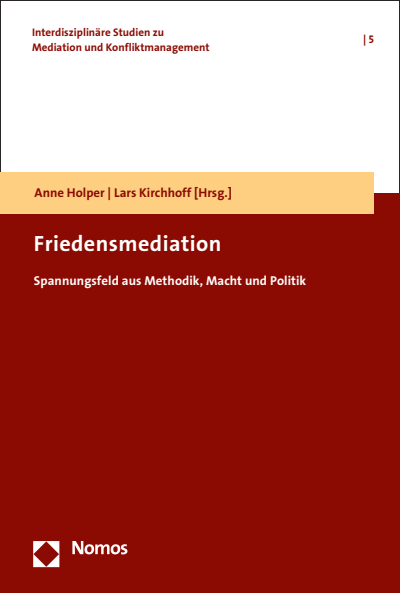
Peace Mediation in Germany’s Foreign Policy
Uniting Method, Power and Politics- Editors:
- |
- Series:
- Interdisziplinäre Studien zu Mediation und Konfliktmanagement, Volume 7
- Publisher:
- 2021
Summary
This volume is dedicated to the field of peace mediation, which has rapidly developed and become profes-sionalised in recent decades, both internationally and in Germany. In bringing together the history and status quo of the field plus the prospects for its future development, the volume has three special features: It combines a critical theoretical and a practical assessment of recent and ongoing political developments. It offers a selection of the ‘Fact Sheets on Peace Mediation’, which have been elaborated by the Federal Foreign Office in cooperation with the Initiative Mediation Support Deutschland (IMSD). And it provides concrete ideas on how Germany's peace mediation profile and methodology can be further heightened and translated into effective and responsible political practice. With contributions byMarike Blunck, Sebastian Dworack, Anne Holper, Lars Kirchhoff, David Lanz, Christoph Lüttmann, Simon J.A. Mason, Dirk Splinter, Luxshi Vimalarajah, Julia von Dobeneck, Brigitta von Messling, Carsten Wieland, Almut Wieland-Karimi and Felix Würkert.
Keywords
Search publication
Bibliographic data
- Edition
- 1/2021
- Copyright Year
- 2021
- ISBN-Print
- 978-3-8487-8211-6
- ISBN-Online
- 978-3-7489-2616-0
- Publisher
- Nomos, Baden-Baden
- Series
- Interdisziplinäre Studien zu Mediation und Konfliktmanagement
- Volume
- 7
- Language
- English
- Pages
- 237
- Product Type
- Edited Book
Table of contents
- Titelei/Inhaltsverzeichnis No access Pages 1 - 24
- Overview Part I No access
- 1. Motivation: Why do we as a state engage in mediation, and how does it suit our country? No access
- 2. Role: What does mediation mean for us, and what is our role in the mediation field? No access
- 3. Resources: Who drives mediation, and which resources can we as a state use for mediation? No access
- 4. Strategy: How do we as a state approach conflict mediation? No access
- Conclusion No access
- References No access
- Introduction No access
- The difficult international political environment of peace mediation No access
- Niches for Germany No access
- References No access
- Introduction No access
- 1.) The Action Plan “Civilian Crisis Prevention, Conflict Resolution and Peacebuilding”: An Initial Milestone No access
- 2.) The “Review Process” and the Establishment of Directorate-General S: Strategic Change Processes in the Federal Foreign Office No access
- 3.) Initiative Mediation Support Deutschland (IMSD): A Call for a More Refined Definition of Peace Mediation No access
- 4.) The Federal Government’s Guidelines: Preventing Crises, Managing Conflicts, Promoting Peace – A Clear Mandate for Directorate-General S No access
- Peace Mediation in the Foreign Policy Activities of the Federal Foreign Office No access
- Outlook No access
- References No access
- Introduction No access
- Complexity of wars and conflicts No access
- Making peace with enemies, not with friends No access
- Peace mediation: The key to sustainable peace No access
- Neither small nor big: Germany’s strength No access
- Women at the negotiating table No access
- Civilian conflict management as a priority No access
- Mediation is both an art and a skill No access
- Expand networks and link tracks No access
- Forger of coherent coalitions No access
- Necessary: Stamina and long-term financing No access
- Conclusion No access
- References No access
- Introduction No access
- The UN-Process: From Classic Process Design to a Strategy of Small Steps No access
- The Fragmentation of the Peace Process: Tug-of-War between the UN and the Astana Trio No access
- “Where next?” – Dealing with Complexity and a Possible Role for Germany No access
- Conclusion No access
- References No access
- Overview Part II No access
- Authors: | | |
- Mediation No accessAuthors: | | |
- Authors: | | |
- No accessAuthors: | | |
- Multiple tracks of engagement No accessAuthors: | | |
- Authors: | | |
- No accessAuthors: | | |
- Authors: | | |
- a) Implementation and operational support for mediation processes No accessAuthors: | | |
- b) Compiling and disseminating expertise No accessAuthors: | | |
- c) Capacity building No accessAuthors: | | |
- Authors: | | |
- No accessAuthors: | | |
- No accessAuthors: | | |
- Authors: | | |
- No accessAuthors: | | |
- Support to national dialogue No accessAuthors: | | |
- References No accessAuthors: | | |
- Authors: | | |
- Authors: | | |
- No accessAuthors: | | |
- Authors: | | |
- No accessAuthors: | | |
- Non-governmental organisations No accessAuthors: | | |
- Insider mediators No accessAuthors: | | |
- Coordination and cooperation of third parties No accessAuthors: | | |
- References No accessAuthors: | | |
- Authors: | |
- Authors: | |
- No accessAuthors: | |
- Authors: | |
- No accessAuthors: | |
- Authors: | |
- → Actor-Relationship Mapping No accessAuthors: | |
- → Interest Analysis No accessAuthors: | |
- → Systemic Feedback Loop Mapping No accessAuthors: | |
- Authors: | |
- No accessAuthors: | |
- Authors: | |
- No accessAuthors: | |
- Summary of the Fact Sheet No accessAuthors: | |
- References No accessAuthors: | |
- Authors: | |
- Authors: | |
- No accessAuthors: | |
- Mediation-related dimensions of norms No accessAuthors: | |
- Authors: | |
- Focus question I: Which (process-related) norms are relevant to the design of a peace mediation process? No accessAuthors: | |
- Authors: | |
- a) Peremptory norms of international law relevant to mediation No accessAuthors: | |
- b) Other norms of international law potentially relevant to mediation No accessAuthors: | |
- Focus question III: How relevant is the constellation of actors to the normative framework? No accessAuthors: | |
- Focus question IV: What normative tensions exist within frameworks of transitional justice? No accessAuthors: | |
- Authors: | |
- No accessAuthors: | |
- Summing-up: methodological considerations on conflicting normative aims No accessAuthors: | |
- References No accessAuthors: | |
- Authors: |
- Authors: |
- Role and attitude in mediation No accessAuthors: |
- Multipartiality No accessAuthors: |
- Acceptance and respect No accessAuthors: |
- Authenticity No accessAuthors: |
- Authors: |
- 1. Actively ensuring that a message has been understood No accessAuthors: |
- 2. Dealing with emotionality No accessAuthors: |
- 3. Building trust and personal contact (rapport) No accessAuthors: |
- 4. Creating a nuanced interest profile No accessAuthors: |
- Authors: |
- 5. Fostering a change of perspective No accessAuthors: |
- Authors: |
- No accessAuthors: |
- Summary: a skilful combination of technique and art No accessAuthors: |
- References No accessAuthors: |
- Authors: |
- Authors: |
- 1. Classifications and Explanatory Approaches No accessAuthors: |
- Authors: |
- Professionalization and Cooperativity No accessAuthors: |
- Adaptivity in Response to Volatility No accessAuthors: |
- Discrepancy Between Conceptual and Methodological Demands and Political Reality No accessAuthors: |
- Competition Between Methodology and Policy? No accessAuthors: |
- 2. Possible Development Axes of Peace Mediation No accessAuthors: |
- Authors: |
- a. Evaluation and Experience of the Effectiveness of Mediation Methodology No accessAuthors: |
- b. Promoting Norms and Regulations for the Practice of Mediation No accessAuthors: |
- c. Reviewing and Adapting the Embedding and Functional Concepts No accessAuthors: |
- d. Conclusion Concerning the Development Axes of Peace Mediation No accessAuthors: |
- 3. Core Questions About the Differentiation of Germany’s Roles No accessAuthors: |
- Authors: |
- a. Positioning in the New (Post-) Multilateral Order No accessAuthors: |
- b. Political-Methodological Mediation Profile of a Middle Power With a Highly Sensitive History No accessAuthors: |
- Authors: |
- Motivation: What do German mediation activities aim for in terms of visibility and relevance; what are their goals with regard to political processes and conflict contexts? No accessAuthors: |
- Role: Where must political power be used, and where, in turn, must it intentionally be limited; where can more leverage be achieved using mediation methods, and where is that not possible? No accessAuthors: |
- Resources: How is German engagement in mediation guided, and which resources from which areas should be used to this end? No accessAuthors: |
- Strategy: Where does German foreign policy have to upgrade its cooperation strategies accordingly, and where must necessary non-involvement be communicated? No accessAuthors: |
- 4. Laboratory for a Middle Power With Multilateral Responsibilities No accessAuthors: |
- Authors: |
- References No accessAuthors: |
- I. Our approach to peace mediation No access
- II. Embedding peace mediation into our stabilisation strategies No access
- III. Why we are expanding our efforts No access
- German direct engagement in close coordination with our partners No access
- Supporting and coordinating mediation processes by other actors No access
- Supporting multilateral engagement and strategic cooperation at state level No access
- Conceptual development/professionalisation No access
- Preparedness No access
- Consent No access
- Impartiality No access
- Inclusivity No access
- National Ownership No access
- Normative Frameworks No access
- Coherence & Coordination No access
- Quality Peace Agreement No access
- Author Biographies No access Pages 231 - 236
- Editor Biographies No access Pages 237 - 237