, to see if you have full access to this publication.
Monograph No access
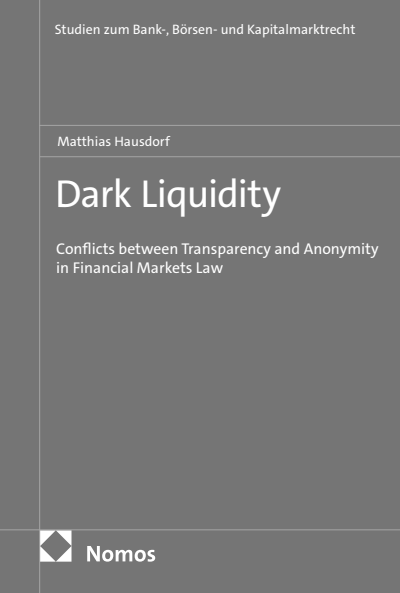
Dark Liquidity
Conflicts between Transparency and Anonymity in Financial Markets Law- Authors:
- Series:
- Studien zum Bank-, Börsen- und Kapitalmarktrecht, Volume 86
- Publisher:
- 2025
Summary
Dark liquidity sheds light on the global phenomenon of non-transparent securities trading. While economic research is incapable of drawing a clear picture of the harm and benefits of dark liquidity, legislators and regulators in modern capital markets are nevertheless pressed to provide a suitable regulatory framework for it. By using law and economics as well as comparative law methods, this work examines the regulation of dark liquidity in the USA, the EU and Switzerland, highlights the strengths and weaknesses of different approaches and formulates guidelines for effective regulation in practice. The work thus informs government decision-makers, academics and practitioners in capital market law.
Keywords
Search publication
Bibliographic data
- Edition
- 1/2025
- Copyright Year
- 2025
- ISBN-Print
- 978-3-7560-2229-8
- ISBN-Online
- 978-3-7489-4881-0
- Publisher
- Nomos, Baden-Baden
- Series
- Studien zum Bank-, Börsen- und Kapitalmarktrecht
- Volume
- 86
- Language
- English
- Pages
- 617
- Product Type
- Monograph
Table of contents
ChapterPages
- Preface No access
- Abbreviations No access
- A. Transparency and Dark Trading No access
- B. Historical Rise of Dark Trading No access
- C. Tightening of Regulatory Scrutiny over Dark Trading No access
- I. Individual Gains No access
- II. Collective Costs No access
- I. Statutory Interpretation as Means to Define the Scope of Regulation No access
- 1. The Literal Rule No access
- 2. The Golden Rule No access
- 3. The Mischief Rule No access
- 1. Language of the Statute No access
- 2. Genesis of the Statute No access
- 3. Context of the Statute No access
- 4. Purpose and Extra-Legal Value of the Statute No access
- 1. Economic Analysis of the Law No access
- 2. Comparative Law No access
- F. Research Questions No access
- I. Fundamental Information about the Issuer No access
- II. Technical Information about the Market No access
- B. Relevance of Market Information Compared to Fundamental Information No access
- aa) Periodic Auction Call No access
- bb) Continuous Call No access
- cc) Hybrid Systems No access
- dd) Order Type: Market or Limit Order No access
- ee) Ambiguity of the Visibility of Depth of Order Book No access
- ff) Impact of Order-Driven Systems on Pre-Trade Transparency No access
- b) Quote-Driven Trading Systems No access
- c) Hybrid Trading Systems No access
- 2. Time of Disclosure No access
- 3. Recipient of Disclosure No access
- 1. Disclosed Information and Purpose of Disclosure No access
- 2. Time and Granularity of Disclosure No access
- 3. Recipient of Disclosure No access
- I. Central Role of Trading Systems No access
- a) Information Systems No access
- b) Trading Systems No access
- a) Multilateral Trading Systems No access
- b) Bilateral Trading Systems No access
- c) Non-Discretionary and Discretionary Trading Systems No access
- d) Systems with a Price Formation Mechanism and Price Importing Systems No access
- III. Implications of Trading Infrastructure on Trade Transparency No access
- 1. ‘Lit’ and ‘Dark’ Trading No access
- 2. ‘Lit’ and ‘Dark’ Pools No access
- 3. ‘Lit’ and ‘Dark’ Orders No access
- 4. ‘Lit’ and ‘Dark’ Liquidity No access
- II. Dark Trading and the Law No access
- a) Partially Dark No access
- b) Completely Dark No access
- c) Examples No access
- a) Completely Dark, Price Importing, with Proprietary Trading No access
- b) Examples No access
- 3. Conclusion No access
- a) Information Function according to the ECMH No access
- b) Behavioral Finance on ECMH No access
- 2. Valuation Function No access
- 3. Allocative Function No access
- II. Promoting and Ensuring Investor Protection No access
- I. Role of Transaction Costs No access
- 1. Informational Efficiency No access
- 2. Market Transparency No access
- 3. Liquidity No access
- 1. Reduction of Fees No access
- 2. Reduction of the Bid-Ask-Spread No access
- 3. Reduction of Market Impact Costs No access
- IV. Conclusions for Further Analysis No access
- 1. Positive Effects of Pre-Trade Transparency on Market Efficiency No access
- 2. Economic Studies No access
- 1. Positive Effects of Post-Trade Transparency on Market Efficiency No access
- 2. Issues with Post-Trade Transparency No access
- 3. Economic Studies No access
- 1. Veiling the Identity of Traders No access
- 2. No Full Order Book Transparency No access
- 3. Introduction of Special-Order Types No access
- 1. Fragmentation of the Trading Landscape No access
- a) Electronic Front Running No access
- b) Slow-Market Arbitrage No access
- 1. Avoiding Information Leakage No access
- aa) Mid-Point Pricing No access
- bb) Cost Savings No access
- b) Pecking Order of Investors No access
- 3. Avoiding Adverse Price Selection due to Market Impact Costs No access
- 4. Protecting Market Makers No access
- a) Theoretical Papers No access
- b) Empirical Papers No access
- c) Empirical Findings on an Optimum of Dark Trading No access
- d) Regulatory Conclusions No access
- a) Exploitation of Midpoint Orders No access
- b) Pinging and Electronic Front Running No access
- c) Preferred Information Access via Dark Pool Operators No access
- d) Evaluation of High-Frequency Trading in Dark Pools No access
- 3. Limited Access to Dark Liquidity No access
- 4. Fragmentation by Dark Trading Increases Transaction Costs No access
- 5. Free-Riding of Information Production No access
- 6. Free-Riding of Regulation and Moral Hazard No access
- a) Principal-Agent-Conflict in Order Routing No access
- b) Front Running No access
- V. Conclusion No access
- A. Pre-Requisites of Regulation and Market Failure No access
- B. Dark Trading in Need of Regulation No access
- C. Principles of Precautious Regulation No access
- I. Advantages of Self-Regulation No access
- II. Disadvantages of Self-Regulation No access
- III. Role of Self-Regulation in the Examined Jurisdictions No access
- I. Market Power and Ruinous Competition No access
- II. Rationalization and Coordination No access
- 1. Externalities No access
- a) Public Goods and the Price Formation Process No access
- aa) Post-Trade Information is Non-Rivalrous No access
- bb) Pre-Trade Information is Rivalrous No access
- c) Only Post-Trade Information is a Public Good No access
- 1. Information Asymmetry No access
- 2. Principal-Agent-Issues and Moral Hazard No access
- A. Introduction No access
- I. The Structure of US Securities Law No access
- 1. Securities and Exchange Commission No access
- 2. Self-Regulatory Organizations No access
- I. Policy Considerations No access
- II. Implemented Measures by the SEC: A Consolidated Tape No access
- 1. Definition No access
- a) Trader-Function of Broker-Dealers No access
- b) Internalizer-Function of Broker-Dealers No access
- 3. Regulatory Requirements No access
- 4. Self-Regulatory Organization No access
- 1. Definition No access
- 2. Regulatory Requirements No access
- 3. Self-Regulatory Organization No access
- a) Merging Markets and Market Participants No access
- aa) No-Action-Letters No access
- (i) The Issue in Board of Trade v. SEC (1991) No access
- (ii) Majority Opinion Delivered by Judge Posner No access
- (iii) Dissenting Opinion Delivered by Judge Flaum No access
- aa) A Revised Exchange Definition under Rule 3b-16 No access
- bb) Definition of ATS: Hybrid Systems Embedded in the Exchange Act’s Framework No access
- a) Registration Requirement under Rule 301 Regulation ATS No access
- aa) New Form ATS-N No access
- (i) Pipeline Trading Systems LLC No access
- (ii) UBS Securities LLC No access
- (iii) Remedying the former Shortfalls No access
- 3. Self-Regulatory Organization No access
- (i) Rule 602 Regulation NMS No access
- (ii) Rule 604 Regulation NMS No access
- (i) Nature of Private Data Feeds No access
- (ii) Issues with Private Data Feeds No access
- cc) Default Rule: Trade Transparency at the Top of the Order Book with Additional Information for Purchase No access
- (i) Customer Requests Broker-Dealer not to Display the Order No access
- (ii) Odd-lot Orders No access
- (iii) Block Orders No access
- (iv) ‘All or None’-Orders (‘Fill or Kill’) No access
- (i) Already Filled Orders No access
- (ii) Order already Sent On No access
- cc) Application of the Exceptions No access
- c) Dark Trading on Exchanges No access
- aa) Broker-Dealers as Market Actors and as Internalization Markets No access
- (i) Rule 602 Regulation NMS No access
- (ii) Rule 604 Regulation NMS No access
- b) Exceptions No access
- c) Summary of Dark Trading with Broker-Dealers No access
- aa) Rule 301 Regulation ATS and Rule 602 Regulation NMS No access
- bb) Lit-ATS: Electronic Communication Networks (ECNs) No access
- b) Dark-ATS under Rule 301(b)(3)(i) Regulation ATS: Reversing the Default Rule to Dark Trading No access
- c) Unregulated and Unlimited Dark Trading in ATS No access
- 1. Exchanges No access
- 2. Broker-Dealers No access
- 3. Alternative Trading Systems No access
- III. Lit and Dark Trading under US law No access
- 1. Scope No access
- 2. Eligible Entities No access
- 3. Eligible Transactions No access
- 4. Open Market Transactions by FRBNY No access
- 1. Membership Access No access
- 2. Order Access No access
- 1. Membership Access No access
- 2. Order Access No access
- 1. Membership Access No access
- 2. Order Access No access
- IV. Effects of Discriminatory Access in ATS No access
- 1. Purpose and Functioning of Rule 606 Regulation NMS No access
- 2. Two De Minimis Exceptions No access
- 3. Criticism No access
- 1. Purpose and Functioning of Rule 611 Regulation NMS No access
- 2. Criticism on the Order Protection Rule No access
- III. Rule 612 Regulation NMS: Sub-Penny Rule No access
- H. Regulatory Incentives for Increased Use of Dark Trading No access
- I. Lowering the 5 %-Threshold for Alternative Trading Systems No access
- II. ATS should Identify Transactions on Tape No access
- III. Including Actionable Indications of Interest into the Definition of ‘Best Bid and Offer’ No access
- I. First Limiting Device under US Law No access
- II. Functioning of the Trade-At Rule No access
- III. Trade-At Rule in Canada and Australia No access
- IV. The Findings of Foley/Putniņš (2016) No access
- 1. Tick Size Pilot Program No access
- 2. Assessment of the Tick Size Pilot Program No access
- 3. The Trade-At Rule in the NMS No access
- I. SEC Regulation Best Execution No access
- II. SEC Rule to Enhance Competition for Order Execution No access
- III. SEC Proposed Tick Size Rule No access
- IV. SEC Proposal on Disclosure of Order Execution Information No access
- L. Conclusion and Criticism No access
- I. The Rise of Dark Trading No access
- 1. A Pan-European Market No access
- a) Uneven playing field among RMs and MTFs No access
- b) Regulatory Gaps between the MTF and SI regime into OTC-Space No access
- c) Loophole in the Transparency Regime No access
- d) Discretion in the Application of MiFID I Rules by the Member States’ NCAs No access
- 3. Comparison to US law No access
- III. The Role of MiFID II/MiFIR No access
- a) Multilateral Systems No access
- b) Bilateral Systems No access
- aa) Nothing but a ‘Set of Rules’ No access
- bb) Trading Systems and Information Systems No access
- 2. Non-Discretionary v. Discretionary Rules No access
- 3. Ordering Principles in the further Discussion No access
- a) EU Law No access
- b) Transposition into German Law No access
- a) EU Law No access
- b) Transposition into German Law No access
- 3. Differences between RMs and MTFs: An Uneven Playing Field? No access
- aa) A New Trading System to Close the Regulatory Gaps No access
- bb) Criticism on the New OTF-Category No access
- cc) A New Type of Multilateral Trading No access
- dd) Sovereign Debt Instruments No access
- ee) A Discretionary Trading System No access
- ff) Eligible Operating Entities No access
- b) Transposition into German law No access
- a) Definition No access
- b) Bilateral Trading No access
- (i) Failure of the SI regime under MiFID I No access
- (ii) MiFID II/MiFIR’s Response No access
- d) Quantitative Definition of ‘Frequent Systematic’ No access
- e) Role of Liquidity No access
- f) Quantitative Definition of ‘Substantial Basis’ No access
- g) Cumulative Requirement and ‘Opt-in’ No access
- h) New Loopholes under MiFID II/MiFIR No access
- 2. Transposition into German Law No access
- 3. Conclusion on New SI-Regime No access
- 1. For Shares No access
- 2. For Derivatives No access
- I. Role of the Trade Transparency Regime for Dark Trading under MiFID II/MiFIR No access
- a) Rule No access
- b) Addressee of Obligation No access
- aa) Equity Instruments No access
- bb) Traded on a Trading Venue No access
- aa) Current Bid and Offer Prices No access
- bb) Depth of Trading Interest at Those Prices No access
- cc) Actionable Indications of Interest No access
- e) Modalities of Publication No access
- f) Access to Data and the System for Systematic Internalizers No access
- a) Paradigm Shift from MiFID I to MiFID II/MiFIR No access
- b) Article 8(1) MiFIR: The Rule No access
- c) Content of Publication No access
- d) Captured Instruments No access
- e) Non-Equity Specific Exemptions of Pre-Trade Transparency No access
- f) Modalities of Publication No access
- 3. Common Manner of Publishing Pre-Trade Transparency Data No access
- aa) Prices that are ‘Widely Published’ and ‘Regarded as Reliable by the Market’ No access
- bb) Market of First Admittance to Trading or Most Liquid Market No access
- cc) Pricing at the Midpoint No access
- dd) Reference Price Waiver captures Block Orders as well as other Orders No access
- ee) Narrowing the Scope of the Reference Price Waiver under the MiFIR refit No access
- ff) Subject to Limitation by Article 5 MiFIR No access
- aa) Transactions Subject to Conditions Other Than the Market Conditions (Article 4(1)(b)(iii) MiFIR) No access
- bb) Transactions Subject to Current Market Conditions in Liquid Markets (Article 4(1)(b)(i) MiFIR) No access
- cc) Transactions Under Current Market Conditions but in an Illiquid Market (Article 4(1)(b)(ii) MiFIR) No access
- aa) Double Volume Cap Mechanism No access
- bb) Comparison with US law No access
- cc) Impact of the DVC on the Market No access
- dd) Circumventing the DVC: Frequent Batch Auctions No access
- ee) MiFID II/MiFIR Refit: Abandonment of the DVC No access
- e) Large in Scale Waiver No access
- f) Using the Large-in-Scale Waiver to Circumvent the Volume Cap Mechanism No access
- g) Order Management Facility Waiver No access
- aa) Granting a Waiver No access
- bb) Withdrawal of Waivers No access
- a) Large in Scale Waiver (Article 9(1)(a) MiFIR) No access
- b) Order Management Facility Waiver (Article 9(1)(a) MiFIR) No access
- c) Indications of Interest That are Above the Size Specific to the Financial Instrument Waiver (Article 9(1)(b) MiFIR) No access
- d) Illiquid Financial Instruments Waiver (Article 9(1)(c) MiFIR) No access
- e) Exchange for Physical Waiver (Article 9(1)(d) MiFIR) No access
- f) Package Order Waiver (Article 9(1)(e) MiFIR) No access
- g) Temporary Suspension (Article 9(4) MiFIR) No access
- h) Granting and Withdrawal of Waivers No access
- i) Comparison to the Waiver Regime for Equity Instruments No access
- IV. Post-Trade Transparency for Trading Venues No access
- 1. Deferrals for Equity Instruments No access
- a) Latest Developments No access
- b) Functioning of the Deferrals for Non-Equity Trading No access
- c) Timing of the Deferrals and Deviating Practices across the EU No access
- d) Proposed Changes under the MiFID II/MiFIR Refit No access
- e) Conclusion No access
- VI. Implementation of a Consolidated Tape No access
- aa) Firm Quotes and Obligation to Contract No access
- bb) Instruments Captured No access
- cc) Modalities of Publication No access
- dd) Minimum Size and Prevailing Market Conditions No access
- ee) Changes to the Minimum Size under the MiFID II/MiFIR Refit No access
- ff) Access No access
- gg) Notification of NCA No access
- hh) Different Quality of Pre-Trade Transparency in Bilateral and Multilateral Trading Systems No access
- aa) No Quoting Obligation Above Standard Market Size No access
- (i) Price Improvement (Article 15(2) subpara. 2 MiFIR) No access
- (ii) Portfolio Transactions (Article 15(3) MiFIR) No access
- (iii) Client Quote is Bigger than Quoting Size (Article 15(4) MiFIR) No access
- aa) Liquid Market No access
- bb) Illiquid Market No access
- aa) Waivers under Article 9(1) MiFIR No access
- bb) Instruments Below the Liquidity Threshold of Article 9(4) MiFIR No access
- cc) No Quoting Requitement for Orders Above the Size Specific for the Financial Instrument No access
- c) Price Improvements No access
- d) Access No access
- 3. Post-Trade Transparency Regime for Equity Instruments No access
- 4. Post-Trade Transparency Regime for Non-Equity Instruments No access
- 1. Advantages in the Transparency Regime No access
- 2. Advantage in Order Pricing No access
- 3. Issue of Bringing Together Client Orders No access
- 4. Trading Obligation and Dark Trading under the SI-regime: An Unlucky Combination? No access
- I. Access to Trading Venues No access
- II. Access to Systematic Internalizers No access
- E. Conclusion and Criticism No access
- A. A New Regime for Swiss Financial Markets No access
- 1. Multilateral vs. Bilateral Trading No access
- 2. Non-Discretionary vs. Discretionary Trading No access
- 3. Securities (‘Effekten’) and Other Financial Instruments No access
- a) Definition No access
- b) Multilateral, Non-Discretionary Trading No access
- c) Trading of Securities No access
- d) Conclusion of Contracts within the System No access
- e) Listing of Securities No access
- 2. Swiss Multilateral Trading Facility (CH-MTF) No access
- 3. Gaps in the Regulatory Regime No access
- a) Definition No access
- aa) CH-OTF under Article 42(a) FinfraG No access
- bb) CH-OTF under Article 42(b) FinfraG No access
- c) Bilateral CH-OTF No access
- 1. Authorization of Exchanges and CH-MTFs No access
- 2. For CH-OTFs No access
- 1. No Trading Obligation for Shares under Swiss Law No access
- 2. Trading Obligation for Derivatives under Swiss Law No access
- 1. Article 27 FinfraG: Principle of Self-Regulation No access
- 2. Article 28 FinfraG: Self-Regulation and Dark Trading No access
- I. Introduction No access
- a) Three Layers of Regulation No access
- b) Pre- and Post-Trade Transparency No access
- a) General Scope of Article 29(1) FinfraG No access
- b) Indications of Interest No access
- c) Traded on the Trading Venue No access
- d) Subjected Instruments: Lit Trading for Shares, Dark Trading for other Securities No access
- aa) Reference Price Waiver No access
- bb) Negotiated Trade Waiver No access
- cc) Order Management Facility Waiver No access
- dd) Large in Scale Waiver No access
- b) Omitted Waivers during the Legislative Process No access
- c) No Volume Cap Mechanism under Swiss law No access
- d) Process: Waiver decision is with the Trading Venue not FINMA No access
- 4. Post-Trade Transparency No access
- a) Large in Scale No access
- b) Size Specific to the Instrument No access
- c) Illiquid Securities No access
- 6. Exception for SNB Transactions, Article 29 FinfraV No access
- a) Entity Subject to Pre-Trade Transparency No access
- b) Instruments Subject to Pre-Trade Transparency No access
- 2. Pre-Trade Transparency for Multilateral CH-OTFs No access
- a) Issues Raised by the Reference to Article 27 FinfraV No access
- b) Firm Offer or Indication of Interest No access
- c) Sufficient Legal Basis No access
- (i) No Quoting Requirement for Illiquid Instruments No access
- (ii) Quoting Requirement above Standard Market Size and Below a Minimum Size No access
- (iii) Discretion with regard to Access to Quotes No access
- (iv) Limiting the Number of Transactions No access
- (v) Updating or Withdrawing Quotes No access
- bb) Overall Evaluation of Proportionality No access
- a) Post-Trade Transparency for Multilateral CH-OTFs No access
- b) Post-Trade Transparency for Bilateral CH-OTFs No access
- 1. Article 18 FinfraG No access
- 2. Article 34 FinfraG No access
- II. Access to CH-OTF No access
- E. Conclusion and Criticism No access
- I. The Rise of Dark Trading No access
- 1. Defining and Categorizing the Subject Matter No access
- 2. Regulatory Goals and the Roles of Lit and Dark Trading No access
- 3. Regulatory Issues when Regulating Dark Trading No access
- 4. In-Depth Analysis of the Regulatory Regimes No access
- 1. Requirements for a Proper Trading Infrastructure Regime No access
- 2. Findings in the Three Jurisdictions No access
- a) Issues with Overbroad Categories No access
- b) Issues with Highly Specific Categories No access
- c) Issues with a Detailed Regime using Qualitative Definitions No access
- 4. Conclusion No access
- a) First Level: Set Trade Transparency as Default Rule No access
- b) Second Level: Implement Clear-Cut Exceptions from the Default Rule No access
- c) Third Level: Consider a Reverse-Exception to Support the Default Rule No access
- aa) First Level: Transparency Rules No access
- bb) Second Level: Exceptions No access
- cc) Third Level: Reverse Exceptions No access
- aa) First Level: Transparency Rules No access
- bb) Second Level: Exceptions No access
- cc) Third Level: Reverse Exception No access
- aa) First Level: Transparency Rules No access
- bb) Second Level: Exceptions No access
- cc) Third Level: Reverse Exception No access
- a) Issues with Overbroad Exceptions No access
- b) Issues with a Limitation Device No access
- c) Issues with Lean Regulation No access
- d) Categorizing the Trade Transparency Regimes No access
- 4. Conclusion No access
- 1. Requirements for a Proper Access Regime No access
- a) Access to Information No access
- b) Access to Trading Venues No access
- 3. Evaluation and Conclusion No access
- 1. Further Measures to Protect Price Formation No access
- a) Order Protection Rule, Sub-Penny Rule, and Speed Bumps in the United States No access
- b) Tick-Size Rule in the European Union No access
- c) Obligation to Trade on a Trading Venue in the European Union No access
- 3. Evaluation and Conclusion No access
- 1. United States No access
- 2. European Union and Germany No access
- 3. Switzerland No access
- C. Conclusion No access
- I. No Blueprint Available No access
- II. Principles for Regulation No access
- I. Principle 1: Have a Broad Trading Infrastructure Regime No access
- 1. US law No access
- 2. EU law No access
- 3. Swiss law No access
- 1. US law No access
- 2. EU law No access
- 3. Swiss Law No access
- IV. Principle 4: Be Cautious with Limiting Devices No access
- V. Principle 5: Ensure Fair Access No access
- VI. Principle 6: Consider Price Protection Rules No access
- 1. US law No access
- 2. EU law No access
- 3. Swiss law No access
- I. What is the definition and purpose of trade transparency and dark trading before the backdrop of the regulatory goal of the three examined jurisdictions? No access
- II. What are the issues with dark trading? No access
- III. Where in the three jurisdictions can dark trading occur and does it serve a regulatory purpose? Or is it rather an exploitation of a loophole and regulatory gaps? No access
- IV. Can an ideal regulatory framework for dark trading be identified among the examined jurisdictions? If not, are there common principles of regulation that may serve as a standard for proper regulation of dark trading? No access
- ANNEX II CDR (EU) 2017/587: Orders large in scale compared with normal market size, standard market sizes and deferred publications and delays No access
- Bibliography No access Pages 579 - 616
- List of Cases No access Pages 617 - 617