, to see if you have full access to this publication.
Edited Book No access
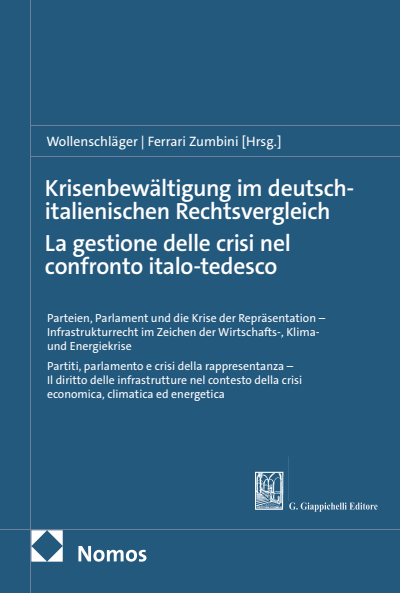
Krisenbewältigung im deutsch-italienischen Rechtsvergleich | La gestione delle crisi nel confronto italo-tedesco
Parteien, Parlament und die Krise der Repräsentation – Infrastrukturrecht im Zeichen der Wirtschafts-, Klima- und Energiekrise | Partiti, parlamento e crisi della rappresentanza – Il diritto delle infrastrutture nel contesto della crisi economica, climatica ed energetica- Editors:
- |
- Publisher:
- 2025
Keywords
Search publication
Bibliographic data
- Edition
- 1/2025
- Copyright Year
- 2025
- ISBN-Print
- 978-3-7560-2994-5
- ISBN-Online
- 978-3-7489-5257-2
- Publisher
- Nomos, Baden-Baden
- Language
- German
- Pages
- 370
- Product Type
- Edited Book
Table of contents
ChapterPages
- Titelei/Inhaltsverzeichnis No access Pages 1 - 10
- Authors:
- 1. I partiti politici nella Costituzione: una disciplina “leggera” No access
- 2. Natura privatistica vs funzione pubblicistica dei partiti: la questione del metodo democratico No access
- 3. Corte costituzionale e partiti No access
- 4. Il controllo del giudice comune: percorsi e limiti No access
- 5. Il finanziamento dei partiti No access
- 6. Partiti e “democrazia protetta”: l’unico meccanismo di protezione No access
- 7. Prospettive: una legge di disciplina dei partiti No access
- Authors:
- I. Einleitung No access
- aa) Historischer Kontext: Einführung des Potentialitätskriteriums und seine Folgen No access
- bb) Das Urteil aus Karlsruhe No access
- cc) Bedeutung des Urteils für den Umgang mit der AfD No access
- aa) Hintergrund: Stiftungsfinanzierung und ihre Kritik No access
- bb) Das Urteil aus Karlsruhe No access
- cc) Pyrrhussieg für die AfD: Das Gesetz zur Finanzierung politischer Stiftungen No access
- a) Hintergrund und Sachverhalt: Die Wahl Kemmerichs zum Ministerpräsidenten No access
- b) Das Urteil aus Karlsruhe No access
- c) Ein symbolischer Erfolg für die AfD No access
- aa) Hintergrund und Sachverhalt No access
- bb) Das Urteil aus Karlsruhe No access
- aa) Hintergrund und Sachverhalt No access
- bb) Das Urteil aus Karlsruhe No access
- c) Wandel der parlamentarischen Kultur und Eigenverantwortung des Parlaments No access
- 4. Fazit No access
- 1. Der Antifaschismus in der italienischen Verfassung: Die XII. Übergangs- und Schlussbestimmung No access
- 2. Die Umsetzung der XII. Übergangs- und Schlussbestimmung: Das Scelba-Gesetz No access
- 3. Die „offene“ Demokratie der italienischen Verfassung No access
- 4. Fazit No access
- Authors:
- Un concetto sfuggente No access
- Divisione della società, unità del popolo No access
- Popolo come ‘identità senza differenze’ No access
- a) il popolo non si identifica con una parte dell’ordinamento No access
- b) il popolo non è rappresentabile No access
- c) l’organizzazione costituzionale come ‘mise en forme’ del conflitto No access
- Cosa significa, oggi, sovranità del popolo? No access
- Authors:
- 1. Geringe Einflussmöglichkeiten No access
- 2. Keine Instrumente direkter Demokratie auf Bundesebene No access
- 3. Parteienstaatliche Überformung des Institutionengefüges No access
- 4. Marginalisierung der einzelnen Abgeordneten No access
- 1. Allgemeines No access
- 2. Unklare Verantwortlichkeiten im Mehr-Ebenen-System No access
- III. Therapievorschläge No access
- Authors:
- I. Grundlagen No access
- II. Einzelregelungen No access
- III. Gleichstellung von Gruppen mit Fraktionen No access
- Intervento No access Pages 109 - 112Authors:
- Authors:
- 1. Il significato poliedrico della sostenibilità No access
- 2.1 La modifica degli articoli 9 e 41 della Costituzione italiana No access
- 2.2 Il contesto normativo attuale in materia di infrastrutture e ambiente No access
- 2.3 Le tendenze normative: strumenti di realizzazione dello sviluppo sostenibile No access
- 2.4 La nuova ondata di piani e programmi per la realizzazione degli interventi No access
- 3. Infrastrutture e ambiente nell’ottica conflittuale degli impatti ambientali No access
- 4.1 Il conflitto intra-ambientale No access
- 4.2 Dalle tutele parallele alle tutele integrate: le infrastrutture sostenibili e la quadratura del cerchio No access
- 5. Infrastrutture sostenibili e tutela del patrimonio culturale e paesaggistico: un cambio di paradigma? No access
- Authors:
- 1. Premessa problematica: un diritto delle infrastrutture o “per” le infrastrutture? No access
- 2. I termini del problema No access
- A) Il ruolo dei pubblici poteri No access
- B) Infrastrutture e servizi pubblici No access
- C) Infrastrutture “critiche”, infrastrutture “strategiche” No access
- D) Gli approntamenti infrastrutturali: una ricostruzione No access
- A) I poteri speciali del governo No access
- B) Il pubblico interesse nei mercati liberalizzati No access
- C) Infrastrutture e reti comuni per la “società europea” No access
- A) Procedimenti complessi: nozione e problemi No access
- B) Approvazione e realizzazione delle infrastrutture No access
- C) Il dibattito pubblico: regole e realtà No access
- 6. Le garanzie No access
- B) Prevenire le liti No access
- C) Fare a meno delle garanzie giurisdizionali? No access
- 7. Conferme dell’impostazione prospettata No access
- 8. Guardando avanti No access
- Authors:
- 1. Welche Infrastrukturen? No access
- 2. Elemente eines Infrastrukturrechts No access
- a) Klimakrise No access
- b) Energiekrise No access
- c) Wirtschaftskrise No access
- 1. Bedeutung und Konkretisierungsbedürftigkeit der Klimaziele No access
- 2. Besondere Qualität der Ziele No access
- 3. Allgemeine Herausforderungen für die Politik und das Recht No access
- a) Die Energienetzbedarfsplanung auf dem Weg zu einer Systementwicklungsplanung No access
- b) Von der Bundesverkehrswegeplanung zu einem Bundesmobilitätsplan No access
- a) Wärmeplanung No access
- b) Elektromobilität: Planung des Ausbaus der Ladeinfrastruktur No access
- c) Die neue Planung der Schienenwege nach dem „Deutschlandtakt“ No access
- d) Neue Instrumente der kommunalen Verkehrsplanung: No access
- 3. Projektplanung: Beschleunigung durch Priorisierung No access
- IV. Fazit No access
- Authors:
- I. Einführung No access
- 1. Rechtswegverkürzung No access
- a) Vorrang und Beschleunigung No access
- b) Früher Erörterungstermin No access
- a) Außerachtlassen von absehbar behebbaren Mängeln No access
- b) Vorgaben für die Vollzugsfolgenabwägung No access
- 4. Zwischenergebnis No access
- a) Erneuerbare-Energien-Richtlinie (RED III) No access
- b) LNG-Beschleunigungsgesetz No access
- a) Ausgangspunkt: Aarhus-Konvention No access
- b) Erneuerbare-Energien-Richtlinie (RED III) No access
- c) LNG-Beschleunigungsgesetz No access
- d) Konkrete Auswirkungen No access
- IV. Fazit No access
- Authors:
- I. Kreditaufnahme der EU und der Bundesrepublik Deutschland No access
- II. Klimaschutz (hier: Windenergieanlagen) No access
- III. Bestimmtheit und Verhältnismäßigkeit von Sicherheitsgesetzgebung No access
- IV. Familienrechtliche Fragen No access
- V. Strafvollzug und Wiederaufnahme von Strafverfahren No access
- VI. Wahlrecht No access
- V. Fazit No access
- Authors:
- 1. Le vicende politiche del paese e le riforme costituzionali. No access
- 2. Ambiti tematici, linee di tendenza della giurisprudenza costituzionale e strumenti processuali. No access
- 3. Ampliamento dell’orizzonte di tutela dei diritti fondamentali. No access
- 4. Focus COVID-19: diritto alla salute e contemperamento tra la sua declinazione individuale e collettiva. No access
- 5. Certezza del diritto, irretroattività delle leggi, sicurezza giuridica e legittimo affidamento. No access
- 6. Pronunce che sono state l’effetto di sentenze della Corte di giustizia e della Corte EDU. No access
- 7. Sentenze relative all’ambiente, al paesaggio e al clima. No access
- Authors:
- I. Einführung No access
- 1. Neufassung des § 2 EEG No access
- a) Festlegung von Flächenzielen für die Länder im WindBG No access
- b) Auswirkungen der Flächenziele auf die bauplanungsrechtliche Zulässigkeit von Windenergieanlagen an Land No access
- c) Fehlende Berücksichtigung artenschutzrechtlicher Belange nach dem System des WindBG No access
- 3. Das Bundes-Klimaanpassungsgesetz (KAnG) als Instrument der Klimaanpassung No access
- 4. Bewertung No access
- 1. Verfassungsrechtlicher Hintergrund No access
- a) Sachverhalt No access
- b) Entscheidung des Hessischen VGH No access
- a) Sachverhalt No access
- b) Entscheidung des Hessischen VGH No access
- 4. Bewertung No access
- 1. Verfassungsrechtlicher Hintergrund No access
- a) Sachverhalt No access
- b) Entscheidung des OVG-Berlin-Brandenburg No access
- c) Bewertung No access
- V. Schlussbemerkung: Zum gegenwärtigen Zustand des deutschen Verwaltungsrechts No access
- Authors:
- 1. Premessa: 2022–2024, un continuo flusso di riforme No access
- 2. Tre importanti snodi: l’intervento sui servizi pubblici No access
- 3. (segue) il nuovo Codice dei contratti pubblici No access
- 4. (segue) le modifiche dell’ordinamento tributario No access
- 5. Il discusso cantiere delle innovazioni istituzionali e di sistema No access
- 6. Novità dal mondo universitario No access
- 7. Alcune (significative) tendenze giurisprudenziali No access
- Authors:
- I. Bonn, 2.–3. Juni 1977 No access
- II. Rom, 18.–19. Mai 1979 No access
- III. München, 11.–12. Juni 1981 No access
- IV. Palermo, 26.–28. Mai 1983 No access
- V. Karlsruhe, 31. Mai–1. Juni 1985 No access
- VI. Pavia, 5.–6. Juni 1987 No access
- VII. Loveno di Menaggio, 17.–18. Mai 1990 No access
- VIII. Certosa di Pontignano, 21.–22. Mai 1993 No access
- IX. Berlin, 3.–4. Mai 1996 No access
- X. Florenz, 28.–29. Mai 1999 No access
- XI. Tübingen, 10.–11. Mai 2002 No access
- XII. Parma, 10.–11. Juni 2004 No access
- XIII. Erfurt, 31. Mai–2. Juni 2007 No access
- XIV. Florenz, 16.–17. Oktober 2009 No access
- XV. Berg, Starnberger See, 21.–22. Oktober 2011 No access
- XVI. Trento, 10.–12. Oktober 2013 No access
- XVII. Augsburg, 10.–12. März 2016 No access
- XVIII. Padua, 11.–12. Mai 2018 No access
- XIX. Online, 21. Mai 2021 No access
- XX. Rom, 17.–18. Juni 2022 No access
- XXI. Kiel, 30. Mai–1. Juni 2024 No access
- Liste der Autorinnen und Autoren/Elenco degli autori No access Pages 369 - 370