Edited Book Open Access Full access
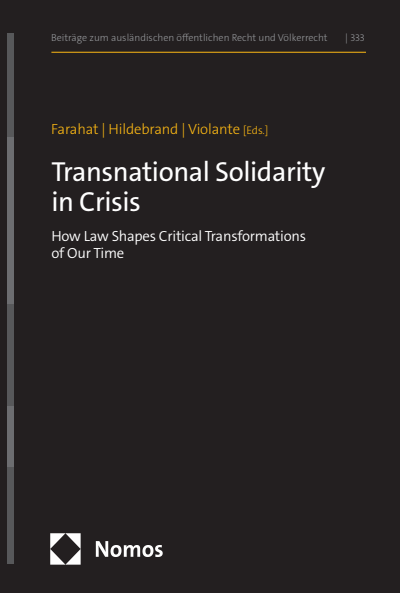
Transnational Solidarity in Crisis
How Law Shapes Critical Transformations of Our Time- Editors:
- | |
- Series:
- Beiträge zum ausländischen öffentlichen Recht und Völkerrecht, Volume 333
- Publisher:
- 2024
Summary
Crises are privileged moments of solidarization and desolidarisation. On one hand, solidarity-based institutions are often at issue in times of crises. On the other hand, solidarity is invoked to mitigate or overcome crises. This puts political and legal authorities, in which solidarity is negotiated, under pressure. This book analyses the impact of such dynamics from a legal and political science perspective by focusing on three societal crises of our time: economic crises, migration crises, and pandemics. The authors combine theoretical and empirical analysis with legal considerations to highlight the role of institutions and law in shaping the dynamic between solidarity and crisis.
Keywords
Search publication
Bibliographic data
- Edition
- 1/2024
- Copyright Year
- 2024
- ISBN-Print
- 978-3-7560-1449-1
- ISBN-Online
- 978-3-7489-1986-5
- Publisher
- Nomos, Baden-Baden
- Series
- Beiträge zum ausländischen öffentlichen Recht und Völkerrecht
- Volume
- 333
- Language
- English
- Pages
- 378
- Product Type
- Edited Book
Table of contents
ChapterPages
- Titelei/InhaltsverzeichnisPages 1 - 10 Download chapter (PDF)
- Authors: | |Download chapter (PDF)
- 1 Introduction
- 2.1 Solidarity as joint action and the possibility of transnational solidarity
- 2.2 The complex relationship between law and solidarity
- 3 Crisis and the intensification of transnational solidarity conflicts
- 3 Crises and transnational solidarity conflicts as challenges for institutional conflict resolution
- 4 Research questions, research interests and overall objectives
- 5 Overview of the book
- Authors:Download chapter (PDF)
- 1 Introduction: When deep integration becomes toxic, and when it does not
- 2 Conceptualising transnational European solidarity
- 3.1 The financial and euro crisis
- 3.2 The Covid-19 pandemic
- 4 About similarities and differences: Understanding the (non-)hegemonic reorganisation of the European “moral economy”
- 5 Conclusion: Preconditions of transnational solidarity
- Authors:Download chapter (PDF)
- 1 Introduction
- 2 Solidarity in an environment of “constructive ambiguity” and “open texture” – some preliminary remarks on the development of the European Monetary Union (EMU)
- 3.1 EMU as an asymmetric construct
- 3.2 The financial crisis as a strong impulse for reform
- 3.3 Conditionality
- 3.4 The struggle for a “fiscal capacity” and the ever more extensive interpretation of the “economic limb” of EMU
- 3.5 Extending solidarity within the existing treaty boundaries: a test case for the future
- 4.1 Preconditions
- 4.2 The reaction by the European Union
- 4.3 The legal structure of Next Generation EU (NGEU)
- 4.4 Solidarity as the legal basis
- 5 Conclusions
- Authors:Download chapter (PDF)
- 1 Introduction
- 2.1 The role of political parties in the EU
- 2.2 Political parties and EU solidarity
- 3 The 2019 EP elections
- 4.1 Data base
- 4.2 Coding categories
- 4.3 Analysis strategy
- 5.1 EU solidarity positions by EP political groups
- 5.2 Preferences for EU solidarity and more general political dimensions
- 6 Conclusion
- Authors:Download chapter (PDF)
- 1. Introduction
- 2.1. Cooperative federalism and federal conditionality
- 2.2. The Supreme Court jurisprudence on grants-in-aid
- 2.3. The Unconstitutional Conditions Doctrine: the Dole Test
- 2.4. Conditionality in the Affordable Care Act
- 3.1. Solidarity and Conditionality in the EU
- 3.2 . Conditionality and solidarity: the case of cohesion policy
- 3.3. Conditionality and solidarity in the most recent development of the EU
- 4. Conclusions
- Authors:Download chapter (PDF)
- Introduction
- 2.1. Solidarity
- 2.2.1. Money comprises credit
- 2.2.2. The hybrid nature of money
- 2.2.3. Money reflects property
- 2.3.2. …that are nevertheless prone to increasing instability
- 3.1. The European market: Solidarity confined to national borders
- 3.2. The original design of the euro: A shared currency without solidarity mechanisms
- 3.3.1. The transformation of the Eurozone
- 4. Conclusions
- Authors:Download chapter (PDF)
- 1. Introduction
- 2.1. Solidaristic practices: Mutual aid in action
- 2.2. Institutionalisation: from solidaristic practices to the Democratic and Social State
- 2.3. The ambivalence of institutionalisation: in particular, of inverted solidarity
- 2.4. Other challenges of the institutionalisation of solidaristic practices, in particular, solidarity in federal polities
- 3.1 The founding ambivalence of the European Communities
- 3.2. The Maastricht decisive moment: the “constitutional” pre-emption of solidarity
- 3.3. The fiscal crises: breaching the Treaties, doubling down on the radical separation of national exchequers, and pushing solidaristic institutions to the breaking point.
- 4.1.1. Suspending Fiscal Rules
- 4.1.2. De facto suspending state aid rules
- 4.1.3. Expanding the acquisition of public bonds and launching a specific pandemic QE: The ECB as the unconditional lender of last resort to Member States
- a) A false step: Repurposing the instruments created during the fiscal crises of the 10s
- b) EU Next Generation
- 4.2. A more solidaristic EU? Between the inklings of a federal solidum and austerity business as usual
- 5. Conclusions: Back to a solidaristic EU?
- Authors:Download chapter (PDF)
- 1 Introduction
- 2 Solidarity in the legal framework of European Neighbourhood policy
- 3.1 The Belarus Crisis
- 3.2 The Ukraine-Russia Crisis
- 4.1 The Commission: DG HOME and Member State Interior Ministries concerns
- 4.2 The Object of Solidarity
- 4.3 The Institutional Setting of Solidarity
- 4.4 The Institutional Response to Incoherence
- 5 Fundamental Rights as Solidarity in the Neighborhood
- 6 Conclusions
- Authors:Download chapter (PDF)
- 1 Introduction
- 2 Solidarity and refugees’ social rights
- 3.1 General overview
- 3.2 Housing
- 3.3 Social assistance
- 3.4 An incremental system?
- 4 Refugees’ social rights in EU law: an expression of solidarity?
- 5 The influence of crisis
- 6 Conclusion
- Authors:Download chapter (PDF)
- 1 Introduction
- 2.1 Solidarities in the EU’s migration policy
- 2.2 The principle of solidarity and fair-sharing of responsibility: a critical anatomy
- 3.1 The Many Modes of Responsibility Sharing: A Critical Overview
- 3.2 Solidarity through EU Funding in Migration: A longitudinal view
- 3.3 Solidarity through funding in the current multi-annual framework 2021–2027
- 3.4 Solidarity through Funding in the New Pact on Migration and Asylum
- 4 Conclusion
- Authors:Download chapter (PDF)
- 1.1 Deflection instead of State Solidarity
- 1.2 Jurisdiction Avoidance and Rightlessness
- 1.3 Transnational Solidarity in the Struggle for Legal Subjectivation
- 2.1 Immediate Solidarity at the Land Border
- 2.2 Search and Rescue at Sea
- 2.3 Cities of Refuge
- 3 Transnational Negotiations of Subjectivity
- Authors:Download chapter (PDF)
- 1 Introduction
- 2 Indigenous populations
- 3 Prison population
- 4 Police killings in the favelas
- 5 Strong rights, weak remedies, strong monitoring, and the hollow hope
- 6 Conclusion
- Authors:Download chapter (PDF)
- 1 Introduction
- 2.1 Pre-COVID Distribution of Pandemic-Related Medical Goods
- 2.2 COVID-19 as a Stress Test of Transnational Solidarity
- 2.3 ACT-Accelerator and COVAX: Between charity and solidarity
- 3.1 Human Rights Law: Legal Dimensions of (Constrained) International Solidarity
- 3.2 A Prospective Legal Approach towards Transnational Solidarity in Pandemics
- 4 Conclusions: Transnational Solidarity in Pandemics at a Crossroads
- Authors: | | |Download chapter (PDF)
- 1 Introduction
- 2 Vaccine Procurement Inequity in Latin America
- 3.1 Secrecy of vaccine agreements
- 3.2.1. Manufacturing agreements
- 3.2.2. Clinical trials
- 3.2.3. Diplomatic approaches
- 3.3.1. Arbitration clauses
- 3.3.2 Tax and law exemptions
- 4 PAHO and COVAX as solidarity mechanisms
- 5 Conclusion
- List of authors and affiliationsPages 377 - 378 Download chapter (PDF)