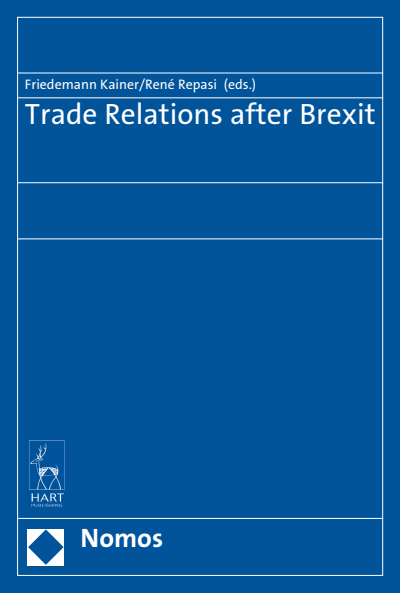
Trade Relations after Brexit
- Editors:
- |
- Publisher:
- 2019
Summary
The exit of the United Kingdom from the EU represents the first large-scale reversal of European integration. It will, in particular, have an appreciable impact on the trade relations with the European continent. This edited volume brings together contributions from leading economists and legal scholars that raise crucial questions and challenges with respect to the Brexit negotiations. In doing so, the contributions do not only look at the withdrawal agreement but, beyond that, at the future trade relations between the UK and the EU after the entry into force of a possible withdrawal agreement.
The authors are driven by the conviction that the future relationship between EU and UK shall allow the utmost possible degree of economic freedoms in the benefit of both sides, taking into account political restraints deriving from UK to meet the main objectives of the Brexit campaign and addressing the special circumstance of the Northern Irish peace process, and from the EU, preventing the emergence of incentives to destabilise the European integration. Against this background, the contributions develop realistic solutions which can serve as a reliable model for the negotiation process.
Keywords
Search publication
Bibliographic data
- Edition
- 1/2019
- Copyright Year
- 2019
- ISBN-Print
- 978-3-8487-5133-4
- ISBN-Online
- 978-3-8452-9334-9
- Publisher
- Nomos, Baden-Baden
- Language
- English
- Pages
- 415
- Product Type
- Edited Book
Table of contents
- Titelei/Inhaltsverzeichnis No access Pages 1 - 6
- Trade Relations after Brexit: An Introduction No access Pages 7 - 14Authors: |
- Authors: |
- Authors: |
- The UK’s loss of sovereignty No accessAuthors: |
- Migration No accessAuthors: |
- EU, the Bottomless Money Pit No accessAuthors: |
- The UK’s Take in the Negotiation and the EU’s Dilemma No accessAuthors: |
- The UK’s Red Lines No accessAuthors: |
- Slow Progress No accessAuthors: |
- The Economic Implications of Brexit No accessAuthors: |
- Resume No accessAuthors: |
- Authors:
- I. Un peu d’histoire No accessAuthors:
- Authors:
- The economic effects of Brexit No accessAuthors:
- Authors:
- A. EU trade negotiations: the outcome from a full Brexit compared with a Soft Brexit No accessAuthors:
- B. What if there was no Trade Deal with the EU? No accessAuthors:
- C. Canada-plus: the only possible negotiated outcome No accessAuthors:
- IV. Conclusions: the post-Brexit world will be a better world No accessAuthors:
- Authors:
- A. Introduction No accessAuthors:
- Authors:
- Authors:
- 1. Early studies No accessAuthors:
- 2. Qualification of the early studies No accessAuthors:
- 3. Newer studies No accessAuthors:
- Authors:
- 1. Additional static trade effects No accessAuthors:
- 2. Additional dynamic trade effects No accessAuthors:
- 3. Additional non-trade effects of economic integration No accessAuthors:
- Authors:
- 1. What scope for deregulation? No accessAuthors:
- 2. What potential for “Global Britain” and new FTAs with third countries? No accessAuthors:
- 3. No more contributions to the EU? No accessAuthors:
- Authors:
- I. Limited impact of Brexit in 2016 No accessAuthors:
- II. Losses in real income in 2017 due to pound devaluation No accessAuthors:
- III. Slower economic growth and investment No accessAuthors:
- Authors:
- I. Long-term implications No accessAuthors:
- II. Short-term implications No accessAuthors:
- E. Bibliography No accessAuthors:
- Authors:
- A. Introduction No accessAuthors:
- B. Trade policy background for the Brexit process No accessAuthors:
- Authors:
- I. Starting point: Parallel membership of EU and EU Member States in the WTO No accessAuthors:
- Authors:
- 1. Formal membership status No accessAuthors:
- 2. Scope of legal obligations No accessAuthors:
- 3. Schedules of Concessions; Tariff Rate Quotas (TRQ) No accessAuthors:
- 4. Agricultural subsidies No accessAuthors:
- 5. Market access for services No accessAuthors:
- 6. Dispute settlement mechanism No accessAuthors:
- 7. Trade defence measures No accessAuthors:
- D. Other EU trade agreements No accessAuthors:
- E. Future EU 27-UK trade relations No accessAuthors:
- F. Brexit and investment protection No accessAuthors:
- G. UK’s third country trade relations No accessAuthors:
- H. Conclusion No accessAuthors:
- Authors:
- A. The ‘Brexit’ Challenge in Trade: Maintaining or Establishing Integrated Markets with Means other than a Single Market No accessAuthors:
- B. Positions on the Future Relationship between the UK and the EU No accessAuthors:
- Authors:
- I. Object Common to all Trade Cooperation: Reducing Costs Attached to Cross-Border Economic Activities No accessAuthors:
- Authors:
- 1. Intensity of Trade Cooperation No accessAuthors:
- 2. Means to Implement Trade Cooperation No accessAuthors:
- 3. Enforcement of Trade Cooperation No accessAuthors:
- 4. Scope of Trade Cooperation No accessAuthors:
- 5. Analytical Grid No accessAuthors:
- Authors:
- 1. Setting the Benchmark: Membership in the European Union No accessAuthors:
- 2. Comprehensive Free Trade Agreement: The Example of CETA No accessAuthors:
- 3. The Political Declaration Setting out the Framework for the Future Relationship No accessAuthors:
- IV. Interim Conclusion No accessAuthors:
- Authors:
- Authors:
- 1. Agreement No accessAuthors:
- 2. Delegation of Powers to Treaty Bodies No accessAuthors:
- 3. International Organisation No accessAuthors:
- Authors:
- 1. Limits Inherent to Agreements No accessAuthors:
- 2. Limits Inherent to the Delegation of Powers to Treaty Bodies No accessAuthors:
- 3. Limits Inherent to the Delegation of Powers to International Organisations No accessAuthors:
- III. Including the Limits of Available Legal Instruments into the Analytical Grid No accessAuthors:
- IV. Interim Conclusion No accessAuthors:
- E. Free Trade Agreements are no Means to Maintain the Existing Level of Market Integration between the UK and the EU No accessAuthors:
- F. Conclusions No accessAuthors:
- Authors:
- I. Introduction No accessAuthors:
- Authors:
- 1. Common Standards and Efficiency in Trade No accessAuthors:
- 2. The Case for Services No accessAuthors:
- Authors:
- a) The principle of competition under the Internal Market law No accessAuthors:
- b) Distortions of Competition due to Differences in Regulatory Costs No accessAuthors:
- 4. Interim Conclusion No accessAuthors:
- Authors:
- 1. Harmonisation: EEA and the EU-Ukraine Association Agreement No accessAuthors:
- 2. Regulatory Cooperation: The CETA Approach No accessAuthors:
- 3. Autonomous Alignment: The Swiss Model No accessAuthors:
- 4. Minimum Standards and Non-Regression: The Backstop Protocol No accessAuthors:
- 5. Analysis No accessAuthors:
- Authors:
- 1. The Need for a Bespoke, Comprehensive, and Living Agreement No accessAuthors:
- Authors:
- a) A Forum for Regulatory Cooperation No accessAuthors:
- b) Monitoring Regulatory Alignment No accessAuthors:
- c) Decision Making No accessAuthors:
- d) Institutional Setting No accessAuthors:
- 3. Conditionality of Market Access No accessAuthors:
- 4. The Need for Legal Protection No accessAuthors:
- 5. Voluntary Equivalence as Case for Cherry Picking? No accessAuthors:
- V. Summary No accessAuthors:
- Authors:
- 1. Introduction: the enduring importance of goods No accessAuthors:
- Authors:
- 2.1. Customs duties and charges having equivalent effect No accessAuthors:
- 2.2. Fiscal barriers due to internal taxation No accessAuthors:
- 2.3. Non-tariff barriers No accessAuthors:
- 2.4. The legal machinery behind free movement of goods No accessAuthors:
- 3. The backstop and the minimum content of a future arrangement for goods No accessAuthors:
- Authors:
- 4.1. Customs duties and charges having equivalent effect under the white paper No accessAuthors:
- 4.2. Fiscal barriers due to internal taxation and the white paper No accessAuthors:
- 4.3. Non-tariff barriers and the white paper No accessAuthors:
- 4.4. The legal machinery behind free movement of goods and the white paper No accessAuthors:
- Authors:
- 5.1. Falling short: regulatory models for goods that do not prevent a hard border No accessAuthors:
- 5.2. Regulatory models that do prevent a hard border (at a cost) No accessAuthors:
- 5.3. Time for hard choices: the UK trilemma No accessAuthors:
- 5.4. Time for serious self-reflection: the EU choices No accessAuthors:
- Authors:
- Introduction – the Importance of Services No accessAuthors:
- The Particular Case of Financial Services No accessAuthors:
- Relevant Considerations in Negotiating a Brexit Deal on Services No accessAuthors:
- Possible Negotiation Outcomes Regarding the Free Movement of Services No accessAuthors:
- Retention of EU Membership No accessAuthors:
- EEA-Style Agreement/EEA-plus-Customs Union-Style Agreement No accessAuthors:
- Free Trade Areas and the Free Movement of Services No accessAuthors:
- CETA plus-style (or EEA minus-style) agreement No accessAuthors:
- Ukraine-style association agreement No accessAuthors:
- CETA/Korea-style agreement. No accessAuthors:
- The ‘No Deal’ Scenario No accessAuthors:
- Developments During the Negotiations on Brexit and their Relevance to the Free Movement of Services No accessAuthors:
- Mansion House speech No accessAuthors:
- Chequers No accessAuthors:
- The July White Paper No accessAuthors:
- The Withdrawal Agreement and Associated Political Declaration No accessAuthors:
- Ground Zero: the Looming Danger of a No Deal Scenario No accessAuthors:
- Endnote? No accessAuthors:
- Authors:
- Abstract No accessAuthors:
- 1. Introduction No accessAuthors:
- Authors:
- 2.1 No More Passporting Post Brexit No accessAuthors:
- 2.2 No alternative—EEA Membership or Bespoke Arrangement No accessAuthors:
- 2.3 Anticipatory Action and Fait Accompli No accessAuthors:
- 2.4 Conclusion: End of Access to Financial Market? No accessAuthors:
- Authors:
- 3.1 The Economic Case for Access to the Internal Market—for the UK No accessAuthors:
- 3.2 The Case for Continental Europe to Stay with Britain No accessAuthors:
- 3.3 Avoiding a Precedent? No accessAuthors:
- 3.4 Political Constraints No accessAuthors:
- 3.5 Currently Hardening Stances No accessAuthors:
- Authors:
- 4.1 Lessons from EU Financial Integration No accessAuthors:
- 4.2 Reason to Worry? No accessAuthors:
- 4.3 Implications for Brexit No accessAuthors:
- Authors:
- 5.1 ‘Special Deal’ As Most Likely Outcome No accessAuthors:
- 5.2 Alternative: Equivalence and Third-Country Passport No accessAuthors:
- 5.3 Private Solutions No accessAuthors:
- 6. Conclusion No accessAuthors:
- Authors:
- I. Introduction No accessAuthors:
- Authors:
- 1. The legal effects and interpretation of the Withdrawal Agreement No accessAuthors:
- 2. The personal scope of the Withdrawal Agreement with respect to citizens’ rights No accessAuthors:
- 3. Administrative procedures for applications for status No accessAuthors:
- 4. The substantive provisions on citizens’ rights No accessAuthors:
- Authors:
- 1. Foundational issues and methods for interpretation No accessAuthors:
- 2. The personal scope of citizens’ rights No accessAuthors:
- 3. Rights related to residence No accessAuthors:
- 4. Residence documents No accessAuthors:
- 5. The rights of workers and self-employed persons No accessAuthors:
- 6. Other provisions No accessAuthors:
- IV. The future mobility framework No accessAuthors:
- V. Some reflections on citizens’ rights after Brexit No accessAuthors:
- Authors:
- A. Introduction No accessAuthors:
- Authors:
- Authors:
- 1. Block Exemptions No accessAuthors:
- 2. Alignment or divergence in the longer run? No accessAuthors:
- II. Mergers No accessAuthors:
- III. Market Investigations No accessAuthors:
- IV. State Aid No accessAuthors:
- Authors:
- I. Public enforcement: cooperation in the ECN and the Advisory Committee on concentrations. No accessAuthors:
- II. Public enforcement: cooperation with third countries. No accessAuthors:
- III. Public enforcement: resource implications No accessAuthors:
- Authors:
- 1. Recognition and enforcement No accessAuthors:
- 2. Follow-on actions based on Commission decisions No accessAuthors:
- D. Transitional arrangements No accessAuthors:
- E. What if the UK stayed in the EEA? No accessAuthors:
- F. Changes from the perspective of the EU No accessAuthors:
- G. Conclusion No accessAuthors:
- Bibliography No accessAuthors:
- Authors:
- A. Introduction No accessAuthors:
- Authors:
- I. Dismantling of non-tariff barriers to trade in public markets No accessAuthors:
- II. Administrative cooperation as a trade-facilitation strategy No accessAuthors:
- III. Boosting the enforceability of the rules No accessAuthors:
- Authors:
- I. Preventing the re-appearance of non-tariff barriers to trade in public markets No accessAuthors:
- II. Continued administrative cooperation as a trade-facilitation strategy No accessAuthors:
- III. Retaining the enforceability of the rules No accessAuthors:
- D. Concluding remarks No accessAuthors:
- Authors:
- Authors:
- I. Reasons for Specific EU-UK Common Substantive Rules. No accessAuthors:
- II. Scenario of No Agreement on Common Substantive Rules No accessAuthors:
- III. Lack of Common Rules on Judicial Protection. No accessAuthors:
- Authors:
- I. Presumptions No accessAuthors:
- II. Uniformity of Existing Law. No accessAuthors:
- III. Uniformity of Future Legislation. No accessAuthors:
- Authors:
- I. Presumptions. No accessAuthors:
- Authors:
- 1. Absence Model (Full Judicial Autonomy of Both Sides). No accessAuthors:
- 2. Cooperation Model (Modified Judicial Autonomy). No accessAuthors:
- 3. Common Dispute Resolution Model. No accessAuthors:
- 4. The Inclusion Model No accessAuthors:
- D. Conclusion. No accessAuthors: