, to see if you have full access to this publication.
Monograph No access
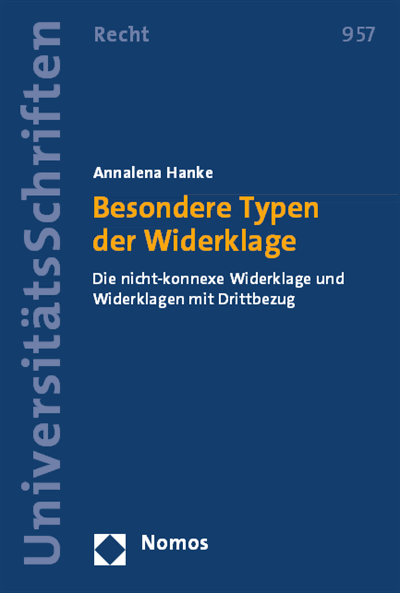
Besondere Typen der Widerklage
Die nicht-konnexe Widerklage und Widerklagen mit Drittbezug- Authors:
- Series:
- Nomos Universitätsschriften - Recht, Volume 957
- Publisher:
- 2019
Keywords
Search publication
Bibliographic data
- Edition
- 1/2019
- Copyright Year
- 2019
- ISBN-Print
- 978-3-8487-5765-7
- ISBN-Online
- 978-3-8452-9939-6
- Publisher
- Nomos, Baden-Baden
- Series
- Nomos Universitätsschriften - Recht
- Volume
- 957
- Language
- German
- Pages
- 252
- Product Type
- Monograph
Table of contents
ChapterPages
- Titelei/Inhaltsverzeichnis No access Pages 1 - 16
- Einführung No access Pages 17 - 20
- A. Allgemeines No access
- B. Historischer Ursprung der §§ 12 ff. No access
- C. Funktion No access
- D. Gerechtigkeitsgehalt No access
- A. Allgemeine Erwägungen zum besonderen Gerichtsstand No access
- B. Historischer Ursprung des § 33 No access
- C. Normzweck des § 33 No access
- D. Anknüpfungspunkte der Gerichtsstände und Geltung der besonderen Gerichtsstände gegenüber Dritten No access
- E. Gerichtsstand des Sachzusammenhangs No access
- F. Ergebnis No access
- A. Anwendungsbereich des § 36 I Nr. 3 No access
- I. Mehrere Personen haben bei verschiedenen Gerichten ihren allgemeinen Gerichtsstand No access
- II. Zeitpunkt der Bestimmung No access
- III. Vorlage oder Antrag No access
- IV. Zeitlicher Anwendungsbereich No access
- C. Ermessensentscheidung des Gerichts nach § 36 I Nr. 3 No access
- I. Allgemeine Sachurteilsvoraussetzungen No access
- 1. Rechtshängigkeit der Hauptklage No access
- 2. Eigenständiger Streitgegenstand der Widerklage No access
- 3. Aufteilung des Streitgegenstandes No access
- 4. Prozessart No access
- 5. Parteiidentität No access
- 6. Zusammenhang zwischen Klage und Widerklage No access
- 7. Zuständigkeit und Widerklage No access
- B. Funktion der Widerklage No access
- I. Zusätzlicher besonderer Gerichtsstand § 33 I No access
- II. Vereinfachte Geltendmachung in der mündlichen Verhandlung § 261 II No access
- III. Gebührenrechtliche Privilegierung No access
- IV. Keine Prozesskostensicherheitsleistungspflicht für Ausländer § 110 II Nr. 4 No access
- V. Beweisführung No access
- D. § 33 II No access
- A. Historie (Entstehungsgeschichte) No access
- B. Der Begriff der nicht-konnexen Widerklage No access
- I. Darstellung und Konsequenz für die nicht-konnexe Widerklage No access
- II. Argumente der Literatur No access
- I. Darstellung und Konsequenz für die nicht-konnexe Widerklage No access
- II. Argumente der Gegenansicht No access
- E. Praxisrelevanz No access
- F. Vergleich mit der „normalen“ Klageerhebung No access
- G. Zweckmäßigkeit einer nicht-konnexen Widerklage No access
- H. Ergebnis und eigene Stellungnahme No access
- A. Allgemeines No access
- 1. Leitsatz No access
- 2. Sachverhalt No access
- 3. Gründe No access
- 4. Stellungnahme No access
- 1. Leitsatz No access
- 2. Sachverhalt No access
- 3. Gründe No access
- 4. Stellungnahme No access
- III. BGH NJW 1975, 1228 (BGH-Urteil vom 21.2.1975) No access
- IV. BGHZ 69, 37 (BGH-Urteil vom 17.5.1977) No access
- V. Weitere ausschlaggebende Urteile No access
- 1. Zusammenhang No access
- 2. Voraussetzungen der Parteiänderung No access
- 3. Voraussetzung der Streitgenossenschaft No access
- 4. Gerichtsstand No access
- 5. Keine Beeinträchtigungen der Belange des Dritten No access
- 1. Zweckmäßigkeit und Sachdienlichkeit No access
- 2. Zweckmäßigkeit, Sachdienlichkeit und Konnexität No access
- 3. Zwischenergebnis No access
- 1. Streitstand No access
- a. Planwidrige Regelungslücke No access
- b. Entgegenstehende Wertungen des Gesetzgebers No access
- 3. Zwischenergebnis No access
- 1. Streitstand No access
- 2. Methodische Überprüfung der Anwendung des § 36 I Nr. 3 analog No access
- 1. Erhebung No access
- 2. Kostenrecht No access
- 3. Sicherheitsleistung No access
- 4. Zwischenergebnis No access
- I. Drittbeteiligung im zivilprozessualen Zweiparteiensystem No access
- II. Voraussetzungen der Streitgenossenschaft und der Klageverbindung No access
- III. Beispielsfall: Bauprozess No access
- IV. Beispielsfall: Verkehrsunfall No access
- V. Beispielsfall: gesellschaftsrechtliche Konstellation No access
- VI. Zwischenergebnis No access
- 1. Planwidrige Regelungslücke No access
- 2. Entgegenstehende Wertungen des Gesetzgebers No access
- 3. Zwischenergebnis No access
- 1. Prozessökonomie als Argument des BGH für die Zulässigkeit der streitgenössischen Drittwiderklage No access
- 2. Prozessökonomie und zivilprozessuale Drittbeteiligung No access
- F. Ergebnis No access
- A. Allgemeines No access
- 1. Leitsatz No access
- 2. Gründe No access
- 1. Sachverhalt No access
- 2. Gründe No access
- 3. Stellungnahme No access
- 1. Leitsatz No access
- 2. Sachverhalt No access
- 3. Gründe No access
- 1. Leitsatz No access
- 2. Sachverhalt No access
- 3. Gründe No access
- 1. Leitsatz No access
- 2. Sachverhalt No access
- 3. Gründe No access
- 4. Stellungnahme No access
- 1. Leitsatz No access
- 2. Sachverhalt No access
- 3. Gründe No access
- 4. Stellungnahme No access
- 1. Leitsatz No access
- 2. Sachverhalt No access
- 3. Gründe No access
- 4. Stellungnahme No access
- 1. Sachverhalt No access
- 2. Gründe No access
- 3. Stellungnahme No access
- 1. Sachverhalt No access
- 2. Gründe No access
- a. Ursprung der gewillkürten Prozessstandschaft No access
- b. Voraussetzungen und Wirkung No access
- c. Gewillkürte Prozessstandschaft und Drittwiderklage No access
- 1. Sachverhalt und Entscheidungsgründe No access
- 2. Stellungnahme No access
- 1. Zweckmäßigkeit, Konnexität und Sachdienlichkeit No access
- 2. § 33 I analog und die schützenswerten Interessen des unbeteiligten Dritten No access
- 3. Zwischenergebnis No access
- II. § 33 I analog im Bezug auf den Dritten No access
- III. Gerichtsstandsbestimmung nach § 36 I Nr. 3 direkt oder analog No access
- 1. Erhebung No access
- 2. Kostenrecht und Sicherheitsleistung No access
- 3. Zwischenergebnis No access
- a. Sachverhalt No access
- b. Gründe No access
- a. Sachverhalt No access
- b. Gründe No access
- a. Sachverhalt No access
- b. Gründe No access
- 4. Alternative zivilprozessrechtskonforme Falllösung No access
- a. Die isolierte Drittwiderklage als prozesstaktisches Mittel No access
- b. Wiederherstellung des prozessualen Gleichgewichts durch die isolierte Drittwiderklage No access
- i. Darstellung der Literaturansicht No access
- (1) Der gesetzliche Schuldnerschutz auf prozessualer Eben des § 407 II BGB No access
- (2) Vergleich der prozessualen Situation des § 407 II BGB mit der Zedentenwiderklage No access
- d. Ergebnis No access
- 1. Sachverhalt No access
- 2. Ansicht des BGH No access
- 3. Alternative zivilprozessrechtskonforme Falllösung No access
- 1. Sachverhalt und Entscheidungsgründe No access
- 2. Alternative zivilprozessrechtskonforme Falllösung No access
- 1. Sachverhalt und Entscheidungsgründe No access
- 2. Alternative zivilprozessrechtskonforme Falllösung No access
- 1. Streitverkündung No access
- 2. Freistellungsklage No access
- 3. Klage auf künftige Freistellung No access
- 4. Zwischenergebnis No access
- VI. Ergebnis No access
- I. Planwidrige Regelungslücke No access
- II. Entgegenstehende Wertungen des Gesetzgebers No access
- F. Gesamtergebnis No access
- I. Sachverhalt No access
- II. Stellungnahme No access
- III. Zwischenergebnis No access
- I. Sachverhalt No access
- II. Stellungnahme No access
- III. Zwischenergebnis No access
- IV. Alternative zivilprozessrechtskonforme Falllösung No access
- I. Sachverhalt und Entscheidungsgründe No access
- II. Stellungnahme No access
- III. Ergebnis No access
- I. Sachverhalt No access
- II. Stellungnahme No access
- E. Ergebnis No access
- § 9 Zusammenfassung und Ergebnisse No access Pages 239 - 246
- Literaturverzeichnis No access Pages 247 - 252
Bibliography (308 entries)
No match found. Try another term.
- Abdul‐Gafaru, A. (2009). Political Context Study- Ghana. Human Rights, Power and Civic Action Research Project, Universities of Oslo, Leeds, and Ghana. Open Google Scholar DOI: 10.5771/9783845299396
- Adepoju, Aderanti (2005). Patterns of Migration in West Africa. In Takyiwaa Manuh (ed.) At Home in the World. International Migration and Development in Contemporary Ghana and West Africa, Sub-Saharan Publishers, Accra, pp. 24-54. Open Google Scholar DOI: 10.5771/9783845299396
- Agunias, D. R., & Analyst, A. P. (2006). From a Zero-Sum to a Win-Win Scenario? Literature Review on Circular Migration. Migration Policy Institute. Washington, DC: Migration Policy Institute. Retrieved from www.migrationinformation.org. Open Google Scholar DOI: 10.5771/9783845299396
- Ahmed, S. (2009). Methods in Sample Surveys Cluster Sampling. Johns Hopkins University. Retrieved from http://ocw.jhsph.edu/courses/StatMethodsForSampleSurveys /PDFs/Lecture5.pdf Open Google Scholar DOI: 10.5771/9783845299396
- Akyeampong, E. (2000a). Africans in the Diaspora: The Diaspora and Africa. African Affairs, 99(395), 183–215. Open Google Scholar DOI: 10.5771/9783845299396
- Akyeampong, E. (2000b). Africans in the Diaspora: The Diaspora and Africa. African Affairs, 99, 183–215. Open Google Scholar DOI: 10.5771/9783845299396
- Akyeampong, K. (2007). Educational expansion and access in Ghana: A review of 50 years of challenge and progress. Centre for International Education University of Sussex, …, 1–16. Open Google Scholar DOI: 10.5771/9783845299396
- Alberts, H. & Hazen, H. D. (2005). ‘There are always two voices: International Students’ Intentions to Stay in the United States or Return to their Home Countries.’ International Migration 43(3):131–154. Open Google Scholar DOI: 10.5771/9783845299396
- Ammassari, S. (2004). From Nation-Building to Entrepreneurship: The Impact of Élite Return Migrants in Côte d’Ivoire and Ghana. Population Space Place, 10, 133–154. Open Google Scholar DOI: 10.5771/9783845299396
- Ammassari, S. (2009). Migration and Development: Factoring Return into the Equation. Newcastle upon Tyne, Cambridge Scholars Publishing. Open Google Scholar DOI: 10.5771/9783845299396
- Ammassari, S., & Black, R. (2001). Harnessing the potential of Migration and Return to Promote Development: Applying Concepts to West Africa. Migration Research Series, (5). Open Google Scholar DOI: 10.5771/9783845299396
- Ann Marie, J. (2010). Return Migration from England to Ireland: the impact of accent on feelings of belonging. Socheolas: Limerick Student Journal of Sociology., 2(2), 18. Open Google Scholar DOI: 10.5771/9783845299396
- Anarfi, J. K., et al. (2000). ‘Push and Pull Factors of International Migration. Country Report: Ghana. Eurostat Working Papers 2000/E (10) Open Google Scholar DOI: 10.5771/9783845299396
- Anarfi, K. J., Kwankye, S. & Ahiadeke, C. (2004) ‘Migration, Return and Impact in Ghana: A Comparative Study of Skilled and Unskilled Transnational Migrants.’ Presentation at the Conference on Migration and Development, Accra, Ghana, September 14-16. Open Google Scholar DOI: 10.5771/9783845299396
- Anarfi, J., & Kwankye, S. (2003). Migration from and to Ghana: A Background Paper. Development Research Centre on Migration, Globalisation and Poverty, Working Paper (December), 38. Retrieved from http://www.migrationdrc.org Open Google Scholar DOI: 10.5771/9783845299396
- Anarfi, J. K., Ababio, O., & Tiemoko, R. (2003). Migration from and to Ghana: A Background Paper. Working Paper, Development Research Centre on Migration, Globalisation and Poverty, Brighton. Open Google Scholar DOI: 10.5771/9783845299396
- Anarfi, J. K., & Jagare, S. (2005). West African Transnational Migrants: What are the Options? In Arusha Conference,’New Frontiers of Social Policy’ (pp. 1–20). Open Google Scholar DOI: 10.5771/9783845299396
- Ann Marie, Joyce. (2010). Return Migration from England to Ireland: the impact of accent on feelings of belonging. Socheolas: Limerick Student Journal of Sociology., 2(2), 18. Retrieved from http://www.ul.ie/sociology/socheolas/vol2/2 Open Google Scholar DOI: 10.5771/9783845299396
- Anthias, F. (2006). Belongings in a globalising and unequal world: rethinking translocations. The Situated Politics of Belonging, 17–31. Open Google Scholar DOI: 10.5771/9783845299396
- Anthias, F. (2013). Identity and Belonging: conceptualisations and political framings (Kompetenznetz Lateinamerika – Ethnicity, Citizenship, Belonging No. 8). Köln. Retrieved from http://www.kompetenzla.uni-koeln.de/fileadmin/WP_Anthias.pdf. Open Google Scholar DOI: 10.5771/9783845299396
- Antonsich, M. (2010). Searching for Belonging; An Analytical Framework. Geography Compass, 4(6), 644–659. Open Google Scholar DOI: 10.5771/9783845299396
- Ardovino, M. (2008). A Brief Literature Review on the Impact of Circular Migration: Brain gain, social capital, and transnational networks on international development. KSC Research Series, 1–20. Open Google Scholar DOI: 10.5771/9783845299396
- Arowolo, Oladele O. (2000). ‘Return Migration and the Problem of Reintegration,’ International Migration, 38 (5): 59-81. Open Google Scholar DOI: 10.5771/9783845299396
- Arthur, J. A. (1991). ‘Interregional Migration of Labour in Ghana, West Africa: Determinants, Consequences and Policy Intervention.’ Review of Black Political Economy 20(2): 89-103. Open Google Scholar DOI: 10.5771/9783845299396
- Asare, P. (2012). Labour Migration in Ghana, (October), 1–15. Retrieved from http://w ww. fesghana.org/uploads/PDF/FES_LabourMigration_2012_FINAL.pdf Open Google Scholar DOI: 10.5771/9783845299396
- Asiedu, A. (2005) ‘Some benefits of migrants’ return visits to Ghana’, Population Space and Place, 11(1): 1–11. Berger Cardoso, J., E.R. Hamilton, N. Rodriguez, K. Eschbach, and J. Hagan Open Google Scholar DOI: 10.5771/9783845299396
- Awumbila, M., Alhassan, O., Badasu, D., Antwi Bosiakoh, T. and Dankyi, E. K. (2011a). Socio-Cultural Dimensions of Migration in Ghana. Woeli. Accra. Open Google Scholar DOI: 10.5771/9783845299396
- Awumbila, M., Alhassan, O., Badasu, D., Antwi Bosiakoh, T. and Dankyi, E. K. (2011b). Socio-Cultural Dimensions of Migration in Ghana. Woeli. Accra. Open Google Scholar DOI: 10.5771/9783845299396
- Awumbila, M., Manuh, T., Quartey, P., Tagoe, C. A., & Thomas Antwi Bosiakoh. (2008). Migration country paper: Ghana. Centre for Migration Studies. Open Google Scholar DOI: 10.5771/9783845299396
- Bakuri, A. Z. (2014). The invisible Ghanaian sex worker active in the Dutch sex industry Amisah Bakuri-ReMa Thesis. Retrieved from https://research.vu.nl/ws/portalfiles/portal/42577536/chapter+2+Informal+Services.pdf Open Google Scholar DOI: 10.5771/9783845299396
- Baraulina, T., & Kreienbrink, A. (2013). Rückkehr und Reintegration Typen und Strategien an den Beispielen Türkei, Georgien und Russische Föderation Beiträge. Beiträge Zu Migration Und Integration, 4. Open Google Scholar DOI: 10.5771/9783845299396
- Barna, L. M. (1976). How culture shock affects communication. Communication, 5, 1-18 Open Google Scholar DOI: 10.5771/9783845299396
- Bauböck, R. (2006). Migration and citizenship: legal status, rights, and political participation. Migration and Citizenship Legal Status Rights and Political Participation. https://doi.org/Digitaal Open Google Scholar DOI: 10.5771/9783845299396
- Befus, C. P. (1988). A multilevel treatment approach for culture shock experienced by sojourners. International Journal of Intercultural Relations, 12, 381-400Berry, J. W. (1990). Psychology of acculturation. Understanding individuals moving between cultures. (R. W. (ed.). Brislin, Ed.). Newbury Park, London, and New Delhi: SAGE Publications. Open Google Scholar DOI: 10.5771/9783845299396
- Berry, J. W. (1997). Lead Article – Immigration, Acculturation, and Adaptation. Applied Psychology, 46(1), 5–34. http://doi.org/10.1080/026999497378467 Open Google Scholar DOI: 10.5771/9783845299396
- Berry, J. W. (1980). Acculturation as varieties of adaptation. In A. M. Padilla (Ed.), Acculturation: Theory, models, and some new findings (pp.9-25). Boulder, CO: Westview. Berry, Open Google Scholar DOI: 10.5771/9783845299396
- Berry, J. W. (1990). Psychology of acculturation. Understanding individuals moving between cultures. (R. W. (ed.). Brislin, Ed.). Newbury Park, London, and New Delhi: SAGE Publications. Open Google Scholar DOI: 10.5771/9783845299396
- Berry, L. (1995). Ghana a country study Ghana. (L. Berry, Ed.) (3rd ed). Washington, D.C Open Google Scholar DOI: 10.5771/9783845299396
- Bhimji, F. (2008). Cosmopolitan belonging and diaspora: second-generation British Muslim women travelling to South Asia. Citizenship Studies 12(4), 413-427. Open Google Scholar DOI: 10.5771/9783845299396
- Bilsborrow, R., Oberai, A., & Standing, G. (1984). Migration Surveys in Low-Income Countries: Guidelines for Survey and Questionnaire Design. London: Croom Helm. Open Google Scholar DOI: 10.5771/9783845299396
- Binaisa, N. (2013). Diasporic Landscape: Theoretical Reflections on African Migrants’ Everyday Practices of ‘Home’and ‘Belonging.’ Journal of Intercultural Studies, 1–17. Open Google Scholar DOI: 10.5771/9783845299396
- Black, R., Ammassari, S., King, R., Litchfield, J., & Tiemoko, R. (2003). Transnational Migration, Return and Development in West Africa. Final Research Report. Sussex Centre for Migration Research, University of Sussex, (April). Open Google Scholar DOI: 10.5771/9783845299396
- Black, R., King, R., & Tiemoko, R. (2003). Migration, return and small enterprise development in Ghana: a route out of poverty? (9). Brighton. Open Google Scholar DOI: 10.5771/9783845299396
- Bledsoe, C. H. & Sow, P. (2011). Back to Africa: Second Chances for the Children of West African Immigrants. Journal of Marriage and Family 73. pp. 747 – 762 Open Google Scholar DOI: 10.5771/9783845299396
- Blunt, A. (2005). Cultural geography: cultural geographies of home. Progress in Human Geography, 29(4), 505–515. Open Google Scholar DOI: 10.5771/9783845299396
- Blunt, A. and R. M. Dowling (2006). Home. London: Routledge. Open Google Scholar DOI: 10.5771/9783845299396
- Blunt, A., & Bonnerjee, J. (2013). Home, city, and diaspora: Anglo-Indian and Chinese attachments to Calcutta. Global Networks, 13(2), 220–240. Open Google Scholar DOI: 10.5771/9783845299396
- Bob-Milliar, G. M. (2009). Chieftaincy, diaspora, and development: The institution of Nk⊃suohene in Ghana. African Affairs, 108(433), 541–558. Open Google Scholar DOI: 10.5771/9783845299396
- Bob-Milliar, G. M., & Bob-Milliar, G. K. (2013). The Politics of Trans-Saharan Transit Migration in the Maghreb: Ghanaian Migrants in Libya, c. 1980 – 2012. African Review of Economics and Finance, 5(1), 60–73. Open Google Scholar DOI: 10.5771/9783845299396
- Boger, J. (2010). WUS-Deutscheskomitee und das Ghanaian German aluni-network: eineplattformfürrückkehrer von rückkehrern’ in World University Service (ed), 60 Jahre. Wiesbaden: World University Service in Deutschland 1950-2010. Open Google Scholar DOI: 10.5771/9783845299396
- Böhning, W. R. (1972). The migration of workers in the United Kingdom and the European Community (p. xvi, 167 p.). London: Oxford Univ. Press. Open Google Scholar DOI: 10.5771/9783845299396
- Borgas, A. eds. (2004). Homecomings: Unsettling Paths of Return, Lanham, MD: Lexington Books, Open Google Scholar DOI: 10.5771/9783845299396
- Borjas J George. ‘Economic Theory and International Migration.’ International Migration Review, 23 no. 3 (1989): 457-485 Open Google Scholar DOI: 10.5771/9783845299396
- Bosiakoh, A. (2012). Toward an agenda for placing migrant hometown associations (HTAs) in migration policy-making discourse in Ghana. International Journal of Sociology and Anthropology, 4(9), 249–256. https://doi.org/10.5897/IJSA12.029 Open Google Scholar DOI: 10.5771/9783845299396
- Bourhis, R. Y., Moise, L. C., Perrault, S. & Senecal, S. (1997). Towards an interactive acculturation model: A social psychological approach. International Journal of Psychology, 32(6), 369-386. Open Google Scholar DOI: 10.5771/9783845299396
- Bovenkerk, F. (1974). The Sociology of Return Migration: A Bibliographic Essay. Publication on European Migration Problems, 10–18. Open Google Scholar DOI: 10.5771/9783845299396
- Brah, A. (1996). Cartographies of diaspora: contesting identities, London. Routledge Open Google Scholar DOI: 10.5771/9783845299396
- Brein, M., & David, K. B. (1971). Intercultural communication and the adjustment of the sojourner. Psychological Bulletin, 76, 215-230. Open Google Scholar DOI: 10.5771/9783845299396
- Brotherton, D. C., & Barrios, L. (2009). Displacement and stigma: The social-psychological crisis of the deportee. Crime, Media, Culture, 5(1), 29-55. Open Google Scholar DOI: 10.5771/9783845299396
- Brubaker, R., & Cooper, F. (2000). Beyond ‘identity.’ Theory& Societ, 29(1), 1–47. Open Google Scholar DOI: 10.5771/9783845299396
- Bruner, E. M. (1996) Tourism in Ghana: the representation of slavery and the return of the black diaspora, American Anthropologist, 98(2), pp. 290–304. Open Google Scholar DOI: 10.5771/9783845299396
- Brouwer, L. (2006). Dutch Moroccan Websites: A Transnational Imagery? Journal of Ethnic and Migration Studies, 32:7, 1153-1168 Brubaker, R., & Cooper, F. (2000). Beyond ‘identity.’ Theory& Societ, 29(1), 1–47. Open Google Scholar DOI: 10.5771/9783845299396
- Bryant, A., & Charmaz, K. (2012). Grounded Theory and Psychological Research. In H. Cooper, P. M. Camic, D. L. Long, A. T. Panter, D. Rindskopf, & K. J. Sher (Eds.), APA handbook of research methods in psychology, Vol. 2. Research designs: Quantitative, qualitative, neuropsychological, and biological (pp. 39-56). Open Google Scholar DOI: 10.5771/9783845299396
- Bryman, A. (2012). Social Research Methods (4th ed.). New York: Oxford Univ. Press. Open Google Scholar DOI: 10.5771/9783845299396
- Bump, M. (2006). Ghana. Searching for Opportunities at Home and Abroad. Migration Information Source. Washington (D.C.): Migration Policy Institute: http://www.migratio ninformation.org/Profiles/display.cfm?ID=381, (accessed, 1. 10. 2006) Open Google Scholar DOI: 10.5771/9783845299396
- Butler, J. (1993). Bodies that matter. On the discursive limits of sex. New York: Routledge. Open Google Scholar DOI: 10.5771/9783845299396
- Byfield, J. (2000). Rethinking the African Diaspora. African Studies Review, 43(1), 1–9. Open Google Scholar DOI: 10.5771/9783845299396
- Byron, M., & Condon, S. (1996). ‘A Comparative Study of Caribbean Return Migration from Britain and France: towards a context-dependent explanation,’ Transactions of the Institute of British Geographers, New Series, 21 (1): pp. 91-104. Open Google Scholar DOI: 10.5771/9783845299396
- Caarls, K. (2015). Living Apart Together Across Borders: How Ghanaian couples form, transform, or dissolve in the context of international migration. Retrieved from http://digitalarchive.maastrichtuniversity.nl/fedora/get/guid:91246c40-32dc-4412-88c2-6fd79251f714/ASSET1 Open Google Scholar DOI: 10.5771/9783845299396
- Campbell, J. (1988). The Power of Myth. New York: Doubleday. Open Google Scholar DOI: 10.5771/9783845299396
- Carletto, C. & de Brauw, A. (2008) Measuring Migration Using Household Surveys. Washington D.C.: The World Bank Migration Operational Vehicle, Operational Note No. 2. Retrieved from http://siteresources.worldbank.org/INTMIGDEV/Resources/28382121237303771337/MigNote2_Carletto_de_Brauw_Measuring_Migration_Using_Household_Surveys.pdf Open Google Scholar DOI: 10.5771/9783845299396
- Carling, J. (2004). ‘Emigration, Return and Development in Cape Verde: The Impact of Closing Borders.’ Population, Space and Place 10: 113-132. Open Google Scholar DOI: 10.5771/9783845299396
- Carling, J., & Erdal, M. B. (2014). Return Migration and Transnationalism: How Are the Two Connected? International Migration, 52 (6), 2–12. doi:10.1111/imig.12180 Open Google Scholar DOI: 10.5771/9783845299396
- Carling, J., & Pettersen, S. V. (2014). Return Migration Intentions in the Integration-Transnationalism Matrix. International Migration, 52(6), 13–30. https://doi.org/10.1111/imig.12161 Open Google Scholar DOI: 10.5771/9783845299396
- Carter, E., J. Donald, and J. Squires (eds) (1993) Space and Place: Theories of Identity and Location, London: Lawrence and Wishart. Open Google Scholar DOI: 10.5771/9783845299396
- Cassarino, J.-P. (2004). Theorising Return Migration: a revisited conceptual approach to return migrants. EUI Working Paper, RSCAS No.2(2). Open Google Scholar DOI: 10.5771/9783845299396
- Cassarino, J.-P. (2008). Return Migrants to the Maghreb: Reintegration and Development Challenges (Global Report 2007). Florence, Italy: European University Institute, Robert Schuman Centre for Advanced Studies. Open Google Scholar DOI: 10.5771/9783845299396
- Castles, S., Korac, M., Vasta, E., & Vertovec, S. (2002). Integration: Mapping the field. Home Office Online Report, (December). Retrieved from http://scholar.google.com/scho lar?hl=en&btnG=Search&q=intitle:Integration+:+Mapping+the+Field#0 Open Google Scholar DOI: 10.5771/9783845299396
- Cerase, F. (1974). ‘Expectations and Reality: A Case Study of Return Migration from the United States to Southern Italy.’ International Migration Review 8(29): 245- 262. Open Google Scholar DOI: 10.5771/9783845299396
- Charmaz, K. (2014). Constructing Grounded Theory. Book (2nd ed., Vol. 2). Sonoma State University, Rohnert Park, USA: SAGE Publications Ltd. https://doi.org/10.1016/j.lisr.2007.11.003 Open Google Scholar DOI: 10.5771/9783845299396
- Childs, P., & Williams, P. (1997). An Introduction to Post-Colonial Theory. London, UK: Prentice Hall. https://doi.org/10.1057/9781137012142_1 Open Google Scholar DOI: 10.5771/9783845299396
- Christou, A. (2006a). ‘Crossing boundaries- ethnicizing employment- gendering labor: gender, ethnicity and social networks in return migration.’ Social & Cultural Geography 7(1): 87-102. Open Google Scholar DOI: 10.5771/9783845299396
- Christou, A. (2006b). ‘American dreams and European nightmares: experiences and polemics of second-generation Greek-American returning migrants,’ Journal of Ethnic and Migration Studies 32(5), pp.831-845 Open Google Scholar DOI: 10.5771/9783845299396
- Cohen, R. (1995) ‘Survey of World Migration’, Cambridge: Cambridge University Press, 1995. Open Google Scholar DOI: 10.5771/9783845299396
- Cohen, Y. & Haberfeld, Y. (2001). ‘Self-Selection and Return Migration: Israeli-Born Jews Returning Home from the United States during the 1980s’, Population Studies 55(1):79– 91. Colton, Open Google Scholar DOI: 10.5771/9783845299396
- Collins, J. (2004). Ghanaian Christianity and Popular Entertainment: Full Circle. History in Africa, 31, 407–423. Retrieved from http://www.jstor.org/stable/4128536 Open Google Scholar DOI: 10.5771/9783845299396
- Colton, N.A. (1993). ‘Homeward Bound: Yemeni Return Migration,’ International Migration Review, 27 (4): pp. 870-882 Open Google Scholar DOI: 10.5771/9783845299396
- Collyer, M. (2012). Deportation and the micropolitics of exclusion: The rise of removals from the UK to Sri Lanka. Geopolitics, 17(2), 276-292. Open Google Scholar DOI: 10.5771/9783845299396
- Constable, N. (1999). ‘At home but not at home: Filipina narratives of ambivalent returns,’ Cultural Anthropology 14(2), pp. 203-228 Open Google Scholar DOI: 10.5771/9783845299396
- Constant A. & Massey S. D. (2002) ‘Return Migration by German Guest workers: Neoclassical Versus New Economic Theories’, International Migration 40, no. 4, pp. 5- 36. Diatta Open Google Scholar DOI: 10.5771/9783845299396
- Corcoran, M. (2002) ‘The process of migration and the reinvention of self: the experiences of returning Irish emigrants’, Éire-Ireland XXXVII (102), pp. 175-191 Open Google Scholar DOI: 10.5771/9783845299396
- Crowley, J. (1999). The politics of belonging: Some theoretical considerations. In A. Geddes and A. Favell (eds) The politics of belonging: Migrants and minorities in contemporary Europe. Aldershot: Ashgate 15-41. Open Google Scholar DOI: 10.5771/9783845299396
- Cuba, L., and D. M. Hummon (1993). A place to call home: identification with dwelling, community, and region. The Sociological Quarterly 34(1), 111-131. Open Google Scholar DOI: 10.5771/9783845299396
- Dahya, E. (1973). ‘Pakistanis in Britain: transients or settlers?’, Race, 14(3): 241-277. Open Google Scholar DOI: 10.5771/9783845299396
- De, P., & Pierre, J. (2008). ‘The Conditions of Modern Return Migrants.’ International Journal on Multicultural Societies, 10(2), 95–105. Open Google Scholar DOI: 10.5771/9783845299396
- De Bree, J., Davids, T., & De Haas, H. (2010). Post-return experiences and transnational belonging of return migrants: a Dutch-Moroccan case study. Global Networks, 10(4), 489–509. https://doi.org/10.1111/j.1471-0374.2010.00299.x Open Google Scholar DOI: 10.5771/9783845299396
- de Haas, H., & Fokkema, T. (2011). The effects of integration and transnational ties on international return migration intentions. Demographic Research, 25, 755–782. Open Google Scholar DOI: 10.5771/9783845299396
- Denzin, N. K. 1970. The Research Act. Chicago: Aldin Open Google Scholar DOI: 10.5771/9783845299396
- Development Research Centre (DRC), (2007) University of Sussex 2007 Global Migrant Origin Database, March 2007 Open Google Scholar DOI: 10.5771/9783845299396
- Di Saint Pierre, F. Martinovic, B., De Vroome, T. (2015). Journal of Ethnic and Migration Studies, volume 41, issue 11, pp. 1836 – 1857 Open Google Scholar DOI: 10.5771/9783845299396
- Diatta, M. A. and Mbow, N. (1999). ‘Releasing the Development Potential of Return Migration: The Case of Senegal.’ International Migration 37(1):243–266. Open Google Scholar DOI: 10.5771/9783845299396
- Diko, Riiskjaer, MHB., and Nielsson, T. (2008). Circular repatriation: the unsuccessful return and reintegration of Iraqis with refugee status in Denmark. New Issues in Refugee Research Paper No. 165 UNHCR, Geneva. Open Google Scholar DOI: 10.5771/9783845299396
- Dixon, J., and K. Durrheim (2004). Dislocating identity: desegregation and the transformation of place. Journal of Environmental Psychology 24, 455-473 Open Google Scholar DOI: 10.5771/9783845299396
- Dorling, D., D. Vickers, et al. (2008). Changing UK. The way we live now. Sheffield: University of Sheffield. Open Google Scholar DOI: 10.5771/9783845299396
- Dumont, J., & Spielvogel, G. (2008). Return migration: a new perspective. International Migration Outlook SOPEMI –2008 Edition, (November 2007), 161–222. Retrieved from http://scholar.google.com/scholar?hl=en&btnG=Search&q=intitle:Return+Migration+:+A+New+Perspective#3 Open Google Scholar DOI: 10.5771/9783845299396
- Duval, D. T. (2004), Linking return visits and return migration among Commonwealth Eastern Caribbean migrants in Toronto. Global Networks, 4: 51–67. doi:10.1111/j.1471-0374.2004.00080.x Open Google Scholar DOI: 10.5771/9783845299396
- Eborka, K. (2014). Developmental Impact of Return Migration in Nigeria: Myth or Reality? ÌÌrìnkèrindò: A Journal of African Migration, (7), 178–206. Open Google Scholar DOI: 10.5771/9783845299396
- EP-Nuffic. (2015). Education system Ghana. Retrieved from https://www.epnuffic.nl/ en/publications/find-a-publication/ education-system-ghana.pdf Open Google Scholar DOI: 10.5771/9783845299396
- Esser, H. (1999). Inklusion, Integration und ethnische Schichtung. Für Konflikt-Und Gewaltforschung Journal of Conflict and Violence Research, 1(1). Retrieved from http://www.uni-bielefeld.de/ikg/jkg/1-1999/esser.pdf. Open Google Scholar DOI: 10.5771/9783845299396
- Esser, H. (2006). Migration, language, and integration. Retrieved from http://193.174.6.11/ alt/aki/files/aki_research_review_4.pdf Open Google Scholar DOI: 10.5771/9783845299396
- Essien, K. (2014). Afie ni Afie’ (Home is Home): Revisiting reverse Trans-Atlantic Journeys to Ghana and the Paradox of Return. Ìrìnkèrindò: A Journal of African Migration, (7), 47–75. Open Google Scholar DOI: 10.5771/9783845299396
- European Commission, (EU). (2006). Ghana Migration Profile, European Union: Delegation of the European Commission in Ghana. Open Google Scholar DOI: 10.5771/9783845299396
- Faist, T. (2008). ‘Migrants as Transnational Development Agents: An Inquiry into the Newest Round of the Migration-Development Nexus.’ Popula- tion, Space and Place 14 (1):21-42 Open Google Scholar DOI: 10.5771/9783845299396
- Fehler, B. O. (2011). (Re)constructing Roots: Genetics and the ‘Return’ of African Americans to Ghana. Mobilities, 6(4), 585–600. Open Google Scholar DOI: 10.5771/9783845299396
- Fenster, T. (2005). Gender and the city: the different formations of belonging. In L. Nelson and J. Seager (eds) A companion to feminist geography. Oxford: Blackwell, 242-257. Open Google Scholar DOI: 10.5771/9783845299396
- Fiske, S.T. (2004). Social beings: A core motives approach to social psychology. United States of America: Wiley. Open Google Scholar DOI: 10.5771/9783845299396
- Fortier, A.-M. (1997). Re-membering places and the performance of belonging(s). Theory, Culture & Society 16(2), 41-64 Open Google Scholar DOI: 10.5771/9783845299396
- Flick, U. (2009). An introduction to qualitative research (4th ed.). London, UK: SAGE Publications Ltd. Open Google Scholar DOI: 10.5771/9783845299396
- Galor, O., and Stark, O. (1990). ‘Migrants’ Savings, the Probability of Return Migration and Migrants’ Performance.’ International Economic Review 31(2):463–467. Ghana Open Google Scholar DOI: 10.5771/9783845299396
- Gaw, K. F. (2000). Reverse culture shock in students returning from overseas. International Journal of Intercultural Relations, 24, 83–104. Open Google Scholar DOI: 10.5771/9783845299396
- Ghartey, G., Jee, L., & Chung, E. (2014). Country Case Ghana. Open Google Scholar DOI: 10.5771/9783845299396
- Ghosh, B. (2000). ‘Introduction,’ in Ghosh, B. (ed), Return Migration: Journey of Hope or Despair?’ International Organisation for Migration and United Nations, Geneva, pp. 1-6. Open Google Scholar DOI: 10.5771/9783845299396
- Gmelch (1980): Return migration. American Review of Anthropology. 9., pp. 135- 159. Open Google Scholar DOI: 10.5771/9783845299396
- Gmelch, G. (1986). The Readjustment of Return Migrants in Western Ireland. Return Migration and Regional Economic Problems, 152–170. Open Google Scholar DOI: 10.5771/9783845299396
- Ghana Statistical Service (GSS) (2014). Ghana Living Standards Survey (GLSS) Round 6: Main Report. Accra. Retrieved from http://www.statsghana.gov.gh/docfiles/glss6/GLSS 6_Main Report.pdf Open Google Scholar DOI: 10.5771/9783845299396
- Ghanem, T. (2003). ‘When Forced Migrants Re- turn ‘Home’: The Psychological Difficulties Re- turnees Encounter in the Reintegration Pro- cess.’ RSC Working Paper. Oxford: University of Oxford. Open Google Scholar DOI: 10.5771/9783845299396
- Glaser, B., & Strauss, A. (1967). The discovery of grounded theory. London, United Kingdom: Weidenfeld and Nicolson. Helms, Open Google Scholar DOI: 10.5771/9783845299396
- Glick Schiller, N., Basch, L., and Szanton Blanc, C. (1992) ‘Transnationalism: a new analytic framework for understanding migration’, in Nina Glick Schiller, Linda Basch and Cristina Szanton-Blanc (eds) Toward a Transnational Perspective on migration, New York: New York Academy of Sciences, pp. 1–24 Open Google Scholar DOI: 10.5771/9783845299396
- Grant, R. (2007) ‘Geographies of investment: how do the wealthy build new houses in Accra, Ghana?’, Urban Forum, 18 (1), 31–59, Open Google Scholar DOI: 10.5771/9783845299396
- Green, C. A., Northwest, K. P., Duan, N., Gibbons, R. D., Studies, H., Hoagwood, K. E., … Wisdom, J. P. (2016). HHS Public Access, 42(5), 508–523. Open Google Scholar DOI: 10.5771/9783845299396
- GTZ. (2009). The Ghanaian Diaspora in Germany Its Contribution to Development in Ghana. Eschborn. Retrieved from https://www.giz.de/fachexpertise/downloads/gtz2 009 en-ghanaian-diaspora.pdf Open Google Scholar DOI: 10.5771/9783845299396
- Gu, Q., & Schweisfurth, M. (2015). Transnational connections, competences, and identities: Experiences of Chinese international students after their return ‘home.’ British Educational Research Journal, 41(6). https://doi.org/10.1002/berj.3175 Open Google Scholar DOI: 10.5771/9783845299396
- Guba, E.G. and Lincoln, Y. S. (1998). Competing paradigms in qualitative research. In Y. S. Denzin, N. K., and Lincoln (Ed.), The Landscape of Qualitative Research: Theories and Issues. (pp. 195–220). London: Sage Publications. Open Google Scholar DOI: 10.5771/9783845299396
- Gullahorn, J. E., & Gullahorn, J. T. (1966). American students abroad: Professional versus personal development. Annals of the American Academy of Political and Social Science, 368, 43-59. Open Google Scholar DOI: 10.5771/9783845299396
- Guzzetta, C. (2004). Return migration: An overview. Journal of Immigrant and Refugee Services, 2, 1-2, 109-117. Open Google Scholar DOI: 10.5771/9783845299396
- Haan, A. (2006). Migration in the development studies literature: Has it come out of its marginality? UNU-WIDER 2006, 1(19), 1–28. Retrieved from http://www.econstor.eu/h andle/10419/63550 Open Google Scholar DOI: 10.5771/9783845299396
- Hagerty, B. M., Lynch-Sauer, J., Patusky, K. L., Bouwsema, M., & Collier, P. (1992). Sense of belonging: a vital mental health concept. Archives of Psychiatric Nursing, 6,1 72–177. http://doi.org/10.1016/0883-9417(92)90028-H Open Google Scholar DOI: 10.5771/9783845299396
- Hanna-Maija Kuhn, Zwania-Rößler, I., Krüger, K., Popp, K., Lesińska, M., Kaczmarczyk, P., & Ivanova, V. (2012). Welcome home? Challenges and Chances of Return Migration, 51. Open Google Scholar DOI: 10.5771/9783845299396
- Hammond, L. (1999). ‘Examining the Discourse of Repatriation: Towards a More Proactive Theory of Return Migration.’ In R. Black and K. Koser, eds., The End of the Refugee Cycle? Refugee Repatriation and Reconstruction. New York / Ox- ford: Open Google Scholar DOI: 10.5771/9783845299396
- Harpviken, K. B. (2014). Split Return: Transnational Household Strategies in Afghan Repatriation. International Migration, 52(6), 57–71. Open Google Scholar DOI: 10.5771/9783845299396
- Heckmann, F., & Wolfgang, B. (2006). Integration of migrants: Contribution of local and regional authorities. Bamberg. Retrieved from www.eurofound.eu.int Open Google Scholar DOI: 10.5771/9783845299396
- Heidegger, M. 1962. Being and Time. New York: Harper. Ignatieff, Open Google Scholar DOI: 10.5771/9783845299396
- Hernandez, B., C. M. Hidalgo, et al. (2007). Place attachment and place identity in natives and non-natives. Journal of Environmental Psychology 27, 310-319. Hickman, Open Google Scholar DOI: 10.5771/9783845299396
- Historyworld. (2016). History of Ghana. Retrieved from http://www.historyworld.net/wrldh is/PlainTextHistories.asp?ParagraphID=plg Open Google Scholar DOI: 10.5771/9783845299396
- Hooks, B. (2009). Belonging: a culture of place. New York: Routledge. Open Google Scholar DOI: 10.5771/9783845299396
- Hunt, J. (2004). Are Migrants More Skilled than Non-Migrants? Repeat, Return and Same-Employer Migrants. Open Google Scholar DOI: 10.5771/9783845299396
- Iara, Anna. 2006. Skill diffusion by temporary migration? Returns to Western European working experience in the EU accession countries. Washington DC: World Bank Global Development Network. http://www.wiiw.ac.at/balkan/files/IARA.pdf Open Google Scholar DOI: 10.5771/9783845299396
- IMF. (2015). Regional Economic Outlook: Sub-Saharan Africa. World Economic and Financial Surveys. Retrieved from http://www.perjacobsson.org/external/pubs/ft/AFR/RE O/2005/eng/01/pdf/ssareo.pdf Open Google Scholar DOI: 10.5771/9783845299396
- International Bureau of Education, I. (2010). World Data on Education Données mondiales de l’ éducation Datos Mundiales de Educación. Wde, 31. Retrieved fromhttp://www.ibe. unesco.org/ Open Google Scholar DOI: 10.5771/9783845299396
- International Organisation for Migration (IOM) Open Google Scholar DOI: 10.5771/9783845299396
- 2001. Glossary on Migration Open Google Scholar DOI: 10.5771/9783845299396
- 2002. World Migration Report 2000, IOM, Geneva. Open Google Scholar DOI: 10.5771/9783845299396
- 2004. Glossary on Migration. International Migration Law. Open Google Scholar DOI: 10.5771/9783845299396
- 2004. Return migration: Policies and practices. Geneva Open Google Scholar DOI: 10.5771/9783845299396
- 2008. World Migration Report 2008: Managing Labour Mobility in the Evolving Global Economy, Volume 4, IOM World Migration Report Series, Geneva Open Google Scholar DOI: 10.5771/9783845299396
- 2008a. ‘Counter-trafficking program, assisted VoTs’, Ghana Country Data 2003-2008, IOM, Accra. Open Google Scholar DOI: 10.5771/9783845299396
- 2008b. Enhancing Data on Migration in West and Central Africa: The Utilisation of Household Surveys for the Measurement of Migration in West and Central Africa, IOM, Geneva. Open Google Scholar DOI: 10.5771/9783845299396
- 2009 Assisted Voluntary Return and Reintegration Programme (AVRRP), IOM Ghana/Accra, Technical Cooperation, I.O.M. (2009). Migration in Ghana. A Country Profile 2009. Accra. Open Google Scholar DOI: 10.5771/9783845299396
- 2011. International Migration Law. Glossary on Migration Open Google Scholar DOI: 10.5771/9783845299396
- 2012a. Return migration. Accessed from http://www.iom. int/jahia/Jahia/managingmigratio n-return-migration. Open Google Scholar DOI: 10.5771/9783845299396
- 2012b. Involuntary return migration. Accessed from http://www.iom.int/jahia/Jahia/a bout-migration/managing-migration/managing-migration-return-migration/involuntary-return-migration Open Google Scholar DOI: 10.5771/9783845299396
- ISSER. (2014). The State of the Ghanaian Economy Report 2014. Accra. Retrieved from http://isser.edu.gh/index.php/sger/50-the-state-of-the-ghanaian-economy-report-2014 Open Google Scholar DOI: 10.5771/9783845299396
- ISSER. (2014). The State of the Ghanaian Economy Report 2014. Accra. Retrieved from http://isser.edu.gh/index.php/sger/50-the-state-of-the-ghanaian-economy-repo rt-2014 Open Google Scholar DOI: 10.5771/9783845299396
- Jach, Regina (2005): Migration, Religion, Raum. Ghanaische Kirchen in Accra, Kumasi und Hamburg in Prozessen von Kontinuität und Kulturwandel, Münster: LIT Verlag. Open Google Scholar DOI: 10.5771/9783845299396
- Jeannett, M. (2005). Been -To, Burger, Transmigranten. Muenster: LIT Verlag. Open Google Scholar DOI: 10.5771/9783845299396
- Johnson, A. M. (2012). Slavery on the Gold Coast and African Resistance to Slavery in Jamaica during the Early Colonial Period. Journal of Historical and Cultural Studies, 18(Limina), 83–89. Open Google Scholar DOI: 10.5771/9783845299396
- Jones, R. (2009). Sense of belonging and its relationship with quality of life and symptom distress among undergraduate college students. Zhurnal Eksperimental’noi i Teoreticheskoi Fiziki. Retrieved from http://scholar.google.com/scholar?hl=en&btn G=Search&q =intitle:No+Title#0 Open Google Scholar DOI: 10.5771/9783845299396
- Joyce Abebrese, by. (2011). Social protection in Ghana: an overview of existing programmes and their prospects and challenges. Open Google Scholar DOI: 10.5771/9783845299396
- Khadria, B. (2004). Migration of Highly Skilled Indians: Case Studies of IT and Health Professionals. OECD Science, Technology, and Industry Working Papers, 2004/06, OECD Publishing. http://dx.doi.org/10.1787/381236020703OECD,(2004).1–40. Open Google Scholar DOI: 10.5771/9783845299396
- Khalid, R. (2011). Changes in Perception of Gender Roles: Returned Migrants, 9, 16–20. Open Google Scholar DOI: 10.5771/9783845299396
- Kim, Y. Y. (2005). Adapting to a new culture: An integrative communication theory. In W. B. Gudykunst (Ed.) Theorising about intercultural communication (pp. 375- 400). Thousand Oaks, CA: Sage. Open Google Scholar DOI: 10.5771/9783845299396
- King, R. L. (1978) ‘Return Migration: A Neglected Aspect of Population Geography’, 19(3), pp.175- 182. Open Google Scholar DOI: 10.5771/9783845299396
- King, R., Strachan, A. J., and Mortimer, J. (1983) Return Migration: A Review of the Literature. Discussion Papers in Geography, 19, Oxford Polytechnic, Oxford. Open Google Scholar DOI: 10.5771/9783845299396
- King, R. (1986). ‘Return Migration and Regional Economic Development: An Overview’ Return Migration and Regional Economic Problems. Ed: Russell King. Kent: Croom Helm Ltd Open Google Scholar DOI: 10.5771/9783845299396
- King, R. (2000). ‘Generalisations from the History of Return Migration’ Return Migration: Journey of Hope or Despair. Geneva: IOM. Open Google Scholar DOI: 10.5771/9783845299396
- King, R. (2012). Theories and typologies of migration: an overview and a primer. Willy Brandt Series of Working Papers in International Migration and Ethnic Relations. Open Google Scholar DOI: 10.5771/9783845299396
- King, R., & Christou, A. (2011). Of Counter-Diaspora and Reverse Transnationalism: Return Mobilities to and from the Ancestral Homeland. Mobilities, 6(4), 451–466. Open Google Scholar DOI: 10.5771/9783845299396
- Kivisto, P. (2001). Theorising transnational immigration: a critical review of current efforts. Ethnic and Racial Studies, 24(4), 549–577. Open Google Scholar DOI: 10.5771/9783845299396
- Kleist, N., & Bob-Milliar, G. M. (2013). Life after deportation and migration crisis: The challenges of involuntary return. DIIS Policy Brief. Danish Institute for International Studies, Copenhagen. Open Google Scholar DOI: 10.5771/9783845299396
- Koser, K. & Black, R. (1999). ‘The End of the Ref- ugee Cycle?’ In the End of the Refugee Cylce? Refugee Repatriation and Reconstruction, edited by Richard Black and Khalid Koser, 2-17. New York / Oxford: Berghahn Books. Open Google Scholar DOI: 10.5771/9783845299396
- Krueger, R. A., & Casey, M. A. (2015). A practical guide for applied research. Focus Groups, 5th Edition, 210–215. Open Google Scholar DOI: 10.5771/9783845299396
- Kubat, D. 1981. ‘The Politics of Return: International Return Migration in Europe,’ Centre for Migration Studies, New York. Open Google Scholar DOI: 10.5771/9783845299396
- Kurekova, L. (2011). Theories of migration: Conceptual review and empirical testing in the context of the EU East-West flows. Cream.conference-Services.net. Retrieved from https://cream.conference-services.net/resources/952/2371/pdf/MECSC 2011_0139_paper.pdf Open Google Scholar DOI: 10.5771/9783845299396
- Kyei, M. (2013). ‘Where to Live’ and ‘How to Survive’: Return and Reintegration of Ghanaian Migrants, Centre for Migration Studies, University of Ghana, Legon, Open Google Scholar DOI: 10.5771/9783845299396
- Kuschminder, K. (2013). Female Return Migration and Reintegration Strategies in Ethiopia. Open Google Scholar DOI: 10.5771/9783845299396
- Lake, O. (1995) Toward a pan-African identity: diaspora African repatriates in Ghana, Anthropological Quarterly, 68(1), pp. 21–36. Open Google Scholar DOI: 10.5771/9783845299396
- Lee, E.S. (1966). A Theory of Migration, Demography, 3(1): 47-57. Lewis, Open Google Scholar DOI: 10.5771/9783845299396
- Lewis, J., A. Williams (1986’). ‘The Economic Impact of Return Migration in Central Portugal,’ in: R. King (ed.), Return Migration and Regional Economic Problems. London: Croom Helm, pp. 100-128 Open Google Scholar DOI: 10.5771/9783845299396
- Lockwood, D., ‘Social integration and system integration’ in Zollschan, K. and Hirsch, W. (eds.), Explorations in Social Change, London, Routledge, and Kegan, 1964 Open Google Scholar DOI: 10.5771/9783845299396
- Long, L. & Oxfeld, E. (eds) (2004), ‘Coming Home: Refugees, Migrants and Those Who Stayed Behind.’ Philadelphia: University of Pennsylvania Press Open Google Scholar DOI: 10.5771/9783845299396
- Lowell, B. L., and A. Findlay. (2002). ‘Migration of Highly Skilled Persons from Developing Countries: Impact and Policy Responses.’ International Migration Papers 44. Geneva: International Labor Office Open Google Scholar DOI: 10.5771/9783845299396
- Luca, M., & Filipoppoulos, P. (2009). Motivational and Adaptation Experiences of Returnees and Migrants to Cyprus: A Grounded Theory Study With Counselling Psychology Application and Practice Implications in Europe, (November 1993). Open Google Scholar DOI: 10.5771/9783845299396
- Magu, S. M. (2014). EngagedScholarship@CSU More than a tribesman: The New African diasporan identity More Than a Tribesman: The New African Diasporan Identity, 1(1). Retrieved from http://engagedscholarship.csuohio.edu/cecr Open Google Scholar DOI: 10.5771/9783845299396
- Manning, P. (2004). Owning and belonging: A semiotic investigation of the affective categories of a bourgeois society. Comparative Studies in Society and History 46(2), 300-325. Open Google Scholar DOI: 10.5771/9783845299396
- Manuh, T. (1998). Ghanaians, Ghanaian Canadians, and Asantes: Citizenship and Identity Among Migrants in Toronto. Africa Today, 45(3), 481–493. Open Google Scholar DOI: 10.5771/9783845299396
- Manuh, Takyiwaa. (2001). ‘Ghanaian Migrants in Toronto, Canada: Care of Kin and Gender Relations.’ Research Review Vol. 17 No. New Series: pp17-26. Open Google Scholar DOI: 10.5771/9783845299396
- Manuh, T. and R. Asante (2005) ‘Reaping the gains of Ghanaians overseas: An evaluation of the Home Coming Summit of 2001’, in Manuh T. (ed.) At Home In The World? International Migration and Development in Contemporary Ghana and West Africa. Accra: Sub-Saharan Africa Press, 292-310. Open Google Scholar DOI: 10.5771/9783845299396
- Manuh, T., Benneh, T., Gebe, Y., Anebo, F. & Agyei, J. (2010). Legal and Institutional Dimensions of Migration in Ghana, Woeli, Accra, Open Google Scholar DOI: 10.5771/9783845299396
- Martin, Jeannett (2005): Been-To, Burger, Transmigranten. Zur Bildungsmigration von Ghanaern und ihrer Rückkehr aus der Bundesrepublik, Münster: LIT Verlag. Open Google Scholar DOI: 10.5771/9783845299396
- Maslow, A. H. (1943). A theory of human motivation. Psychological Review, 50, 370–396. https://doi.org/10.1037/h0054346 Open Google Scholar DOI: 10.5771/9783845299396
- Massey, D. S., Arango, J., Hugo, G., Kouaouci, A., Pellegrino, A., & Taylor, J. E. (1993). Theories of International Migration: A Review and Appraisal. Population and Development Review, 19(3), 431–466. Open Google Scholar DOI: 10.5771/9783845299396
- Massey, D. S., J. Arango, G. Hugo, A. Kouaouci, A. Pellegrino, and J. E. Taylor (1998), Worlds in motion: Understanding international migration at the end of the millennium. Clarendon Press: Oxford. Open Google Scholar DOI: 10.5771/9783845299396
- Mazzucato, V. (2007). Return Migration in Ghana: An Overview. Retrieved from www.oecd.org/workingpapers Open Google Scholar DOI: 10.5771/9783845299396
- McHugh, K. E., & Mings, R. C. (1996). The Circle of Migration: Attachment to Place in Aging. Annals of the Association of American Geographers, 86 (3), 530–550. Open Google Scholar DOI: 10.5771/9783845299396
- Mensah, K., Mackintosh, M. & Henry, L. (2005). The ‘Skills Drain’ of Health Professionals from the Developing World: A Framework for Policy Formulation. Medact. Open Google Scholar DOI: 10.5771/9783845299396
- Mensah, E. A. (2016). Involuntary Return Migration and Reintegration. The Case of Ghanaian Migrant Workers from Libya. Int. Migration & Integration, 17(1), 303–323. Open Google Scholar DOI: 10.5771/9783845299396
- Middleton, T. (2012). The Politics of Belonging in the Himalayas: Local Attachments and Boundary Dynamics by Joanna Pfaff-Czarnecka and Gerard Toffin, Eds.; Reviewed by Townsend Middleton. Himalaya, the Journal of the Association for Nepal, and Himalayan Studies. https://doi.org/10.1111/1469-8676.12004_17 Open Google Scholar DOI: 10.5771/9783845299396
- Miescher, S. F. (2007) ‘Becoming an ɔpanyin: elders, gender, and masculinities in Ghana since the nineteenth century’, in C. M. Cole, T. Manuh and S. F. Miescher (eds) Africa after gender? Indiana: Indiana University Press, 253–69 Open Google Scholar DOI: 10.5771/9783845299396
- Mikkelson, B. 1995. ‘Methods for Development Work and Research,’ Sage Publications, New Delhi. Open Google Scholar DOI: 10.5771/9783845299396
- Miles, M. B., & Huberman, A. M. (1994). Qualitative data analysis: An expanded sourcebook (2nd ed.). Thousand Oaks, CA: Sage. Open Google Scholar DOI: 10.5771/9783845299396
- Ministry of Interior. (2016). National Migration Policy for Ghana (1st ed.). Accra. https://doi.org/10.1017/CBO9781107415324.004 Open Google Scholar DOI: 10.5771/9783845299396
- Ministry of Finance (MoF). (2015). Ghana 2015 Eurobond. Open Google Scholar DOI: 10.5771/9783845299396
- Mohamoud, A. (2003). African diaspora and African development. Background Paper for AfroNeth, Presented December, 5. Retrieved from http://www.diaspora-centre.org/DOCS/Diaspora_Developme.pdf Open Google Scholar DOI: 10.5771/9783845299396
- Morley, D. (2001) ‘Belongings: Place, Space and Identity in a Mediated World’, European Journal of Cultural Studies 4(4): 425–48. Open Google Scholar DOI: 10.5771/9783845299396
- Moss, T., & Majerowicz, S. (2012). No Longer Poor: Ghana’s New Income Status and Implications of Graduation from IDA. Working Paper 300, Centre for Global Development, 4164000416(202), 21. Open Google Scholar DOI: 10.5771/9783845299396
- Ní Laoire, C. (2008). Complicating host-newcomer dualisms: Irish return migrants as home-comers or newcomers? Translocations: Migration and Social Change, 4(1), 35–50. Open Google Scholar DOI: 10.5771/9783845299396
- Nieswand, B. (2008). Ghanaian Migrants in Germany and the Social Construction of Diaspora. African Diaspora, 1, 28–52. Open Google Scholar DOI: 10.5771/9783845299396
- Nieswand, B. (2014). The Burgers’ Paradox: Migration and the transnationalisation of social inequality in southern Ghana. Ethnography, 15(4), 403–425. Open Google Scholar DOI: 10.5771/9783845299396
- Nyberg-Sorensen N, Van Hear N, Engberg-Pedersen P. (2002). The migration-development nexus evidence and policy options state-of-the-art overview. Int. Migr. 40:3–47. Open Google Scholar DOI: 10.5771/9783845299396
- Oberg, K. (1960). Cultural shock: Adjustment to new cultural environments. Practical Anthropology, 7, 177-182. Open Google Scholar DOI: 10.5771/9783845299396
- Organisation for Economic Cooperation and Development (OECD). Open Google Scholar DOI: 10.5771/9783845299396
- 2010. ‘The Contribution of Diaspora Return to Post-Conflict and Fragile Countries’ Available at: http://www.oecd.org/pages/0,3417,en_39406396_39407473_1_1_1_1 _1,00.html Accessed on: 28 November 2011 Oxfeld, Open Google Scholar DOI: 10.5771/9783845299396
- 2015. Development Aid at A Glance: AFRICA. 2015 edition. Open Google Scholar DOI: 10.5771/9783845299396
- Olaosebikan, J. (2013a). Responses to the 1983 Expulsion of Aliens from Nigeria: A Critique. Indexed African Journals Online: Www.ajol.info An International Multidisciplinary Journal, 7(30), 340–352. Open Google Scholar DOI: 10.5771/9783845299396
- Olaosebikan, J. (2013b). Responses to the 1983 Expulsion of Aliens from Nigeria: A Critique. Indexed African Journals Online: Www.ajol.info An International Multidisciplinary Journal, 7(30), 340–352. Open Google Scholar DOI: 10.5771/9783845299396
- Olwig, Karen Fog 1999 Narratives of Belonging: Life stories in family networks of West Indian background. In: Sørensen, Ninna Nyberg (ed.): Narrating Mobility, Boundaries and Belonging. CDR Working Paper. Copenhagen: Centre for Development Research. Open Google Scholar DOI: 10.5771/9783845299396
- Patricia, M., & Muhammad, E. (2003). The Trans-Atlantic Slave Trade: A Forgotten Crime Against Humanity as Defined by International Law. American University International Law Review, 19(4), 883–947. Open Google Scholar DOI: 10.5771/9783845299396
- Pedersen, M. H. (2003). Between Homes: Post-War Return, Emplacement And The Negotiation Of Belonging In Lebanon (No. 79). Denmark: Open Google Scholar DOI: 10.5771/9783845299396
- Peil, M. (1974). Ghana’s Aliens. The International Migration Review, Vol. 8(No. 3), 367–381. Open Google Scholar DOI: 10.5771/9783845299396
- Perbi, A. 2002. ‘Merchants, Middlemen and Monarchs: Dutch and Ghanaians in the Atlantic Slave Trade,’ in van Kessel, I. (ed), Merchants, Missionaries and Migrants: 300 years of Dutch-Ghanaian Relations, KIT Publishers, Amsterdam. Petras, Open Google Scholar DOI: 10.5771/9783845299396
- Pfaff-Czarnecka, J. (2011). From ‘Identity’ To ‘Belonging’ In Social Research: Plurality, Social Boundaries, and the Politics of the Self. Working Papers in Development Sociology and Social Anthropology, Bielefeld, (368), 0–18. Open Google Scholar DOI: 10.5771/9783845299396
- Pfaff-Czarnecka, J. (2013). Multiple Belonging and the Challenges to Biographic Navigation. MMG Working Paper 13-05, 13(5), 1–32. Open Google Scholar DOI: 10.5771/9783845299396
- Pfaff-Czarnecka, J., & Toffin, G. (Eds.). (2011). The politics of belonging in the Himalayas. New Delhi: New Delhi.Sage. Open Google Scholar DOI: 10.5771/9783845299396
- Pollini, G. (2005). Elements of a theory of place attachment and socio-territorial belonging. International Review of Sociology 15(3), 497-515.32 Open Google Scholar DOI: 10.5771/9783845299396
- Portes, A. (1998) ‘Social Capital: its origins and applications in modern sociology’. Annual Review of Sociology, 24, 1-24. Open Google Scholar DOI: 10.5771/9783845299396
- Portes, A., Guarnizo, L. E. & Landolt, P. (1999) The study of transnationalism: pitfalls and promise of an emergent research field, Ethnic and Racial Studies, 22(2), pp. 217–237. Open Google Scholar DOI: 10.5771/9783845299396
- Probyn, E. (1996) Outside Belongings. New York: Routledge. Proshansky, Open Google Scholar DOI: 10.5771/9783845299396
- Pungas, E., Toomet, O., Tammaru, T., & Anniste, K. (2012). Are Better Educated Migrants Returning? Evidence from Multi-Dimensional Education Data. Univerity of Tartu, Estonia. Open Google Scholar DOI: 10.5771/9783845299396
- Pusch, B., & Splitt, J. (2013). Binding the Almanci to the ‘Homeland’ – Notes from Turkey. Perceptions, 18(3), 129–166. Open Google Scholar DOI: 10.5771/9783845299396
- Ralph, D., & Staeheli, L. (2011). Home and migration: mobilities, belonings and identities. Geography Compass, 5(7), 517–530. Open Google Scholar DOI: 10.5771/9783845299396
- Ralph, D. (2012). Managing sameness and difference: The politics of belonging among Irish-born return migrants from the United States. Social and Cultural Geography, 13, 445-460. doi: 10.1080/14649365.2012.698747 Open Google Scholar DOI: 10.5771/9783845299396
- Rapport, N. & Andrew, D. (1998a). The Topic and the Book. In: Rapport, Nigel & Andrew Dawson (eds.): Migrants of Identity. Perceptions of home in a world of movement. Oxford: Berg. Open Google Scholar DOI: 10.5771/9783845299396
- Rapport, N. & Andrew, D. (1998b). Home and Movement: A polemic. In: Rapport, Nigel & Andrew Dawson (eds.): Migrants of Identity. Perceptions of home in a world of movement. Oxford: Berg. Open Google Scholar DOI: 10.5771/9783845299396
- Ramji, H. (2006). British Indians ‘returning home’: An exploration of transnational belongings. Sociology 40(4), 645-662.Reference Division, C. O. of I. (1956). The making of Ghana. London: Mildner and Sons. Open Google Scholar DOI: 10.5771/9783845299396
- Ravenstein, E. G. (1885) ‘The laws of migration’ Journal of the Royal Statistical Society, 48:167-235. Open Google Scholar DOI: 10.5771/9783845299396
- Reference Division, C. O. of I. (1956). The making of Ghana. London: Mildner and Sons. Open Google Scholar DOI: 10.5771/9783845299396
- Rhoades, R. E. (1978). Foreign Labor And German Industrial Capitalism 1871–1978: the evolution of a migratory system. American Ethnologist, 5, 553–573. Open Google Scholar DOI: 10.5771/9783845299396
- Richter, M. (2012). Researching Transnational Social Spaces: A Qualitative Study of the Spanish Second Generation in Switzerland. Forum Qualitative Sozialforschung / Forum: Qualitative Social Research, 13(3). Open Google Scholar DOI: 10.5771/9783845299396
- Riiskjaer, MHB., and Nielsson, T. (2008). Circular repatriation: the unsuccessful return and reintegration of Iraqis with refugee status in Denmark. New Issues in Refugee Research Paper No. 165 UNHCR, Geneva. Open Google Scholar DOI: 10.5771/9783845299396
- Robins, K. (1993) ‘Prisoners of the city: Whatever could a postmodern city be?’, in E. Carter et al. (eds), Space and Place: Theories of Identity and Location, London: Lawrence and Wishart, 303–31. Open Google Scholar DOI: 10.5771/9783845299396
- Rodriguez, N. P., & Piore, M. J. (1981). Birds of Passage: Migrant Labor and Industrial Societies. Contemporary Sociology, 10, 298. Open Google Scholar DOI: 10.5771/9783845299396
- Rogers, R. (1984): Return migration in comparative perspective, in: Kubat, Daniel (Hg.): The Politics of Return. International Return Migration in Europe, New York: Centre for Migration Studies, 277–301 Open Google Scholar DOI: 10.5771/9783845299396
- Rogers, Rosemarie 1997: Migration Return Policies and the Countries of Origin. In: Hailbronner, Kay; Martin, David; Motomura, Hiroshi (Eds.): Immigration Admissions. Vol. 3. Berghahn Books Open Google Scholar DOI: 10.5771/9783845299396
- Rooth, D.-O. & Saarela J. (2007), ‘Selection in Migration and Return Migration: Evidence from Micro Data’, Economics Letters, Vol. 94, pp. 90-95. Open Google Scholar DOI: 10.5771/9783845299396
- Rouch, J. (1954). Migration in the Gold Coast. Accra. (Mimeographed) Open Google Scholar DOI: 10.5771/9783845299396
- Rouch, J. (1959). ‘The Study of Migration.’ West Africa 29: 417-19 Open Google Scholar DOI: 10.5771/9783845299396
- Sachs, J. D. (2016). Toward an International Migration Regime. American Economic Review: Papers & Proceedings, 106(5), 451–455. Open Google Scholar DOI: 10.5771/9783845299396
- Saldana, J. (2016). The Coding Manual for Qualitative Researchers (3rd ed.). London: SAGE Publications Ltd. Open Google Scholar DOI: 10.5771/9783845299396
- Savage, M., G. Bagnall, et al. (2004). Globalisation and belonging. Thousands Oaks: SAGE Open Google Scholar DOI: 10.5771/9783845299396
- Schans, D., Mazzucato, V., Schoumaker, B., & Flahaux, M.-L. (2013). Changing patterns of Ghanaian migration (MAFE Working Paper No. 20). Open Google Scholar DOI: 10.5771/9783845299396
- Schramm, K. (2004) Coming home to the Motherland: pilgrimage tourism in Ghana, in: S. Coleman & J. Eade (Eds) Reframing Pilgrimage: Cultures in Motion, pp. 133–150 (London: Routledge) Open Google Scholar DOI: 10.5771/9783845299396
- Schrier, A. (1958). Ireland and the American emigration, 1850-1900 (p. x, 210 p.). Minneapolis: Univ. Minnesota Press. Open Google Scholar DOI: 10.5771/9783845299396
- Schröder, Sabine (2006): Die ghanaische Diaspora in Deutschland – Entwicklungsmotor für ihr Heimatland? Beiträge der ghanaischen Diaspora in Deutschland und ihrer Organisationen zur Entwicklung ihres Heimatlandes, diploma thesis, Humboldt University Berlin, Department of Geography (April 2006) Open Google Scholar DOI: 10.5771/9783845299396
- Schuetz, A. (1945). The Homecomer. The American Journal of Sociology, 50(5), 369–376. Open Google Scholar DOI: 10.5771/9783845299396
- Schutz, A. (1944). The Stranger: An Essay in Social Psychology. The American Journal of Sociology. Open Google Scholar DOI: 10.5771/9783845299396
- Setrana, M. B., & Tonah, S. (2014). Return Migrants and the Challenge of Reintegration: The Case of Returnees to Kumasi, Ghana. Ìrìnkèrindò: A Journal of African Migration, 7(January), 113–142. Open Google Scholar DOI: 10.5771/9783845299396
- Sieveking, Nadine/Faist, Thomas/Fauser, Margit (2008): Gutachten zum entwicklungspolitischen Engagement der in NRW lebenden MigrantInnen afrikanischer Herkunft. Working Paper 38/2008, COMCAD – Center on Migration, Citizenship and Development. Bielefeld. Open Google Scholar DOI: 10.5771/9783845299396
- Snel, E., Faber, M., & Engbersen, G. (2015). To Stay or Return? Explaining Return Intentions of Central and Eastern European Labour Migrants. Central and Eastern European Migration Review, 4(2), 5–24. Open Google Scholar DOI: 10.5771/9783845299396
- Stefanovic, D., Loizides, N., & Parsons, S. (2014). Home is Where the Heart Is? Forced Migration and Voluntary Return in Turkey’ s Kurdish Regions. Open Google Scholar DOI: 10.5771/9783845299396
- Stefansson, A. (2004). ‘Sarajevo Suffering: Homecoming and the Hierarchy of Homeland Hardship.’ Homecomings: Unsettling Paths of Return. Eds: Fran Markowitz and Anders Stefansson. USA: Lexington Books Open Google Scholar DOI: 10.5771/9783845299396
- Straubhaar, T. (2000). International Mobility of the Highly Skilled: Brain Gain, Brain Drain or Brain Exchange. Hamburgisches Weltwirtschafts 88: 7-21. Open Google Scholar DOI: 10.5771/9783845299396
- Strauss, A.L. (1987) Qualitative Analysis for Social Scientists. Cambridge: Cambridge University Press. Open Google Scholar DOI: 10.5771/9783845299396
- Strauss, A.L. and Corbin, J. (1990) Basics of Qualitative Research: Grounded Theory Procedures and Techniques. London: Sage. Open Google Scholar DOI: 10.5771/9783845299396
- Strauss, A.L. and Corbin, J. (1998) Basics of Qualitative Research: Grounded Theory Procedures and Techniques, 2nd edn. London: Sage. Open Google Scholar DOI: 10.5771/9783845299396
- Swanson, J. (1979). The consequences of emigration for economic development: a review of the literature. Papers in Anthropology, 20 (1), 39–56. Open Google Scholar DOI: 10.5771/9783845299396
- Taylor Linne, (2009). Return Migrants in Ghana, Institute for Public Policy Research, London, UK. Open Google Scholar DOI: 10.5771/9783845299396
- Terazzas, A. (2010). Connected Through Services: Diaspora volunteers and Global Development, Migration Policy institute, Washington, DC Open Google Scholar DOI: 10.5771/9783845299396
- Teo, S.Y. (2011). ’The Moon Back Home is Brighter’: Return Migration and the Cultural Politics of Belonging. Journal of Ethnic and Migration Studies, 37(5):805-820 Open Google Scholar DOI: 10.5771/9783845299396
- Thomas-Hope, E. (1999). ‘Return Migration to Jamaica and its Development Potential’, International Migration, 37(1):183–207 Open Google Scholar DOI: 10.5771/9783845299396
- Thomas-Hope, E. (2002). Transnational Livelihoods and Identities in Return Migration to the Caribbean: The Case of Skilled Returnees to Jamaica, in Ninna Nybergg Sorensen and Karen Fog Olwig (Eds.) Work and Migration: Life and Livelihoods in a Globalising World, London and New York, Routledge, pp. 187-201. Open Google Scholar DOI: 10.5771/9783845299396
- Thomas, Kevin, J. A. (2008). ‘Return Migration in Africa and the Relationship between Educational Attainment and Labor Market Success: Evidence from Uganda’, International Migration Review, 42 (3): 652-674 Open Google Scholar DOI: 10.5771/9783845299396
- Tılıç-Rittersberger, H., Çelik, K., & Özen, Y. (1986). Returning to ‘Home’ from Germany: Reasons and dynamics of return migration. Retrieved from Http://cream.conference services.net/resources/952/2371/pdf/MECSC2011_0252_paper.pdf,1–19. Open Google Scholar DOI: 10.5771/9783845299396
- Toa-kwapong, N. C. E. (2016). Taking It Back to the Motherland: ‘The Untold Tales of Accra’s Returnees. Anthropology Honors Projects. 28. Open Google Scholar DOI: 10.5771/9783845299396
- Todaro, M. P.1969 ‘A model of labor migration and urban unemployment in less-developed countries.’ American Economic Review, 59: 138-148. Open Google Scholar DOI: 10.5771/9783845299396
- Tonah, S. (2007). Ghanaians Abroad and Their Ties Home: Cultural and Religious Dimensions of Transnational Migration (No. 25). Bielefeld. Open Google Scholar DOI: 10.5771/9783845299396
- Trudeau, D. (2006). Politics of belonging in the construction of landscapes: placemaking, boundary-drawing and exclusion. Cultural Geographies 13, 421-443. Open Google Scholar DOI: 10.5771/9783845299396
- Tsuda, T. (2003) Strangers in the Ethnic Homeland: Japanese Brazilian Return Migration in Transnational Perspective (New York: Columbia University Press). Open Google Scholar DOI: 10.5771/9783845299396
- Tsuda, T. (Ed.) (2009) Diasporic Homecomings: Ethnic Return Migration in Comparative Perspective (Stanford: Stanford University Press). Ungruhe, Open Google Scholar DOI: 10.5771/9783845299396
- Twum-Baah, K. (2005). Volume and characteristics of international Ghanaian migration. In M. Takyiwaa (Ed.), At Home in the World? International Migration and Development in Contemporary Ghana and West Africa (pp. 55–77). Accra: Sub-Saharan Publishers. Open Google Scholar DOI: 10.5771/9783845299396
- UN DESA. (1998). Recommendations on Statistics of International Migration. Revision 1 (Series M No. 58). New York. Open Google Scholar DOI: 10.5771/9783845299396
- UNDESA 1999 ‘Capacity-building supported by the United Nations: some evaluations and some lessons’, UNDESA, New York.UNDP Open Google Scholar DOI: 10.5771/9783845299396
- UNDP. (2015a). Briefing note for countries on the 2015 Human Development Report: Ghana. Retrieved from http://hdr.undp.org/sites/all/themes/hdr_theme/country-note s/GHA.p df Open Google Scholar DOI: 10.5771/9783845299396
- UNDP. (2015b). Briefing note for countries on the 2015 Human Development Report: Ghana. Open Google Scholar DOI: 10.5771/9783845299396
- UNDP. (2015c). Human Development Report 2015: Work for Human Development Empowered. Open Google Scholar DOI: 10.5771/9783845299396
- Vertovec, S. (1999). Conceiving and Researching Transnationalism Conceiving and Researching Transnationalism. Ethnic and Racial Studies, 22(2). Open Google Scholar DOI: 10.5771/9783845299396
- Vertovec, S. (2001). Transnationalism and identity. Journal of Ethnic and Migration Studies 27(4), 573-82. Open Google Scholar DOI: 10.5771/9783845299396
- Whatley, W., & Gillezeau, R. (2009). The impact of the slave trade on African economies. World Economic History Congress, (1982), 1–29. https://doi.org/10.1300/J26 5v03n01_02 Open Google Scholar DOI: 10.5771/9783845299396
- White, A. (2014). Polish Return and Double Return Migration. Europe – Asia Studies, 66(1). https://doi.org/10.1080/09668136.2013.855021. Open Google Scholar DOI: 10.5771/9783845299396
- Weiss, R. S. (1994). Learning from strangers: The art and method of qualitative interview studies. New York: Free Press. Open Google Scholar DOI: 10.5771/9783845299396
- Wiest, R. (1979). Anthropological perspectives on return migration: a critical commentary. Papers in Anthropology, 20(1), 67–88. Open Google Scholar DOI: 10.5771/9783845299396
- Willig, C. (2013). Introducing Qualitative Research in Psychology. Psychology (3rd ed.). UK: McGraw-Hill Education (UK). Open Google Scholar DOI: 10.5771/9783845299396
- Wong, M. (2013). Navigating return: The gendered geographies of skilled return migration to Ghana. Global Networks, 4(2014), 438–457. Open Google Scholar DOI: 10.5771/9783845299396
- World Bank (2016) http://data.worldbank.org/indicator/NY.GDP.PCAP.CD/countries /GH?display=graph Open Google Scholar DOI: 10.5771/9783845299396
- Yendaw, E., Tanle, A., & Kumi-Kyereme, A. (2013). Socio-Economic Status of International Return Migrants to the Berekum Municipality, Ghana. International Journal of Business and Social Science, 4(10). Open Google Scholar DOI: 10.5771/9783845299396
- Yuval-Davis, N. (2003). Belongings: in between the Indigene and the Diasporic. In U. Özkırımlı (Ed.), Nationalism and its Futures (pp. 127–144). Basingstoke: Palgrave Macmillan. https://doi.org/10.1057/9780230524187 Open Google Scholar DOI: 10.5771/9783845299396
- Yuval-Davis, N. (2006). Belonging and the politics of belonging. Patterns of Prejudice, 40(3), 197–214. https://doi.org/10.1080/00313220600769331p Open Google Scholar DOI: 10.5771/9783845299396
- Yuval-Davis, N., F. Anthias, et al. (2005). Secure borders and safe haven and the gendered politics of belonging: Beyond social cohesion. Ethnic and Racial Studies 28(3), 513-535. Open Google Scholar DOI: 10.5771/9783845299396
- Zelinsky, W. (1971). The Hypothesis of the Mobility Transition, Geographical Review, 61(2): 219. Open Google Scholar DOI: 10.5771/9783845299396