, to see if you have full access to this publication.
Monograph No access
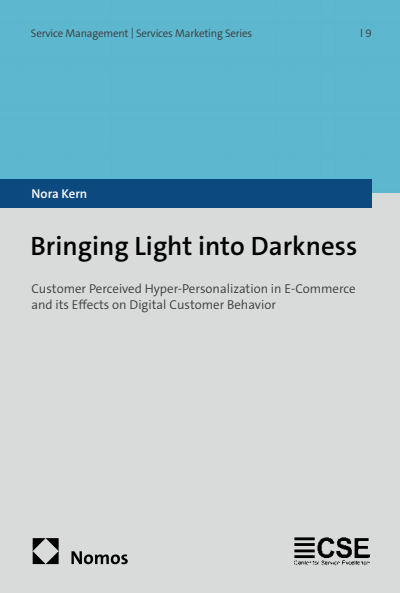
Bringing Light into Darkness
Customer Perceived Hyper-Personalization in E-Commerce and Its Effects on Digital Customer Behavior- Authors:
- Series:
- Reihe Dienstleistungsmanagement | Dienstleistungsmarketing, Volume 9
- Publisher:
- 2025
Summary
Hyper-personalisation is currently considered THE leading buzzword in digital marketing. But how does this form of communication affect digital customer behaviour? This book provides evidence-based answers to that question and introduces a validated measurement model for hyper-personalisation in e-commerce. Drawing on literature analysis, qualitative interviews and quantitative studies, the author is the first to systematically conceptualise and empirically test hyper-personalisation. The results show that it increases perceived usefulness, persuasion and emotional attachment—without triggering reactance. Based on these findings, the book addresses both researchers and practitioners in digital marketing.
Search publication
Bibliographic data
- Edition
- 1/2025
- Copyright Year
- 2025
- ISBN-Print
- 978-3-7560-3422-2
- ISBN-Online
- 978-3-7489-6301-1
- Publisher
- Nomos, Baden-Baden
- Series
- Reihe Dienstleistungsmanagement | Dienstleistungsmarketing
- Volume
- 9
- Language
- English
- Pages
- 520
- Product Type
- Monograph
Table of contents
ChapterPages
- Preface No access
- List of Abbreviations No access
- Abstract No access
- Zusammenfassung No access
- 1.1 Relevance of the Topic and Problem Definition No access
- 1.2 Research Gaps No access
- 1.3 Research Objectives and Research Questions No access
- 1.4 Methodological Approach No access
- 1.5 Course of the Investigation No access
- 2.1.1 Definition of Customer Communication No access
- 2.1.2 Digital vs. Non-Digital Customer Communication No access
- 2.1.3 Customer Communication and its Relation to (Digital) Marketing No access
- 2.1.4 Definition of E-Commerce No access
- 2.1.5 Status Quo of the E-Commerce Sector No access
- 2.1.6 Relevance of Customer Communication for E-Commerce No access
- 2.2.1 Big Data Analytics No access
- 2.2.2 Artificial Intelligence No access
- 2.2.3 Marketing Automation No access
- 2.3.1 Definition of the Digital Customer and Related Expectations No access
- 2.3.2.1 Customer Centricity and Technological Developments as Central Enablers of Digital Marketing Activities No access
- 2.3.2.2 The Role of Customer Value in Digital Customer Behavior No access
- 2.3.2.3 Digital Customer Experience and its Relation to Hyper-Personalized Customer Communication No access
- 2.3.2.4 Identification of Moments of Truth and its Relevance for Hyper-Personalized Customer Communication No access
- 2.3.2.5 The Meaning of Attention, Cognitive Processes and Emotions No access
- 2.3.2.6 Companies’ Objectives of Customer Satisfaction, Customer Delight and Customer Loyalty No access
- 2.4.1 Evolution from Mass Marketing to Hyper-Personalization No access
- 2.4.2.1.1 Online Behavioral Advertising (OBA) and its Relationship to Hyper-Personalization No access
- 2.4.2.1.2 Definition of Hyper-Personalization No access
- 2.4.2.1.3 Application Fields of Hyper-Personalization in the Context of the Marketing Mix No access
- 2.4.2.1.4 Overview of Prior Research Approaches in the Context of Hyper-Personalization No access
- 2.4.2.2.1 Implementation of Hyper-Personalization in Practice No access
- 2.4.2.2.2 Current Best-Practice Examples of Hyper-Personalized Customer Communication No access
- 2.5.1 Significance of Customer Decision-Making and Information Processing No access
- 2.5.2 Models of Customer Decision-Making No access
- 2.5.3 The Role of Hyper-Personalization to Support Specific Phases of Customer Decision-Making No access
- 2.6.1.1 Definition of Privacy No access
- 2.6.1.2 Customer Privacy Concerns No access
- 2.6.2 Filter Bubbles and the Fear of Missing Out No access
- 2.6.3 Psychological Reactance Theory No access
- 3.1.1 Conceptual Foundations of the Constructs in the Context of Potential Positive Effects No access
- 3.1.2 Hypothesis Development in the Context of Potential Positive Effects No access
- 3.2.1 Conceptual Foundations of the Constructs to Be Considered No access
- 3.2.2 Hypothesis Development in the Context of Intrusiveness and Potential Reducing Factors No access
- 3.3 Final Research Model No access
- 4.1 Relevance and Objectives of Scale Development No access
- 4.2 Overview of the Scale Development Process No access
- 4.3.1 Construct Definition of “Perceived Hyper-Personalization” No access
- 4.3.2.1 Construct Dimensionality and Measurement Model No access
- 4.3.2.2 Conceptual Dimensions of “Perceived Hyper-Personalization” No access
- 4.3.3 Perceived Hyper-Personalization and the Relation to Other Constructs No access
- 4.4.1 Literature Research for Initial Item Generation No access
- 4.4.2.1 Objective and Study Design No access
- 4.4.2.2 Interview Guideline No access
- 4.4.2.3 Conduction of Interviews No access
- 4.4.2.4 Qualitative Content Analysis No access
- 4.4.2.5 Key Results of the Expert Interviews No access
- 4.4.3.1 Objective and Study Design No access
- 4.4.3.2 Description of the Questionnaire of the Customer Study No access
- 4.4.3.3 Conduction and Sample No access
- 4.4.3.4 Analysis and Results of the Quantitative Study No access
- 4.4.4 Overview of the Results of the Qualitative and Quantitative Studies No access
- 4.5.1 First Validation Phase – Exploratory Factor Analysis (EFA) No access
- 4.5.2 Second Validation Phase – Confirmatory Model Testing and Analysis (CFA) No access
- 4.6 Discussion of Results No access
- 5.1 Objective and Study Design No access
- 5.2 Measurements No access
- 5.3 Manipulation Check No access
- 5.4 Data Collection and Sample No access
- 5.5 Data Analysis No access
- 5.6 Discussion of Results No access
- 6.1 Objective of the Study No access
- 6.2 Study Design No access
- 6.3 Measurements No access
- 6.4 Data Collection and Sample No access
- 6.5 Data Analysis No access
- 6.6 Discussion of Results No access
- 7.1 Theoretical Implications No access
- 7.2 Practical Implications No access
- 7.3 Limitations and Directions for Future Research No access
- 8. Conclusion and Outlook No access Pages 399 - 404
- Appendix 1: Systematic Literature Review in the Context of “Hyper-Personalization” No access
- Appendix 2: Interview Guideline for Expert Interviews in the Context of the Scale Development Process (Item Generation and Checking) No access
- Appendix 3: Classification of Interview Partners/Experts No access
- Appendix 4: Overview of Category Formation with the Help of Anchor Examples for Content Analysis of the Expert Interviews No access
- Appendix 5: Questionnaire for the Quantitative Customer Study in the Context of the Scale Development Process – Item Generation and Checking No access
- Appendix 6.1: Definition of Hyper-Personalization – Results from the Customer Study No access
- Appendix 6.2: Advantages and Disadvantages of Hyper-Personalization No access
- Appendix 7: Quantitative Customer Study for First Validation of Items (EFA) – Scenario Description No access
- Appendix 8.1: Final Correlation Matrix for EFA No access
- Appendix 8.2: KMO and Bartlett Test for Final EFA No access
- Appendix 8.3: Final Anti-Image Correlations for EFA No access
- Appendix 8.4: Communalities of EFA No access
- Appendix 8.5: Factor Matrix of EFA No access
- Appendix 8.6: Structure Matrix of EFA No access
- Appendix 8.7: Correlation Matrix for Factors (EFA) No access
- Appendix 8.8: Reliability Statistics (EFA) No access
- Appendix 8.9: Inter-Item Correlation Matrix (EFA) No access
- Appendix 9: Quantitative Customer Study for Confirmatory Factor Analysis (CFA) – Scenario Description No access
- Appendix 10: Measurements in the Context of Nomological Validity (CFA) No access
- Appendix 11: Stimuli for Quantitative Customer Study to Analyze Positive Effects of Hyper-Personalization No access
- Appendix 12: Measurements: Study of Positive Effects of Hyper-Personalization No access
- Appendix 13: SEM Including Marker Variable to Test Common Method Bias No access
- Appendix 14: SEM Analysis of Positive Effect Including “Gender” as Control Variable No access
- Appendix 15: Scenario Description to Analyze Hyper-Personalization in the Context of Intrusiveness No access
- Appendix 16: Measurements to Analyze Hyper-Personalization in the Context of Intrusiveness No access
- Appendix 17: SEM Analysis to Analyze Hyper-Personalization in the Context of Intrusiveness Including “Gender” as Control Variable No access
- List of References No access Pages 453 - 520