, to see if you have full access to this publication.
Edited Book No access
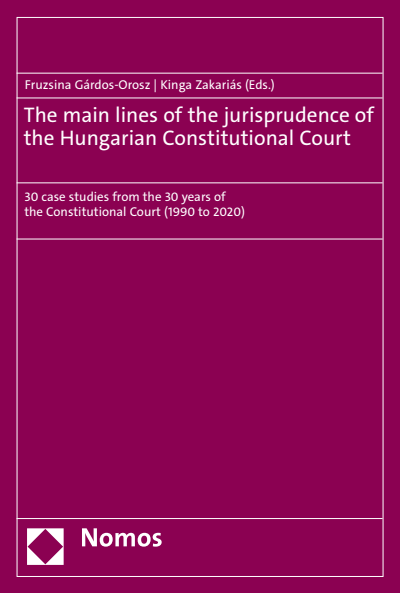
The main lines of the jurisprudence of the Hungarian Constitutional Court
30 case studies from the 30 years of the Constitutional Court (1990 to 2020)- Editors:
- |
- Publisher:
- 2022
Summary
Die verfassungsrechtlichen Umbrüche Ungarns waren in den letzten Jahrzehnten enorm. Der Band untersucht die Rechtsprechung des ungarischen Verfassungsgerichtshofs und bietet damit die Möglichkeit eines tiefen Verständnisses des demokratischen Systems.
Keywords
Search publication
Bibliographic data
- Copyright Year
- 2022
- ISBN-Print
- 978-3-8487-8561-2
- ISBN-Online
- 978-3-7489-2982-6
- Publisher
- Nomos, Baden-Baden
- Language
- English
- Pages
- 548
- Product Type
- Edited Book
Table of contents
ChapterPages
- Titelei/Inhaltsverzeichnis No access Pages 1 - 16
- Authors: |
- 1. Introduction No accessAuthors: |
- 2. The constitutional regulation of the HCC in the Constitution and the Fundamental Law No accessAuthors: |
- 3. Organisation of the HCC No accessAuthors: |
- Authors: |
- Authors: |
- 4.1.1. Preliminary and posterior norm control No accessAuthors: |
- 4.1.2. The judicial initiative and the constitutional complaint No accessAuthors: |
- 4.1.3. Interpretation of the FL and other competences No accessAuthors: |
- 4.2. Legal consequences No accessAuthors: |
- 5. Epilogue No accessAuthors: |
- Bibliography No accessAuthors: |
- Authors:
- 1. Background No accessAuthors:
- 2. Petition No accessAuthors:
- Authors:
- 3.1. In Hungary, every human being, regardless of their citizenship, has the inherent, inviolable and inalienable fundamental right to life and human dignity. Since the essential content of fundamenta... No accessAuthors:
- 3.2. Human life and human dignity are values preceding the law that can only be construed in unity: one is a condition for the other. The protection of these values, which are untouchable for the law,... No accessAuthors:
- Authors:
- 4.1. Clash of the deontologist and utilitarian concepts of the unconstitutionality of the death penalty in the concurring opinions No accessAuthors:
- 4.2. The role of the right to dignity—the joint conception of the life and dignity No accessAuthors:
- 5. Aftermath of the Decision No accessAuthors:
- Bibliography No accessAuthors:
- Authors:
- 1. Background No accessAuthors:
- 2. Petition No accessAuthors:
- Authors:
- 3.1. The interrelation of the right to life and the right to dignity (self-determination) with abortion requires that abortion be provided for by law. On the one hand, the exclusion of abortion direct... No accessAuthors:
- 3.2. The legal status of the human being includes two fundamental rights of substance which fill the formal category of legal capacity and express the human quality of the person: the right to life an... No accessAuthors:
- 3.3. The protection of the life of the foetus is the state’s duty from the moment of conception. It follows from the state’s objective, institutional duty to protect life that the State cannot constit... No accessAuthors:
- 3.4. The right of freedom of conscience in the context of abortion means that the State may not force anyone into a situation which is incompatible with an essential conviction which defines his or he... No accessAuthors:
- Authors:
- 4.1. Formal unconstitutionality with substantive findings: right of self-determination versus the objective, institutional duty of the state to protect No accessAuthors:
- 4.2. The preliminary question of the legal status of the foetus No accessAuthors:
- 4.3. Additional substantive findings No accessAuthors:
- 4.4. The relationship between freedom of conscience and abortion No accessAuthors:
- Authors:
- 5.1. Decision 48/1998. (XI. 23.) AB – Abortion II. No accessAuthors:
- 5.2. Protection of the foetus in the FL No accessAuthors:
- Bibliography No accessAuthors:
- Authors:
- 1. Background No accessAuthors:
- 2. Petition No accessAuthors:
- Authors:
- 3.1. The rule of law cannot be established against the rule of law (and in particular against legal certainty). It is also part of the constitutional principle of the rule of law that the limits and c... No accessAuthors:
- 3.2. The re-criminalisation of offences for which the statute of limitations has already expired, the extension of the statutory limitation period for offences not yet statute-barred, the interruption... No accessAuthors:
- 3.3. From the point of view of the limitation period, no constitutional distinction can be drawn between political and other reasons why the State has not asserted its criminal claim. Because of its i... No accessAuthors:
- 3.4. Excluding the possibility of a full pardon (and limiting it to mitigation of the punishment) is unconstitutional [Article 30/A (1) (k) of the Constitution]. No accessAuthors:
- Authors:
- 4.1. Objective-teleological reasoning vs. natural law No accessAuthors:
- 4.2. The self-regulatory nature of the legal system No accessAuthors:
- 4.3. Conflict between legal certainty and justice in the specific historical context of the transition to the rule of law No accessAuthors:
- 4.4. Doctrinal maximalism No accessAuthors:
- 5. Aftermath of the Decision No accessAuthors:
- Bibliography No accessAuthors:
- Authors: |
- Authors: |
- 1.1. Domestic legal background No accessAuthors: |
- 1.2. International legal background No accessAuthors: |
- 3. Petition No accessAuthors: |
- Authors: |
- 4.1. Generally recognised norms of international law become parts of Hungarian law by means of general transformation, international treaties do so by means of a specific transformation, through promu... No accessAuthors: |
- 4.2. The constitutionality of a rule connected to international law must be scrutinized from additional perspectives compared to a rule related exclusively to Hungarian law [Article 7 (1) of the Const... No accessAuthors: |
- 4.3. Exclusion of statutory limitations may happen either according to Hungarian law, or by international law if there is an international legal obligation binding for Hungary [Article 7 (1) of the Co... No accessAuthors: |
- 4.4. The rules on the punishment of war crimes and crimes against humanity, as they fundamentally endanger humanity and international coexistence, are peremptory rules of international law [Article 7 ... No accessAuthors: |
- Authors: |
- 5.1. The relation between international law and domestic law No accessAuthors: |
- 5.2. Constitutional review of norms deriving from international law No accessAuthors: |
- 5.3. The assessment of the findings on statute of limitations No accessAuthors: |
- 5.4. Classification of international crimes No accessAuthors: |
- 6. Aftermaths of the Decision No accessAuthors: |
- Bibliography No accessAuthors: |
- Authors:
- 1. Background No accessAuthors:
- 2. Petition No accessAuthors:
- Authors:
- 3.1. Information on persons exercising public authority or participating in political life, related to the fact that they were previously engaged in activities, or were members of an organization enga... No accessAuthors:
- 3.2. Maintaining the confidentiality of political police records generated under a non-rule-of-law regime shall not restrict the right to informational self-determination of data subjects and other ri... No accessAuthors:
- Authors:
- 4.1. Data protection and data of public interest No accessAuthors:
- 4.2. Informational self-determination: rights of persons under surveillance No accessAuthors:
- 5. Aftermath of the Decision No accessAuthors:
- Bibliography No accessAuthors:
- Authors: |
- 1. Background No accessAuthors: |
- 2. Petition No accessAuthors: |
- Authors: |
- 3.1. The decision of a terminally ill patient not to live until the natural end of his/her life when it is filled with suffering is part of the patient’s right to self-determination. This right can be... No accessAuthors: |
- 3.2. The desire of a terminally ill patient to end their life with the active help of a physician cannot be regarded as such part of their right to self-determination that cannot be withdrawn, even in... No accessAuthors: |
- Authors: |
- 4.1. The doctrine of indivisibility and the doctrine of ‘living law’ No accessAuthors: |
- 4.2. Active euthanasia: an eternal dream? No accessAuthors: |
- 5. Aftermath of the Decision No accessAuthors: |
- Bibliography No accessAuthors: |
- Authors:
- Authors:
- 1.1. Registered Partnerships Act I No accessAuthors:
- 1.2. The notion of marriage in the Hungarian legal order and according to the interpretation of the HCC No accessAuthors:
- 2. Petition No accessAuthors:
- Authors:
- 3.1. Marriage is protected as an institution by the state and this protection is to be maintained in the future (Article 15 of Constitution). No accessAuthors:
- 3.2. The formation of a cohabitation is related to the right to self-autonomy [Article 54 (1) of the Constitution]. No accessAuthors:
- 3.3. As same-sex persons cannot marry, their registered partnership does not hurt and endanger the protected heterosexual marriage (Article 15 of the Constitution). No accessAuthors:
- 3.4. The registered partnership for heterosexual partners has factually the same legal consequences as marriage and this is contrary to Article 15 of the Constitution and it may empty the constitution... No accessAuthors:
- Authors:
- 4.1. The priority of the protection of marriage No accessAuthors:
- 4.2. The merging of the definition of cohabitation and registered partnership into each other and the protection of cohabitation No accessAuthors:
- 4.3. The registered partnership as an independent legal institution No accessAuthors:
- 4.4. The registered partnership for different-sex partners No accessAuthors:
- Authors:
- 5.1. Registered partnerships Act II No accessAuthors:
- 5.2. Decision 32/2010. (III. 25.) AB – Registered Partnership II. No accessAuthors:
- 5.3. The registered partnership and the Act on the protection of the family in the decisions of the HCC No accessAuthors:
- 5.4. Decision 3003/2021. (I. 14.) AB on the close relative status of registered partners No accessAuthors:
- Bibliography No accessAuthors:
- Authors:
- Authors:
- 1.1. Decision 184/2010. (X. 28.) AB – Special Tax I. No accessAuthors:
- 1.2. New constitutional framework and new special tax rules No accessAuthors:
- 2. Petition No accessAuthors:
- Authors:
- 3.1. According to the Constitutional Court’s established case law, the tax’s primary function is to make natural and legal persons contribute to public burdens. Secondarily, it is also the means of st... No accessAuthors:
- 3.2. The retroactive taxation that applies to incomes given by law and earned without abuse in a tax year closed by a tax return violates the right to human dignity [Articles 54 (1) and 70/I (2) of th... No accessAuthors:
- Authors:
- 4.1. Limits of tax as a regulatory instrument No accessAuthors:
- 4.2. Limits of retroactive taxation No accessAuthors:
- 5. Aftermath of the Decision No accessAuthors:
- Bibliography No accessAuthors:
- Authors:
- 1. Background No accessAuthors:
- 2. Petition No accessAuthors:
- 3. Decision and its reasoning No accessAuthors:
- 4. Doctrinal analysis No accessAuthors:
- 5. Aftermath of the Decision No accessAuthors:
- Bibliography No accessAuthors:
- Authors:
- 1. Background No accessAuthors:
- 2. Petition No accessAuthors:
- Authors:
- 3.1. If there is only a formal legal remedy against a provision of a statute, then this statute is a directly effective statute for the purposes of Article 26 (2) of the HCC Act, and there is a right ... No accessAuthors:
- 3.2. The reference to the historical constitution in Article R (3) of the FL means that the historical background of each institution must be taken into account in its interpretation. No accessAuthors:
- 3.3. Article R (3) of the FL also implies that when interpreting constitutional provisions, not only the individual provisions must be examined, but also their context, so that the FL remains a unifie... No accessAuthors:
- 3.4. The retirement age for judges cannot be deduced from Article 26 (1) of the FL (judicial independence and immovability). This is a matter for the legislature to decide, and there is no obstacle to... No accessAuthors:
- Authors:
- 4.1. The issues of admissibility No accessAuthors:
- 4.2. The achievements of the historical constitution as a mean of interpretation No accessAuthors:
- 4.3. The content and scope of the principle of judicial independence No accessAuthors:
- 4.4. The integrity of the FL—managing the tension between constitutional provisions No accessAuthors:
- Authors:
- 5.1. Influence on legislation No accessAuthors:
- 5.2. Influence on the judges effected No accessAuthors:
- 5.3. Influence on the jurisprudence of the HCC No accessAuthors:
- Bibliography No accessAuthors:
- Authors: |
- 1. Background No accessAuthors: |
- 2. Petition No accessAuthors: |
- Authors: |
- 3.1. The declaration of a regulatory offence must also comply with the requirements of the rule of law in connection with the declaration of a criminal offence, the criminal law intervention and the c... No accessAuthors: |
- 3.2. By declaring the use of public areas for permanent living to be a regulatory offence, without a legitimate aim, the legislator criminalized a forced life situation threatening a serious crisis, e... No accessAuthors: |
- 3.3. Regulatory Offences Act does not meet the requirement of the ‘clarity of norms’ as an increased requirement against the norms establishing the punishment, if the act creates, in essence, practica... No accessAuthors: |
- 3.4. The authorization given to the local authority to create sanctions (fines) meets the requirement of the rule of law only with the substantive legal guarantees and clear framework prescribed by la... No accessAuthors: |
- Authors: |
- 4.1. Rule of law requirements for constitutional law of regulatory offences No accessAuthors: |
- 4.2. Fundamental issues of sanctioning the use of public areas for long-term living No accessAuthors: |
- 4.3. The principle of the ‘clarity of norms’ and the question of strict liability No accessAuthors: |
- 4.4. The basic conditions of the rule of law in the creation of local authority sanctions No accessAuthors: |
- 5. Aftermath of the Decision No accessAuthors: |
- Bibliography No accessAuthors: |
- Authors:
- Authors:
- 1.1. The previous practice of the HCC No accessAuthors:
- 1.2. Legal background No accessAuthors:
- 2. Petition No accessAuthors:
- Authors:
- 3.1. The TP cannot be classified as any source of law in the Hungarian legal system. The TP act as a ‘slide’ capable of continuously depriving the HCC of its review powers [Articles R (1) and T) of th... No accessAuthors:
- 3.2. Transitory provisions cannot be regarded as amendments to the FL [Articles B) (1) and S) of the FL]. No accessAuthors:
- 3.3. It is a requirement stemming from the rule of law that the scope and content of the FL in force can be clearly found at any time. The amendments must be incorporated into the constitutional text ... No accessAuthors:
- 3.4. The legislature included non-transitory rules in the Transitory Provisions, thus exceeding the scope of the authorization granted by the FL [Articles B (1) and S) of the FL]. No accessAuthors:
- Authors:
- 4.1. The TP to the FL cannot be regarded as part of the FL No accessAuthors:
- 4.2. Transitional Provisions cannot be considered as amendments to the FL No accessAuthors:
- 4.3. The ‘coherency of substance and structure’ of the FL is a requirement of the rule of law No accessAuthors:
- 4.4. The rules of the TP exceeding the authorization are invalid under public law No accessAuthors:
- 5. Aftermath of the Decision No accessAuthors:
- Bibliography No accessAuthors:
- Authors: |
- 1. Background No accessAuthors: |
- 2. Petition No accessAuthors: |
- Authors: |
- 3.1. Registration as a general mandatory requirement of the exercise of the right to vote is an unnecessary and disproportionate restriction on the right to vote; however, such a measure may be consti... No accessAuthors: |
- 3.2. The ban on publishing political advertisements during electoral campaign periods in certain branches of the media as well as the ban on publishing the results of political surveys during the last... No accessAuthors: |
- Authors: |
- 4.1. Whether the justification of registration is convincing and whether the new constitutional context of fundamental rights is taken into account No accessAuthors: |
- 4.2. Whether advance electoral registration and the campaign-related restrictions amount to a limitation on exercising certain fundamental rights No accessAuthors: |
- 5. Aftermath of the Decision No accessAuthors: |
- Bibliography No accessAuthors: |
- Authors:
- Authors:
- 1.1. Legal background and the former praxis of the HCC No accessAuthors:
- 1.2. International outlook No accessAuthors:
- 2. Petition No accessAuthors:
- Authors:
- 3.1. The decision of ECtHR containing statements regarding the legal provisions examined by the HCC was a substantial circumstance from a legal perspective that necessitated a second revision process ... No accessAuthors:
- 3.2. The criminalization of the use of totalitarian symbols may be justified, because behaviours related to the symbols of 20th century extremist political dictatorships may violate human dignity and ... No accessAuthors:
- 3.3. A requirement resulting from the provisions of the FL is a clear expression of what the legislative authority considers to be the protected legal interest and punishable conduct. The phrasing mus... No accessAuthors:
- 3.4. The HCC attaches great importance to whether the issue under consideration is subject to an already established judicial practice (case law) which is absolutely necessary to aid the enforcement a... No accessAuthors:
- Authors:
- 4.1. On the necessity of repeated posterior norm control No accessAuthors:
- 4.2. On the criminalization of the use of totalitarian symbols and the protection of human dignity No accessAuthors:
- 4.3. On the clear articulation of the legislative intention No accessAuthors:
- 4.4. On judicial practice (case law) No accessAuthors:
- 5. Aftermath of the Decision No accessAuthors:
- Bibliography No accessAuthors:
- Authors:
- 1. Background No accessAuthors:
- 2. Petition No accessAuthors:
- Authors:
- 3.1. It is a constitutional requirement that the legislative procedure takes place in accordance with the provisions of the Rules of the House [Articles B, 4 (1) and 5 (7) of the FL]. However, grantin... No accessAuthors:
- 3.2. It is a constitutional requirement for the state to ensure the acquisition of church status, enabling religious communities to function independently and to acquire entitlements available to chur... No accessAuthors:
- 3.3. The Parliament may establish specific rules for the operation of religious communities that allow greater freedom of internal organisation and regulation than associations. However, it is not a c... No accessAuthors:
- Authors:
- 4.1. Constitutional justification for terminating church legal status No accessAuthors:
- 4.2. Dilemmas in the religious activity and public law definition of churches No accessAuthors:
- 4.3. Two-level regulation instead of one-level regulation No accessAuthors:
- 5. Aftermath of the Decision No accessAuthors:
- Bibliography No accessAuthors:
- Authors:
- Authors:
- 1.1. The regulation in Hungary No accessAuthors:
- 1.2. Practice of the HCC No accessAuthors:
- 1.3. International outlook No accessAuthors:
- 2. Petition No accessAuthors:
- Authors:
- 3.1. In cases of exceptional constitutional complaint, which is directed at a norm, the examination of personal involvement is exceptionally important, since it is the personal, direct, and present ha... No accessAuthors:
- 3.2. The right to private life and the right to human dignity are tied to each other exceptionally closely. The right to human dignity forms the foundation of the protection of the inviolable sphere o... No accessAuthors:
- 3.3. Secret intelligence gathering enables a forcible intrusion into all segments of private life (including the intimate ones) and might affect people other than the target of the observation; theref... No accessAuthors:
- Authors:
- 4.1. Differentiating between Exceptional Constitutional Complaint and Actio Popularis No accessAuthors:
- 4.2. The Foundations of the Right to Private Life No accessAuthors:
- 4.3. The Conflict between the Right to Private Life and National Security No accessAuthors:
- 5. Aftermath of the Decision No accessAuthors:
- Bibliography No accessAuthors:
- Authors:
- Authors:
- 1.1. Evolution of the Hungarian legislation No accessAuthors:
- 1.2. International outlook No accessAuthors:
- 2. Petition No accessAuthors:
- Authors:
- 3.1. The designation of the acting court by a discretionary decision of the President of the NOJ violates the requirement of a fair process [Article XXVIII (1) of the FL]. No accessAuthors:
- 3.2. The power of the President of the NOJ to transfer court cases does not comply with the right to a lawful judge either [Article 6 (1) of the ECHR]. No accessAuthors:
- 3.3. The definitive nature of the decision of the President of the NOJ violates the right to remedy [Article XXVIII (7) of the FL, Article 13 of the ECHR]. No accessAuthors:
- 3.4. The decision of the President of the NOJ to transfer a court case does not qualify as an on‑the‑merits decision (Article 27 of the HCC Act). No accessAuthors:
- Authors:
- 4.1. The so‑called objective test of the impartial administration of justice as one of the assessment criteria of the right to a fair trial No accessAuthors:
- 4.2. The right to a lawful judge No accessAuthors:
- 4.3. The qualification of the decision of the President of the NOJ and the right to remedy No accessAuthors:
- 5. Aftermath of the Decision No accessAuthors:
- Bibliography No accessAuthors:
- Authors:
- 1. Background No accessAuthors:
- 2. Petition No accessAuthors:
- Authors:
- 3.1. The carrying out of the commercial sale of tobacco products—in itself—does not entail that the said economic activity would constitute an acquired possession or a constitutionally protected propr... No accessAuthors:
- 3.2. The commercial retail of tobacco products carried out for a longer period is protected by the freedom of enterprise. The monopolisation of that activity by the state on general interest grounds d... No accessAuthors:
- Authors:
- 4.1. The constitutional protection of private property No accessAuthors:
- 4.2. The constitutional protection of the freedom of enterprise No accessAuthors:
- 5. Aftermath of the Decision No accessAuthors:
- Bibliography No accessAuthors:
- Authors:
- Authors:
- 1.1. The regulation of concurrent three strikes No accessAuthors:
- 1.2. International outlook No accessAuthors:
- 2. Petition No accessAuthors:
- Authors:
- 3.1. It is contrary to the requirement of legal certainty if it is unpredictable in which cases the stricter concurrent sentences—constituting even mandatory life imprisonment—may be imposed [Article ... No accessAuthors:
- 3.2. The threat of similar punishment for criminal offences of different material gravity undermines legal certainty by breaching the principle of proportionality, besides, narrowing judicial discreti... No accessAuthors:
- Authors:
- 4.1. Concurrent three strikes and the requirement of predictability arising from the requirement of legal certainty No accessAuthors:
- 4.2. Concurrent three strikes and the constitutional criteria with respect to the penalty system governed by the rule of law No accessAuthors:
- 5. Aftermath of the Decision No accessAuthors:
- Bibliography No accessAuthors:
- Authors: |
- 1. Background No accessAuthors: |
- 2. Petition No accessAuthors: |
- Authors: |
- 3.1. It is the task of the HCC to examine whether the protection of human dignity justifies the restriction of the freedom of the press in the case at hand, i.e. whether the judgment complained of cre... No accessAuthors: |
- 3.2. Any reports of an assembly shall constitute a direct manifestation of the freedom of the press, the unencumbered provision of information, and of the role the press has in creating ‘a democratic ... No accessAuthors: |
- 3.3. Image rights protect the external manifestation of the human personality and—broadcasting essential traits of personality—are indirectly used to identify it. Consequently, image rights are to be ... No accessAuthors: |
- 3.4. As long as certain ways of providing information do not abuse the freedom of the press, references to image rights might rarely serve as grounds to limit the exercise of the freedom of the press.... No accessAuthors: |
- Authors: |
- 4.1. The extent of constitutional review of judicial decisions in civil law cases No accessAuthors: |
- 4.2. The scope of the freedom of the press No accessAuthors: |
- 4.3. The scope of the right to one’s image No accessAuthors: |
- 4.4. Limiting the scope of the freedom of the press in order to protect the right to human dignity No accessAuthors: |
- 5. Aftermath of the Decision No accessAuthors: |
- Bibliography No accessAuthors: |
- Authors:
- Authors:
- 1.1. Introductory remarks No accessAuthors:
- 1.2. International outlook No accessAuthors:
- 2. Petition No accessAuthors:
- Authors:
- 3.1. According to the consistent practice of the HCC, if the petitioner claims that the content of a new provision is unconstitutional, the HCC does not examine the unconstitutionality of the law enac... No accessAuthors:
- 3.2. The absolute prohibition of inhuman or degrading treatment laid down in the ECHR and the FL requires that the space for life and movement provided for prisoners in multiple-person cells must in a... No accessAuthors:
- Authors:
- 4.1. Examination of the legislation incorporating the new provision No accessAuthors:
- 4.2. Determination of the minimum amount of space to be provided for detainees No accessAuthors:
- 5. Aftermath of the Decision No accessAuthors:
- Bibliography No accessAuthors:
- Authors: |
- 1. Background No accessAuthors: |
- 2. Petition No accessAuthors: |
- Authors: |
- 3.1. In the event of a serious crisis affecting the fundamental rights of the masses of the weaker parties, the protection of consumers’ rights and the duty to help the victims are the primary duty of... No accessAuthors: |
- 3.2. When assessing whether the rule of law infringes legal certainty, the calculation of the sufficient period of preparation and the assessment of retroactivity may also take into account whether it... No accessAuthors: |
- 3.3. The time limit for bringing an action and the length of the procedure are related to the fundamental right of access to a court, but do not violate the right to a fair trial [Articles XXVIII and ... No accessAuthors: |
- 3.4. Although the set of special procedural rules creates a special procedural order which, due to the accumulation of legal restrictions, raises constitutional doubts as to the fairness of the proced... No accessAuthors: |
- 3.5. EU law is not international law, so the HCC has no jurisdiction to examine whether a law is in breach of EU law, or whether it has been adopted in conformity with EU law in form or substance [Art... No accessAuthors: |
- Authors: |
- 4.1. Consumer protection in a financial crisis No accessAuthors: |
- 4.2. Criteria for legal certainty No accessAuthors: |
- 4.3. The content of the right to a fair trial No accessAuthors: |
- 4.4. Procedural obstacles—significant impediment to the exercise of fundamental rights No accessAuthors: |
- 4.5. Relationship between EU law and domestic law No accessAuthors: |
- 5. Aftermath of the Decision No accessAuthors: |
- Bibliography No accessAuthors: |
- Authors:
- 1. Background No accessAuthors:
- 2. Petition No accessAuthors:
- Authors:
- 3.1. The Internet is not an area exempt from the law; the communication taking place there may be subject to legal regulation, and the enforcement of the rights and obligations enshrined in the FL is ... No accessAuthors:
- 3.2. The ‘web 2.0’ sites are outside the scope of the services examined in the case, as in the specific case typical private expressions were published, addressing communication to a specific stakehol... No accessAuthors:
- 3.3. It constitutes a restriction of the freedom of the press if the operator of a website may be held liable for any post published without moderation that is otherwise infringing (Article IX of the ... No accessAuthors:
- 3.4. The assessment of proportionality depends on the amount of damages awarded for the infringement (Article IX of the FL). No accessAuthors:
- 3.5. The liability of the website operator is based solely on the fact of the infringement and the moderation of comments or its absence is not a decisive factor; after the occurrence of the infringem... No accessAuthors:
- Authors:
- 4.1. Regulation of Internet communication No accessAuthors:
- 4.2. The need for differentiation between online content services No accessAuthors:
- 4.3. Liability for the content of the comment No accessAuthors:
- 4.4. The question of proportionality No accessAuthors:
- 4.5. The importance of the infringing nature of the comment No accessAuthors:
- 5. Aftermath of the Decision No accessAuthors:
- Bibliography No accessAuthors:
- Authors:
- 1. Background No accessAuthors:
- 2. Petition No accessAuthors:
- 3. Decision and its reasoning No accessAuthors:
- 4. Doctrinal analysis No accessAuthors:
- 5. Aftermath of the decision No accessAuthors:
- Bibliography No accessAuthors:
- Authors: | |
- 1. Background No accessAuthors: | |
- 2. Petition No accessAuthors: | |
- Authors: | |
- 3.1. In exercising its powers, the HCC may examine whether the joint exercise of certain powers by the EU violates human dignity, other fundamental rights, Hungary’s sovereignty or self-identity based... No accessAuthors: | |
- 3.2. The HCC attributes great importance to the constitutional dialogue within the EU [Article E) (2) of the FL]. No accessAuthors: | |
- Authors: | |
- 4.1. The new competence and the three tests No accessAuthors: | |
- 4.2. The weaknesses of comparative analyses: constitutional dialogue in action No accessAuthors: | |
- 5. Aftermath of the Decision No accessAuthors: | |
- Bibliography No accessAuthors: | |
- Authors:
- 1. Background No accessAuthors:
- 2. Petition No accessAuthors:
- Authors:
- 3.1. The duty to preserve biodiversity has become a constitutional value, which should be taken into consideration when defining regulations within sectoral policies. No accessAuthors:
- 3.2. When interpreting Article P) (1) of the FL, one should not forget the natural law foundations of biodiversity protection and the international commitments of Hungary. No accessAuthors:
- 3.3. In connection with the state of natural assets, an absolute contextual canon results from Article P) of FL (rights of future generations and the subsequent obligations, the importance of long-ter... No accessAuthors:
- 3.4. The alienation of the state-owned nature conservation areas is possible, but along the lines of strict legal guarantees, which are capable for the qualitative and quantitative protection of the v... No accessAuthors:
- Authors:
- 4.1. Rights of future generations and the associated obligations No accessAuthors:
- 4.2. Precautions and long-term thinking No accessAuthors:
- 4.3. Protecting biodiversity No accessAuthors:
- 5. Aftermath of the Decision No accessAuthors:
- Bibliography No accessAuthors:
- Authors:
- 1. Background No accessAuthors:
- 2. Petition No accessAuthors:
- Authors:
- 3.1. The scope of freedom of speech covers communicative acts which are part of the public social dialogue [Article IX (1) of the FL]. No accessAuthors:
- 3.2. Freedom of speech may cover non-verbal expressions. A necessary but not sufficient condition to this is that the perpetrator acts with the aim of expressing his or her opinion. In addition, the a... No accessAuthors:
- 3.3. A specific act of disfigurement of public works of art and monuments may be considered political speech, falling within the scope of freedom of expression, but in other cases it may qualify as ba... No accessAuthors:
- Authors:
- 4.1. Scope of freedom of speech No accessAuthors:
- 4.2. Non-verbal expression of opinion, symbolic speech No accessAuthors:
- 4.3. Pouring paint over a monument and freedom of speech No accessAuthors:
- 5. Aftermath of the Decision No accessAuthors:
- Bibliography No accessAuthors:
- Authors:
- 1. Background No accessAuthors:
- 2. Petition No accessAuthors:
- Authors:
- 3.1. The facts of each offence must be determined by law. There is insufficient basis for inference with regard to the new facts of this Article of the Criminal Code to conclude that certain decisions... No accessAuthors:
- 3.2. The criminal facts of supporting illegal immigration should not include altruistic conduct which fulfils the obligation to help the vulnerable and the poor and which is not related to a prohibite... No accessAuthors:
- Authors:
- 4.1. Nullum crimen sine legerule No accessAuthors:
- 4.2. The constitutional requirement No accessAuthors:
- 5. Aftermath of the Decision No accessAuthors:
- Bibliography No accessAuthors:
- Authors:
- 1. Background No accessAuthors:
- 2. Petition No accessAuthors:
- Authors:
- 3.1. Only the HCC can find that national law violates the ECHR [Article 24 (2) f) of the FL]. No accessAuthors:
- 3.2. The Constitutional Court may directly apply findings of the ECtHR’s judgment, in case those were made in respect of the petitioner’s case (Article Q of the FL). No accessAuthors:
- 3.3. Benefits are insurance-type benefits which fall under the scope of the 1st Additional Protocol. No accessAuthors:
- 3.4. Signatory states have a wide margin of appreciation in setting the conditions for paying the benefit. No accessAuthors:
- 3.5. Even if the law appied in the concrete case does not violate the international agreement, its application may exceptionally result in a situation that is contrary to the ECHR as an international ... No accessAuthors:
- 3.6. The period of the payment of the benefit must be taken into consideration when calculating the insurance period for eligibility [Article Q (2) of the FL]. No accessAuthors:
- Authors:
- 4.1. Leeway of the HCC to resolve the situation in contravention with the judgment of the ECtHR No accessAuthors:
- 4.2. Adoption of a constitutional requirement instead of annulment of the contested provision No accessAuthors:
- 4.3. Casuistic nature of the constitutional requirement adopted by the HCC No accessAuthors:
- 4.4. Violations through continuous infringements following the decision of an international judicial forum No accessAuthors:
- 4.5. An alternative to the HCC’s ‘bell rope’ practice? No accessAuthors:
- 4.6. Factual and temporal intricacies of the case No accessAuthors:
- 5. Aftermath of the Decision No accessAuthors:
- Bibliography No accessAuthors:
- Authors: |
- 1. Background No accessAuthors: |
- 2. Petition No accessAuthors: |
- Authors: |
- 3.1. The cases of special legal order constitute a special constitutional situation where certain fundamental rights, such as the freedom of expression, may be restricted to a greater extent than is g... No accessAuthors: |
- 3.2. It is not a breach of the principle of nullum crimen sine lege if a new criminal offence does not contain elements that are inherently unintelligible and therefore inapplicable, so that the lawma... No accessAuthors: |
- Authors: |
- 4.1. Restrictions on expression during special legal regimes No accessAuthors: |
- 4.2. The new statutory definition of fear-mongering, the principle of nullum crimen sine lege and legal certainty No accessAuthors: |
- 5. The aftermath of the Decision No accessAuthors: |
- Bibliography No accessAuthors: |
- Statistical Account No access Pages 539 - 544
- List of Authors No access Pages 545 - 548