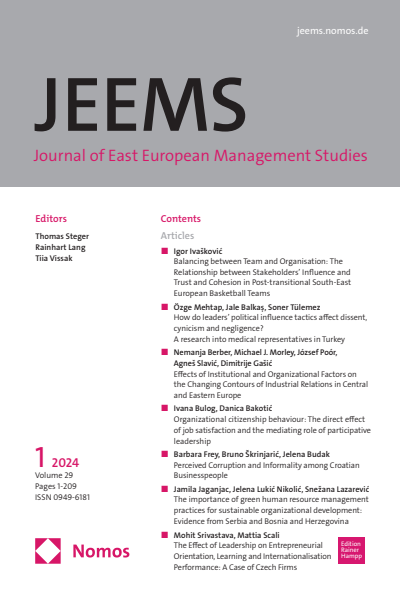
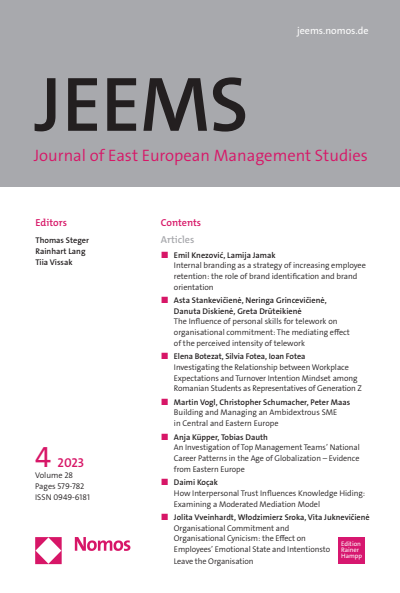
The Journal of East European Management Studies aims to promote dialogue and cooperation among scholars seeking to examine,explore and explain the behaviour and practices of management within the transforming societies of Central and Eastern Europe.The theoretical interests of the journal areorganisational and management change,Central and East European societies (including those on the fringes of Europe) undergoing processes of transition or transformation, andscientific issues of business, management and organisation that arise in such contexts.The JEEMS aims to attract social scientific contributions from scholars of any nation and region, but particularly wishes to encourageauthors from those countries directly experiencing transformational change. Its potential readership is international, comprising academicsand practitioners with an involvement or interest in the management of change in transforming societies in Central and Eastern Europe.
Creativity and innovation is generally considered to be one of the important factors in the competitiveness and success of organizations. The managers of an organization can positively affect individual creativity and firm innovativeness by...
In the process of organisational change, there are two broad categories of employees’ reactions: those who are open to change and those who have a difficult time accepting change in general, including organisational change. These differences can...
This study examines the moderating role of work centrality in the relationship between work alienation and organisational commitment on employees of Turkish SMEs. Past research has demonstrated an inverse association between alienation and...
The aim of this paper is to present and analyze the relevant factors affecting functional decision making, which are related to specific organizations in terms of undefined conditions, as well as manager’s characteristics in the given...