, to see if you have full access to this publication.
Monograph No access
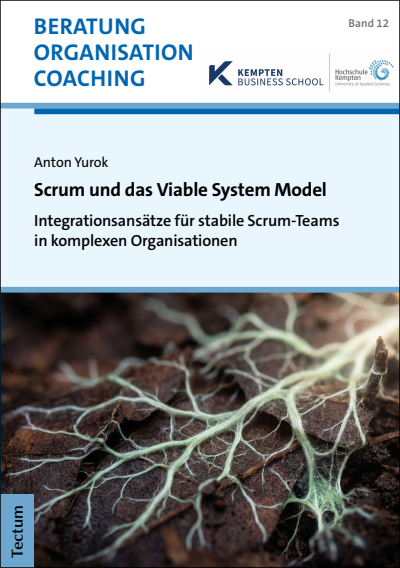
Scrum und das Viable System Model
Integrationsansätze für stabile Scrum-Teams in komplexen Organisationen- Authors:
- Series:
- Beratung, Organisation und Coaching, Volume 12
- Publisher:
- 2026
Summary
The author examines how the Viable System Model (VSM) can be used to analyse and further develop Scrum in complex organisations. It starts from the observation that Scrum implementations repeatedly face problems of stability and effectiveness that cannot be explained by poor application alone. For this purpose, Scrum is examined from a systems-theoretical perspective and compared with the requirements of organizational viability. The results show that Scrum in its basic form does not describe a fully viable system in the sense of the VSM but can be specifically analysed and complemented. Central problems often arise less within the team itself than in its organisational embedding.
Keywords
Search publication
Bibliographic data
- Edition
- 1/2026
- Copyright Year
- 2026
- ISBN-Print
- 978-3-68900-638-9
- ISBN-Online
- 978-3-68900-639-6
- Publisher
- Tectum, Baden-Baden
- Series
- Beratung, Organisation und Coaching
- Volume
- 12
- Language
- German
- Pages
- 173
- Product Type
- Monograph
Table of contents
ChapterPages
- Vorwort No access
- Abstract No access
- Abbildungsverzeichnis No access
- Tabellenverzeichnis No access
- 1.1 Motivation und Ausgangslage No access
- 1.2 Problembeschreibung No access
- 1.3 Zielsetzung No access
- 1.4 Hauptziel No access
- 1.5 Forschungsfragen No access
- 2.1.1 Historische Entwicklung und Motivation agiler Ansätze No access
- 2.1.2 Empirische Verbreitung und Praxiserfahrungen mit Agilität No access
- 2.2.1 Historische Entwicklung und Rahmenbedingungen von Scrum No access
- 2.2.2 Empirische Anwendung und Praxis von Scrum No access
- 2.3.1 Historie und wissenschaftlicher Kontext No access
- 2.3.2 Grundlagen und Funktionsweise in der Praxis No access
- 2.3.3 Anwendungsfelder und empirische Praxis No access
- 2.3.4 Forschungsstand und Integrationspotenzial zu agilen Methoden No access
- 3.1 Forschungsdesign No access
- 3.2 Forschungsfrage und Design Requirements (Relevance Cycle) No access
- 3.3 Grounding in the Knowledge Base (Rigor Cycle) No access
- 3.4 Artefakt und Validierung (Design Cycle) No access
- 3.5 Einsatz digitaler Werkzeuge und KI-gestützter Hilfsmittel No access
- 4.1.1 Definition von Agilität No access
- 4.1.2 Konzeptionelle Unterschiede zwischen klassischen und agilen Ansätzen No access
- 4.2.2 Strukturelle Elemente von Scrum No access
- 4.2.3 Rollen und Verantwortlichkeiten in Scrum No access
- 4.2.4 Die Werte von Scrum No access
- 4.2.5 Zusammenfassung No access
- 4.3.1 Grundprinzipien der Systemtheorie für Organisationen No access
- 4.3.2 Organisationsstruktur aus systemtheoretischer Sicht No access
- 4.3.3 Strukturelle Kopplung von Mensch und Organisation No access
- 4.3.4 Kopplungsmodalitäten in Organisationen No access
- 4.4.1 Kybernetik als theoretische Grundlage No access
- 4.4.2 Das Gesetz der erforderlichen Varietät (Law of Requisite Variety) No access
- 4.4.3 Homöostase, Feedback und Ultrastabilität No access
- 4.4.4 Bionik als Referenzrahmen No access
- 4.4.5 Autonomie und Rekursion No access
- 4.4.6 Das Viable System Model – Struktur und Systemfunktionen No access
- 4.4.7 Das Modell No access
- 4.5.1 Verbindung von Systemtheorie und VSM No access
- 4.5.2 Verbindung von VSM und Agilität No access
- 4.5.3 Agilität als Zugang zur individuellen Dimension No access
- 4.5.4 Einordnung von Scrum in den theoretischen Ordnungsrahmen No access
- 4.5.5 Zwischenfazit: Einordnung der vier theoretischen Stränge No access
- 5.1.1 Einordnung der Arbeit im aktuellen wissenschaftlichen Diskurs No access
- 5.1.2 Viabilitätsprobleme in organisationalen Strukturen No access
- 5.1.3 Autopoiesis auf unterschiedlichen Rekursionsebenen organisationaler Systeme No access
- 5.2.1 Integration von VSM und Scrum nach Wehinger und Herrmann (2012) No access
- 5.2.2 Integration von VSM und Scrum: Experiment von Lambertz (2016) No access
- 5.3.1 Zielsetzung und analytischer Rahmen der VSM-Analyse No access
- 5.3.2 Methodische Vorgehensweise der qualitativen Inhaltsanalyse No access
- 5.3.3 Produktbezogene Perspektive: Das Scrum-Team als wertschöpfendes System No access
- 5.3.4 Sozialsystemische Perspektive: Das Scrum-Team als soziales System No access
- 5.3.5 Synthese der Analyseperspektiven No access
- 5.4.1 Anforderungen an das V-Scrum No access
- 5.4.2 Strukturbaustein 1 (VS-1): Explizite Differenzierung von operativer Arbeit und Managementebenen No access
- 5.4.3 Strukturbaustein 2 (VS-2): Explizite Operationalisierung der sozialen Ebene No access
- 5.4.4 Strukturbaustein 3 (VS-3): Entlastung und funktionale Fokussierung der Rolle des Scrum Masters No access
- 5.4.5 Strukturbaustein 4 (VS-4): Verankerung disziplinarischer Führung beim Scrum Master No access
- 5.4.6 Strukturbaustein 5 (VS-5): Normative Verankerung der Produktvision No access
- 5.4.7 Strukturbaustein 6 (VS-6): Differenzierte Strukturierung des Product Backlogs No access
- 5.4.8 Strukturbaustein 7 (VS-7): Differenzierte Retrospektiven No access
- 5.4.9 Strukturbaustein 8 (VS-8): Algedonische Signale ermöglichen No access
- 6.1 Ziel und Abgrenzung der Demonstration No access
- 6.2.1 Leitplanken des Frameworks No access
- 6.2.2 Vergleich struktureller Elemente No access
- 6.2.3 Abgrenzung der Rollenlogik No access
- 6.2.4 Einschätzung des Integrationsmodells „V-Scrum“ No access
- 7.1 Design und Durchführung der Experteninterviews No access
- 7.2 Auswertung und Kategorisierung der Rückmeldungen No access
- 7.3.1 Beobachtungen zu den Spannungsfeldern L1–L5 No access
- 7.3.2 Beobachtungen zu den Strukturbausteinen von V-Scrum No access
- 7.33 Schlussfolgerungen für V-Scrum No access
- 8.1 Ausgangspunkt und Fokussierung (Relevance Cycle) No access
- 8.2 Wissenschaftliche Fundierung (Rigor Cycle) No access
- 8.3 Entwicklung, Darstellung und Validierung des Artefakts (Design Cycle) No access
- 9.1 Beantwortung der Forschungsfragen No access
- 9.2.1 Legitimation systemischer Instrumente für agile Transformationen No access
- 9.2.2 Viabilitätslücken als strukturelle Herausforderungdes Scrum-Frameworks No access
- 9.2.3 Implikationen für die Scrum-Praxis No access
- 9.3.1 Theoretische Begrenzungen No access
- 9.3.2 Methodische Limitationen No access
- 10.1 Weiterentwicklung des Artefakts No access
- 10.2 Anschlussfragen und neue Forschungsfelder No access
- Literaturverzeichnis No access Pages 147 - 154