, to see if you have full access to this publication.
Monograph No access
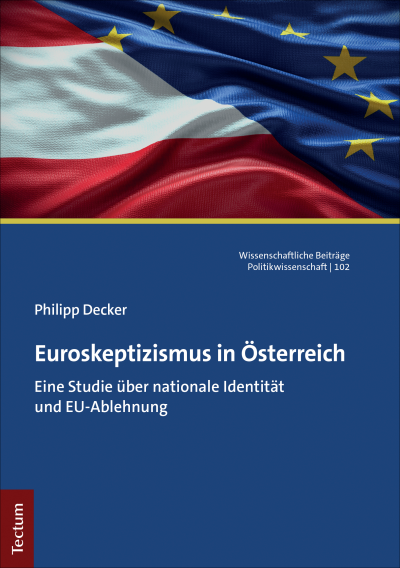
Euroskeptizismus in Österreich
Eine Studie über nationale Identität und EU-Ablehnung- Authors:
- Series:
- Wissenschaftl.Beitr.a.d.Tectum Verlag: Politikwissenschaft, Volume 102
- Publisher:
- 2022
Keywords
Search publication
Bibliographic data
- Copyright Year
- 2022
- ISBN-Print
- 978-3-8288-4818-4
- ISBN-Online
- 978-3-8288-7932-4
- Publisher
- Tectum, Baden-Baden
- Series
- Wissenschaftl.Beitr.a.d.Tectum Verlag: Politikwissenschaft
- Volume
- 102
- Language
- German
- Pages
- 182
- Product Type
- Monograph
Table of contents
ChapterPages
- Titelei/Inhaltsverzeichnis No access Pages I - XII
- Einleitung No access Pages 1 - 4
- 1.1. Die Europäische Union – Ein europäischer Zweckverband No access
- 1.2. Erste Schritte der Integration No access
- 1.3. Die EG wird zur Europäischen Union No access
- 1.4. Die Richtung des europäischen Projektes: Bundesstaat, Staatenbund oder Staatenverbund? No access
- 1.5. EU – Quo vadis? No access
- 2.1.1. Die soziokulturelle Dimension von Nation und Nationalismus No access
- 2.1.2. Die sozioökonomische Dimension von Nation und Nationalismus No access
- 2.1.3. Die politische Dimension von Nation und Nationalismus No access
- 2.1.4. Die ideologisch-kognitive Dimension von Nation und Nationalismus No access
- 2.2. Nationalismus im Kontext der Globalisierung No access
- 2.3.1. Ethno-Symbolismus No access
- 2.3.2. Sozialkonstruktivismus No access
- 2.3.3. Sozialpsychologische Ansätze No access
- 3.1. Renationalisierungsthese No access
- 3.2. Mangelnde Legitimation? No access
- 3.3.1. Rationale Faktoren No access
- 3.3.2. EU-Ablehnung aufgrund von Identität und Einstellungen No access
- 3.3.3. Unterschiedliche kollektive Identitäten und Verteidigung der in-group No access
- 3.3.4. Der Einfluss von ökonomischer Rationalität und Identität im Vergleich No access
- 4.1. Österreichische deutschnationale Identität No access
- 4.2. Die Erste Republik – Anfänge einer eigenständigen österreichischen nationalen Identität No access
- 4.3. Die moderne österreichische nationale Identität in der Zweiten Republik No access
- 5.1. Generelle Grundlagen des Rechtspopulismus No access
- 5.2. Spezifischer österreichischer Nationalstolz als Basis für EU-Gegner No access
- 5.3. Artikulation nationaler Positionen in Bezug auf weltpolitische Bruchlinien No access
- 6. Resümee No access Pages 171 - 174
- Quellen No access
Bibliography (99 entries)
No match found. Try another term.
- Altvater, Elmar & Mahnkopf, Birgit, Konkurrenz für das Empire. Die Zukunft der Europäischen Union in der globalisierten Welt (Münster, 2007). Open Google Scholar DOI: 10.5771/9783828879324
- Anderson, Benedict, Die Erfindung der Nation. Zur Karriere eines folgenreichen Konzepts (Frankfurt am Main; New York, 1996). Open Google Scholar DOI: 10.5771/9783828879324
- Anderson, Christopher J., „When in Doubt, Use Proxies: Attitudes toward Domestic Politics and Support for European Integration“, in: Comparative Political Studies, Ausg. 31, Nr. 5 (1998), S. 569–601. Open Google Scholar DOI: 10.5771/9783828879324
- Assmann, Jan, Das kulturelle Gedächtnis. Schrift, Erinnerung und politische Identität in frühen Hochkulturen (München, 1997). Open Google Scholar DOI: 10.5771/9783828879324
- Beck, Ulrich (Hrsg.), Was ist Globalisierung? Irrtümer des Globalismus: Antworten auf Globalisierung. 5. Auflage (Frankfurt am Main, 1998) Open Google Scholar DOI: 10.5771/9783828879324
- Beck, Ulrich & Grande, Edgar, Das kosmopolitische Europa. Gesellschaft und Politik in der Zweiten Moderne (Frankfurt am Main, 2007). Open Google Scholar DOI: 10.5771/9783828879324
- Berezin, Mabel, „Introduction / Territory, Emotion, and Identity: Spatial Recalibration in a New Europe“, in: Mabel Berezin & Martin Schain (Hrsg.), Europe without Borders. Remapping Territory, Citizenship, and Identity in a Transnational Age (Baltimore, 2003), S. 1–32. Open Google Scholar DOI: 10.5771/9783828879324
- Bhabha, Homi, „Narrating the Nation“, in: John Hutchinson & Anthony D. Smith (Hrsg.), Nationalism (Oxford, 1994), S. 306–311. Open Google Scholar DOI: 10.5771/9783828879324
- Bruter, Michael, „Civic and Cultural Components of a European Identity: A Pilot Model of Measurement of Citizens’ Levels of European Identity“, in: Richard K. Herrmann, Thomas Risse & Marilynn B. Brewer (Hrsg.), Transnational Identities. Becoming European in the EU (Oxford, 2004), S. 186–213. Open Google Scholar DOI: 10.5771/9783828879324
- Busek, Erhard, Eine Seele für Europa. Aufgaben für einen Kontinent (Wien, 2008). Open Google Scholar DOI: 10.5771/9783828879324
- Carey, Sean, „Undivided Loyalties: Is National Identity an Obstacle to European Integration?“, in: European Union Politics, Ausg. 3, Nr. 4 (London, 2002), S. 387–413. Open Google Scholar DOI: 10.5771/9783828879324
- Carmichael, Cathie, „Conclusions: Language and National Identity in Europe“, in: Stephen Barbour & Cathie Carmichael (Hrsg.), Language and Nationalism in Europe (Oxford, 2000), S. 280–289. Open Google Scholar DOI: 10.5771/9783828879324
- Castano, Emanuele, „European Identity: A Social-Psychological Perspective“, in: Richard K. Herrmann, Thomas Risse & Marilynn B. Brewer (Hrsg.), Transnational Identities. Becoming European in the EU (Oxford, 2004), S. 40–58. Open Google Scholar DOI: 10.5771/9783828879324
- Cerutti, Furio, „Why political identity and legitimacy matter in the European Union“, in: Furio Cerutti & Sonia Lucarelli (Hrsg.), The search for a European identity. Values, policies and legitimacy of the European Union (London, 2008). Open Google Scholar DOI: 10.5771/9783828879324
- D’Appolonia, A. C., „National and European Identities between Myths and Realities“, in: Ulf Hedetoft (Hrsg.), Political Symbols, Symbolic Politics: European Identities in Transformation (Aldershot, 1998), S. 65–79. Open Google Scholar DOI: 10.5771/9783828879324
- Davies, Norman, Europe: A history (London, 1997). Open Google Scholar DOI: 10.5771/9783828879324
- Decker, Frank, „Die populistische Herausforderung. Theoretische und ländervergleichende Perspektiven“, in: Frank Decker (Hrsg.), Populismus: Gefahr für die Demokratie oder nützliches Korrektiv? (Wiesbaden, 2006), S. 9–32. Open Google Scholar DOI: 10.5771/9783828879324
- Decker, Philipp, „The European Parliament elections in Austria will be the latest battleground in the far-right’s challenge to the country’s EU consensus“, in: EUROPP – European Politics and Policy (Feb. 2014a). Open Google Scholar DOI: 10.5771/9783828879324
- Decker, Philipp, „One year into office, Austria’s grand coalition is under pressure from the growing popularity of the far-right Freedom Party“, in: EUROPP – European Politics and Policy (Oct. 2014b). Open Google Scholar DOI: 10.5771/9783828879324
- Decker, Philipp, „Nationalities without Nationalism? The cultural consequences of Metternich’s nationality policy“, in: Nationalities Papers (2022), S. 1–18. Open Google Scholar DOI: 10.5771/9783828879324
- Decker, Philipp, Braunstein, Jürgen & Campbell, David, „Interdisciplinarity as a Source of Relevance for Political Science“, in: Austrian Journal of Political Science, 47(3), Dez. 2018, S. 19–32. Open Google Scholar DOI: 10.5771/9783828879324
- DeLamater, John, Katz, Daniel & Kelman, Herbert C., „On the Nature of National Involvement: A Preliminary Study“, in: Journal of Conflict Resolution, Ausg. 13 (1969), S. 320–357. Open Google Scholar DOI: 10.5771/9783828879324
- Delanty, Gerard, Inventing Europe: Idea, Identity, Reality (London, 1995). Open Google Scholar DOI: 10.5771/9783828879324
- Díez Medrano, Juan, Framing Europe: Attitudes to European Integration in Germany, Spain, and the United Kingdom (Princeton, 2003). Open Google Scholar DOI: 10.5771/9783828879324
- Druckman, Daniel, „Nationalism, Patriotism, and Group Loyalty: A Social Psychological Perspective“, in: Mershon International Studies Review, Ausg. 38, Nr. 1 (Apr. 1994), S. 43–68. Open Google Scholar DOI: 10.5771/9783828879324
- Druckman, James N., „On the Limits of Framing Effects: Who Can Frame?“, in: The Journal of Politics, Ausg. 63, Nr. 4 (Oxford, Nov. 2001), S. 1041–1066. Open Google Scholar DOI: 10.5771/9783828879324
- Europäische Union, Vertrag über eine Verfassung für Europa (Luxemburg, 2005). Open Google Scholar DOI: 10.5771/9783828879324
- Flecker, Jörg & Kirschenhofer, Sabine, Die populistische Lücke: Umbrüche in der Arbeitswelt und Aufstieg des Rechtspopulismus am Beispiel Österreichs (Berlin, 2007). Open Google Scholar DOI: 10.5771/9783828879324
- Gabel, Matthew, Interests and Integration: Market Liberalization, Public Opinion, and European Union (Ann Arbor, 1998). Open Google Scholar DOI: 10.5771/9783828879324
- Gabel, Matthew, „Public Support for European Integration: An Empirical Test of Five Theories“, in: The Journal of Politics, Ausg. 60, Nr. 2 (1998), S. 333–354. Open Google Scholar DOI: 10.5771/9783828879324
- Gellner, Ernest, Nationalismus. Kultur und Macht (Berlin, 1999). Open Google Scholar DOI: 10.5771/9783828879324
- Gilland, Karin & Goldmann, Kjell, „Nationality and Europeanisation: Conclusions“, in: Kjell Goldmann und Karin Gilland (Hrsg.), Nationality versus Europeanisation: the national view of the nation in four EU countries (Stockholm, 2001), S. 166–184. Open Google Scholar DOI: 10.5771/9783828879324
- Griller, Stefan, „Ein Staat ohne Volk? Zur Zukunft der Europäischen Union“, in: IEF Working Paper, Nr. 21 (Wien, Okt. 1996). Open Google Scholar DOI: 10.5771/9783828879324
- Guibernau, Montserrat Nations without States. Political Communities in a Global Age (Cambridge, 1999). Open Google Scholar DOI: 10.5771/9783828879324
- Gourevitch, Peter, „The second image reversed: The international sources of domestic politics“, in: International Organization, Ausg. 32. Nr. 4 (1978), S. 881–912. Open Google Scholar DOI: 10.5771/9783828879324
- Hazard, Paul, The European Mind. The Critical Years, 1680–1715 (Middlesex, 1964). Open Google Scholar DOI: 10.5771/9783828879324
- Heater, Derek, The idea of European unity (Leicester, 1992). Open Google Scholar DOI: 10.5771/9783828879324
- Heinisch, Reinhard, McDonnell, Duncan & Werner, Annika, „Equivocal Euroscepticism: How Populist Radical Right Parties Can Have Their EU Cake and Eat It“, in: Journal of Common Market Studies 59(2) 2021, S. 189–205. Open Google Scholar DOI: 10.5771/9783828879324
- Hinsley, F. H., Power and the Pursuit of Peace. Theory and Practice in the History of Relations between States (Cambridge, 1963). Open Google Scholar DOI: 10.5771/9783828879324
- Hooghe, Liesbet & Marks, Gary, „Does Identity or Economic Rationality Drive Public Opinion on European Integration?“, in: Political Science and Politics, Ausg. 37, Nr. 3 (Jul. 2004), S. 415–420. Open Google Scholar DOI: 10.5771/9783828879324
- Hooghe, Liesbet & Marks, Gary, „Calculation, Community and Cues: Public Opinion on European Integration“, in: European Union Politics, Ausg. 6, Nr. 4 (London, 2005), S. 419–443. Open Google Scholar DOI: 10.5771/9783828879324
- Ifversen, Jan, „Europe and European culture – a conceptual analysis“, in: European Societies, Ausg. 4, Nr. 1 (London, 2002), S. 1–26. Open Google Scholar DOI: 10.5771/9783828879324
- Jászi, Oscar, The Dissolution of the Habsburg Monarchy (Chicago, 1929). Open Google Scholar DOI: 10.5771/9783828879324
- Joas, Hans & Mandry, Christof, „Europa als Werte- und Kulturgemeinschaft“, in: Gunnar Folke Schuppert (Hrsg.) Europawissenschaft (Baden-Baden, 2005), S. 541–572. Open Google Scholar DOI: 10.5771/9783828879324
- Johnson, Lonnie, „The Society and Its Environment“, in: Eric Solsten & David E. McClave (Hrsg.), Austria: a country study, 2. Auflage (Washington, D.C., 1994), S. 65–116. Open Google Scholar DOI: 10.5771/9783828879324
- Kellas, J. G., The Politics of Nationalism and Ethnicity (London, 1991). Open Google Scholar DOI: 10.5771/9783828879324
- Knelangen, Wilhelm, „Ist die Europäische Union ein Fall für die Vergleichende Regierungslehre?“, in: Johannes Varwick & Wilhelm Knelangen (Hrsg.), Neues Europa – alte EU? Fragen an den europäischen Integrationsprozess (Opladen, 2004), S. 113–132. Open Google Scholar DOI: 10.5771/9783828879324
- Kohli, Martin, „The Battlegrounds of European Identity“, in: European Societies, Ausg. 2, Nr. 2 (London, 2000), S. 113–137. Open Google Scholar DOI: 10.5771/9783828879324
- Kymlicka, Will, Multicultural Citizenship: A Liberal Theory of Minority Rights (Oxford, 1995). Open Google Scholar DOI: 10.5771/9783828879324
- Laffan, Brigid, „The European Union and Its Institutions as ‚Identity Builders‘“, in: Richard K. Herrmann, Thomas Risse & Marilynn B. Brewer (Hrsg.), Transnational Identities. Becoming European in the EU (Oxford, 2004), S. 75–96. Open Google Scholar DOI: 10.5771/9783828879324
- Luif, Paul, „The Austrian View of Nationality“, in: Kjell Goldmann & Karin Gilland (Hrsg.), Nationality versus Europeanisation. The national view of the nation in four EU countries (Stockholm, 2001), S. 85–125. Open Google Scholar DOI: 10.5771/9783828879324
- Marin, Bernd, Antisemitismus ohne Antisemiten: Studien zur Vorurteilsdynamik (Frankfurt am Main; New York, 2000). Open Google Scholar DOI: 10.5771/9783828879324
- Martet, M. Jean, „M. Clemenceau and the Versailles Peace Treaty“, in: Journal of the Royal Institute of International Affairs, Vol. 9, Nr. 6 (Blackwell, Nov. 1930), S. 783–800. Open Google Scholar DOI: 10.5771/9783828879324
- McLaren, Lauren M., „Public Support for the European Union: Cost/Benefit Analysis or Perceived Cultural Threat?“, in: The Journal of Politics, Ausg. 64, Nr. 2 (Mai 2002), S. 551–566. Open Google Scholar DOI: 10.5771/9783828879324
- Meinhof, Ulrike Hanna, „Europe Viewed from Below: Agents, Victims, and the Threat of the Other“, in: Richard K. Herrmann, Thomas Risse & Marilynn B. Brewer (Hrsg.), Transnational Identities. Becoming European in the EU (Oxford, 2004), S. 214–246. Open Google Scholar DOI: 10.5771/9783828879324
- Menasse, Robert, „Es war zweimal: Der Wiederholungszwang in der Zweiten Republik“, in: Ein-Sichten und Vor-Bilder. Überlegungen, Materialien und Texte zur Identität Österreichs (Schulheft 66, 1992), S. 23–32. Open Google Scholar DOI: 10.5771/9783828879324
- Michalski, Krzysztof, Die geistige und kulturelle Dimension Europas: Reflexionsgruppe der Europäischen Kommission (Europäische Kommission, 2004). Open Google Scholar DOI: 10.5771/9783828879324
- Mummendey, Amélie & Waldzus, Sven, „National Differences and European Plurality: Discrimination or Tolerance between European Countries“, in: Richard K. Herrmann, Thomas Risse & Marilynn B. Brewer (Hrsg.), Transnational Identities: Becoming European in the EU (Oxford, 2004), S. 59–74. Open Google Scholar DOI: 10.5771/9783828879324
- Özkirimli, Umut, Theories of Nationalism. A Critical Introduction (New York, 2000). Open Google Scholar DOI: 10.5771/9783828879324
- Pelinka, Anton, „Österreichische und jüdische Identität“, in: Anton Pelinka, Huber Sickinger & Karin Stögner, Kreisky Haider: Bruchlinien österreichischer Identitäten (Wien, 2008), S. 1–23. Open Google Scholar DOI: 10.5771/9783828879324
- Pfetsch, Frank R. Die Europäische Union. Geschichte, Institutionen, Prozesse, 3. Auflage (Paderborn; München, 2005). Open Google Scholar DOI: 10.5771/9783828879324
- Pfetsch, Frank R., Das neue Europa (Wiesbaden, 2007). Open Google Scholar DOI: 10.5771/9783828879324
- Pollak, Johannes, Repräsentation ohne Demokratie. Kollidierende Systeme der Repräsentation in der Europäischen Union (Wien; New York, 2007). Open Google Scholar DOI: 10.5771/9783828879324
- Pollak, Johannes & Slominski, Peter, Das politische System der EU (Wien, 2006). Open Google Scholar DOI: 10.5771/9783828879324
- Posener, Alan, Imperium der Zukunft: Warum Europa Weltmacht werden muss (München, 2007). Open Google Scholar DOI: 10.5771/9783828879324
- Quaisser, W. & Wood, S. „The ‚New European Union‘ – Characteristics, Contradictions and Challenges“, in: Kurzanalysen und Informationen des Osteuropa-Instituts Regensburg, Nr. 30 (Regensburg, Febr. 2008). Open Google Scholar DOI: 10.5771/9783828879324
- Richmond, A. H., „Ethnic Nationalism and Post-Industrialism“, in: John Hutchinson & Anthony D. Smith (Hrsg.) Nationalism (Oxford, 1994), S. 289–299 Open Google Scholar DOI: 10.5771/9783828879324
- Riley, Patrick, Leibniz. Political writings (Cambridge; New York, 1992). Open Google Scholar DOI: 10.5771/9783828879324
- Risse, Thomas, „European Institutions and Identity Change: What Have We Learned?“, in: Richard K. Herrmann, Thomas Risse & Marilynn B. Brewer (Hrsg.), Transnational Identities. Becoming European in the EU (Oxford, 2004), S. 247–272. Open Google Scholar DOI: 10.5771/9783828879324
- Risse, Thomas, „Social Constructivism and European Integration“, in: Antje Wiener & Thomas Diez (Hrsg.), European Integration Theory (Oxford, 2004), S. 159–176. Open Google Scholar DOI: 10.5771/9783828879324
- Rittberger, Berthold, Die Europäische Union. Politik, Institutionen, Krisen (München, 2021). Open Google Scholar DOI: 10.5771/9783828879324
- Sbragia, Alberta, „Italy Pays for Europe: Political Leadership, Political Choice, and Institutional Adaptation“, in: Maria Green Cowles, James Caporaso & Thomas Risse (Hrsg.), Transforming Europe: Europeanization and Domestic Change (Ithaka, NY, 2001), S. 79–96. Open Google Scholar DOI: 10.5771/9783828879324
- Sbragia, Alberta M. (Hrsg.), Euro-Politics. Institutions and Policymaking in the „New“ European Community (Washington D.C., 1992). Open Google Scholar DOI: 10.5771/9783828879324
- Scharpf, Fritz, Regieren in Europa. Effektiv und demokratisch? (Frankfurt/M.; New York, 1999). Open Google Scholar DOI: 10.5771/9783828879324
- Schmidt, Paul, „Austria: Taking a Walk on the Wild Side“, in: Michael Kaeding, Johannes Pollak & Paul Schmidt (Hrsg.) Euroscepticism and the Future of Europe: Views from the Capitals (Cham, 2021), S. 5–8. Open Google Scholar DOI: 10.5771/9783828879324
- Schmitter, Philippe C., How to democratize the European Union … and why bother? (Lanham, Md., 2000). Open Google Scholar DOI: 10.5771/9783828879324
- Smith, Anthony D., Nations and Nationalism in a Global Era (Cambridge, 1995). Open Google Scholar DOI: 10.5771/9783828879324
- Smith, Anthony D., „National Identity and the Idea of European Unity“, in: Peter Gowan & Perry Anderson (Hrsg.), The Question of Europe (London, 1997), S. 318–344. Open Google Scholar DOI: 10.5771/9783828879324
- Smith, Anthony D., „National Identity and the Idea of European Unity“, in: International Affairs (Royal Institute of International Affairs), Ausg. 68, Nr. 1 (Jan. 1992), S. 55–76. Open Google Scholar DOI: 10.5771/9783828879324
- Smith, Anthony D., Nationalism (Cambridge, 2001). Open Google Scholar DOI: 10.5771/9783828879324
- Smith, Anthony D., The Cultural Foundations of Nations: Hierarchy, Covenant, and Republic (Oxford, 2008). Open Google Scholar DOI: 10.5771/9783828879324
- Smith, Tom W. & Kim, Seokho, „National Pride in Cross-national and Temporal Perspective“, in: International Journal of Public Opinion Research, Nr. 18 (Spring, 2006), S. 127–136. Open Google Scholar DOI: 10.5771/9783828879324
- Smutny, Florian, Das Nationale. Aktuelle Impulse für die Nationalismustheorie (Wien, 2004). Open Google Scholar DOI: 10.5771/9783828879324
- Spier, Tim, „Populismus und Modernisierung“, in: Frank Decker (Hrsg.), Populismus: Gefahr für die Demokratie oder nützliches Korrektiv? (Wiesbaden, 2006), S. 33–58. Open Google Scholar DOI: 10.5771/9783828879324
- Spohn, Willfried, „Austria: From Habsburg Empire to a Small Nation in Europe“, in: Atsuko Ichijo & Willfried Spohn (Hrsg.), Entangled Identities: Nations and Europe (London; New York, 2005), S. 55–71. Open Google Scholar DOI: 10.5771/9783828879324
- Staudinger, Anton, „Die nationale Frage im Österreich der Ersten und Zweiten Republik“, in: Erich Zöllner (Hrsg.), Volk, Land und Staat: Landesbewußtsein, Staatsidee und nationale Fragen in der Geschichte Österreichs (Wien, 1984), S. 168–179. Open Google Scholar DOI: 10.5771/9783828879324
- Steenbergen, Marco R. & Jones, „Modeling Multilevel Data Structures“, in: American Journal of Political Science, Ausg. 46 (2002), S. 218–237. Open Google Scholar DOI: 10.5771/9783828879324
- Szczerbiak, Aleks & Taggart, Paul, „Introduction: Researching Euroscepticism in European Party Systems: A Comparative and Theoretical Research Agenda“, in: Aleks Szczerbiak & Paul Taggart (Hrsg.), Opposing Europe? The Comparative Party Politics of Euroscepticism (New York, 2008), S. 1–27. Open Google Scholar DOI: 10.5771/9783828879324
- Tajfel, Henri, Human Groups and Social Categories: Studies in Social Psychology (Cambridge, 1981). Open Google Scholar DOI: 10.5771/9783828879324
- Tálos, Emmerich, Vom Siegeszug zum Rückzug: Sozialstaat Österreich 1945–2005 (Innsbruck, 2005). Open Google Scholar DOI: 10.5771/9783828879324
- Tilly, Charles, The Formation of National States in Western Europe (Princeton, 1975). Open Google Scholar DOI: 10.5771/9783828879324
- Wagner, Gerhard, Projekt Europa. Die Konstruktion europäischer Identität zwischen Nationalismus und Weltgesellschaft (Berlin, 2005). Open Google Scholar DOI: 10.5771/9783828879324
- Weidenfeld, Werner, „Europäische Einigung im historischen Überblick“, in: Werner Weidenfeld & Wolfgang Wessels (Hrsg.), Europa von A bis Z. Taschenbuch der europäischen Integration (Bonn, 2006), S. 13–48. Open Google Scholar DOI: 10.5771/9783828879324
- Wiebe, Robert H., Who we are. A History of Popular Nationalism (Princeton, 2002). Open Google Scholar DOI: 10.5771/9783828879324
- Wimmer, Hannes, Evolution der Politik: Von der Stammesgesellschaft zur modernen Demokratie (Wien, 1996). Open Google Scholar DOI: 10.5771/9783828879324
- Wimmer, Hannes, Die Modernisierung politischer Systeme. Staat, Parteien, Öffentlichkeit (Wien [u. a.], 2000). Open Google Scholar DOI: 10.5771/9783828879324
- Wodak, Ruth & Pelinka, Anton (Hrsg.), The Haider Phenomenon in Austria (New York, 2017). Open Google Scholar DOI: 10.5771/9783828879324
- Zaller, John R., The Nature and Origins of Mass Opinion (Cambridge, 1992). Open Google Scholar DOI: 10.5771/9783828879324
- Zaretsky, Eli, „The Birth of Identity Politics in the 1960s: Psychoanalysis and the Public/Private Division“, in: Mike Featherstone, Scott Lash & Roland Robertson (Hrsg.), Global Modernities (London, 1995), S. 244–259. Open Google Scholar DOI: 10.5771/9783828879324