, to see if you have full access to this publication.
Monograph No access
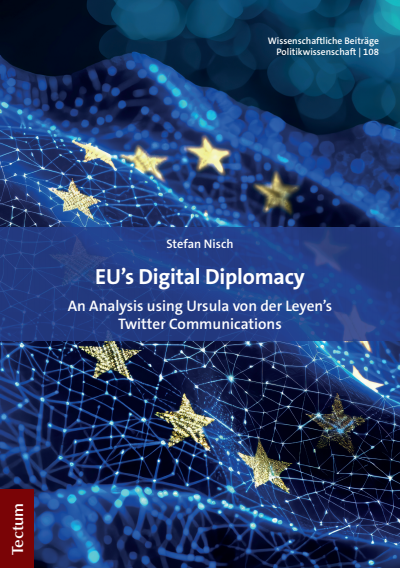
EU’s Digital Diplomacy
An Analysis using Ursula von der Leyen’s Twitter Communications- Authors:
- Series:
- Wissenschaftl.Beitr.a.d.Tectum Verlag: Politikwissenschaft, Volume 108
- Publisher:
- 2024
Summary
This book analyses the EU's digital diplomacy through Ursula von der Leyen's Twitter communications. The reader is given an insight into the EU's communication strategies during the Ukraine crisis and its role as a global actor. The study includes an analysis of over 2500 tweets and uses methods such as VADER Sentiment Analysis and LDA Topic Modelling to capture themes and emotional nuances. The results show how political communication in social media influences public perception and political discourse. In addition, the analyses of Ursula von der Leyen's communications are compared with studies on Olaf Scholz.
Keywords
Search publication
Bibliographic data
- Edition
- 1/2024
- Copyright Year
- 2024
- ISBN-Print
- 978-3-68900-174-2
- ISBN-Online
- 978-3-68900-175-9
- Publisher
- Tectum, Baden-Baden
- Series
- Wissenschaftl.Beitr.a.d.Tectum Verlag: Politikwissenschaft
- Volume
- 108
- Language
- English
- Pages
- 170
- Product Type
- Monograph
Table of contents
ChapterPages
- Titelei/Inhaltsverzeichnis No access Pages I - XII
- 1.1. Significance of the study No access
- 1.2. Research questions No access
- 1.3. Book structure No access
- 2.1.1. Concept of crisis communication No access
- 2.1.2. Russian invasion of Ukraine as crisis No access
- 2.1.3. European unified communication during crises situations No access
- 2.1.4. Communication of politicians during a crisis No access
- 2.1.5. President of the European Commission No access
- 2.2.1. Concept of social media No access
- 2.2.2. Social Media as a platform for political communication No access
- 2.2.3. The role of Twitter in political communication No access
- 2.2.4. Studies on political communication on Twitter No access
- 2.2.5. Sentiment analysis and its relevance to political discourse No access
- 2.2.6. Overview of social media communication during crisis events No access
- 2.2.7. Public engagement in political social media communication No access
- 2.3.1. Concept of framing No access
- 2.3.2. Explanation of framing theory and its key concepts No access
- 2.3.3. Framing theory and its application to political communication No access
- 2.3.4. Framing theory applied on political communication on social media No access
- 2.3.5. Framing the Russian aggression against Ukraine No access
- 3.1. Data retrieval and processing overview No access
- 3.2. Data collection process No access
- 3.3. Description of the dataset No access
- 3.4. Preprocessing steps No access
- 3.5.1. Natural language processing No access
- 3.5.2. Introduction to sentiment analysis No access
- 3.5.3. Sentiment analysis No access
- 3.5.4. Techniques of sentiment analysis No access
- 3.5.5. Sentiments compared with stance No access
- 3.5.6. Application of VADER sentiment analysis No access
- 3.6.1. Technique of detecting frames No access
- 3.6.2. Application of LDA topic modeling No access
- 3.7.1. Validity considerations No access
- 3.7.2. Reliability considerations No access
- 3.7.3. Ethical considerations No access
- 4.1.1. Overview of von der Leyen’s Twitter communication 2021–2022 No access
- 4.1.2. Overview of von der Leyen’s Twitter communication 2022–2023 No access
- 4.1.3. Engagement of the public on von der Leyen’s tweets No access
- 4.1.4. Overview of Scholz Twitter communication 2022–2023 No access
- 4.2.1. Findings from von der Leyen sentiment analysis 2021–2022 No access
- 4.2.2. Findings from von der Leyen sentiment analysis 2022–2023 No access
- 4.2.3. Correlation analysis between sentiments and engagement metrics No access
- 4.2.4. Findings from the sentiment analysis of Olaf Scholz 2022–2023 No access
- 4.3.1. Findings from von der Leyen LDA topic modeling 2021–2022 No access
- 4.3.2. Findings from von der Leyen topic modeling 2022–2023 No access
- 4.3.3. Engagement from the public of von der Leyen’s tweets No access
- 4.3.4. Findings from Scholz topic modeling No access
- 4.4.1. Comparing the overview between different time periods No access
- 4.4.2. Comparing the overview between von der Leyen and Scholz No access
- 4.4.3. Comparing sentiment analysis across different time periods No access
- 4.4.4. Comparing the sentiments between von der Leyen and Scholz No access
- 4.4.5. Comparing the frames across the different time periods No access
- 4.4.6. Comparing the frames between von der Leyen and Scholz No access
- 4.4.7. Correlations of Events during the invasion of Ukraine No access
- 4.5. Translated tweets No access
- 5.1.1. Interpretation of the overview No access
- 5.1.2. Implications of the overview No access
- 5.2.1. Identification of key frames No access
- 5.2.2. Analysis of framing strategies No access
- 5.2.3. Implications of framing strategies No access
- 5.3.1. Findings of the sentiment analysis No access
- 5.3.2. Analysis of the used sentiments No access
- 5.3.3. Implications of the expressed sentiments No access
- 5.4.1. Framing and sentiments of political communication No access
- 5.4.2. Unity of the European Union No access
- 5.4.3. Engagement of the public during a crisis on social media No access
- 6.1. Summary of key findings No access
- 6.2. Additional findings No access
- 6.3. Answering the research questions No access
- 6.4. Contribution to the field of study No access
- 6.5. Limitations of the study No access
- 6.6. Recommendations for future research No access
- References No access Pages 141 - 168
- Acknowledgments No access Pages 169 - 170