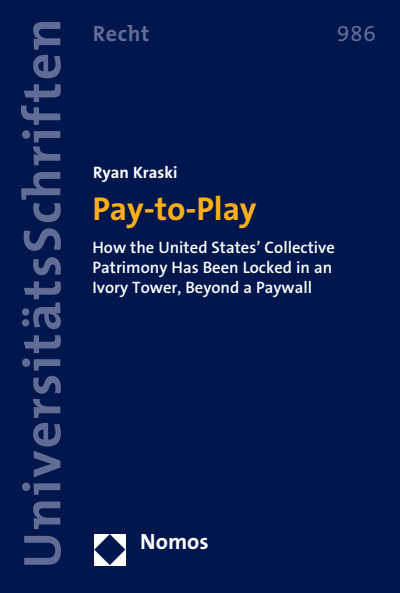
Pay-to-Play
How the United States’ Collective Patrimony Has Been Locked in an Ivory Tower, Beyond a Paywall- Authors:
- Series:
- Nomos Universitätsschriften - Recht, Volume 986
- Publisher:
- 2021
Summary
Pay-to-Play provides an accessible approach toward understanding two systems for knowledge creation and dissemination that are embedded in the US legal system, namely private, nonprofit universities and copyright law. Pay-to-Play identifies the harsh reality that an expansive body of academic works remains locked away behind for-profit paywalls. Accessing these works for individuals is prohibitively expensive and is usually only made possible through even more expensive institutional memberships. As a result, most people are unnecessarily excluded from the innovation process, which lies at the very core of the Constitution’s Copyright Clause.
Dr. Ryan Kraski is a former lecturer and research fellow at the University of Cologne, Germany and is currently in-house counsel in the private sector.
Keywords
Search publication
Bibliographic data
- Copyright year
- 2021
- ISBN-Print
- 978-3-8487-7194-3
- ISBN-Online
- 978-3-7489-1226-2
- Publisher
- Nomos, Baden-Baden
- Series
- Nomos Universitätsschriften - Recht
- Volume
- 986
- Language
- English
- Pages
- 278
- Product type
- Book Titles
Table of contents
- Titelei/Inhaltsverzeichnis No access Pages 1 - 14
- I. Definitions No access
- II. Why Focus on Universities and Copyright Law? No access
- B. General Structure No access
- C. Questions Presented No access
- D. Methods No access
- E. Literature Review No access
- F. Contributions of this Research No access
- I. Early European Societies and Universities No access
- II. The Emergence of the American System No access
- I. University Privileges No access
- II. Privileges in the US No access
- I. The Early Curriculum in Europe No access
- II. The Developing Curriculum in the Americas No access
- I. The Professional Pathway No access
- II. The Mobility Pathway No access
- III. The Social Pathway No access
- I. The Funding Schemes No access
- II. Negative Outcomes of Federal Funding No access
- III. How Finance Affected the Various Types of Universities No access
- F. The US’ Third Sector: Nonprofits No access
- 1. Overcoming Contract Failure through the Nonprofit Form No access
- 2. The Non-Distribution Constraint No access
- 1. The Organizational Test No access
- 2. The Operational Test No access
- 3. The Private Inurement Test No access
- 1. Safe-Harbor No access
- 2. UBIT Taxes No access
- IV. State Regulation No access
- V. Federal Regulation No access
- 1. Access Statistics No access
- 2. Campus Diversity No access
- 3. Access and University Type No access
- 4. The Outcome of the HEA’s Student Lending No access
- 1. Education Statistics No access
- 2. The Focus of University Instruction No access
- 3. Free Speech Protections on Campus No access
- 4. How the University Types Influence Each Other No access
- 1. Research Statistics No access
- 2. Research Universities No access
- 3. The Types of Research No access
- IV. Certification No access
- V. Social Mobility No access
- 1. Commercial Operations No access
- 2. Compensation No access
- 3. Capital Accumulation No access
- I. Private, Nonprofit Universities and the Public Benefit No access
- J. Private, Nonprofit Universities’ Legal Structuring and the Public Benefit No access
- K. How Can Private, Nonprofit Universities be Improved through the Law? No access
- A. Introduction No access
- B. History No access
- C. The Means and Ends of US Copyright No access
- I. Various Exceptions to Copyright No access
- II. International Law and Copyright in the US No access
- 1. Open Access No access
- 2. Creative Commons Licenses No access
- 3. Pirating No access
- 4. Technical Barriers No access
- 1. The Core of Copyright Protection No access
- 2. The Effects of Fair Use Codification No access
- 3. Campus Policies No access
- 4. How the Rings of Regulation Affect Access No access
- 1. The Governmental Sector No access
- 2. The For-Profit Sector: Paywalls No access
- 3. The For-Profit Sector: Free Access No access
- 4. The Nonprofit Sector No access
- 5. The Pirates No access
- 1. The Production Function and the Different Types of Works No access
- 2. The Production Function and Academic Works No access
- 1. Structure in the Print Era No access
- 2. Structure in the Digital Era No access
- 3. Universities as a Structural Alternative to Copyright No access
- 4. Alternative For-profit Structures No access
- V. Expressive Function Assessment No access
- F. Copyright Law and the Public Benefit No access
- G. How Can Copyright be Improved Through the Law? No access
- Part III: Summary No access Pages 245 - 253
- Conclusion No access Pages 254 - 258
- Works Cited No access Pages 259 - 278