Book Titles Open Access Full access
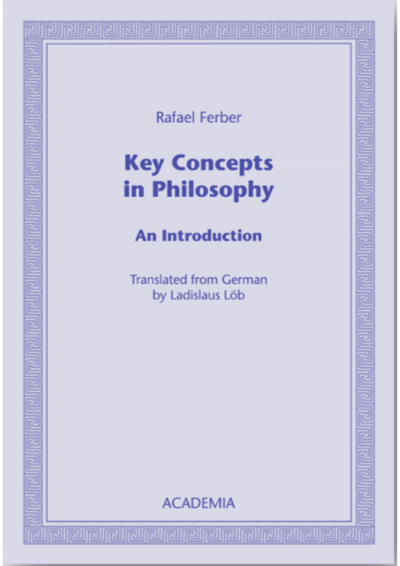
Key Concepts in Philosophy
An Introduction- Authors:
- Series:
- Academia Philosophical Studies, Volume 50
- Publisher:
- 2015
Summary
The book provides an introduction to six fundamental philosophy concepts - philosophy, language, knowledge, truth, being and good. At the same time, it aims to initiate its readers into the process of philosophical thinking. The book is addressed to students and laypeople, but also contains new ideas for specialists. It is written in a clear, accessible and engaging style, and its author 'shares, and manages to convey, something of Plato's own commitment to philosophy' (Phronesis).
Search publication
Bibliographic data
- Copyright year
- 2015
- ISBN-Print
- 978-3-89665-648-3
- ISBN-Online
- 978-3-89665-805-0
- Publisher
- Academia, Baden-Baden
- Series
- Academia Philosophical Studies
- Volume
- 50
- Language
- English
- Pages
- 242
- Product type
- Book Titles
Table of contents
ChapterPages
- Titelei/InhaltsverzeichnisPages 1 - 12 Download chapter (PDF)
- The Beginning in the Cave
- Word and Concept
- Philosophy and Common Sense
- Philosophy, Science and Art
- Philosophy as an Ideal
- Speech as Action
- Three Functions of Linguistic Action
- Expression and Meaning
- What Is the Meaning of an Expression?
- Meaning and Rule
- Sensation and Argument
- Deductive and Inductive Arguments
- How Do We Justify the Conclusion of an Inductive Argument?
- The Induction Principle as a Hypothetical Postulate of Practical Reason
- When Are Axioms True?
- The Classic Definition of Truth
- Objections to the Classic Definition and Tarski’s Reformulation
- Five Criteria of Truth
- The Plus of the Concept of Truth Over the Five Criteria
- The Classic Definition as the Decisive Criterion and the Ideal
- The Four Meanings of “is”
- Real Existence and Real Facts
- Physical Facts and Psychic Facts
- Semantic Existence and Semantic Facts
- The Being of Universals
- The Being of Fictitious Things and the Being of Nothingness
- The Good, Morally and Extramorally
- Cognitivism
- Emotivism
- Institutionalism
- The Concept of the Good as the Foundation of Morality
- The Good as Utility
- The Good as a Rule
- Minimum and Maximum Morality
- The Generalisation Rule as an Axiomatic Demand of Practical Reason
- Bibliography Pages 225 - 236 Download chapter (PDF)
- Name Index Pages 237 - 238 Download chapter (PDF)
- Subject Index Pages 239 - 242 Download chapter (PDF)