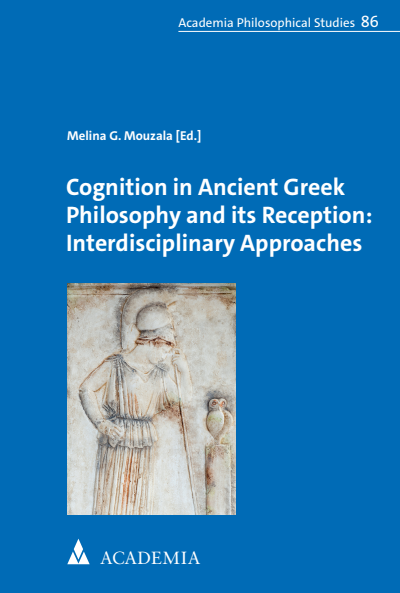
Cognition in Ancient Greek Philosophy and its Reception: Interdisciplinary Approaches
- Editors:
- Series:
- Academia Philosophical Studies, Volume 86
- Publisher:
- 2024
Summary
This book brings together perspectives from philosophy and neuroscience on cognition in Ancient Greek Philosophy and its reception. It first provides a useful introduction to various aspects of cognition in Ancient Greek Philosophy, at different periods of its history, both from the perspective of philosophy and neuroscience. After presenting in depth interdisciplinary approaches to important aspects of cognition in Early and Classical Greek Philosophy, it focuses on issues of cognition in Late Antiquity and Neoplatonism. The authors investigate major problems of cognition and knowledge that are representative of different eras and perspectives. Melina G. Mouzala is an Associate Professor at the Department of Philosophy of the University of Patras. Her research interests include the Platonic and Aristotelian traditions as well as ancient and byzantine commentaries on Aristotle. With contributions byGeorgina Angelopoulou | Douglas R. Campbell | Gary M. Gurtler | Albert R. Haig | Evangelos Kafetzopoulos | Vasileios Kafetzopoulos | Dimitrios Kasselimis | Nikolaos Laskaris | Andrei Lebedev | Chiara Militello | Melina G. Mouzala | Georgios Papageorgiou | Constantin Potagas | Kyriaki Sidiropoulou | Irini Skaliora | Daniel J. Tolan | Corentin Tresnie | Dimitrios Tsolakopoulos
Keywords
Search publication
Bibliographic data
- Edition
- 1/2024
- Copyright Year
- 2024
- ISBN-Print
- 978-3-98572-174-0
- ISBN-Online
- 978-3-98572-175-7
- Publisher
- Academia, Baden-Baden
- Series
- Academia Philosophical Studies
- Volume
- 86
- Language
- English
- Pages
- 375
- Product Type
- Edited Book
Table of contents
- Titelei/Inhaltsverzeichnis No access Pages 1 - 8
- Introduction No access Pages 9 - 32Authors:
- Abbreviations No access Pages 33 - 34
- Authors: | | | | |
- Abstract No access
- Introduction No access
- The Story of Psammetichus’ children and Myths of gestures No access
- The Odyssey of Language-origin research and Gesture theories No access
- Thought and a Language of ‘true’ Names No access
- The modern view of the relationship between Thought and Language and the process of Naming No access
- An inherited will: The vital ability to pose questions No access
- Bibliography No access
- Authors:
- Abstract No access
- (I) Preliminary methodological remarks on pseudo-historical developmentalism, Plato-centrism and the misconceived category of ‘Presocratics.’ The archaic roots of idealism (mentalism) and substance du... No access
- (II) Demiourgos and creationism in pre-Platonic philosophy. Creation by divine mind is a form of objective idealism (mentalism). No access
- (III) Objections to the denial of existence of idealism (mentalism) in Greek philosophy by M.Burnyeat and B. Williams. Forms and aspects of idealism in Greek thought. No access
- (IV) The birth of the new naturalistic paradigm in the scientific revolution in Miletus in 6th century B.C. No access
- (V) The theoretical conflict between naturalistic empiricism and metaphysical mentalism in early Greek philosophy. No access
- (VI) Noesis vs. ‘touching by hand’. The dispute between rationalism and empiricism, mentalism and naturalism in the mirror of the parable of ‘gigantomachia over being’ in Plato’s Sophist. No access
- Bibliography No access
- Authors:
- Abstract No access
- The issue No access
- The beginning No access
- The view of contemporary neuroscience No access
- The cognitive penetrability of perception No access
- Conclusion No access
- Bibliography No access
- Authors:
- Abstract No access
- Preliminaries No access
- I. Amathia and the Various Forms of Knowledge in Plato No access
- II. Kakia, Agnoia and Amathia: Nosos, Aischos and the Tripartite Soul No access
- III. The Detachment of Ignorance and, consequently, Amathia from the other Κinds of Badness in the Sophist No access
- IV. Medicine, Gymnastics and Education: The Role of Dianoia and Thumos in the Cathartic Elenchus (Sph. 230b1-d4) No access
- Conclusions No access
- Bibliography No access
- Authors:
- Abstract No access
- 1. The material conditions of human cognition No access
- 2. The significance of biology for a theory of the soul No access
- 3. The body as the friend of nous: cardiology and hepatology No access
- 4. The body as the enemy of nous: psychic disorders No access
- 5. Human and non-human bodies (and cognition) No access
- Bibliography No access
- Authors:
- Abstract No access
- 1. What is memory? No access
- 2. The stages is the mnemonic process No access
- 3. The location of memory No access
- 4. Memory representations in the brain No access
- 5. Recollection No access
- 6. Adaptations in the mnemonic capabilities No access
- 7. Memory and animals No access
- Conclusions No access
- Acknowledgements No access
- Bibliography No access
- Authors: |
- Abstract No access
- Bibliography No access
- Authors:
- Abstract No access
- Introduction No access
- Olfaction in ancient times and modern olfactory science No access
- Odors and their receptors No access
- Which words are used to identify odors? No access
- The olfactory system(s) No access
- The use(s) of olfaction No access
- Beyond “hedonicity” No access
- Greek Texts No access
- Bibliography No access
- Authors:
- Abstract No access
- 1 Introduction No access
- 2 The Text Itself No access
- 3 The scala naturae and Ontological Motion No access
- 4 Rational Motion No access
- 5 Stoic Background No access
- 6 Origen and Stoic Psychology in περὶ αὐτεξουσίου No access
- 7 Conclusion No access
- Bibliography No access
- Authors:
- Abstract No access
- 1. Continuities and discontinuities in Plotinus and the “New” Platonism No access
- 2. An overview of Plotinus’ metaphysical system No access
- 3. Mental content, concepts, and language in Plotinus No access
- 4. Sensory perception and the external world No access
- 5. The nature of the self, consciousness, and the unconscious No access
- 6. Mind, body, substance, and free will No access
- 7. Plotinus and contemporary understandings of cognition No access
- Bibliography No access
- Authors:
- Abstract No access
- Introduction No access
- I.1. Matter as the Image of Mass No access
- I.2. Sensations and Imaginations No access
- I.3. Imagination and Affections No access
- II.1. Planets and Memory No access
- II.2. Motion No access
- II.3. Physician and Nature No access
- II.4. Reason and Knowledge No access
- II.5. Souls and Time No access
- Conclusion No access
- Bibliography No access
- Authors:
- Abstract No access
- Introduction: a provocative statement from Proclus No access
- 1.1 Sense-perception is always particular No access
- 1.2 The sensible objet is exterior No access
- 1.3. Sense-perception and motion No access
- 2.1 Cosmic and human perception No access
- 2.2 Activity and passivity of sense-perception No access
- 2.3 The guiding role of common sense No access
- 3.1 Opinion is a kind of rational knowledge No access
- 3.2 Rational faculties and their logoi No access
- 3.3 How can opinion guide sense-perception? No access
- 4.1 Educating despite sense-perception No access
- Conclusions No access
- Bibliography No access
- Authors:
- Abstract No access
- 1. The five faculties No access
- 2. Stages of knowledge No access
- 3. The two traditional classifications in Olympiodorus’ works No access
- 4. From the two classifications to the nine-step model No access
- Bibliography No access
- Notes on the Contributors No access Pages 361 - 366
- Index Locorum No access Pages 367 - 370
- Index Nominum No access Pages 371 - 372
- Index Rerum No access Pages 373 - 375