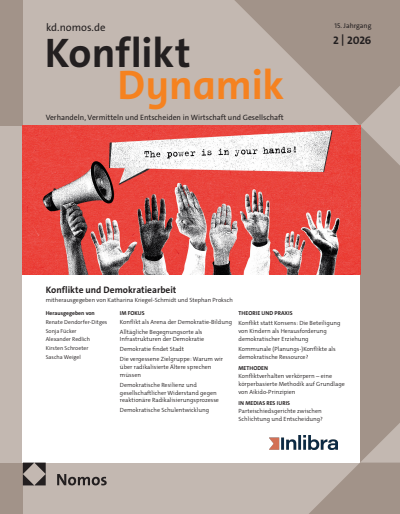
Democracy thrives on conflict. It is both challenged and enabled by it. Democracy education grounded in the principles of radical democracy does not view conflict dynamics as a deficit, but rather as arenas of discursive negotiations where democracy...
Democracy depends on places of everyday encounters — but these are in decline. This article explores how the erosion of spaces due to individualized lifestyles, spatial segregation, and disinvestment in public infrastructure weakens societal trust...
Democracy must be worked for; it cannot be taken for granted. The democratization processes occurring at the local level extend beyond the scope of conventional educational provisions, manifesting instead in community work, citizen participation,...
When it comes to radicalization, public attention—as well as most prevention programs—tends to focus primarily on adolescents and young adults. However, in our counseling practice, we have observed a different and largely overlooked phenomenon...
The number of democracies worldwide is declining, and democracy in Germany is also under increasing pressure. Reactionary radicalization processes are manifesting themselves in political polarization, the most visible sign of which is the electoral...
With democracy under pressure and frequently under threat worldwide, all measures to preserve democracy are very important. As a place where all children and young people can be reached, schools play an important role in raising awareness of the...
Children’s participation is considered a core element of democratic education, yet in the practice of educational institutions it often remains selective and conflict averse. This paper explores the tension between the normative claim and the...
Representatives of agonistic democracy theory emphasize that conflicts are inevitable and necessary for democratic processes. In conflict resolution practice, the relationship between democracy and conflict becomes particularly evident at the local...
The number and significance of arbitration proceedings vary among German political parties. The parties fulfill the legal mandate for »arbitration and decision-making« in different ways within the framework of their statutory autonomy. The...