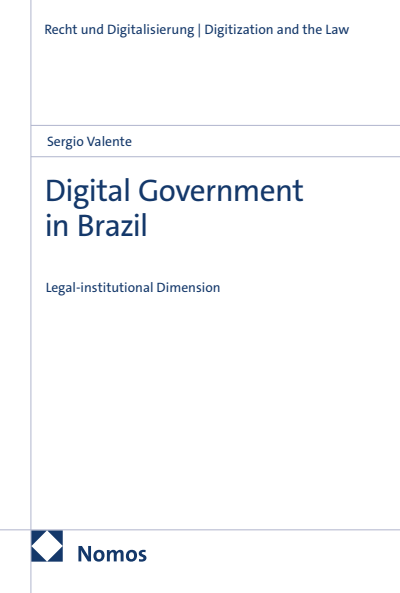
This book examines Digital Government in Brazil as a public policy from a legal-institutional perspective. Drawing on neoinstitutionalist approaches, it analyzes how legal norms, institutions, and actor constellations shape the state’s digital transformation. In addition to an in-depth analysis of the Brazilian legal framework, the study includes comparative insights from German Digital Government and European Union policies. Through case studies such as judicial digitalization, electronic voting, and internet governance, the book identifies structural limits of Brazil’s digital agenda. It concludes by proposing guidelines for a democratic digital welfare state and innovation-oriented state capacity. The author is a legal scholar specializing in public law and public policy analysis.
Keywords
Search publication
Bibliographic data
Edition
1/2026
Copyright Year
2026
ISBN-Print
978-3-7560-3563-2
ISBN-Online
978-3-7489-6623-4
Publisher
Nomos, Baden-Baden
Series
Recht und Digitalisierung | Digitization and the Law
Volume
26
Language
English
Pages
374
Product Type
Monograph
Table of contents
ChapterPages
Acknowledgments No access
A. Overview No access
B. Social and political context No access
C. Research question, objectives, justification, and methodology No access
D. Digital government as an object of study No access
E. Dissertation structure No access
1.1 Digital Government as a public policy No access
1.2 Policy sciences and the institutionalist contribution No access
1.3 Institutionalism in the legal world No access
1.4 From policy sciences to law No access
1.5 The role of law in public policy No access
1.6 Legal dogmatics and its relationship with the political element No access
1.7 Analysis frameworks in LPP: the key questions of the legal-institutional view No access
1.8 Digital Government as a metapolicy No access
1.9.1 Enabling and constraining: the instrumental keying of institutions No access
1.9.2 Institutions as equilibrium: stabilizing choices and preferences No access
1.9.3 Strategies and declarations as pre-normative institutions No access
1.9.4 Institutions as norms and rules No access
1.9.5 The management of incentives and disincentives by institutions No access
1.9.6 Institutions as frames of meaning No access
1.9.7 Actors, constellation of actors, and modes of interaction No access
1.9.8 Path dependency No access
1.9.9 Veto points and enabling points No access
1.9.10 Discourses and ideas in inter- and intra-institutional relations No access
1.10 Chapter conclusion No access
2.1 Overview and institutional trajectory No access
2.2.1.1 Limited scope: political resistance and regional inequality No access
2.2.1.2 Low binding nature of rules and lack of division of competences No access
2.2.1.3 Orientation towards economic efficiency and debureaucratization No access
2.2.1.4 Regulating the digital administrative process No access
2.2.1.5 Components of Digital Government No access
2.2.1.6 Creation of a unique identification number No access
2.2.1.7 Standards and rules of interoperability and open data No access
2.2.1.8 Duties of the administration and rights of the “user” citizen No access
2.2.1.9 The balance between formality and risk No access
2.2.1.10 Innovation, experimentation, and external control/audit No access
2.2.2.1 Access to Information Act (LAI) No access
2.2.2.2 Law No. 12,682/2012 on electronic documents No access
2.2.2.3 Civil Rights Framework for the Internet No access
2.2.2.4 General Data Protection Law No access
2.2.2.5 Digital signature regulations No access
2.2.2.6 Electronic Public Records System (Serp) No access
2.2.2.7 Legal Framework for Startups, Govtechs and sandboxes No access
2.3 Chapter conclusion No access
3.1.1 Electronic elections No access
3.1.2 Internet governance No access
3.1.3 The electronic judicial process No access
3.2.1 The European Union and the digital transformation: cohesion and discourse No access
3.2.2 Digital Government in Germany: incrementalism and coordination No access
3.3 Chapter conclusion No access
4.1 The welfare state and the Brazilian situation No access
4.2 Digital welfare state as a state of dynamic capabilities No access
4.3 The political direction of Digital Government No access
4.4 The challenges of coordination in the federal system No access
4.5 Innovation Environment: administration in the self-regulatory logic No access
4.6 Public services, public participation and technology as a catalyst No access
4.7 Chapter conclusion No access
Conclusion No access Pages 337 - 340
References No access Pages 341 - 374
Similar publications
from the series "Recht und Digitalisierung | Digitization and the Law"