, to see if you have full access to this publication.
Monograph Partial access
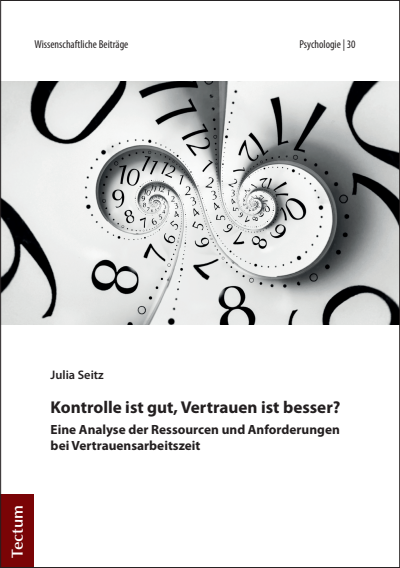
Kontrolle ist gut, Vertrauen ist besser?
Eine Analyse der Ressourcen und Anforderungen bei Vertrauensarbeitszeit- Authors:
- Series:
- Wissenschaftliche Beiträge aus dem Tectum Verlag: Psychologie, Volume 30
- Publisher:
- 2019
Keywords
Search publication
Bibliographic data
- Edition
- 1/2019
- Copyright Year
- 2019
- ISBN-Print
- 978-3-8288-4144-4
- ISBN-Online
- 978-3-8288-6982-0
- Publisher
- Tectum, Baden-Baden
- Series
- Wissenschaftliche Beiträge aus dem Tectum Verlag: Psychologie
- Volume
- 30
- Language
- German
- Pages
- 318
- Product Type
- Monograph
Table of contents
ChapterPages
- Titelei/Inhaltsverzeichnis Partial access Pages I - XVI
- 1 Einleitung No access Pages 1 - 8
- 2.1 „With great power comes great responsibility“ – wesentliche Charakteristika von Vertrauensarbeitszeit No access
- 2.2 Die Verbreitung der Vertrauensarbeitszeit No access
- 2.3 Die (polarisierte) Debatte um Vertrauensarbeitszeit No access
- 2.4.1 Der Arbeitskraftunternehmer – Selbstkontrolle, Selbstökonomisierung und Selbstrationalisierung No access
- 2.4.2 Der flexible Mensch – Flexibilisierung als Problem No access
- 2.4.3 Der Intrapreneur – Unternehmer im Unternehmen No access
- 2.4.4 Discretionary time – Zeitautonomie neu gedacht No access
- 2.4.5 Zusammenfassung und Folgerungen No access
- 3.1 Die Handlungsregulationstheorie No access
- 3.2.1 Prinzipien, Elemente und Entwicklung des Job Demands-Resources Modells No access
- 3.2.2 Persönliche Ressourcen innerhalb des JD-R-Modells No access
- 3.2.3 Erweiterungen des Modells: Challenge und Hindrance Demands und das Triple Match Principle No access
- 3.2.4 Kritik des Modells und Einordnung in den Anwendungsfall Vertrauensarbeitszeit No access
- 3.3.1 Autonomie in der Arbeit als Anforderung No access
- 3.3.2 Arbeitsvolumen No access
- 3.3.3 Entgrenzungsverhalten No access
- 3.3.4 Anwesenheitskultur No access
- 3.3.5 Anforderungen an die zeitliche Flexibilität – Primat betrieblicher Zeitinteressen No access
- 3.4.1 Arbeitszeitautonomie No access
- 3.4.2 Handlungsspielraum No access
- 3.4.3 Soziale Unterstützung No access
- 3.4.4 Qualität der Beziehung zur Führungskraft No access
- 3.4.5 Begrenzung der Arbeitszeit / Segmentation von Arbeit und Privatleben No access
- 3.4.6 Persönliche Ressourcen – Selbstwirksamkeit und Self-Leadership No access
- 3.5 Zusammenfassung der Anforderungen und Ressourcen der VAZ No access
- 4.1 Forschungsstand und theoretische Bezüge zu flexiblen Arbeitszeitmodellen No access
- 4.2.1 Stichprobe No access
- 4.2.2 Operationalisierung No access
- 4.2.3 Datenanalyse No access
- 4.3 Ergebnisse No access
- 4.4 Diskussion No access
- 5.1.1 Grundmodell der VAZ: Autonomieanforderungen und Arbeitszeitautonomie No access
- 5.1.2 Grundprozess 1: Arbeitszeitautonomie als Ressource No access
- 5.1.3 Grundprozess 2: Selbstorganisation als Anforderung No access
- 5.2 Studiendesign No access
- 5.3 Ergänzende Hinweise zur Unternehmensstichprobe No access
- 5.4.1 Operationalisierung der Anforderungen No access
- 5.4.2 Operationalisierung der Ressourcen No access
- 5.4.3 Operationalisierung der abhängigen Variablen No access
- 5.4.4 Operationalisierung von Kontroll- und Kontextvariablen No access
- 5.5 Stichprobenmerkmale und deskriptive Auswertungen No access
- 5.6 Strategie der Datenanalyse No access
- 5.7.1 Ergebnisse zum Grundmodell der VAZ No access
- 5.7.2 Ergebnisse zum Grundprozess 1: Arbeitszeitautonomie als Ressource No access
- 5.7.3 Ergebnisse zum Grundprozess 2: Selbstorganisation als Anforderung No access
- 5.8 Diskussion No access
- 6.1 Zusammenfassung der zentralen Ergebnisse No access
- 6.2 Limitationen der vorliegenden Arbeit No access
- 6.3 Ansätze für weitere Forschung auf dem Gebiet der Vertrauensarbeitszeit No access
- 6.4 Handlungsempfehlungen: Wie lässt sich eine mitarbeitergerechte Version der Vertrauensarbeitszeit gestalten? No access
- Anhang No access Pages 269 - 296
- Literaturverzeichnis No access Pages 297 - 318
Bibliography (193 entries)
No match found. Try another term.
- Literaturverzeichnis Open Google Scholar DOI: 10.5771/9783828869820
- Acock, A. C. (2013). Discovering Structural Equation Modeling Using Stata. College Station, Texas: Stata Press. Open Google Scholar DOI: 10.5771/9783828869820
- Albert, M., Gensicke, T., Hurrelmann, K., Leven, I., Quenzel, G., Schneekloth, U.et al. (2015). Jugend 2015. Eine pragmatische Generation im Aufbruch. 17. Shell Jugendstudie (Bd. 17). Frankfurt am Main: S. Fischer. Open Google Scholar DOI: 10.5771/9783828869820
- Andresen, M. (2009). Das (Un-)Glück der Arbeitszeitfreiheit. Eine ökonomisch-psychologische Analyse und Bewertung. Wiesbaden: Gabler. Open Google Scholar DOI: 10.5771/9783828869820
- Andreßen, P. & Konradt, U. (2007). Messung von Selbstführung: Psychometrische Überprüfung der deutschsprachigen Version des Revised Self-Leadership Questionnaire. Zeitschrift für Personalpsychologie, 6(3), 117–128. Open Google Scholar DOI: 10.5771/9783828869820
- ArbZG. (1994). Arbeitszeitgesetz,1 G v. 6.6.1994 I 1170 (ArbZRG) (Zuletzt geändert durch Art. 12a G v. 11.11.2016 I 2500 ed., BGBl. I S. 1170, 1171). Open Google Scholar DOI: 10.5771/9783828869820
- Bakker, A. B., Boyd, C. M., Dollard, M. F., Gillespie, N., Winefield, A. H. & Stough, C. (2010). The role of personality in the job demands-resources model. A study of Australian academic staff. Career Development International, 15(7), 622–636. Open Google Scholar DOI: 10.5771/9783828869820
- Bakker, A. B. & Demerouti, E. (2007). The Job Demands-Resources model: state of the art. Journal of Manegerial Psychology, 22(3), 309–328. Open Google Scholar DOI: 10.5771/9783828869820
- Bakker, A. B. & Demerouti, E. (2014). Job Demands-Resources Theory. In C. Cooper & P. Chen (Hrsg.), Well-being: A complete reference guide (S. 37–64). Chichester: Wiley-Blackwell. Open Google Scholar DOI: 10.5771/9783828869820
- Bakker, A. B., Demerouti, E. & Euwema, M. C. (2005). Job Resources Buffer the Impact of Job Demands on Burnout. Journal of Occcupational Health Psychology, 10(2), 170–180. Open Google Scholar DOI: 10.5771/9783828869820
- Bakker, A. B., Demerouti, E. & Schaufeli, W. B. (2005). The crossover of burnout and work engagement among working couples. Human Relations, 58(5), 661–689. Open Google Scholar DOI: 10.5771/9783828869820
- Bakker, A. B., Demerouti, E. & Verbeke, W. (2004). Using the Job Demands-Resources Model to predict Burnout and Performance. Human Resource Management, 43(1), 83–104. Open Google Scholar DOI: 10.5771/9783828869820
- Bakker, A. B. & Sanz-Vergel, A. I. (2013). Weekly work engagement and flourishing: The role of hindrance and challenge job demands. Journal of Vocational Behavior, 83, 397–409. Open Google Scholar DOI: 10.5771/9783828869820
- Bakker, A. B., ten Brummelhuis, L. L., Prins, J. T. & van der Heijden, F. M. M. A. (2011). Applying the job demands-resources model to the work-home interface: A study among medical residents and their partners. Journal of Vocational Behavior, 79, 170–180. Open Google Scholar DOI: 10.5771/9783828869820
- Baltes, B. B., Briggs, T. E., Huff, J. W., Wright, J. A. & Neuman, G. A. (1999). Flexible and Compressed Workweek Schedules: A Meta-Analysis of Their Effects on Work-Related Criteria. Journal of Applied Psychology, 84(4), 496–513. Open Google Scholar DOI: 10.5771/9783828869820
- Bandura, A. (1977). Self-efficacy: Toward a Unifying Theory of Behavioral Change. Psychological Review, 84(2), 191–215. Open Google Scholar DOI: 10.5771/9783828869820
- Bannai, A. & Tamakoshi, A. (2014). The association between long working hours and health: A systematic review of epidemiological evidence. Scandinavian Journal of Work, Environment & Health, 40(1), 5–18. Open Google Scholar DOI: 10.5771/9783828869820
- Bauer, F., Groß, H., Lehmann, K. & Munz, E. (2004). Arbeitszeit 2003. Arbeitszeitgestaltung, Arbeitsorganisation und Tätigkeitsprofile. Köln: ISO - Institut zur Erforschung sozialer Chancen. Open Google Scholar DOI: 10.5771/9783828869820
- Beckmann, M. & Cornelissen, T. (2014). Self-Managed Working Time and Employee Effort: Microeconometric Evidence (Bd. 636, S. 1–43): SOEP Papers on Multidisciplinary Panel Data Research at DIW Berlin. Open Google Scholar DOI: 10.5771/9783828869820
- Blok, M. M., Groenesteijn, L., Schelvis, R. & Vink, P. (2012). New Ways of Working: does flexibility in time and location of work change work behavior and affect business outcomes? Work-a Journal of Prevention Assessment & Rehabilitation, 41, 2605–2610. Open Google Scholar DOI: 10.5771/9783828869820
- Böhm, S., Herrmann, C. & Trinczek, R. (2004a). Herausforderung Vertrauensarbeitszeit. Zur Kultur und Praxis eines neuen Arbeitszeitmodells. Berlin: Edition Sigma. Open Google Scholar DOI: 10.5771/9783828869820
- Böhm, S., Herrmann, C. & Trinczek, R. (2004b). Vertrauensarbeitszeit - die Zeit des Arbeitskraftunternehmers? In H. J. Pongratz & G. G. Voß (Hrsg.), Typisch Arbeitskraftunternehmer? Befunde der empirischen Arbeitsforschung (S. 139–186). Berlin: Edition Sigma. Open Google Scholar DOI: 10.5771/9783828869820
- Borritz, M. & Kristensen, T. S. (1999). Copenhagen Burnout Inventory. Copenhagen: National Institute of Occupational Health. Open Google Scholar DOI: 10.5771/9783828869820
- Boyd, C. M., Bakker, A. B., Pignata, S., Winefield, A. H., Gillespie, N. & Stough, C. (2011). A Longitudinal Test of the Job Demands-Resources Model among Australian University Academics. Applied Psychology: An International Review, 60(1), 112–140. Open Google Scholar DOI: 10.5771/9783828869820
- Bredehöft, F., Dettmers, J., Hoppe, A. & Janneck, M. (2015). Individual work design as a job demand: The double-edged sword of autonomy. Journal Psychologie des Alltagshandelns, 8(2), 1–13. Open Google Scholar DOI: 10.5771/9783828869820
- Breevaart, K., Bakker, A. B., Demerouti, E. & Derks, D. (2016). Who takes the lead? A multi-source diary study on leadership, work engagement, and job performance. Journal of Organizational Behavior, 37, 309–325. Open Google Scholar DOI: 10.5771/9783828869820
- Breevaart, K., Bakker, A. B., Demerouti, E. & van den Heuvel, M. (2015). Leader-member exchange, work engagement, and job performance. Journal of Managerial Psychology, 30(7), 754–770. Open Google Scholar DOI: 10.5771/9783828869820
- Brinkmann, U. (2011). Die unsichtbare Faust des Marktes. Betriebliche Kontrolle und Koordination im Finanzmarktkapitalismus. Berlin: Edition Sigma. Open Google Scholar DOI: 10.5771/9783828869820
- Brough, P., Timms, C., Siu, O. L., Kalliath, T., O’Driscoll, M. P., Sit, C. H. P.et al. (2013). Validation of the Job Demands-Resources model in cross-national samples: Cross-sectional and longitudinal predictions of psychological strain and work engagement. Human Relations, 66(10), 1311–1335. Open Google Scholar DOI: 10.5771/9783828869820
- Brown, T. A. (2006). Confirmatory Factor Analysis for Applied Research. New York London: The Guilford Press. Open Google Scholar DOI: 10.5771/9783828869820
- Bundesvereinigung der deutschen Arbeitgeberverbände. (2014). Moderne Arbeitsformen,BDA kompakt. Berlin: BDA - Die Arbeitgeber. Open Google Scholar DOI: 10.5771/9783828869820
- Büssing, A. (1996). Social tolerance of working time scheduling in nursing. Work & Stress, 10(3), 238–250. Open Google Scholar DOI: 10.5771/9783828869820
- Cavanaugh, M. A., Boswell, W. R., Roehling, M. V. & Boudreau, J. W. (2000). An empirical examination of self-reported work stress among U.S. managers. Journal of Applied Psychology, 85(1), 65–74. Open Google Scholar DOI: 10.5771/9783828869820
- CDU & FDP. (2017). Koalitionsvertrag für Nordrhein-Westfalen 2017-2022,https://www.cdu-nrw.de/sites/default/files/media/docs/nrwkoalition_koalitionsvertrag_fuer_nordrhein-westfalen_2017_-_2022.pdf. Düsseldorf: NRW Koalition. Open Google Scholar DOI: 10.5771/9783828869820
- Chrisopoulos, S., Dollard, M. F., Winefield, A. H. & Dormann, C. (2010). Increasing the probability of finding an interaction in work stress research: A two-wave longitudinal test of the triple-match principle. Journal of Occupational and Organizational Psychology, 83, 17–37. Open Google Scholar DOI: 10.5771/9783828869820
- Christ, O. & Schlüter, E. (2012). Strukturgleichungsmodelle mit Mplus. Eine praktische Einführung. München: Oldenbourg. Open Google Scholar DOI: 10.5771/9783828869820
- Clausen, T., Burr, H. & Borg, V. (2014a). Do psychosocial job demands and job resources predict long-term sickness absence? An analysis of register-based outcomes using pooled data on 39,408 individuals in four occupational groups. International Archives of Occupational and Environmental Health, 87, 909–917. Open Google Scholar DOI: 10.5771/9783828869820
- Clausen, T., Burr, H. & Borg, V. (2014b). Do psychosocial work conditions predict risk of disability pensioning? An analysis of register-based outcomes using pooled data on 40,554 observations. Scandinavian Journal of Public Health, 42, 377–384. Open Google Scholar DOI: 10.5771/9783828869820
- Clausen, T., Nielsen, K., Gomes Carneiro, I. & Borg, V. (2012). Job demands, job resources and long-term sickness absence in the Danish eldercare services: a prospective analysis of register-based outcomes. Journal of Advanced Nursing, 68(1), 127–136. Open Google Scholar DOI: 10.5771/9783828869820
- Colquitt, J. A., Conlon, D. E., Wesson, M. J., Porter, C. O. L. H. & Ng, K. Y. (2001). Justice at the Millennium: A Meta-Analytic Review of 25 Years of Organizational Justice Research. Journal of Applied Psychology, 86(2), 425–445. Open Google Scholar DOI: 10.5771/9783828869820
- Costa, G., Sartori, S. & Akerstedt, T. (2006). Influence of Flexibility and Variability of Working Hours on Health and Well-Being. Chronobiology International, 23(6), 1125–1137. Open Google Scholar DOI: 10.5771/9783828869820
- Crawford, E. R., LePine, J. A. & Rich, B. L. (2010). Linking Job Demands and Resources to Employee Engagement and Burnout: A Theoretical Extension and Meta-Analytic Test. Journal of Applied Psychology, 95(5), 834–848. Open Google Scholar DOI: 10.5771/9783828869820
- Cunningham, C. E., Woodward, C. A., Shannon, H. S., MacIntosh, J., Lendrum, B., Rosenbloom, D.et al. (2002). Readiness for organizational change: A longitudinal study of workplace, psychological and behavioural correlates. Journal of Occupational and Organizational Psychology, 75, 377–392. Open Google Scholar DOI: 10.5771/9783828869820
- Dansereau, F., Cashman, J. & Graen, G. (1973). Instrumentality Theory and Equity Theory as Complementary Approaches in Predicting the Relationship of Leadership and Turnover among Managers. Organizational Behaviour and Human Performance, 10, 184–200. Open Google Scholar DOI: 10.5771/9783828869820
- De Jonge, J. & Dormann, C. (2003). The DISC Model: Demand-Induced Strain Compensation Mechanisms in Job Stress. In M. F. Dollard, A. H. Winefield & H. R. Winefield (Hrsg.), Occupational Stress in the Service Professions (S. 43–74). London and New York: Taylor & Francis. Open Google Scholar DOI: 10.5771/9783828869820
- De Jonge, J. & Dormann, C. (2006). Stressors, Resources, and Strain at Work: A Longitudinal Test of the Triple-Match Principle. Journal of Applied Psychology, 91(5), 1359–1374. Open Google Scholar DOI: 10.5771/9783828869820
- Deci, N., Dettmers, J., Krause, A. & Berset, M. (2016). Coping in Flexible Working Conditions - Engagement, Disengagement and Self-Endangering Strategies. Journal Psychologie des Alltagshandelns, 9. Open Google Scholar DOI: 10.5771/9783828869820
- Demerouti, E. & Bakker, A. B. (2011). The Job Demands-Resources model: Challenges for future research. South African Journal of Industrial Psychology, 37(2), 1–9. Open Google Scholar DOI: 10.5771/9783828869820
- Demerouti, E., Bakker, A. B., Nachreiner, F. & Schaufeli, W. B. (2001). The Job Demands-Resources Model of Burnout. Journal of Applied Psychology, 86(3), 499–512. Open Google Scholar DOI: 10.5771/9783828869820
- Dettmers, J., Deci, N., Baeriswyl, S., Berset, M. & Krause, A. (2016). Self-Endangering Work Behavior. In M. Wiencke, M. Cacace & S. Fischer (Hrsg.), Healthy at Work. Interdisciplinary Perspectives (S. 37–51). Switzerland: Springer. Open Google Scholar DOI: 10.5771/9783828869820
- Dettmers, J., Vahle-Hinz, T., Friedrich, N., Keller, M., Schulze, A. & Bamberg, E. (2012). Entgrenzung der täglichen Arbeitszeit - Beeinträchtigungen durch ständige Erreichbarkeit bei Rufbereitschaft. In B. Badura, A. Ducki, H. Schröder, J. Klose & M. Meyer (Hrsg.), Fehlzeiten-Report 2012. Gesundheit in der flexiblen Arbeitswelt: Chancen nutzen - Risiken minimieren. Berlin Heidelberg: Springer. Open Google Scholar DOI: 10.5771/9783828869820
- Drexel, I. (2002). Das Konzept des Arbeitskraftunternehmers - ein Leitbild für gewerkschaftliche Berufsbildungspolitik? In E. Kuda & J. Strauß (Hrsg.), Arbeitnehmer als Unternehmer? Herausforderungen für Gewerkschaften und berufliche Bildung (S. 119–131). Hamburg: VSA Verlag. Open Google Scholar DOI: 10.5771/9783828869820
- Dulebohn, J. H., Bommer, W. H. & Liden, R. C. (2012). A Meta-Analysis of Antecedents and Consequences of Leader-Member Exchange. Integrating the Past With an Eye Toward the Future. Journal of Management, 38(6), 1715–1759. Open Google Scholar DOI: 10.5771/9783828869820
- Ebbinghaus, B. & Eichhorst, W. (2006). Employment Regulation and Labor Market Policy in Germany, 1991–2005. Bonn: Forschungsinstitut zur Zukunft der Arbeit - Institute for the Study of Labor. Open Google Scholar DOI: 10.5771/9783828869820
- Eberling, M., Hielscher, V., Hildebrandt, E. & Jürgens, K. (2004). Prekäre Balancen. Flexible Arbeitszeiten zwischen betrieblicher Regulierung und individuellen Ansprüchen. Berlin: Edition Sigma. Open Google Scholar DOI: 10.5771/9783828869820
- European Union. (2015). First Findings: Sixth European Working Conditions Survey (S. 1–8): European Union. Open Google Scholar DOI: 10.5771/9783828869820
- Faust, M. (2002). Der “Arbeitskraftunternehmer” - eine Leitidee auf dem ungewissen Weg der Verwirklichung. In E. Kuda & J. Strauß (Hrsg.), Arbeitnehmer als Unternehmer? Herausforderungen für Gewerkschaften und berufliche Bildung (S. 56–80). Hamburg: VSA Verlag. Open Google Scholar DOI: 10.5771/9783828869820
- Feuerhahn, N., Bellingrath, S. & Kudielka, B. M. (2013). The Interplay of Matching and Non-Matching Job Demands and Resources on Emotional Exhaustion among Teachers. Applied Psychology-Health and Well Being, 5(2), 171–192. Open Google Scholar DOI: 10.5771/9783828869820
- Frese, M. (1989). Theoretical Models of Control and Health. In S. L. Sauter, J. R. Hurrell Jr & C. Cooper (Hrsg.), Job Control and Worker Health (S. 107–128): John Wiley & Sons Ltd. Open Google Scholar DOI: 10.5771/9783828869820
- Frese, M. & Zapf, D. (1994). Action as the Core of Work Psychology: A German Approach. In H. C. Triandis, D. M.D. & L. M. Hough (Hrsg.), Handbook of Industrial and Organizational Psychology (Bd. 4, S. 271–340). Palo Alto: Consulting Psychologists Press. Open Google Scholar DOI: 10.5771/9783828869820
- Galovan, A. M., Fackrell, T., Buswell, L., Jones, B. L., Hill, E. J. & Carroll, S. J. (2010). The Work-Family Interface in the United States and Singapore: Conflict Across Cultures. Journal of Family Psychology, 24(5), 646–656. Open Google Scholar DOI: 10.5771/9783828869820
- Garcia-Herrero, S., Mariscal, M. A., Gutierrez, J. M. & Ritzel, D. O. (2013). Using Bayesian networks to analyze occupational stress caused by work demands: Preventing stress through social support. Accident Analysis and Prevention, 57, 114–123. Open Google Scholar DOI: 10.5771/9783828869820
- Geramanis, O. (2002). Vertrauensarbeitszeit – Die verpasste Chance? WSI-Mitteilungen, 6, 347–352. Open Google Scholar DOI: 10.5771/9783828869820
- Gerstner, C. R. & Day, D. V. (1997). Meta-Analytic Review of Leader-Member Exchange Theory: Correlates and Construct Issues. Journal of Applied Psychology, 82(6), 827–844. Open Google Scholar DOI: 10.5771/9783828869820
- Geurts, S. A. E., Taris, T. W., Kompier, M. A. J., Dikkers, J. S. E., Van Hooff, M. L. M. & Kinnunen, U. M. (2005). Work-home interaction from a work psychological perspective: Development and validation of a new questionnaire, the SWING. Work & Stress, 19(4), 319–339. Open Google Scholar DOI: 10.5771/9783828869820
- Geyer, J. & Krause, A. (2016). Veränderungen der Erwerbsanreize durch das Elterngeld Plus für Mütter und Väter. Berlin: Deutsches Institut für Wirtschaftsforschung. Open Google Scholar DOI: 10.5771/9783828869820
- Glißmann, W. & Peters, K. (2001). Mehr Druck durch mehr Freiheit. Die neue Autonomie der Arbeit und ihre paradoxen Folgen. Hamburg: VSA-Verlag. Open Google Scholar DOI: 10.5771/9783828869820
- Goodin, R. E., Mahmud Rice, J., Parpo, A. & Eriksson, L. (2008). Discretionary Time. A New Measure of Freedom. New York: Cambridge University Press. Open Google Scholar DOI: 10.5771/9783828869820
- Graen, G. & Uhl-Bien, M. (1995). Relationship-based Approach to Leadership: Development of Leader-Member Excahnge (LMX) Theory of Leadership over 25 Years: Applying a Multi-Level Multi-Domain Perspective. Leadership Quarterly, 6(2), 219–247. Open Google Scholar DOI: 10.5771/9783828869820
- Greenhaus, J. H. & Powell, G. N. (2006). When Work and Family Are Allies: A Theory of Work-Family Enrichment. The Academy of Management Review, 31(1), 72–92. Open Google Scholar DOI: 10.5771/9783828869820
- Hacker, W. (2002). Redefinition of work orders: The approach of action regulation theory,25th International Congress of Applied Psychology. Singapore. Open Google Scholar DOI: 10.5771/9783828869820
- Hacker, W. (2003). Action Regulation Theory: A practical tool for the design of modern work processes? European Journal of Work and Organizational Psychology, 12(2), 105–130. Open Google Scholar DOI: 10.5771/9783828869820
- Hacker, W. & Sachse, P. (2014). Allgemeine Arbeitspsychologie. Psychische Regulation von Tätigkeiten. Göttingen: Hogrefe. Open Google Scholar DOI: 10.5771/9783828869820
- Hackman, J. R. (1969). Nature of the task as a determiner of job behavior. Personnel Psychology, 22, 435–444. Open Google Scholar DOI: 10.5771/9783828869820
- Hackman, J. R. & Lawler, E. E. (1971). Employee Reactions to Job Characteristics. Journal of Applied Psychology Monograph, 55(3), 259–286. Open Google Scholar DOI: 10.5771/9783828869820
- Haipeter, T., Lehndorff, S. & Schilling, G. (2002). Vertrauensarbeitszeit. Analyse eines neuen Rationalisierungskonzepts. Leviathan, 30(3), 360–383. Open Google Scholar DOI: 10.5771/9783828869820
- Häring, A., Schütz, H., Gilberg, R., Kleudgen, M., Wöhrmann, A. M. & Brenscheidt, F. (2016). Methodenbericht und Fragebogen zur BAuA-Arbeitszeitbefragung 2015. Dortmund Berlin Dresden: Bundesanstalt für Arbeitsschutz und Arbeitsmedizin. Open Google Scholar DOI: 10.5771/9783828869820
- Henz, U. & Mills, C. (2015). Work-Life conflict in Britain: Job Demands and Resources. European Sociological Review, 31(1), 1–13. Open Google Scholar DOI: 10.5771/9783828869820
- Herrmann, C. (2005). Selbstorganisierte Entgrenzung der Arbeitszeit? Flexible Arbeitszeiten und neue Formen der Arbeitsorganisation. In H. Seifert (Hrsg.), Flexible Zeiten in der Arbeitswelt (S. 216–243). Frankfurt New York: Campus. Open Google Scholar DOI: 10.5771/9783828869820
- Hipp, L. & Stuth, S. (2013). Management und Teilzeit? - Eine empirische Analyse zur Verbreitung von Teilzeitarbeit unter Managerinnen und Managern in Europa. Kölner Zeitschrift für Soziologie und Sozialpsychologie, 65, 101–128. Open Google Scholar DOI: 10.5771/9783828869820
- Hobfoll, S. E. (1998). Stress, Culture, and Community. The Psychology and Philosophy of Stress. New York London: Plenum Press. Open Google Scholar DOI: 10.5771/9783828869820
- Hoff, A. (2002). Vertrauensarbeitszeit: einfach flexibel arbeiten. Wiesbaden: Gabler. Open Google Scholar DOI: 10.5771/9783828869820
- Hoff, A. (2012a). Vertrauensarbeitszeit und Arbeitszeitgesetz. Personalführung, 12, 88–89. Open Google Scholar DOI: 10.5771/9783828869820
- Hoff, A. (2012b, 22.10.2013). Zeitkonto – Vertrauensarbeitszeit – Arbeitszeit-Freiheit: die drei Alternativen bei selbst gesteuerter Arbeitszeit. Verfügbar unter: www.arbeitszeitsysteme.com Open Google Scholar DOI: 10.5771/9783828869820
- Hoff, A. & Priemuth, T. (2001). Vertrauensarbeitszeit: Stand der Dinge und Perspektiven. Personalführung, 12, 44–47. Open Google Scholar DOI: 10.5771/9783828869820
- Hoff, A. & Priemuth, T. (2002). Unter welchen Bedingungen funktioniert Vertrauensarbeitszeit? Ergebnisse einer Mitarbeiterbefragung. Personal, 9, 10–14. Open Google Scholar DOI: 10.5771/9783828869820
- Hoff, A. & Weidinger, M. (1999). Erfolgsfaktoren der Vertrauensarbeitszeit. Personal, 8, 380?ff. Open Google Scholar DOI: 10.5771/9783828869820
- Hoffmann, R. & Suchny, O. (2016). Aussichten für die Arbeit der Zukunft,Working Paper Forschungsförderung (Bd. 013, S. 1–34). Düsseldorf: Hans-Böckler-Stiftung. Open Google Scholar DOI: 10.5771/9783828869820
- Höge, T. (2011). Perceived Flexibility Requirements at Work and the Entreployee-Work-Orientation: Concept and Measurment. Journal Psychologie des Alltagshandelns, 4(1), 3–21. Open Google Scholar DOI: 10.5771/9783828869820
- Höge, T. & Hornung, S. (2015). Perceived flexibility requirements: Exploring mediating mechanisms in positive and negative effects on worker well-being. Economic and Industrial Democracy, 36(3), 407–430. Open Google Scholar DOI: 10.5771/9783828869820
- Höge, T., Palm, E. & Strecker, C. (2016). Anforderungen an selbstorganisierte Arbeit und das Verhältnis von Arbeit und Privatleben. Zur Rolle von passiver und aktiver IuK-Technologie-Nutzung in der Freizeit. Wirtschaftspsychologie, 2, 35–43. Open Google Scholar DOI: 10.5771/9783828869820
- Hollmann, S., Hellert, U. & Schmidt, K.-H. (2005). Anforderungen an eine zielbezogene Selbststeuerung im Rahmen hochflexibler Arbeitszeitmodelle. Wirtschaftspsychologie, 3, 44–52. Open Google Scholar DOI: 10.5771/9783828869820
- Houghton, J. D., Dawley, D. & DiLiello, T. C. (2012). The abbreviated self-leadership questionnaire (ASLQ): a more concise measure of self-leadership. International Journal of Leadership Studies, 7(2), 216–232. Open Google Scholar DOI: 10.5771/9783828869820
- Houghton, J. D. & Neck, C. P. (2002). The revised self-leadership questionnaire. Testing a hierarchichal factor structure for self-leadership. Journal of Managerial Psychology, 17(8), 672–691. Open Google Scholar DOI: 10.5771/9783828869820
- Janke, I., Stamov-Roßnagel, C. & Scheibe, S. (2014). Verschwimmen die Grenzen? Auswirkungen von Vertrauensarbeitszeit auf die Schnittstelle von Arbeit und Privatleben. Zeitschrift für Arbeitswissenschaft, 68(2), 97–105. Open Google Scholar DOI: 10.5771/9783828869820
- Joensuu, M., Kivimäki, M., Koskinen, A., Kouvonen, A., Pulkki-Raback, L., Vahtera, J.et al. (2012). Differential Associations of Job Control Components With Mortality: A Cohort Study, 1986–2005. American Journal of Epidemiology, 175(7), 609–619. Open Google Scholar DOI: 10.5771/9783828869820
- Joensuu, M., Kivimäki, M., Pentti, J., Virtanen, M., Väänänen, A. & Vahtera, J. (2014). Components of job control and mortality. Occupational and Environmental Medicine, Published Online First, 1–7. Open Google Scholar DOI: 10.5771/9783828869820
- Jurczyk, K. (2010). Entgrenzte Arbeit - Entgrenzte Familie. Arbeitszeitpolitische Herausforderungen aus der Lebenswelt. In H. Groß & H. Seifert (Hrsg.), Zeitkonflikte. Renaissance der Arbeitszeitpolitik (S. 239–261). Berlin: Edition Sigma. Open Google Scholar DOI: 10.5771/9783828869820
- Jurczyk, K. & Voß, G. G. (2000). Entgrenzte Arbeitszeit - Reflexibe Alltagszeit. Die Zeiten des Arbeitskraftunternehmers. In E. Hildebrandt & G. Linne (Hrsg.), Reflexive Lebensführung. Zu den sozialökologischen Folgen flexibler Arbeit (S. 151–205). Berlin: Edition Sigma. Open Google Scholar DOI: 10.5771/9783828869820
- Karasek, R., Brisson, C., Kawakami, N., Houtman, I., Bongers, P. & Amick, B. (1998). The Job Content Questionnaire (JCQ): An Instrument for Internationally Comparative Assessments of Psychosocial Job Characteristics. Journal of Occupational Health Psychology, 3(4), 322–355. Open Google Scholar DOI: 10.5771/9783828869820
- Karasek, R. & Theorell, T. (1990). Healthy Work. Stress, Productivity, and the Reconstruction of Working Life. New York: Basic Books Open Google Scholar DOI: 10.5771/9783828869820
- Kelliher, C. & Anderson, D. (2010). Doing more with less? Flexible working practices and the intensification of work. Human Relations, 63(1), 83–106. Open Google Scholar DOI: 10.5771/9783828869820
- Kelly, E. L., Moen, P. & Tranby, E. (2011). Changing Workplaces to Reduce Work-Family Conflict: Schedule Control in a White-Collar Organization. American Sociological Review, 76(2), 265–290. Open Google Scholar DOI: 10.5771/9783828869820
- Kinnunen, U., Mäkikanga, A., Mauno, S., De Cuyper, N. & Witte, H. (2014). Development of perceived job insecurity across two years: Associations with antecedents and employee outcomes. Jounal of Occupational Health Psychology, 19(2), 243–258. Open Google Scholar DOI: 10.5771/9783828869820
- Klein-Schneider, H. (2007). Flexible Arbeitszeit – Vertrauensarbeitszeit. Frankfurt am Main: Bund-Verlag. Open Google Scholar DOI: 10.5771/9783828869820
- Kratzer, N. & Sauer, D. (2005). Entgrenzung von Arbeit. Konzept, Thesen, Befunde. In K. Gottschall & G. G. Voß (Hrsg.), Entgrenzung von Arbeit und Leben. Zum Wandel der Beziehung von Erwerbstätigkeit und Privatsphäre im Alltag (S. 87–123). München Mehring: Rainer Hampp Verlag. Open Google Scholar DOI: 10.5771/9783828869820
- Krause, A., Baeriswyl, S., Berset, M., Deci, N., Dettmers, J., Dorsemagen, C.et al. (2015). Selbstgefährdung als Indikator für Mängel bei der Gestaltung mobil-flexibler Arbeit: Zur Entwicklung eines Erhebungsinstruments. Wirschaftspsychologie, 1, 49–59. Open Google Scholar DOI: 10.5771/9783828869820
- Kreiner, G. E. (2006). Consequences of work-home segmentation or integration: a person-environment fit perspective. Journal of Organizational Behaviour, 27, 485–507. Open Google Scholar DOI: 10.5771/9783828869820
- Kristensen, T. S., Borritz, M., Villadsen, E. & Christensen, K. B. (2005). The Copenhagen Burnout Inventory: A new tool for the assessment of burnout. Work & Stress, 19(3), 192–207. Open Google Scholar DOI: 10.5771/9783828869820
- Kristensen, T. S., Hannerz, H., Hogh, A. & Borg, V. (2005). The Copenhagen Psychosocial Questionnaire - a tool for the assessment and improvement of the psychosocial work environment. Scandinavian Journal of Work, Environment & Health, 31(6), 438–449. Open Google Scholar DOI: 10.5771/9783828869820
- Kubicek, B., Korunka, C. & Tement, S. (2014). Too much job control? Two studies on curvilinear relations between job control and eldercare workers’ well-being. International Journal of Nursing Studies, 51(12), 1644–1653. Open Google Scholar DOI: 10.5771/9783828869820
- Lazarus, R. S. & Folkman, S. (1984). Stress, appraisal, and coping. New York: Springer. Open Google Scholar DOI: 10.5771/9783828869820
- LePine, J. A., Podsakoff, N. P. & LePine, M. A. (2005). A meta-analytic test of the challenge stressor-hindrance stressor framework: An explanation for inconsistent relationships among stressors and performance. Academy of Management Journal, 48(5), 764–775. Open Google Scholar DOI: 10.5771/9783828869820
- Lewicki, R. J. & Bunker, B. B. (1995). Trust in Relationships. A Model of Development and Decline. In B. B. Bunker & J. Z. Rubin (Hrsg.), Conflict, Cooperation, and Justice: Essays Inspired by the Work of Morton Deutsch (S. 133–174). San Francisco: Jossey-Bass. Open Google Scholar DOI: 10.5771/9783828869820
- Llorens, S., Schaufeli, W. B., Bakker, A. B. & Salanova, M. (2007). Does a positive gain spiral of resources, efficacy beliefs and engagement exist? Computers in Human Behavior, 23, 825–841. Open Google Scholar DOI: 10.5771/9783828869820
- Lorente, L., Salanova, M., Martinez, I. & Schaufeli, W. B. (2008). Extension of the job demands-resources model in the prediction of burnout and engagement among teachers over time. Psicothema, 20(3), 354–360. Open Google Scholar DOI: 10.5771/9783828869820
- Lott, Y. (2014). Flexiblilität und Autonomie in der Arbeitszeit: Gut für die Work-Life-Balance? Düsseldorf: Wirtschafts- und Sozialwissenschaftliches Institut der Hans-Böckler-Stiftung. Open Google Scholar DOI: 10.5771/9783828869820
- Luhmann, N. (1968). Vertrauen. Ein Mechanismus der Reduktion sozialer Komplexität. Stuttgart: Ferdinand Enke Verlag. Open Google Scholar DOI: 10.5771/9783828869820
- Manz, C. C. (1986). Self-Leadership: Toward an Expanded Theory of Self-Influence Processes in Organiazations. Academy of Management Review, 11(3), 585–600. Open Google Scholar DOI: 10.5771/9783828869820
- Mark, G. M. & Smith, A. P. (2008). Stress Models: A review and suggested new direction. In J. Houdmont & S. Leka (Hrsg.), Occupational health psychology: European perspectives on research, education and practice (S. 111–144). Nottingham: Nottingham University Press. Open Google Scholar DOI: 10.5771/9783828869820
- Maslach, C., Jackson, S. E. & Leiter, M. P. (1996). Maslach Burnout Inventory – Manual (3). Palo Alto, CA: Consulting Psychologists Press. Open Google Scholar DOI: 10.5771/9783828869820
- Maslach, C., Schaufeli, W. B. & Leiter, M. P. (2001). Job Burnout. Annual Review of Psychology, 52, 397–422. Open Google Scholar DOI: 10.5771/9783828869820
- Matta, V. I. (2015). Führen selbstgesteuerte Arbeitszeiten zu einer Ausweitung der Arbeitsstunden? Eine Längsschnittanalyse auf der Basis des Sozio-oekonomischen Panels. Zeitschrift für Soziologie, 44(4), 253–271. Open Google Scholar DOI: 10.5771/9783828869820
- McNall, L. A., Masuda, A. D. & Nicklin, J. M. (2010). Flexible Work Arrangements, Job Satisfaction, and Turnover Intentions: The Mediating Role of Work-to-Family Enrichment. The Journal of Psychology, 144(1), 61–81. Open Google Scholar DOI: 10.5771/9783828869820
- Moen, P., Fan, W. & Kelly, E. L. (2013). Team-level flexibility, work-home spillover, and health behavior. Social Science & Medicine, 84, 69–79. Open Google Scholar DOI: 10.5771/9783828869820
- Moen, P., Kelly, E. L. & Hill, R. (2011). Does Enhancing Work-Time Control and Flexibility Reduce Turnover? A Naturally Occurring Experiment. Social Problems, 58(1), 69–98. Open Google Scholar DOI: 10.5771/9783828869820
- Moen, P., Kelly, E. L., Tranby, E. & Huang, Q. L. (2011). Changing Work, Changing Health: Can Real Work-Time Flexibility Promote Health Behaviors and Well-Being? Journal of Health and Social Behavior, 52(4), 404–429. Open Google Scholar DOI: 10.5771/9783828869820
- Muthén, L. K. & Muthén, B. (1998–2011). Mplus Users’s Guide (Sixth Edition). Los Angeles, CA: Muthén & Muthén. Open Google Scholar DOI: 10.5771/9783828869820
- Nahrgang, J. D., Morgeson, F. P. & Hofmann, D. A. (2011). Safety at work: A meta-analytic investigation of the link between job demands, job resources, burnout, engagement, and safety outcomes. Journal of Applied Psychology, 96(1), 71–94. Open Google Scholar DOI: 10.5771/9783828869820
- Nijp, H. H., Beckers, D. G. J., Geurts, S. A. E., Tucker, P. & Kompier, M. A. J. (2012). Systematic review on the association between employee worktime control and work-non-work balance, health and well-being, and job-related outcomes. Scandinavian Journal of Work Environment & Health, 38(4), 299–313. Open Google Scholar DOI: 10.5771/9783828869820
- Nippert-Eng, C. (1996). Calendars and Keys: The Classification of “Home” and “Work”. Sociological Forum, 11(3), 563–582. Open Google Scholar DOI: 10.5771/9783828869820
- Nordmetall. (2017). 27.6.17: Standpunkte TV zur Arbeitswelt 4.0: “Wir brauchen mehr Flexibilität im Arbeitszeitgesetz”,Nordmetall Presse- und Öffentlichkeitsarbeit. Hamburg: Nordmetall. Open Google Scholar DOI: 10.5771/9783828869820
- Nübling, M., Stößel, U., Hasselhorn, H.-M., Michaelis, M. & Hofmann, F. (2006). Measuring psychological stress and strain at work: Evaluation of the COPSOQ Questionnaire in Germany. GMS Psycho-Social-Medicine, 3, Doc05. Open Google Scholar DOI: 10.5771/9783828869820
- Oechsle, M. & Reimer, T. (2016). Väter zwischen Beruf und Familie. Handlungskrisen, Bewältigungsstrategien und gesellschaftliche Transformationsprozesse. Österreichische Zeitschrift für Soziologie, 41(Supplement 1), 213–237. Open Google Scholar DOI: 10.5771/9783828869820
- Oesterreich, R. (1981). Handlungsregulation und Kontrolle. München/Wien/Baltimore: Urban & Schwarzenberg. Open Google Scholar DOI: 10.5771/9783828869820
- Paul, T. & Schyns, B. (2012). Mehrdimensionale Skala zur Erfassung des Leader-Member Exchange (LMX-MDM nach Liden & Maslyn, 1998), Übersetzung. In A. Glöckner-Rist (Hrsg.), Zusammenstellung sozialwissenschaftlicher Items und Skalen. ZIS Version 15.00. Bonn: GESIS. Open Google Scholar DOI: 10.5771/9783828869820
- Pedersen, V. B. & Jeppesen, H. J. (2012). Contagious flexibility? A study on whether schedule flexibility facilitates work-life enrichment. Scandinavian Journal of Psychology, 53(4), 347–359. Open Google Scholar DOI: 10.5771/9783828869820
- Peters, A., Michel, A. & Sonntag, K. (2014). Konflikte zwischen Privat- und Berufsleben bei Führungskräften. Segmentierung der privaten Lebensbereiche von der Arbeit als eine Ressource? Zeitschrift für Arbeits- und Organisationspsychologie, 58(2), 64–79. Open Google Scholar DOI: 10.5771/9783828869820
- Peters, P., den Dulk, L. & van der Lippe, T. (2009). The effects of time-spatial flexibility and new working conditions on employees’ work-life balance: the Dutch case. Community, Work & Family, 12(3), 279–297. Open Google Scholar DOI: 10.5771/9783828869820
- Podsakoff, N. P., LePine, J. A. & LePine, M. A. (2007). Differential challenge stressor-hindrance stressor relationships with job attitudes, turnover intentions, turnover and withdrawal behavior: A meta-analysis. Journal of Applied Psychology, 92(2), 438–454. Open Google Scholar DOI: 10.5771/9783828869820
- Pongratz, H. J. & Voß, G. G. (2004a). Arbeitskraft und Subjektivität. Einleitung und Stellungnahme aus Sicht der Arbeitskraftunternehmer-These. In H. J. Pongratz & G. G. Voß (Hrsg.), Typisch Arbeitskraftunternehmer? Befunde der empirischen Arbeitsforschung (S. 7–31). Berlin: Edition Sigma. Open Google Scholar DOI: 10.5771/9783828869820
- Pongratz, H. J. & Voß, G. G. (2004b). Typisch Arbeitskraftunternehmer? Befunde der empirischen Arbeitsforschung. Berlin: Edition Sigma. Open Google Scholar DOI: 10.5771/9783828869820
- Possinger, J. (2013). Vaterschaft im Spannungsfeld von Erwerbs- und Familienleben. Wiesbaden: Springer. Open Google Scholar DOI: 10.5771/9783828869820
- Powell, G. N. & Greenhaus, J. H. (2010). Sex, gender, and the work-to-family interface: exploring negative and positive interdependencies. Academy of Management Journal, 53(3), 513–534. Open Google Scholar DOI: 10.5771/9783828869820
- Preisendörfer, P. (1995). Vertrauen als soziologische Kategorie. Möglichkeiten und Grenzen einer entscheidungstheoretischen Fundierung des Vertrauenskonzepts. Zeitschrift für Soziologie, 24(4), 263–272. Open Google Scholar DOI: 10.5771/9783828869820
- Pröll, U. (2003). Flexible Arbeit und Gesundheit. Intensivierungsrisiken und Ansatzpunkte nachhaltiger Gestaltung. Jahrbuch für Kritische Medizin, 39, 31–52. Open Google Scholar DOI: 10.5771/9783828869820
- Reinecke, J. & Pöge, A. (2010). Strukturgleichungsmodelle. In C. Wolf & H. Best (Hrsg.), Handbuch der sozialwissenschaftlichen Datenanalyse (S. 775–804). Wiesbaden: VS Verlag / Springer. Open Google Scholar DOI: 10.5771/9783828869820
- Rexroth, M., Peters, A. & Sonntag, K. (2012). Flexibilisierung und Entgrenzung der Arbeit aus arbeitspsychologischer Sicht am Beispiel des Projektes „Work-Life-Balance: Wege zur nachhaltigen Verankerung von Work-Life-Balance in der Kultur von Unternehmen“. In B. Badura, A. Ducki, H. Schröder, J. Klose & M. Meyer (Hrsg.), Fehlzeiten-Report 2012. Gesundheit in der flexiblen Arbeitswelt: Chancen nutzen - Risiken minimieren (S. 131–138). Berlin Heidelberg: Springer. Open Google Scholar DOI: 10.5771/9783828869820
- Rigotti, T. (2010). Der Psychologische Vertrag und seine Relevanz für die Gesundheit von Beschäftigten. In B. Badura, H. Schröder, J. Klose & K. Macco (Hrsg.), Fehlzeitenreport 2009. Arbeit und Psyche: Belastungen reduzieren ? Wohlbefinden fördern Zahlen, Daten, Analysen aus allen Branchen der Wirtschaft (S. 157–165). Heidelberg: Springer. Open Google Scholar DOI: 10.5771/9783828869820
- Rigotti, T., Holstad, T., Mohr, G., Stempel, C., Hansen, E., Loeb, C.et al. (2014). Rewarding and sustainable health-promoting leadership. Dortmund Berlin Dresden: Bundesanstalt für Arbeitsschutz und Arbeitsmedizin. Open Google Scholar DOI: 10.5771/9783828869820
- Rigotti, T., Schyns, B. & Mohr, G. (2008). A Short Version of the Occupational Self-Efficacy Scale: Structural and Construct Validity Acreoss Five Countries. Journal of Career Assessment, 16(2), 238–255. Open Google Scholar DOI: 10.5771/9783828869820
- Rimann, M. & Udris, I. (1997). Subjektive Arbeitsanalyse: Der Fragebogen SALSA. In O. Strohm & E. Ulich (Hrsg.), Unternehmen arbeitspsychologisch bewerten. Zürich: vdf Hochschulverlag. Open Google Scholar DOI: 10.5771/9783828869820
- Rinderspacher, J. P. (2001). Bei Anruf Arbeit - Die Strategie der Externalisierung zeitlicher Ungewissheit und ihre Folgen. In H. Martens, G. Peter & F. O. Wolf (Hrsg.), Zwischen Selbstbestimmung und Selbstausbeutung. Gesellschaftlicher Umbruch und neue Arbeit (S. 39–65). Frankfurt/Main: Campus. Open Google Scholar DOI: 10.5771/9783828869820
- Roberts, H. E. & Foti, R. J. (1998). Evaluating the Interaction between Self-Leadership and Work Structure in Predicting Job Satisfaction. Journal of Business and Psychology, 12(3), 257–267. Open Google Scholar DOI: 10.5771/9783828869820
- Rodriguez-Munoz, A., Sanz-Vergel, A. I., Demerouti, E. & Bakker, A. B. (2012). Reciprocal Relationships Between Job Demands, Job Resources and Recovery Opportunities. Journal of Personnel Psychology, 11, 86–94. Open Google Scholar DOI: 10.5771/9783828869820
- Satorra, A. (2000). Scaled and adjusted restricted tests in multi-sample analysis of moment structures. In R. D.?h. Heijmans, D. S. G. Pollock & A. Satorra (Hrsg.), Innovations in multivariate statistical analysis. A Festschrift for Heinz Neudecker (S. 223–247). Londen: Kluwer Academic Publishhers. Open Google Scholar DOI: 10.5771/9783828869820
- Schaufeli, W. B. (2015). Engaging leadership in the job demands-resources model. Career Development International, 20(5), 446–463. Open Google Scholar DOI: 10.5771/9783828869820
- Schaufeli, W. B., Bakker, A. B. & Salanova, M. (2006). The Measurement of Work Engagement With a Short Questionnaire. Educational and Psychological Measurement, 66(4), 701–716. Open Google Scholar DOI: 10.5771/9783828869820
- Schaufeli, W. B., Bakker, A. B. & Van Rhenen, W. (2009). How changes in job demands and resources predict burnout, work engagement, and sickness absenteeism. Journal of Organizational Behavior, 30(7), 893–917. Open Google Scholar DOI: 10.5771/9783828869820
- Schaufeli, W. B., Salanova, M., González-Romá, V. & Bakker, A. B. (2002). The Measurement of Engagement and Burnout: A Two Sample Confirmatory Factor Analytic Approach. Journal of Happiness Studies, 3, 71–92. Open Google Scholar DOI: 10.5771/9783828869820
- Schaufeli, W. B. & Taris, T. (2013). The Job Demands-Resources Model: A critical review. Gedrag & Organisatie, 26(2), 182–204. Open Google Scholar DOI: 10.5771/9783828869820
- Schaufeli, W. B. & Taris, T. W. (2014). A Critical Review of the Job Demands-Resources Model: Implications for Improving Work and Health. In G. F. Bauer & O. Hämmig (Hrsg.), Bridging Occupational, Organizational and Public Health: A Transdisciplinary Approach (S. 43–68). Dordrecht: Springer. Open Google Scholar DOI: 10.5771/9783828869820
- Schermelleh-Engel, K., Moosbrugger, H. & Müller, H. (2003). Evaluating the Fit of Structural Equation Models: Tests of Significance and Descriptive Godness-of-Fit Measures. Methods of Psychological Research Online, 8(2), 23–74. Open Google Scholar DOI: 10.5771/9783828869820
- Schulze, H. & Weichbrodt, J. (2015). Organisationspsychologische Herausforderungen raum-zeitlich flexibler Wissensarbeit. Dortmund: Gesellschaft für Arbeitswissenschaft. Open Google Scholar DOI: 10.5771/9783828869820
- Schyns, B. & Paul, T. (2012). Skala zur Erfassung des Leader-Member Exchange (LMX 7 nach Graen & Uhl-Bien, 1995), Übersetzung. In A. Glöckner-Rist (Hrsg.), Zusammenstellung sozialwissenschaftlicher Items und Skalen. ZIS Version 15.00. Bonn: GESIS. Open Google Scholar DOI: 10.5771/9783828869820
- Schyns, B. & von Collani, G. (2002). A new Occupational Self-Efficacy Scale and its relation to personality constructs and organisational variables. European Journal of Work and Organizational Psychology, 11(2), 219–241. Open Google Scholar DOI: 10.5771/9783828869820
- Semmer, N. (1984). Streßbezogene Tätigkeitsanalyse. Psychologische Untersuchungen zur Analyse von Streß am Arbeitsplatz. Weinheim & Basel: Beltz Verlag. Open Google Scholar DOI: 10.5771/9783828869820
- Semmer, N., Zapf, D. & Dunckel, H. (1995). Assessing stress at work: a framework and an instrument. In O. Svane & C. Johansen (Hrsg.), Work and Health (S. 105–113). Luxembourg: Office for Official Publications of the European Communities. Open Google Scholar DOI: 10.5771/9783828869820
- Sennett, R. (1998). Der flexible Mensch. Frankfurt am Main Wien: Büchergilde Gutenberg. Open Google Scholar DOI: 10.5771/9783828869820
- Simmel, G. (1958). Soziologie. Untersuchungen über die Formen der Vergesellschaftung (4). Berlin: Duncker & Humblot. Open Google Scholar DOI: 10.5771/9783828869820
- Simpson, R. (1998). Presenteeism, Power and Organizational Change: Long Hours as a Carrer Barrier and the Impact on the Working Lives of Women Managers. British Journal of Management (Special Issue), 9, 37–50. Open Google Scholar DOI: 10.5771/9783828869820
- Singe, I. & Croucher, R. (2003). The management of trust-based working time in Germany. Personnel Review, 32(4), 492–509. Open Google Scholar DOI: 10.5771/9783828869820
- Solnet, D., Kralj, A. & Kandampully, J. (2012). Generation Y Employees: An Examination of Work Attitude Differences. The Journal of Applied Management and Entrepreneurship, 17(3), 36–54. Open Google Scholar DOI: 10.5771/9783828869820
- Spector, P. E. & Jex, S. M. (1998). Development of Four Self-Report Measures of Job Stressors and Strain: Interpersonal Conflict at Work Scale, Organizational Constraints Scale, Quantitative Workload Inventory, and Physical Symptoms Inventora. Journal of Occupational Health Psychology, 3(4), 356–367. Open Google Scholar DOI: 10.5771/9783828869820
- Stewart, G. L., Courtright, S. H. & Manz, C. C. (2011). Self-Leadership: A Multilevel Review. Journal of Management, 37(1), 185–222. Open Google Scholar DOI: 10.5771/9783828869820
- Trinczek, R. (2005). Über Zeitautonomie, ihre Regulierung und warum es so selten funktioniert. In H. Seifert (Hrsg.), Flexible Zeiten in der Arbeitswelt (S. 375–397). Frankfurt New York: Campus. Open Google Scholar DOI: 10.5771/9783828869820
- Tuckey, M. R., Bakker, A. B. & Dollard, M. F. (2012). Empowering Leaders Optimize Working Conditions for Engagement: A Multilevel Study. Journal of Occupational Health Psychology, 17(1), 15–27. Open Google Scholar DOI: 10.5771/9783828869820
- Unsworth, K. L. & Mason, C. M. (2012). Help yourself: The mechanisms through which self-leadership intervention influences strain. Journal of Occupational Health Psychology, 17(2), 235–245. Open Google Scholar DOI: 10.5771/9783828869820
- Van den Broeck, A., De Cuyper, N., De Witte, H. & Vansteenkiste, M. (2010). Not all job demands are equal: Differentiating job hindrances and job challenges in the Job Demands-Resources model. European Journal of Work and Organizational Psychology, 19(6), 735–759. Open Google Scholar DOI: 10.5771/9783828869820
- Van den Broeck, A., Van Ruysseveldt, J., Smulders, P. & De Witte, H. (2011). Does an intrinsic value orientation strengthen the impact of job resources? A perspective from the job demands-resources model. European Journal of Work and Organizational Psychology, 20(5), 581–609. Open Google Scholar DOI: 10.5771/9783828869820
- Van Yperen, N. W. & Snijders, T. A. B. (2000). A Multilevel Analysis of the Demand-Control Model: Is Stress at Work Determined by Factors at the Group Level or the Individual Level? Journal of Occupational Health Psychology, 5(1), 182–190. Open Google Scholar DOI: 10.5771/9783828869820
- Volpert, W. (1987). Psychische Regulation von Arbeitstätigkeiten. In U. Kleinbeck & J. Rutenfranz (Hrsg.), Arbeitspsychologie (S. 1–42). Göttingen/Toronto/Zürich: Hogrefe. Open Google Scholar DOI: 10.5771/9783828869820
- Voß, G. G. & Pongratz, H. J. (1998). Der Arbeitskraftunternehmer. Eine neue Grundform der Ware Arbeitskraft? Kölner Zeitschrift für Soziologie und Sozialpsychologie, 50(1), 131–158. Open Google Scholar DOI: 10.5771/9783828869820
- Warr, P. (1994). A conceptual framework for the study of work and mental health. Work & Stress, 8(2), 84–97. Open Google Scholar DOI: 10.5771/9783828869820
- Webb, J. (2004). Organizations, Self-identities and the New Economy. Sociology, 38(4), 719–738. Open Google Scholar DOI: 10.5771/9783828869820
- Wieland, R. & Scherrer, K. (2002). Vertrauensarbeitszeit - Merkmale einer gesunden und tragfähigen Praxis. Wuppertaler Psychologische Berichte, 2, 1–16. Open Google Scholar DOI: 10.5771/9783828869820
- Wingen, S., Hohmann, T., Bensch, U. & Plum, W. (2004). Vertrauensarbeitszeit - Neue Entwicklung gesellschaftlicher Arbeitszeitstrukturen. Dortmund Berlin Dresden: Bundesanstalt für Arbeitsschutz und Arbeitsmedizin. Open Google Scholar DOI: 10.5771/9783828869820
- Wöhrmann, A. M., Gerstenberg, S., Hünefeld, L., Pundt, F., Reeske-Behrens, A., Brenscheidt, F.et al. (2016). Arbeitszeitreport Deutschland 2016. Dortmund: Bundesanstalt für Arbeitsschutz und Arbeitsmedizin. Open Google Scholar DOI: 10.5771/9783828869820
- Xanthopoulou, D., Bakker, A. B., Demerouti, E. & Schaufeli, W. B. (2007). The Role of Personal Resources in the Job Demands-Resources Model. International Journal of Stress Management, 14(2), 121–141. Open Google Scholar DOI: 10.5771/9783828869820
- Xanthopoulou, D., Bakker, A. B., Demerouti, E. & Schaufeli, W. B. (2009). Work engagement and financial returns: A diary study on the role of job and personal resources. Journal of Organizational and Occupational Psychology, 82, 183–200. Open Google Scholar DOI: 10.5771/9783828869820
- Young, C. & Lim, C. (2014). Time as a Network Good: Evidence from Unemployment and the Standard Workweek. Sociological Science, 1, 10–27. Open Google Scholar DOI: 10.5771/9783828869820
- Zapf, D. (1993). Stress-oriented Analysis of Computerized Work. European Work and Organizational Psychologist, 3(2), 85–100. Open Google Scholar DOI: 10.5771/9783828869820
- Zapf, D. & Semmer, N. (2004). Stress und Gesundheit in Organisationen. In H. Schuler (Hrsg.) ,Enzyklopädie der Psychologie. Organisationspsychologie – Grundlagen und Personalpsychologie (Bd. 3, S. 1007–1112). Göttingen: Hogrefe. Open Google Scholar DOI: 10.5771/9783828869820