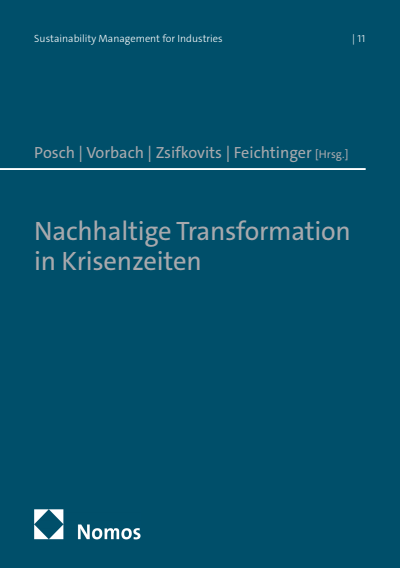
Nachhaltige Transformation in Krisenzeiten
- Editors:
- | | |
- Series:
- Sustainability Management for Industries, Volume 11
- Publisher:
- 2025
Summary
In economically challenging times, strategies for the
twin transition — the green and digital transformation — are essential. The restructuring of our economic system creates sustainable opportunities for innovation but also entails risks. Companies must develop new concepts to harness ecological and digital potential, engage stakeholders, and strengthen resilience. Under the motto
Sustainable Transformation in Times of Crisis, the 11th volume in the
Sustainability Management for Industries (SMI) series presents practical contributions on industrial transformation, climate neutrality, and the circular economy. Case studies and solution-oriented approaches illustrate how companies can make their value creation sustainable and remain fit in the future.
With contributions by Josef Baumüller | Therese Bouvier-Schwarz | Daniel Dantine | Gerald Feichtinger | Bernhard Freiseisen | Paulina Fernández | Anna Fölser | Mario Hofellner | Gerald Katterbauer | David Koller | Clara Kopeinig | Jacob Kopeinig | Kevin Anton Kriechbaum | Patrick Kuballa | Andreas Meltzer | Thomas Nigl | Viroel Nita | Heinz Nusser | Martin Popowicz | Wolfgang Posch | Susanne Roßkogler | Martin Schönberg | David Schönmayr | Walter Schwaiger | Michael Tost | Andreas Zehetner | Helmut Zsifkovits
Keywords
Search publication
Bibliographic data
- Edition
- 1/2025
- Copyright Year
- 2025
- ISBN-Print
- 978-3-7560-1990-8
- ISBN-Online
- 978-3-7489-5529-0
- Publisher
- Nomos, Baden-Baden
- Series
- Sustainability Management for Industries
- Volume
- 11
- Language
- German
- Pages
- 198
- Product Type
- Edited Book
Table of contents
- Danksagung No access
- Inhaltsverzeichnis No access
- Authors: |
- 1. Introduction No access
- 2. The Clean Industrial Deal and GHG Management No access
- 3.1. Activity-Based GHG Accounting and Management No access
- 3.2. Activity-Based GHG Accounting: Demonstration No access
- 3.3. Activity-Based GHG (Risk) Management: Applications No access
- 4. Final Considerations No access
- Abbreviations No access
- References No access
- Authors: | |
- 1. Introduction No access
- Structure of the EDM No access
- Creation of the EDM No access
- 2.2. Life Cycle Assessment (LCA) No access
- 2.3. Integration of LCA results into EDM No access
- 3.1. Normalization of LCA-results No access
- 3.2. Completion of the EDM No access
- 4. Discussion No access
- 5. Conclusion No access
- Abbreviations No access
- References No access
- Authors: |
- 1. Introduction No access
- 2.1. ISO standardization No access
- 2.2. Other standards and regulations No access
- 3.1. Morphological analysis of LCAs No access
- 3.2. Terminology for the morphological analysis of LCAs No access
- 3.3. Super-classes for the morphological analysis of LCAs No access
- 3.4. Exemplary application of the morphological box No access
- 4. Discussion and Outlook No access
- Abbreviations No access
- References No access
- Authors: | |
- 1. Introduction No access
- 2. Methodology No access
- 3.1. Functional Unit No access
- 3.2. System boundaries No access
- 3.3. Life Cycle Phases No access
- 3.4. Impact categories No access
- 4.1. Components for welding equipment No access
- 4.2. Transportation to the manufacturer No access
- 4.3. Production No access
- 4.4. Transportation to customer No access
- 4.5. Use phase of welding equipment No access
- 4.6. Repair No access
- 4.7. End-of-Life No access
- 5. Life Cycle Impact Assessment Results No access
- 6. Implications No access
- 7. Conclusion and Outlook No access
- Abbreviations No access
- References No access
- Authors:
- 1. Motivation No access
- 2.1. Anwendungsbereich No access
- 3.1. EU-Taxonomie No access
- 3.2. Corporate Sustainability Reporting Directive No access
- 4.1. Klimawandelfolgen und Resilienz No access
- 4.2. Emissionen aus Wasserkraftreservoiren No access
- 4.3. Verortung von Nachhaltigkeitsmaßnahmen No access
- 5. Resümee und Ableitung von Handlungsempfehlungen No access
- Abkürzungsverzeichnis No access
- Literatur No access
- Authors: |
- 1. Einleitung No access
- 2. Literatur und Datensammlung No access
- 3. Methodik No access
- 4. Ergebnisse No access
- 5. Schlussfolgerung und Ausblick No access
- Abkürzungsverzeichnis No access
- Literatur No access
- Authors: |
- 1. Einleitung No access
- 2. Das Konzept der zirkulären Kohlenstoffwirtschaft No access
- 3. Erforderliche Rahmenbedingungen für die Transformation zur CO₂-Nutzung im Kohlenstoffmarkt No access
- 4. Die CO₂ Value Chain – Von der Abscheidung zur Wertschöpfung No access
- 5.1. Chemische Nutzung No access
- 5.2. Biologische Nutzung No access
- 5.3. Mineralische Nutzung No access
- 5.4. Physikalische Nutzung No access
- 5.5. Reifegradübersicht und Entwicklungsperspektiven: Die CO₂-Nutzung im S-Kurven-Modell No access
- 6. Diskussion No access
- 7. Fazit und Ausblick No access
- Abkürzungsverzeichnis No access
- Literatur No access
- Authors: |
- 1. Einleitung No access
- Verengen (narrowing) No access
- Verlangsamen (slowing) No access
- Schließen (closing) No access
- 3. Der „Last-Mile-Gap“ No access
- 4. Diskussion und Fazit No access
- Literatur No access
- Authors: | |
- 1.1. Die doppelte Herausforderung: Kosten und Nachhaltigkeit No access
- Reduzierung der Energiekosten No access
- Geringere Betriebs- und Wartungskosten No access
- Steigerung der Produktivität No access
- Signifikante CO2-Einsparungen No access
- Effiziente Ressourcennutzung No access
- Einhaltung höchster Hygienestandards No access
- Schnelle Amortisation No access
- Flexible und skalierbare Lösungen No access
- Zukunftssicherheit No access
- 2. Vorgehensweise zur Systembewertung No access
- 3. Fazit No access
- Abkürzungsverzeichnis No access
- Literatur No access
- Authors: | |
- 1. Introduction No access
- 2. Method No access
- 3.1. Appropriate Frame No access
- 3.2. Creative Alternatives No access
- 3.3. Reliable Information and Uncertainty No access
- 3.4. Clear values No access
- 3.5. Logically correct reasoning No access
- 3.6. Commitment to action No access
- 4. Conclusion No access
- List of abbreviations No access
- References No access
- Authors: | |
- 1. Context No access
- 2. Overview of the lithium-ion battery supply chain No access
- 3. Supply chain transparency No access
- 4.1. Capturing of real-world supply chains in trade statistics No access
- 4.2. Country-of-origin reporting and bilateral asymmetries No access
- 5. Voluntary initiatives and regulations No access
- 6. Traceability of the mineral supply chains No access
- 7. The EU battery regulation No access
- 8. Conclusions No access
- Abbreviations No access
- References No access
- Authors: |
- 1.1. Einfluss der Industrie auf die Umwelt No access
- 1.2. Beitrag der Industrie zum Wohlstand in der EU No access
- 1.3. Ressourcensituation in Europa No access
- Twin Transition No access
- Industrie 5.0 No access
- Clean Industrial Deal No access
- 2. Methode No access
- 3. Ergebnisse No access
- 4. Diskussion No access
- 5. Ausblick No access
- Abkürzungsverzeichnis No access
- Literatur No access
- Autorenverzeichnis No access
- Index No access