, to see if you have full access to this publication.
Edited Book No access
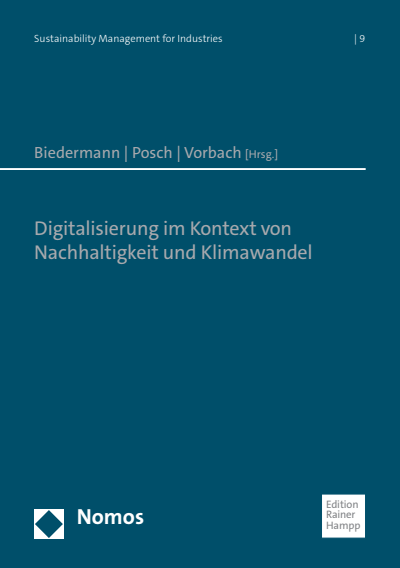
Digitalisierung im Kontext von Nachhaltigkeit und Klimawandel
- Editors:
- | |
- Series:
- Sustainability Management for Industries, Volume 9
- Publisher:
- 2021
Search publication
Bibliographic data
- Edition
- 1/2021
- Copyright Year
- 2021
- ISBN-Print
- 978-3-98542-009-4
- ISBN-Online
- 978-3-95710-296-6
- Publisher
- Hampp, Baden-Baden
- Series
- Sustainability Management for Industries
- Volume
- 9
- Language
- German
- Pages
- 165
- Product Type
- Edited Book
Table of contents
ChapterPages
- Titelei/Inhaltsverzeichnis No access Pages 1 - 10
- Authors:
- Authors:
- 1.1 Szenario der Energiewende No accessAuthors:
- 1.2 Hauptfaktor Energieeffizienz No accessAuthors:
- Authors:
- 2.1 Aspekte der Digitalisierung No accessAuthors:
- 2.2 Auswirkung auf die Energieeffizienz No accessAuthors:
- Authors:
- 3.1 Einbettung der Digitalisierung in Energiebelange No accessAuthors:
- 3.2 Auswirkung auf Energiemanagementfunktionen No accessAuthors:
- 4. Ausblick No accessAuthors:
- 5. Literatur No accessAuthors:
- Authors: | |
- 1. Einleitung No accessAuthors: | |
- Authors: | |
- 2.1 Petrophysikalische und lithofazielle Parameter No accessAuthors: | |
- 2.2 Hydrologische Bedingungen im Untergrund No accessAuthors: | |
- 2.3 Topographische Einflüsse No accessAuthors: | |
- Authors: | |
- 3.1 Erdwärmesonden No accessAuthors: | |
- 3.2 Abteufung der Bohrung No accessAuthors: | |
- 3.3 Sondeneinbau und Verpressung No accessAuthors: | |
- 3.4 Übergang Energiegewinnung – Verbraucher No accessAuthors: | |
- Authors: | |
- 4.1 Anforderungen an ein Smart Grid System No accessAuthors: | |
- 4.2 Vom Use Case zum Modell No accessAuthors: | |
- Authors: | |
- Authors: | |
- 5.1.1 CO2-Footprint des geothermalen Systems No accessAuthors: | |
- 5.1.2 CO2-Footprint von Pelletheizungen No accessAuthors: | |
- 5.1.3 Vergleichbare CO2 Emissionen aus Erdgas und Heizöl No accessAuthors: | |
- 6. Zusammenfassung No accessAuthors: | |
- 7. Literatur No accessAuthors: | |
- Authors: | | | |
- 1. Introduction No accessAuthors: | | | |
- 2. Scope 3 Carbon Accounting No accessAuthors: | | | |
- Authors: | | | |
- 3.1. Systematic Literature Review Process No accessAuthors: | | | |
- 3.2. Basic Observations No accessAuthors: | | | |
- Authors: | | | |
- 4.1. Definition of Boundaries No accessAuthors: | | | |
- 4.2. Data Collection and Preparation No accessAuthors: | | | |
- 4.3. Evaluation and Interpretation No accessAuthors: | | | |
- Authors: | | | |
- 5.1. Opportunities for Digital Technologies in S3CA No accessAuthors: | | | |
- 5.2. Limitations and Recommendations No accessAuthors: | | | |
- 6. Conclusions No accessAuthors: | | | |
- 7. References No accessAuthors: | | | |
- Authors: | |
- 1. Motivation No accessAuthors: | |
- Authors: | |
- 2.1. Nachhaltigkeit No accessAuthors: | |
- 2.2. Auswirkungen des Einsatzes von AM auf Ökonomie No accessAuthors: | |
- 2.3. Auswirkungen des Einsatzes von AM auf Nachhaltigkeit No accessAuthors: | |
- Authors: | |
- Authors: | |
- 3.1.1. Berechnung des technischen Nutzwertes No accessAuthors: | |
- 3.1.2. Berechnung der Nachhaltigkeitsbilanzen No accessAuthors: | |
- 3.1.3. Berechnung der ökonomischen Eigenschaften No accessAuthors: | |
- 3.2. Einordnen der ganzheitlichen Betrachtung No accessAuthors: | |
- 4. Validierung am Fallbeispiel No accessAuthors: | |
- 5. Zusammenfassung und Ausblick No accessAuthors: | |
- 6. Literatur No accessAuthors: | |
- Authors: |
- 1. Einleitung No accessAuthors: |
- Authors: |
- 2.1 Digitalisierung und Nachhaltigkeit No accessAuthors: |
- 3. Methodik No accessAuthors: |
- 4. Analyse No accessAuthors: |
- 5. Diskussion und Ausblick No accessAuthors: |
- 6. Literatur No accessAuthors: |
- Authors: | |
- 1. Einleitung No accessAuthors: | |
- Authors: | |
- 2.1 Reduktion No accessAuthors: | |
- 2.2 Substitution No accessAuthors: | |
- 2.3 Kompensation No accessAuthors: | |
- 2.4 Referenzszenario: Nicht agieren No accessAuthors: | |
- 3. Systemsicht: Externe Faktoren mit starkem Einfluss No accessAuthors: | |
- 4. Berücksichtigung von Preisschwankungen No accessAuthors: | |
- Authors: | |
- 5.1 Eine neue Wirtschaftlichkeitsrechnung No accessAuthors: | |
- 5.2 Eine digitalisierte Maßnahmenauswahl No accessAuthors: | |
- 6. Literatur No accessAuthors: | |
- Authors: |
- 1. Einleitung No accessAuthors: |
- Authors: |
- 2.1 Warum Visualisierung? No accessAuthors: |
- 2.2 Dialog mit Daten No accessAuthors: |
- Authors: |
- 3.1 Zeitreihendaten No accessAuthors: |
- 3.2 Datenanalyse No accessAuthors: |
- 3.3 Visualisierungsanwendungen No accessAuthors: |
- Authors: |
- Authors: |
- 4.1.1 Ausgangslage und Daten No accessAuthors: |
- 4.1.2 Resultate No accessAuthors: |
- 4.2 Vergleichen von Zeitreihendaten No accessAuthors: |
- 5. Schlussfolgerungen No accessAuthors: |
- 6. Danksagung No accessAuthors: |
- 7. Literatur No accessAuthors: |
- Authors: |
- Authors: |
- 1.1 Problemstellung No accessAuthors: |
- Authors: |
- 1.2.1 Verdichtung mit Edge Computing No accessAuthors: |
- 1.2.2 Informationsgewinn und Datenvisualisierung No accessAuthors: |
- 1.2.3 Entscheidungsfindung No accessAuthors: |
- 2. Edge Computing in der Praxis No accessAuthors: |
- 3. Anwendungen und Ausblick No accessAuthors: |
- 4. Literatur No accessAuthors: |
- Authors: |
- 1. Einleitung No accessAuthors: |
- Authors: |
- Authors: |
- 2.1.1. Das Recycling im Produktlebenszyklus No accessAuthors: |
- 2.1.2. Recyclingverfahren No accessAuthors: |
- 2.2. Digitaler Zwilling No accessAuthors: |
- 3. Eigenes Vorgehen No accessAuthors: |
- 4. Anwendungsbeispiel No accessAuthors: |
- 5. Zusammenfassung und Ausblick No accessAuthors: |
- 6. Literatur No accessAuthors: |
- Authors:
- 1. Einleitung No accessAuthors:
- 2. Definition „Nachhaltige Mitarbeiterentwicklung“ No accessAuthors:
- 3. Gründe für „Nachhaltige Mitarbeiterentwicklung“ No accessAuthors:
- 4. Faktor Mensch in der professionellen Luftfahrt No accessAuthors:
- 5. Faktor Mensch in anderen Unternehmen No accessAuthors:
- 6. Wirksamer Einsatz von e-Learning No accessAuthors:
- 7. Mitarbeitermotivation mit e-Learning No accessAuthors:
- Authors:
- 8.1. Betriebsleiter No accessAuthors:
- 8.2. Industriereinigungskraft No accessAuthors:
- 8.3. LKW-Fahrer No accessAuthors:
- 9. Ausblick No accessAuthors:
- 10. Literatur No accessAuthors:
- Index No access Pages 163 - 165