The isothermal forging of titanium alloys leads to a large amount of process engineering efforts due to the use of inert gas, which can be reduced by encasing the titanium in steel. This study evaluates boundary effects between encasing and billet,...
Forming processes on forging presses often go together with considerable vibrations which negatively affect staff health and machine availability. When designing machine foundations, there is currently a conflict of objectives regarding the optimum...
This study investigated the joint influence of oxygen-free ball milling of titanium aluminide powder (TiAl) and the addition of unalloyed components on the properties of green and sintered parts. The addition of unalloyed powder increases the green...
When hot forging steels, the formation of scale results in a loss of mass and increased tool wear. To analyze how the alloying element chromium affects the formation of the oxide scale layer, a conventional C45 steel is compared to a laboratory melt...
This article examines how force sensors must be positioned to detect incorrect positioning of forging blanks. For this purpose, simulative investigations are carried out on a die. Positions for possible sensor placement are applied in a grid...
Shear cutting is a widely applied process for chipless separation in industry. However, multiple disruptive factors such as ram displacement reduce the shear cutting quality. A system of pneumatic cylinders and pressure accumulators compensates for...
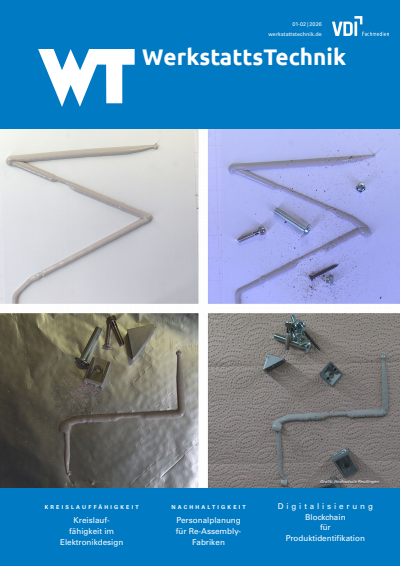
Pressure-sensitive adhesives are used to bond components over a large area. Because of the high viscosity of the adhesive, the surface condition is highly significant for the toughness of the bond. For example, for non-repeatable milled surfaces,...
Rising costs and climate change are forcing us to rethink how we use resources. Resource-saving development processes such as lightweight design are in demand across industries. However, the knowledge of lightweight optimization is often not or only...
The mass production process of fineblanking is suitable for manufacturing functional components, such as gears, due to its high dimensional accuracy, low die roll height, and smooth sheared surface. Requirements on sheared surfaces in technically...
As previous models do not take into account tool-side batch fluctuations, transfering these models into practice is only possible to a limited extent. This is one of the reasons why process adaptation still takes up 8–16 % of production time. To...
Production automation in individual and small series is challenging due to the low level of standardization and heterogeneous requirements. This article derives the requirements for an approach to determine needs-based automation measures and...
MAX phase composites offer great potential for simplifying the process chain of precision glass moulding for the replicative manufacturing of precision optics made of glass. The properties of these materials can be customized by varying the chemical...
Galvanized sheets are indispensable for corrosion protection of components. Tempering of galvanized sheets using roller hearth furnaces can be improved in terms of quality and efficiency. Subsequent surface treatments are often necessary, e.g. for...
The SiPro project, establishment of a continuous simulation process chain in heavy industry, is a project funded by the Federal Ministry for Economic Affairs and Climate Protection (BMWK) as part of the 7th Energy Research Program. The aim is to...