, to see if you have full access to this publication.
Book Titles No access
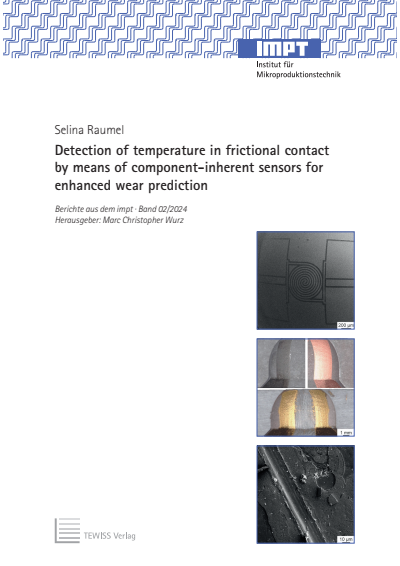
Detection of temperature in frictional contact by means of component-inherent sensors for enhanced wear prediction
- Authors:
- Series:
- Berichte aus dem IMPT, Volume 02/2024
- Publisher:
- 2024
Keywords
Search publication
Bibliographic data
- Copyright year
- 2024
- ISBN-Print
- 978-3-95900-946-1
- ISBN-Online
- 978-3-95900-946-1
- Publisher
- TEWISS, Garbsen
- Series
- Berichte aus dem IMPT
- Volume
- 02/2024
- Language
- German
- Pages
- 173
- Product type
- Book Titles
Table of contents
ChapterPages
- Titelei/Inhaltsverzeichnis No access Pages I - XX
- 1. Introduccion No access Pages 1 - 3
- 2.1 Introduction of friction and frictional contacts No access
- 2.2 Wear mechanisms No access
- 2.3 Influences on friction and wear No access
- 2.4 Mathematical modelling of wear No access
- 3.1 Tribometer No access
- 3.2 Overview of analytical wear models No access
- 3.3 Mathematical contact and flash temperature models No access
- 3.5 Temperature measurement methods in frictional contacts No access
- 3.6 Laser technology for sensor production No access
- 3.7 Laser direct structuring on ceramics No access
- 4.1 Initial situation No access
- 4.2 Research questions No access
- 4.3 Task and objective No access
- 4.4 Approach No access
- 5.1 XHV-adequate atmosphere No access
- 5.2 Universal Mechanical Tester (UMT) No access
- 5.3 Cathode sputtering system No access
- 5.4 Analysis and characterization No access
- 5.5 Thermal stress analysis No access
- 5.6 Sensor production and contacting No access
- 5.7 Electrical measurements and characterization No access
- 5.8 Analytical modelling and simulation No access
- 5.9 Adhesive strength analysis No access
- 5.10 Sensor parameters No access
- 5.11 Properties of technical ceramics No access
- 6.1 Experimental boundary conditions No access
- 6.2 Material selection and sensor design No access
- 6.3 Selective laser ablation of the sensor structure No access
- 6.4 Characterization of the component inherent sensors No access
- 6.5 Interim summary of the sensor development No access
- 7.1 Process development of laser direct structuring on ceramic materials No access
- 7.2 Contacting No access
- 7.3 Transfer of the developed process to a machinable ceramic material No access
- 7.4 Characterization of the conductive tracks No access
- 7.5 Interim summary - LDS on ceramic substrates No access
- 7.6 Production and metallization of the ceramic sphere holder No access
- 8.1 Integration No access
- 8.2 Experimental set-up No access
- 8.3 Results and discussion of the measurements No access
- 8.4 Comparison to mathematical results No access
- 8.5 Summary and discussion of the results No access
- 9.1 Real contact area No access
- 9.2 Friction induced temperature No access
- 9.3 Mechanical and tribological properties No access
- 9.4 Wear calculation No access
- 9.5 Experimental validation of the model No access
- 10 Concluding, Remarks and Perspektives No access Pages 127 - 130
- A.1 Appendix I : Overview of the scope of work for the sensor production No access
- A.2 Appendix II - XHV-adequate atmosphere No access
- A.3 Appendix III - Results temperature measurements No access
- A.4 Appendix IV - Additional measurement attempts No access
- A.5 Preliminary simulations No access
- A.6 Appendix V - xSol No access
- A.7 Appendix VI - Samples after the friction tests No access
- A.8 Appendix VII - Overview of the mathematical model No access
- A.9 Appendix VIII - First preliminary tests on glass No access
- Bibliography No access Pages 143 - 173