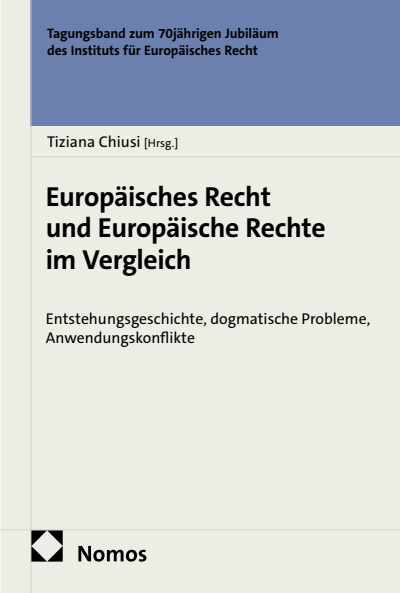
Europäisches Recht und Europäische Rechte im Vergleich
Entstehungsgeschichte, dogmatische Probleme, Anwendungskonflikte- Editors:
- Publisher:
- 2026
Summary
The conference proceedings marking the 70th anniversary of the Institute for European Law show how the common European legal culture is being developed from a variety of national perspectives. From the reception of Roman law to questions of freedom of movement under EU law, from the Europeanisation of economic legislation in Georgia to the new Czech Civil Code, it brings together contributions from legal scholars from Spain, Bulgaria, Georgia, Poland, Czechia and Germany. It deals with developments in national private law, conflicts of application under EU law and fundamental methodological issues. The volume thus continues the Institute's mission to research and compare European laws and promote their convergence, reaffirming the European motto: United in diversity.
With contributions by María José Azaustre Fernandez | Irakli Burduli | Maria Del Carmen Lopez-Rendo Rodriguez | Zurab Dzlierishvili | David Elischer | Margarita Fuenteseca | Aleksander Grebieniow | Simeon Groysman | Ekaterina Mateeva | Ventsislav Petrov | Dimitar Stoyanov
Keywords
Search publication
Bibliographic data
- Edition
- 1/2026
- Copyright Year
- 2026
- ISBN-Print
- 978-3-7560-3609-7
- ISBN-Online
- 978-3-7489-6764-4
- Publisher
- Nomos, Baden-Baden
- Language
- German
- Pages
- 391
- Product Type
- Edited Book
Table of contents
- Vorwort No access
- Grußwort der Direktorin des Instituts für Europäisches Recht No access Pages 11 - 14Authors:
- Grußwort des saarländischen Ministers der Finanzen und für Wissenschaft No access Pages 15 - 16Authors:
- Grußwort der Dekanin der Rechtswissenschaftlichen Fakultät der Universität des Saarlandes No access Pages 17 - 20Authors:
- Grußwort der Vorsitzenden des Clusters für Europaforschung der Universität des Saarlandes (CEUS) No access Pages 21 - 24Authors:
- Rückblick auf das Institut für Europäisches Recht der Universität des Saarlandes – Europäisches Recht contra Europarecht No access Pages 25 - 34Authors:
- Authors:
- I. Die besondere Rolle des Saarlandes in Bezug auf die europäische Integration No access
- 1. Das Konzept der Integration durch Recht No access
- a) Verwandlung zum Verfassungsgericht No access
- aa) autonome Auslegung und Geltung des Unionsrechts No access
- bb) institutionelle Autonomie No access
- c) Integration durch Werte No access
- III. Integration und Demokratie No access
- IV. Schlussfolgerungen No access
- Authors:
- I. Introduction No access
- II. Academic aspects No access
- III. Imperial aspects No access
- IV. Some inferences No access
- Die Ausübung des Rechts auf Freizügigkeit in der EU und die nationale Regelung des Herkunftsmitgliedstaats, die keine Elternschaft von Personen desselben Geschlechts zulässt – Anwendungskonflikte No access Pages 75 - 104Authors:
- Authors:
- I. INTRODUCCIÓN No access
- 1. Ámbito de aplicación territorial No access
- 2. La última residencia habitual del causante en el momento del fallecimiento como nexo general No access
- 3. Estructura de los foros de competencia No access
- 1. El domicilio del heredero-actor sequitur forum rei No access
- 2. El domicilio del causante No access
- 3. El lugar de situación de los bienes hereditarios- forum rei sitae No access
- 1. La definición de Alfeno Varo: elementos materiales del domicilio No access
- 2. La constitución de Diocleciano y Maximiano: elementos intencionales No access
- 3. La distinción entre corpus y animus: construcción dogmática No access
- 4. Criterios complementarios de determinación del domicilio No access
- 5. Criterios negativos: lo que no constituye domicilio No access
- 1. Criterios de determinación según el Considerando 23 No access
- 2. Casos complejos: el Considerando 24 No access
- 3. Carácter único de la residencia habitual: jurisprudencia del TJUE No access
- 4. Características de la residencia habitual No access
- 1. Insuficiencia de las declaraciones del interesado No access
- 2. Estancias pasajeras previas a la muerte No access
- 3. Casos de residencia escindida: trabajo vs. vida familiar No access
- 4. Jurisprudencia del TJUE: casos principales No access
- 5. Valoración de la jurisprudencia No access
- 1. Identidad de los conceptos de domicilium y residencia habitual No access
- 2. El principio domicilium re et facto transfertur, non nuda contestatione No access
- 3. La distinción entre lugar de residencia y lugar de trabajo No access
- 4. Los criterios de integración social No access
- 5. La insuficiencia de criterios patrimoniales aislados No access
- 6. El tratamiento de las situaciones temporales No access
- VIII. CONCLUSIONES No access
- FALTARIA INCLUIR LA BIBLIOGRAFIA QUE IBA EN EL ORIGINAL No access
- Authors:
- I. Einleitung No access
- II. Römisches Recht No access
- III. Rezeption No access
- IV. Phase der Kodifizierung No access
- V. Europäische Erbrsechtsverordung No access
- VI. Schlussfolgerungen No access
- Authors:
- I. Einführung No access
- II. Historischer Kontext, Paradigma der Rechtspolitik und Bedeutung des Assoziierungsabkommens No access
- 1. Recht der oHG No access
- 2. Recht der KG No access
- 1. Recht der GmbH No access
- a) „Re-Regulierungsart“ des Aktienrechts No access
- b) Notwendigkeit des inklusiven Systems No access
- c) Die Betrachtung der Frage im Kontext der Kapitalstruktur und der Wertpapiermärkte No access
- d) Kapitalmarktrecht und institutionelle Eigenschaft No access
- V. Schlussbemerkung No access
- Authors:
- I. Un bref retour sur l’évolution de la législation civile tchèque No access
- 1. Le droit de la consommation No access
- 2. Le droit de préemption No access
- 3. Le droit locatif No access
- 4. Le droit de la famille No access
- III. Conclusion No access
- Authors:
- I. Die agnati sind jedoch… (agnati autem sunt…) No access
- II. Die cognati sind… No access
- III. Unterscheidung zwischen agnati und cognati No access
- IV. Agnatio und Abstammungslinien römischer Bürger No access
- Authors:
- Fazit No access
- Authors:
- I. Introduction No access
- 1. General Remarks No access
- a) Condition on the Part of the Exploited Party No access
- b) Criterion on the Part of the Exploiting Party No access
- 3. The Objective Condition No access
- 1. General remarks No access
- 2. Avoidance of the Contract No access
- 3. Partial Avoidance and Adaptation of the Contract No access
- 4. Additional Claim for Damages No access
- 5. Renegotiation of the Contract No access
- IV. Conclusions No access
- Authors:
- 1. In one part of European legislations the relative invalidity is explicitly established as one of the forms of the invalidity. No access
- 2. In another part of European legislations the relative invalidity is not explicitly established as one of the forms of the invalidity. It finds expression in other forms of invalidity. No access
- II. According to the second view, the relative invalidity is not a form of invalidity. No access
- Authors:
- I. Einleitung No access
- II. Vorentwurfe vor dem Zweiten Weltkrieg No access
- III. Vorentwürfe nach dem Zweiten Weltkrieg No access
- IV. Kleine Anmerkungen zum polnischen Zivilgesetzbuch von 1964 No access
- V. Fazit No access
- Authors:
- 1. Outlook of the study No access
- 2. “Geography” of the study No access
- 1. The Dichotomous Approach: Origins and Exemplary Applications No access
- 2. Savigny’s Four-Element Canon No access
- 3. Further Relevant Elaborations on Legal Interpretation No access
- 1. Historical development of Bulgarian law and legal science No access
- 2. Classics of Bulgarian Civil Law Science No access
- 3. Tseko Torbov and the philosophization of legal interpretation No access
- 1. Acceptance of Soviet Theory on Legal Interpretation at the Dawn of Socialist Bulgaria No access
- 2. Concepts of Interpretation in Bulgarian Socialist Legal Science No access
- V. Current state of doctrine No access
- 1. Conclusion on the reasons for the disagreements regarding logical interpretation No access
- 2. Conclusion on the competing systems of interpretation methods in the theoretical debate in Bulgaria No access
- Einflussnahme des deutschen Rechts auf die georgische Zivilrechtsfortbildung durch die Auslegung des georgischen Obersten Gerichts (II) No access Pages 347 - 356Authors:
- Authors:
- Einführung No access
- I. Umfang der AGB-Kontrolle No access
- II. Wirkung, rechtliche Folgen der Missbräuchlichkeit und Zuständigkeitsbereich nationaler Gerichte No access
- Zusammenfassung No access
- Authors:
- I. Historische Einleitung – Der Weg Polens zum Vindikationsvermächtnis No access
- II. Bestimmung und Gegenstand des Vindikationsvermächtnisses No access
- III. Wirksamkeit des Vermächtnisses No access
- IV. Haftung des Vermächtnisnehmers für die Schulden des Erblassers No access
- V. Schlussfolgerungen No access
- Verzeichnis der Autorinnen und Autoren No access Pages 389 - 390