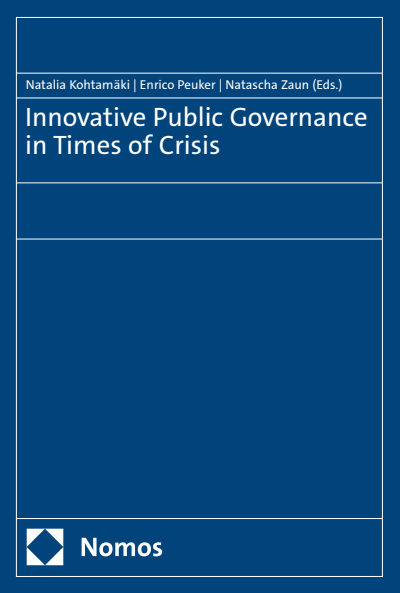
Innovative Public Governance in Times of Crisis
- Herausgeber:innen:
- | |
- Verlag:
- 2024
Zusammenfassung
Der Sammelband verbindet zwei wichtige Trends in der aktuellen Entwicklung der öffentlichen Verwaltung und des Verwaltungsrechts. Er untersucht, wie Innovationen im institutionellen oder regulatorischen Bereich zum Krisenmanagement beitragen können. Hierzu versammelt der Band internationale Rechts- und Sozialwissenschaftler:innen, die innovative Governancearrangements auf nationaler, europäischer und internationaler Ebene als Antworten auf die Finanz-, die Migrations- und die Coronakrise analysieren. Die Herausgeber:innen des Bandes sind Experten:innen im Bereich des Verwaltungsrechts, der Verwaltungswissenschaft, des Europarechts und Public Policy.Mit Beiträgen vonAssoc.-Prof. Maija Dahlberg | Prof. Johannes Eichenhofer | Dr. Michał Florczak | Prof. Robert Frau | Dr. Laura Kihlström | Dr. Dimitrios Kivotidis | Prof. Natalia Kohtamäki | Prof. Magdalena Kmak | Prof. Łukasz Łotocki | Prof. Artur Nowak-Far | Prof. Eeva Nykänen | Prof. Enrico Peuker | Stephen Philips | Dr. Jakob Schemmel | Prof. Sebastian Sikorski | Dr. Liina-Kaisa Tynkkynen | Prof. Natascha Zaun
Schlagworte
Publikation durchsuchen
Bibliographische Angaben
- Auflage
- 1/2024
- Copyrightjahr
- 2024
- ISBN-Print
- 978-3-7560-1824-6
- ISBN-Online
- 978-3-7489-4487-4
- Verlag
- Nomos, Baden-Baden
- Sprache
- Englisch
- Seiten
- 227
- Produkttyp
- Sammelband
Inhaltsverzeichnis
- Titelei/InhaltsverzeichnisSeiten 1 - 6 Download Kapitel (PDF)
- Autor:innen: | |Download Kapitel (PDF)
- I. The phenomenon of crises in troubled times
- II. Scope and content
- III. Structure of the book
- Autor:innen:Download Kapitel (PDF)
- I. Introduction
- II.1. Global governance as a means of providing public goods/services
- II.2. The basic regulatory structures available to address global crises
- II.3. The financial realm of the coordination of international public policy
- II.4. The health realm of the international public policy consideration
- III. Conclusions
- Autor:innen:Download Kapitel (PDF)
- I.1. Theory of Institutional Change
- I.2. Identifying Institutional Change in Financial Markets Law
- II.1. The European Council and the Member States
- II.2. The European Central Bank
- II.3. The Commission and the European Parliament
- III.1.1. Building uniformity and gathering information
- III.1.2. Ensuring uniformity by enforcement
- III.2.1. European agencies
- III.2.2. The Banking Union
- III.3.1. The EFSF and ESM
- III.3.2. OMT and PSPP
- IV.1. Constitutional resilience and evolution
- IV.2. Expert governance and national sovereignty
- V. Key findings
- Autor:innen:Download Kapitel (PDF)
- I. Introduction
- II. Competing interpretations of crisis
- III. 'Innovative' administrative reform in Greece
- IV. Innovative or retrogressive?
- V. Conclusions
- Autor:innen: |Download Kapitel (PDF)
- I. Introduction
- II.1. What is a ‘migration crisis’?
- II.2. Coloniality and the myth of difference
- III.1. Haitian Refugee Crisis
- III.2. 9/11 and the Tampa Crisis
- III.3. The 2015 Refugee Crisis in the EU
- IV. Evaluating the crisis response
- Autor:innen:Download Kapitel (PDF)
- I. Introduction – crisis as a category of analysis
- II.1. Migration crisis in 2015
- II.2. EU-Belarusian border crisis in 2021
- II.3. Refugee crisis caused by the war in Ukraine in 2022
- III. Innovations in Public Governance in the context of the migration crisis
- IV. Introduction of a hotspot approach during the 2015 crisis
- V. Implementation of a relocation scheme during the 2015 crisis
- VI. Arrangements with third countries to reduce migration flows following the 2015 crisis
- VII. Shift to a more restrictive migration policy paradigm
- VIII. The first ever implementation of the Temporary Protection Directive
- IX. Conclusions
- Autor:innen:Download Kapitel (PDF)
- I.1. The ‘refugee crisis’ as a challenge for the German asylum and migration governance
- I.2.1. The requirements of international, European, and German asylum, refugee and human rights protection as pressure for action
- I.2.2. Complex structures and reform backlog within German asylum and migration governance as an obstacle
- II.1.1. Faster and ‘better’ registration
- II.1.2. Improving data exchange by expanding digital technology
- II.1.3. Acceleration of asylum procedures
- II.I.4. Faster integration for asylum seekers with ‘good prospects of remaining’
- II.1.5. Measures to accommodate asylum seekers
- II.1.6. Measures to deter new immigrants
- II.2. Reaction as innovation? On the innovative potential of the measures taken
- II.3. Conclusion
- III. Lessons learned? Testing German asylum and migration governance in the context of the Russian invasion of Ukraine
- Autor:innen:Download Kapitel (PDF)
- I.1.1. The WHO as a player in international law
- (a) Internal ‘law’
- (b) Treaty-making powers
- (c) Temporary recommendations
- I.2. UN-Security Council’s practice
- II.1. The WHO
- II.2.1. Res. 2532 (2020)
- II.2.2. Res. 2565 (2021)
- II.2.3. Statement by the President of the Security Council
- II.3. International Response during Covid-19 and the Innovations introduced
- II.4. Aftermath
- III. The Human Rights Dimension
- IV. Result
- Autor:innen: |Download Kapitel (PDF)
- I. Introduction
- II.1. Exploring technological innovation during the Covid-19 pandemic crisis
- II.2. New trends in patient care
- III.1. EU policy strategy for artificial intelligence system
- III.2. High-risk AI systems
- IV. Conclusions
- Autor:innen: | | |Download Kapitel (PDF)
- I. Introduction
- II.1. Overview of the administrative and legal framework
- II.2.1. Communicable Diseases Act
- II.2.2. Emergency Powers Act
- II.2.3. Section 23 of the Constitution
- II.3. Conclusions on the use of legal instruments governing the health crisis
- III.1. Study and data description
- III.2. Emergency Powers Act and the Communicable Diseases Act: Perspectives of the health system leaders
- III.3. Innovative management during Covid-19
- III.4. Summary of the empirical findings
- IV. Conclusions
- IndexSeiten 223 - 226 Download Kapitel (PDF)
- ContributorsSeiten 227 - 227 Download Kapitel (PDF)