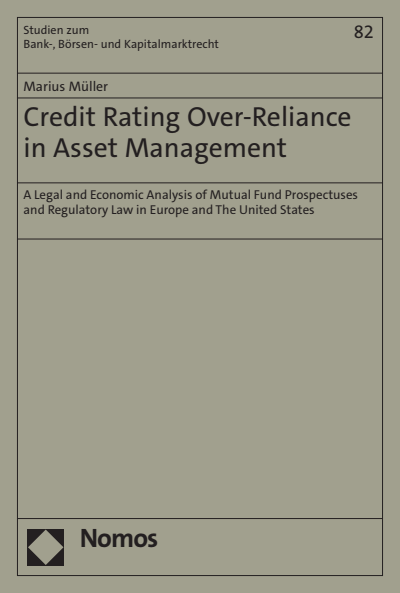
Credit Rating Over-Reliance in Asset Management
A Legal and Economic Analysis of Mutual Fund Prospectuses and Regulatory Law in Europe and The United States- Autor:innen:
- Reihe:
- Studien zum Bank-, Börsen- und Kapitalmarktrecht, Band 82
- Verlag:
- 2023
Zusammenfassung
Durch die Finanzkrise 2008 wurden der weitreichende Einfluss von Kreditratings an den Kapitalmärkten in den Fokus gerückt sowie Zweifel an der Qualität der von den Agenturen veröffentlichten Ratings bestätigt. Im Kontext regulatorischer Bemühungen den Einfluss von Ratings einzuschränken, setzt sich das Werk mit der Frage auseinander, inwieweit Investmentfonds dazu verpflichtet sind, Anleihen zu veräußern, die nach einer Rating-Herabstufungen nicht mehr den Anlagerichtlinien entsprechen. Nach einer stat. Analyse von 200 europäischen und US-amerikanischen Fondsprospekten folgt eine Bewertung der Regelungsziele und Erarbeitung eines Strukturvorschlags für die Formulierung von Richtlinien im Sinne des Anleger- und Marktfunktionsschutzes.
Schlagworte
Publikation durchsuchen
Bibliographische Angaben
- Copyrightjahr
- 2023
- ISBN-Print
- 978-3-7560-1335-7
- ISBN-Online
- 978-3-7489-1862-2
- Verlag
- Nomos, Baden-Baden
- Reihe
- Studien zum Bank-, Börsen- und Kapitalmarktrecht
- Band
- 82
- Sprache
- Englisch
- Seiten
- 262
- Produkttyp
- Monographie
Inhaltsverzeichnis
- Titelei/Inhaltsverzeichnis Kein Zugriff Seiten 1 - 20
- A. Background Kein Zugriff
- 1. Regulation of Rating Over-Reliance in Asset Management Kein Zugriff
- 2. Credit Rating Downgrades as Threat to Financial Stability Kein Zugriff
- 3. Investment Guidelines as Subject of Regulation and Supervision Kein Zugriff
- C. Research Questions Kein Zugriff
- D. Methodology and Approach Kein Zugriff
- 1. Historic Development Kein Zugriff
- (i) Role of Creditworthiness Information for Financial Markets Kein Zugriff
- (ii) Function of Credit Rating Agencies as Information Intermediary for Market Participants Kein Zugriff
- 3. Market for Intermediated Financial Information as Structural Determinant Kein Zugriff
- 4. Credit Ratings Agencies within the Efficient Market Hypothesis Kein Zugriff
- 5. Credit Ratings between Transaction and Information Markets Kein Zugriff
- 6. Summary Kein Zugriff
- 1. Assessment of Default Probability Kein Zugriff
- (i) Subjective Third-Party Opinion Kein Zugriff
- (ii) Relative Grading of Creditworthiness Kein Zugriff
- (iii) Symbolical Expression of Credit Rating Kein Zugriff
- (i) Investor Pays vs. Issuer Pays Model Kein Zugriff
- (ii) The Rating Process: Solicited vs. Unsolicited Ratings Kein Zugriff
- (i) Issuer Rating Kein Zugriff
- (a) Bonds Kein Zugriff
- (b) Structured Financial Products Kein Zugriff
- (c) Preferred Stock Kein Zugriff
- (d) Sovereigns Kein Zugriff
- 5. Summary: Credit Ratings as Universal and Subjective Third-Party Opinions on Credit Risk Kein Zugriff
- 1. Regulation of Banks – Basel I, II & III Kein Zugriff
- 2. Regulation of Market Access Kein Zugriff
- (i) Insurances & Pension Funds Kein Zugriff
- (a) US Money Market Funds Kein Zugriff
- (b) EU Money Market Funds Kein Zugriff
- (a) Types of Debt Contract Rating Triggers Kein Zugriff
- (b) Implications of Debt Contract Rating Triggers Kein Zugriff
- (ii) Rating-Based Risk Limits and Strategies within Investment Mandates Kein Zugriff
- (iii) Summary: Credit Ratings’ Regulatory Function with Evident Trigger Effects Kein Zugriff
- (i) East-Asian Financial Crisis Kein Zugriff
- (ii) Corporate Bankruptcies: Enron and WorldCom Kein Zugriff
- (a) US Residential House Financing – Mortgage-Backed Securities and Collateralized Debt Obligations Kein Zugriff
- (b) Wide-Ranging Rating Downgrades Following Collapse of US Housing Market Kein Zugriff
- (iv) Sovereign Rating Downgrades as Crisis Contagion Kein Zugriff
- (i) Cognitive Biases and Skewed Incentives Kein Zugriff
- (ii) Parallels in Proposed Policy Implications Kein Zugriff
- (i) Flawed Rating Processes and Models as Source of Error Kein Zugriff
- (ii) Inaccurate Ratings as Result of Flawed Models and Processes Kein Zugriff
- 4. Misconceptions of Credit Ratings’ Meaning – Rating Over-Reliance Kein Zugriff
- (i) Structural Implications of Debt Markets Kein Zugriff
- (ii) Market Timing Implications Kein Zugriff
- (iii) Contagion through Credit Rating Agencies’ Rules Kein Zugriff
- (iv) Liquidity Squeeze Resulting from Sell-Offs Kein Zugriff
- 6. Summary: Consequences to Downgrades Following Ratings’ Failed Information Function Fortified through Rating Over-Reliance and Disadvantageous Structural and Situational Determinants Kein Zugriff
- 1. IOSCO Code of Conduct and Reputation Kein Zugriff
- (i) Credit Rating Agency Reform Act of 2006 Kein Zugriff
- (ii) Dodd Frank Act of 2010 Kein Zugriff
- 3. Regulation and Liability of CRAs in the EU Kein Zugriff
- 4. Summary Kein Zugriff
- 1. Market Segmentation through Rating Defined Investment Limits Kein Zugriff
- 2. Evidence for Synchronizing References to the Investment Grade Boundary Kein Zugriff
- (i) Results of Studies on Bond, Credit Default Swaps and Stock Prices Kein Zugriff
- (ii) Strong Price Movements around the Investment-/Non-Investment Grade Barrier Kein Zugriff
- (iii) Significance of Market Reactions of Solicited and Unsolicited Ratings Kein Zugriff
- (iv) Market Reactions in Advance of Rating Changes Kein Zugriff
- (v) Stronger Market Reactions to Downgrades Compared to Upgrades Kein Zugriff
- (i) Market Segmentation through Rating-Based Investment Limits Kein Zugriff
- (ii) Investment Grade Barrier as Synchronizer of Rating-Based Rules Kein Zugriff
- 3. Summary: Material Informational Value Inexplicable by the Semi-Efficient Market Hypothesis and Need for Regulation of Forced Sell-Offs with Focus on Investment Grade Barrier Kein Zugriff
- (i) US Approach to Reduce Rating Reliance: Early Initiatives and Dodd Frank Kein Zugriff
- (a) Content of Financial Stability Board Guidelines Kein Zugriff
- (1) CRA III Kein Zugriff
- (2) Non CRA III initiatives Kein Zugriff
- 2. Summary: Orchestrated and Wide-Ranging Initiatives to Reduce Rating Reliance within the US and Europe Kein Zugriff
- 1. Rationale for Collective Investments & Significance of Asset Management Kein Zugriff
- (i) Money Market Funds Kein Zugriff
- (ii) Investment Grade Index Funds Kein Zugriff
- (a) Collateral Downgrades Kein Zugriff
- (b) Counterparty Downgrade Kein Zugriff
- (c) Downgrade through Investment Guideline Minimum Risk Boundary Kein Zugriff
- 1. Historic Emergence of Investment Guidelines for Mutual Funds Kein Zugriff
- (i) Discretion, Moral Hazard and Economic Incentives Kein Zugriff
- (ii) Governance of Collective Investments Kein Zugriff
- 3. Emergence and Driver of Credit Rating References in Investment Guidelines Kein Zugriff
- 1. Introduction of KAGB §29 (2a) on the Basis of CRA III Article 5a Kein Zugriff
- 2. Amendments to Investment Act of 1940 Following Section 939 of Dodd Frank Kein Zugriff
- (i) Response by German Financial Market Authority BaFin Kein Zugriff
- (ii) Response by the SEC Kein Zugriff
- (i) Demand of Individual Credit Risk Assessments & Communication of Downgrade Procedures Kein Zugriff
- (ii) Access to Underlying Credit Rating Information Kein Zugriff
- (iii) Disclosure on Uses of External Ratings Kein Zugriff
- (iv) Quality of Counterparties and Collateral Kein Zugriff
- (v) Managing External Credit Rating Changes Kein Zugriff
- (vi) Investor Reliance on External Credit Ratings Kein Zugriff
- (vii) Summary: Confirmation of Ratings’ Market Relevant Role within Investment Guidelines & Proposals for Adjustment Kein Zugriff
- (i) General Joint Committee Good Practices Kein Zugriff
- (ii) Specific Joint Committee Good Practices Kein Zugriff
- 6. Comparative Summary of IOSCO and Joint Committee Good Practices Kein Zugriff
- (i) Pre-Crisis Survey Study by Cantor, Thomas and Gwilym Kein Zugriff
- (ii) Text Recognition Study on US Mutual Fund Investment Guidelines Kein Zugriff
- 2. Need for Comprehensive Empirical Review of Status-Quo Kein Zugriff
- 1. Do mutual fund investment guidelines pose a source of mechanistic rating reliance that can trigger forced sell-offs in a downgrade scenario? Kein Zugriff
- 2. Is there a consistent approach between US and EU issued documentation to address mechanistic rating reliance? Kein Zugriff
- 3. What constitutes non-mechanistic investment guidelines? Kein Zugriff
- 4. Which implications derive from investment guidelines that do not mechanistically rely on external credit ratings? Kein Zugriff
- 1. Model Requirements Kein Zugriff
- (i) Score Computation Structure Kein Zugriff
- (ii) Screening Process and Data Kein Zugriff
- (a) US Fund Database Kein Zugriff
- (b) E.U. Fund Database Kein Zugriff
- (i) Variable 1: Jurisdiction of Offering Kein Zugriff
- (ii) Variable 2: Size of Asset Management Firm Kein Zugriff
- (a) European Investment Objectives Kein Zugriff
- (b) US Investment Objectives Kein Zugriff
- (i) Group 1: Determinants of Rating Reliance Kein Zugriff
- (ii) Group 2: Divestment Controls Kein Zugriff
- (iii) Group 3: Divestment Alleviating Factors Kein Zugriff
- 1. Determining the Appropriate Econometric Methodology Kein Zugriff
- 2. Statistical Analysis of Results – Mann Whitney U-Test Kein Zugriff
- 3. Hypothesis Based Test Procedure Kein Zugriff
- 1. Hypothesis 1: There is no significant reliance on credit ratings. Kein Zugriff
- 2. Hypothesis 2: Mutual funds will not be forced to sell-off portfolio positions following a rating downgrade below the investment grade boundary by either S&P, Moody’s or Fitch. Kein Zugriff
- 3. Hypothesis 3: There is equal rating reliance between mutual fund prospectuses issued in the EU and the US. Kein Zugriff
- 4. Hypothesis 4: Large asset management firms are less reliant on external ratings compared to smaller firms Kein Zugriff
- 5. Hypothesis 5: Mutual funds categorized as “Investment Grade” funds are on average more reliant on external ratings. Kein Zugriff
- 6. Hypothesis 6: Mutual funds categorised as High Yield and Specialised Funds rely, on average, less mechanistically on external ratings compared to other all funds. Kein Zugriff
- (i) Structure of the Two-Sample Z-Test Kein Zugriff
- (ii) Rating Reliance Criteria and Jurisdiction Kein Zugriff
- (iii) Rating Reliance Criteria and Fund Size Kein Zugriff
- (i) Do mutual fund investment guidelines pose a source of mechanistic rating reliance that can trigger forced sell-offs in a downgrade scenario? Kein Zugriff
- (ii) Is there a consistent approach between US and EU issued documentation to address mechanistic rating reliance? Kein Zugriff
- (iii) What constitutes non-mechanistic investment guidelines? Kein Zugriff
- (i) Lack of Rating References and Contract Elements as Source of Low Rating Reliance Kein Zugriff
- (ii) Varied Results by Hypotheses Tests on Firm Size and Fund Type Kein Zugriff
- (iii) Non-Expressive Results from Differentiation between Fund Size and Reliance Categories Kein Zugriff
- (iv) Characteristics of Non-Mechanistically Rating Relying on Investment Guidelines Kein Zugriff
- (i) Theoretical Drawbacks to Elements of Divestment Controls Kein Zugriff
- (ii) Implications Deriving from Theoretical Drawbacks of Divestment Controls Kein Zugriff
- 4. Discussion on Conflict between Investor Protection and Enablement of Market Functioning Kein Zugriff
- (i) Decline in Role of Internal Risk Assessments Kein Zugriff
- (ii) Unclarity over Share of Rating-Based Investment Guidelines Kein Zugriff
- (iii) No Utilisation of Rating Outlooks or Watchlist Conditions Kein Zugriff
- (iv) Fewer Retention Clauses than Stated in 2007 Kein Zugriff
- (v) Equal Share of Proportionate Rating Definitions Kein Zugriff
- (vi) Confirmation of Results on US funds Kein Zugriff
- (vii) Concluding the Comparative Review of Empirical Findings Kein Zugriff
- (v) Relative Positioning to Previous Studies Kein Zugriff
- V. Summary and Conclusion Kein Zugriff Seiten 231 - 236
- 1. List of EU Funds Analysed (Table 9) Kein Zugriff
- 2. List of US Funds Analysed (Table 10) Kein Zugriff
- B. Empirical Model Structure (Table 11) Kein Zugriff
- 1. Reliance Score Distribution (Figure 2) Kein Zugriff
- 2. Immediacy Score Distribution (Figure 3) Kein Zugriff
- Bibliography Kein Zugriff Seiten 251 - 262
Literaturverzeichnis (215 Einträge)
Es wurden keine Treffer gefunden. Versuchen Sie einen anderen Begriff.
- Abidi, Nordine, and Falagiarda Matteo, and Miquel-Flores, Ixart. 2019. Credit rating dynamics: evidence from a natural experiment” European Central Bank Working Paper Series No. 2274. Google Scholar öffnen DOI: 10.5771/9783748918622
- Ackermann, Ulrich, and Joachim Jäckle. 2006. “Ratingverfahren aus Emittentensicht.” In Betriebs-Berater, 878–884. Google Scholar öffnen DOI: 10.5771/9783748918622
- Adams, Charles, Donald Mathieson, and Garry Schinasi. 1999. International Capital Markets. International Monetary Fund., International Monetary Fund Publication Services. Google Scholar öffnen DOI: 10.5771/9783748918622
- Aizenman, Joshua, Mahir Binici, and Michael Hutchison. 2013. “Credit ratings and the pricing of sovereign debt during the euro crisis.” Oxford Review of Economic Policy (Oxford University Press.) 29: 582–609. Google Scholar öffnen DOI: 10.5771/9783748918622
- Alfaro, Laura. 2014. “Sovereign Debt Restructuring: Evaluating the Impact of the Argentina Ruling” Harvard Law Review Google Scholar öffnen DOI: 10.5771/9783748918622
- Almeida, Heitor, Igor Cunha, Miguel Ferreira, and Felipe Restrepo. 2017. “The Real Effects of Credit Ratings: The Sovereign Ceiling Channel.” The Journal of Finance 72 (2): 250–290. Google Scholar öffnen DOI: 10.5771/9783748918622
- Amadou, Sy N.R.. 2009. “The Systemic Regulation of Credit Rating Agencies and Rated Markets” International Monetary Fund Working Paper Google Scholar öffnen DOI: 10.5771/9783748918622
- Asmussen, Jörg. 2005. “Rating-Agenturen und Finanzaufsicht.” Betriebswirtschaftliche Forschung und Praxis, (3) 246–255. Google Scholar öffnen DOI: 10.5771/9783748918622
- Athanassiou, Phoebus. 2015. “Reducing Over-Reliance on Credit Rating Agencies: State of Play and Challenges Ahead.” Journal of European and Comparative Law 22 (5): 662. Google Scholar öffnen DOI: 10.5771/9783748918622
- Aramonte, Eren. 2019. “Investment mandates and fire sales: the case of mutual funds and BBB bonds.” BIS Quarterly Review, Google Scholar öffnen DOI: 10.5771/9783748918622
- Arendts, Martin. 1993. “ Beratungs- und Aufklärungspflichten über das einem Wertpapier erteilte Rating“ in: Wertpapier-Mitteilungen Teil IV — Zeitschrift für Wirtschafts- und Bankrecht (WM) 1993, 229 ff. Google Scholar öffnen DOI: 10.5771/9783748918622
- Arrow, Kennethin. 1985. “The Economics of Agency” in: Pratt, John and Zeckhauser, Richard. 1985. Principals and Agents: The Structure of Business, 37–51. Google Scholar öffnen DOI: 10.5771/9783748918622
- BaFin, (Bundesanstalt für Finanzdienstleistungsaufsicht). 2011. “Der Wertpapierprospekt – Türöffner zum deutschen und europäischen Kapitalmarkt.” Google Scholar öffnen DOI: 10.5771/9783748918622
- BaFin, (Bundesanstalt für Finanzdienstleistungsaufsicht). 2014. “German action plan to reduce overreliance on CRA ratings.” Google Scholar öffnen DOI: 10.5771/9783748918622
- BaFin, (Bundesanstalt für Finanzdienstleistungsaufsicht). 2014. “Notes on the use of external ratings and on making own credit risk assessments” Google Scholar öffnen DOI: 10.5771/9783748918622
- Baghai, Ramin, Bo Becker, and Stefan Pitschner. 2018. “The Private Use of Credit Ratings: Evidence from Investment Mandates.” Google Scholar öffnen DOI: 10.5771/9783748918622
- Bank für Internationalen Zahlungsausgleich. 2005. “Basler Ausschuss für Bankenaufsicht, Änderung der Eigenkapitalvereinbarung zur Einbeziehung der Marktrisiken (2006).” Google Scholar öffnen DOI: 10.5771/9783748918622
- Bank for International Settlement. 2009. “The Joint Forum, Stocktaking on the Use of Credit Ratings, Basel Committee on Banking Supervision.” Google Scholar öffnen DOI: 10.5771/9783748918622
- Bank for International Settlement. 2005. “The role of ratings in structured finance: issues and implications.” 42. Google Scholar öffnen DOI: 10.5771/9783748918622
- Baranova, Yuliya, Jamie Coen, Pippa Lowe, Joseph Nass, and Laura Silvestri. 2017. Stimulating stress across the financial system: the resilience of corporate bond markets and the role of investment funds. Bank of England. Google Scholar öffnen DOI: 10.5771/9783748918622
- Behr, Patrick, and André Güttler. 2008. “Informational Content of Unsolicited Ratings.” Journal of Banking and Finance 587–599. Google Scholar öffnen DOI: 10.5771/9783748918622
- Belloni, Marco, Tobias Helmersson, Mariusz Jarmuzek, Bejamin Mosk, and Filip Nikolic. 2020. “Understanding what happens when “angels fall”.” CB Financial Stability Review. November. Accessed February 2021. https://www.ecb.europa.eu/pub/financial-stability/fsr/focus/2020/html/ecb.fsrbox202011_03~578f4f74dc.en.html. Google Scholar öffnen DOI: 10.5771/9783748918622
- Benmelech, Efraim, and Jennifer Dlugosz. 2009. “The Credit Rating Crisis.” In NBER Macroeconomics Annual 2009, Volume 24, by Kenneth Rogoff and Michael Woodford, editors Daron Acemoglu. University of Chicago Press. Google Scholar öffnen DOI: 10.5771/9783748918622
- BlackRock. 2019. Introduction to BlackRock. Accessed May 27, 2019. https://www.blackrock.com/sg/en/introduction-to-blackrock. Google Scholar öffnen DOI: 10.5771/9783748918622
- BlackRock. 2014. “Re: IOSCO Consultation Report: Good Practices on Reducing Reliance on CRAs in Asset Management.” 2014 September. Google Scholar öffnen DOI: 10.5771/9783748918622
- Blaurock, Uwe. 2007. “Control and Responsibility of Credit Rating Agencies.” Electronic Journal of Comparative Law11.3. Google Scholar öffnen DOI: 10.5771/9783748918622
- Blaurock, Uwe. 2007. “Verantwortlichkeit von Ratingagenturen – Steuerung durch Privat- oder Aufsichtsrecht?” Zeitschrift für Unternehmens- und Gesellschaftsrecht 5 (36): 603–653. Google Scholar öffnen DOI: 10.5771/9783748918622
- Brister, Bill. M., and Kennedy, Robert E., and Liu, Pu. 1994 The Regulation Effect of Credit Ratings on Bond Interest Yield: The Case of Junk Bonds Journal of Business Finance & Accounting, 21(4), 511–531. Google Scholar öffnen DOI: 10.5771/9783748918622
- Brunnermeier, Markus. 2010. Financial Crisis Report – For Financial Crisis Inquire Commission. Google Scholar öffnen DOI: 10.5771/9783748918622
- Budäus, Dietrich. 2006. “Rating von Bund Ländern und Kommunen.” In Zukunft des öffentlichen Sektors, by Hermann Hill, 167–177. Google Scholar öffnen DOI: 10.5771/9783748918622
- Bundesversicherungsamt. 2000. “Rundschreiben vom 1.12.2000 zur Anlage der Rücklage der Sozialversicherungsträger nach §83 Abs. 1 Nr.1 SGB IV – Schuldverschreibungen, hier: Unternehmensanleihen/Industrieobligationen und weitere Inhaberschuldverschreibungen, Geschäftsz. V1–4060–2101–99.” Google Scholar öffnen DOI: 10.5771/9783748918622
- Byoun, Soku, and Shin Yoon. 2002. “Unsolicited credit ratings: Theory and empirical analysis.” Financial Management Association Annual Meeting 27: 89–112. Google Scholar öffnen DOI: 10.5771/9783748918622
- Campbell, John, and Glen Taksler. 2003. “Equity Volatility and Corporate Bond Yields.” The Journal of Finance 58 (6): 2321–2350. Google Scholar öffnen DOI: 10.5771/9783748918622
- Cantor, Richard, and Frank Packer. 1994. “The Credit Rating Industry.” Federal Reserve Bank of New York Quarterly Review Summer-Fall 19 (2): 1–26. Google Scholar öffnen DOI: 10.5771/9783748918622
- Cantor, Richard. 2004. “Introduction to recent research on credit ratings” Journal of Banking & Finance 28 (11) 2565–2573. Google Scholar öffnen DOI: 10.5771/9783748918622
- Cantor, Richard and Mann, Chris. September 2006. “Analyzing the Tradeoff Between Ratings Accuracy and Stability” Moody’s Investor Services Special Comment Google Scholar öffnen DOI: 10.5771/9783748918622
- Çelik, Serdar, Gül Demirtaş, and Mats Isaksson. 2020. “Corporate Bond Market Trends, Emerging Risks and Monetary Policy.” OECD Capital Market Series 21. Google Scholar öffnen DOI: 10.5771/9783748918622
- Center for Economic and Social Rights: Guidelines on a common definition of European Money Market Funds, CESR/10–049. N.d. Google Scholar öffnen DOI: 10.5771/9783748918622
- Chen, Zhiha, Aziz A. Lookman, Norman Schürhoff, and Duane J. Seppi. 2014. “Rating-Based Investment Practices and Bond Market Segmentation.” Review of Asset Pricing Studies 4 (2): 162–205. Google Scholar öffnen DOI: 10.5771/9783748918622
- Chen, Zhiha, Aziz A. Lookman, Norman Schürhoff, and Duane J. Seppi. 2014. “Valuation in Over-the-Counter Markets,.” Swiss Finance Institute Research Paper 10–30: 5. Google Scholar öffnen DOI: 10.5771/9783748918622
- Cheng, Mei, and Monica Neamtiu. 2009. “An Empirical Analysis of Changes in Credit Rating Properties: Timeliness, Accuracy and Volatility.” Journal of Accounting and Economics 47: 108–130. Google Scholar öffnen DOI: 10.5771/9783748918622
- Chevallier, Judith, and Glenn Ellison. 1997. “Risk Taking to Mutual Funds as a Response to Incentives.” Journal of Political Economy 105 (6): 1167–1200. Google Scholar öffnen DOI: 10.5771/9783748918622
- Coase, Ronald. n.d. “The Problem of Social Cost.” The Journal of Law and Economics (University of Chicago Press) 3: 1–43. Google Scholar öffnen DOI: 10.5771/9783748918622
- Coffee, John. 2011. “Ratings Reform: The Good, The Bad and The Ugly.” 1 Harvard Law Review Spring Issue 231–278. Google Scholar öffnen DOI: 10.5771/9783748918622
- Cohen, Bejamin, and Michela Scatigna. 2016. “Banks and capital requirements: channels of adjustment.” Journal of Banking and Finance 29 (1): 56–69. Google Scholar öffnen DOI: 10.5771/9783748918622
- Committee of European Securities Regulators. 2010. “CESR’s Guidelines on a common definition of European money market funds” CESR/10–049. Google Scholar öffnen DOI: 10.5771/9783748918622
- Conroy, Walter. 1995. “Risk-Based Capital Adequacy Guidelines: A Sound Regulatory Policy or A Symptom of Regulatory Inadequacy?” Fordham Law Review 63 (6): 2395–2443. Google Scholar öffnen DOI: 10.5771/9783748918622
- Cormier, Renaud. 2002. “Credit Cliff Dynamic: When Rating Agencies Pull the Trigger.” 21 American Bankers Institution Journal 16. Google Scholar öffnen DOI: 10.5771/9783748918622
- Crabbe, Leland, and Mitchell Post. 1992. “The effect of SEC amendments to rule 2A-7 on the commercial paper market.” Finance and Economics Discussion Series 199, Board of Governors of the Federal Reserve System. Google Scholar öffnen DOI: 10.5771/9783748918622
- Da, Zhi, and Pengjie Gao. 2009. “Clientele Change, Persistent Liquidity Shock, and Bond Return Reversal After Rating Downgrades.” https://ssrn.com/abstract=1280834. Google Scholar öffnen DOI: 10.5771/9783748918622
- Däubler, Wolfgang. 2003. “Mehr Kontrolle über Ratingagenturen?” Betriebs-Berater 429–434. Google Scholar öffnen DOI: 10.5771/9783748918622
- Darbellay, Aline. 2011. “Regulating Ratings, The Credit Rating Agency Oligopoly from a Regulatory Perspective.” Schweizer Schriften zum Finanzmarktrecht 102. Google Scholar öffnen DOI: 10.5771/9783748918622
- Darbellay, Aline, and Frank Partnoy. 2012. “Credit Rating Agencies and Regulatory Reform.” San Diego Legal Studies Paper No. 12–082. Google Scholar öffnen DOI: 10.5771/9783748918622
- De Bondt, Werner, and Richard Thaler. 1985. “Does the Stock Market Overract?” 40th Journal Finance 318–350. Google Scholar öffnen DOI: 10.5771/9783748918622
- De Pascalis, Francesco. 2017. “Credit Ratings and Market Over-reliance.” Nijhoff International Trade Law Series 15. Google Scholar öffnen DOI: 10.5771/9783748918622
- Deipenbrock, Gudula. 2003. “Externes Rating – Heilsversprechen für internationale Finanzmärkte?” Betriebs-Berater, 1849–1854. Google Scholar öffnen DOI: 10.5771/9783748918622
- Deipenbrock, Gudula. 2005. „Aktuelle Rechtsfragen zur Regulierung des Ratingwesens“ Zeitschrift für Wirtschafts- und Bankrecht, 261–267 Google Scholar öffnen DOI: 10.5771/9783748918622
- Deipenbrock, Gudula. 2007. “Der US-Amerikanische Rechtsrahmen für das Ratingwesen – Ein Modell für die europäische Regulierungsdebatte?“ Zeitschrift für Wirtschafts- und Bankrecht, 2217–2222. Google Scholar öffnen DOI: 10.5771/9783748918622
- Deutsche Bundesbank. 2001. “Monatsbericht April 2001“ Google Scholar öffnen DOI: 10.5771/9783748918622
- Dichev, Ilia, and Joseph Piotroski. 2001. “The long-run stock returns following bond rating changes.” Journal of Finance 56: 173–203. Google Scholar öffnen DOI: 10.5771/9783748918622
- Dombalagian, Onnig H. 2007. “Licensing the Word on the Street: The SEC's Role in Regulating Information.” Buffalo Law Review 55 (1): 1–69. Google Scholar öffnen DOI: 10.5771/9783748918622
- Duffie, Darrell, and Bruno Strulovici. 2012. “Capital Mobility and Asset Pricing.” Econometrica 2469–2509. Google Scholar öffnen DOI: 10.5771/9783748918622
- Duffie, Darrell, Nicolae Gârleanu, and Heje Pedersen Lasse. 2007. “Valuation in Over-the-Counter Markets.” The Review of Financial Studies 20 (6): 1865–1900. Google Scholar öffnen DOI: 10.5771/9783748918622
- Duffie, Darrell, Nicolae Garleanu, and Lasse Pedersen. 2007. “Valuation in Over-The-Counter Markets.” The Review of Financial Studies 20 (6): 1865–1900. Google Scholar öffnen DOI: 10.5771/9783748918622
- EBA/EOPA/ESMA. 07 November 2013. “Joint Consultation Paper on Mechanistic References to Credit Ratings.” Google Scholar öffnen DOI: 10.5771/9783748918622
- EBA/EIOPA/ESMA. 2014. “Final Report On Mechanistic references to credit ratings in the ESAs’ guidelines and recommendations”. Google Scholar öffnen DOI: 10.5771/9783748918622
- Ebenroth, Carsten, and Thomas Dillon. 1993. “The International Rating Game: An Analysis of the Liability of Rating Agencies in Europe, England, and the United States.” Law and Policy in International Business (24). Google Scholar öffnen DOI: 10.5771/9783748918622
- Ederington, Louis, and Jeremy Goh. 1998. “Bond Rating Agencies and Stock Analysts: Who Knows What When?” Journal of Financial and Quantitative Analysis 33 (4): 569–585. Google Scholar öffnen DOI: 10.5771/9783748918622
- Ederington, Louis, Jess Yawitz, and Brian Roberts. 1987. “The Informational Content of Bond Ratings.” The Journal of Financial Research 10 (3): 211–226. Google Scholar öffnen DOI: 10.5771/9783748918622
- Ellul, Andrew, Chotibhak Jotikasthira, and Christian Lundblad. 2011. “Regulatory Pressure and Fire Sales in the Corporate Bond Market.” Journal of Financial Economics 101: 596–620. Google Scholar öffnen DOI: 10.5771/9783748918622
- El-Saghi, Makram. 2010. “The Role of Rating Agencies in Financial Crises: Event Studies from the Asian Flu.” Cambridge Journal of Economics 34 (4): 671–685. Google Scholar öffnen DOI: 10.5771/9783748918622
- Emmenegger, Susan. 2006. “Die Regulierung von Rating Agenturen.” Schweizerische Zeitschrift für Wirtschafts- und Finanzmarktrecht 32–40. Google Scholar öffnen DOI: 10.5771/9783748918622
- Enriques, Luca, and Jonathan Marcey. 2001. “Creditors Versus Capital Formation: the case against the European Capital Rules.” 86 Cornell Law Review 1165–1166. Google Scholar öffnen DOI: 10.5771/9783748918622
- EU Commission. 2008. Staff Working Document accompanying the Proposal for a Regulation on credit rating agencies. Impact Assessment, COM 704. Google Scholar öffnen DOI: 10.5771/9783748918622
- EU Commission. 2011. “Public Consultation on Credit Rating Agencies” European Commission Directorate General Internal Market and Services. Google Scholar öffnen DOI: 10.5771/9783748918622
- European Fund and Asset Management Association. 2019. “An Overview of the Asset Management Industry” 11th edition. Google Scholar öffnen DOI: 10.5771/9783748918622
- European Fund and Asset Management Association. 2018. “International Statistical Release – Worldwide Regulated Open-Ended Fund Assets and Flows”. Google Scholar öffnen DOI: 10.5771/9783748918622
- European Securities and Markets Authority. 2015. “Technical Advice on reducing sole and mechanistic reliance on external credit ratings, reducing sole and mechanistic reliance on external credit ratings”. Google Scholar öffnen DOI: 10.5771/9783748918622
- European Securities Markets Expert Group (ESME). June 2009. “ESME’s Report to the European Commission: Role of Credit Rating Agencies.” Google Scholar öffnen DOI: 10.5771/9783748918622
- European Supervisory Authorities (ESA). 2016. “Final Report: Good Practices for Reducing Mechanistic Reliance on Credit Ratings.” Google Scholar öffnen DOI: 10.5771/9783748918622
- European Systemic Risk Board. 2020. “Issues note on liquidity in the corporate bond and commercial paper markets, the procyclical impact of downgrades and implications for asset managers and insurers.” ESRB Technical Note 3–10. Google Scholar öffnen DOI: 10.5771/9783748918622
- European Systemic Risk Board. 2020. “A system-wide scenario analysis of large-scale corporate bond downgrades.” ESRB Technical Note Google Scholar öffnen DOI: 10.5771/9783748918622
- Evan, Cheryl. 2012. “What Makes You So Special? Ending the Credit Rating Agencies’ Special Status and Access to Confidential Information.” Valparaiso University Law Review 46 (4): 1091–1187. Google Scholar öffnen DOI: 10.5771/9783748918622
- Fama, Eugene. 1991. “Efficient Capital Markets.” 46th Journal of Finance 46 (5): 1575–1617. Google Scholar öffnen DOI: 10.5771/9783748918622
- Fama, Eugene, and Michael Jensen. 1983. “Separation of Ownership and Control.” 26th Journal of Law and Economics (Corporations and Private Property: A Conference Sponsored by the Hoover Institution) 301–325. Google Scholar öffnen DOI: 10.5771/9783748918622
- Fender, Ingo and Mitchell, Janet. June 2005. “Structured Finance: Complexity, Risk and the Use of Rating” BIS Quarterly Review Google Scholar öffnen DOI: 10.5771/9783748918622
- Ferri, Giovanni, Li-Gang Liu, and Joseph Stiglitz. 2003. “The Procyclical Role of Rating Agencies: Evidence from the East Asian Crisis, Economic Notes.” Review of Banking, Finance and Monetary Economics 28 (3): 335–355. Google Scholar öffnen DOI: 10.5771/9783748918622
- Financial Crisis inquiry Commission. 2011. “The Financial Crisis Inquiry Report.” Google Scholar öffnen DOI: 10.5771/9783748918622
- Financial Stability Board. 2010. “Principles for Reducing Reliance on CRA Ratings.” Google Scholar öffnen DOI: 10.5771/9783748918622
- Financial Stability Board. 2008. “Report of the FSF on Enhancing Market and Institutional Resilience.” Financial Stability Forum. Google Scholar öffnen DOI: 10.5771/9783748918622
- Financial Stability Board. 2012. “Roadmap and workshop for reducing reliance on CRA ratings”. Google Scholar öffnen DOI: 10.5771/9783748918622
- Financial Stability Board. 2013. “Thematic Review on FSB Principles for Reducing Reliance on Credit Rating Agency Ratings”. Google Scholar öffnen DOI: 10.5771/9783748918622
- Frankel, Tamar, and Arthur Laby. 2018. Regulation of Money Managers, Third Edition Set. Wolters Kluwer Law & Business. Google Scholar öffnen DOI: 10.5771/9783748918622
- Friedmann, Tom. n.d. “Interview in The Newshour with Jim Lehrer on 13th of February 1996.” Washington Law Quarterly (77). Google Scholar öffnen DOI: 10.5771/9783748918622
- Frost, Carol Ann. 2007. “Credit Rating Agencies in Capital Markets: A Review of Research Evidence on Selected Criticisms of the Agencies.” 22nd Journal of Accounting, Audit and Finance 469–492. Google Scholar öffnen DOI: 10.5771/9783748918622
- Göres, Ulrich. 2013. In Handbuch Kapitalmarktinformation, 2nd edition, by Habersack,M.; Mülbert,P.; Schlitt, M. (editors). C.H.Beck. Google Scholar öffnen DOI: 10.5771/9783748918622
- G20. 11–12 November 2010. “The G20 Seoul Summit Leaders’ Declaration.” Google Scholar öffnen DOI: 10.5771/9783748918622
- Gabbi, Giampaolo, and Andrea Sironi. 2005. “Which factors affect corporate bonds pricing? Empirical evidence from eurobonds primary market spreads.” European Journal of Finance 11 (1): 59–74. Google Scholar öffnen DOI: 10.5771/9783748918622
- Gande, Amar, and David Parsley. 2006. News Spillover in the Sovereign Debt Market. Working Paper Nr. 6, Hong Kong Institute for Monetary Research, 691–734. Google Scholar öffnen DOI: 10.5771/9783748918622
- Gibson, Heather, Stephen Hall, and George Tavlas. n.d. “Self-fulfilling dynamics: The interactions of sovereign spreads, sovereign ratings and bank ratings during the Euro financial crisis.” Journal of International Money and Finance 371–385. Google Scholar öffnen DOI: 10.5771/9783748918622
- Gilson, Ronald, and Reinier Kraakman. 1984. “Fifty Years of Federal Securities Regulation: Symposium on Contemporary Problems in Securities Regulation.” Virginia Law Review 70 (4): 549–644. Google Scholar öffnen DOI: 10.5771/9783748918622
- Goel, Anand, and Anjan Thakor. 2011. “Credit Ratings and Litigation Risk.” SSRN. 15 March. https://ssrn.com/abstract=1787206. Google Scholar öffnen DOI: 10.5771/9783748918622
- Goh, Jeremy, and Louis Ederington. 1993. “ Is a Bond Rating Downgrade Bad News, Good News, or No News for Stockholders?” 48th Journal of Finance 2001–2008. Google Scholar öffnen DOI: 10.5771/9783748918622
- Goodman, Roy. 1968. “Municipal Bond Rating Testimony.” Financial Analysts Journal 59–65. Google Scholar öffnen DOI: 10.5771/9783748918622
- Gromb, Denis, and Dimitri Vayanos. 2009. “Financially Constrained Arbitrage and Cross-Market Contagion.” Working paper INSEAD. Google Scholar öffnen DOI: 10.5771/9783748918622
- Haar, Brigitte. 2013. “Civil Liability of Credit Rating Agencies after CRA 3- Regulatory All-or-Nothing Approaches Between Immunity and Over-Deterrence.” Paper No. 2013–02, University of Oslo Faculty of Law Research. Google Scholar öffnen DOI: 10.5771/9783748918622
- Habersack, Matthias. 2005. “Rechtsfragen des Emittenten-Ratings.” Zeitschrift für das gesamt Handels- und Wirtschaftsrecht (169): 185–211. Google Scholar öffnen DOI: 10.5771/9783748918622
- Hand, John R. M., and Holthausen, Robert W., and Leftwich, Richard W.. 1992. “The Effect of Bond Rating Agency Announcements on Bond and Stock Prices” The Journal of Finance (47) 2: 733–752. Google Scholar öffnen DOI: 10.5771/9783748918622
- Hannoun, Hervé. 2013. “Sovereign Risk in Bank Regulation and Supervision: Where do we stand?” In Sovereign Risk: A World without Risk-Free Assets? BIS Papers chapters 71, by Bank for International Settlements (ed.), 139–153. Bank for International Settlements. Google Scholar öffnen DOI: 10.5771/9783748918622
- Hanusch, Marek, Shakill Hassan, Yashir Algu, Luchelle Soobyah, and Alexander Kranz. 2016. “The Ghost of a Rating Downgrade: What Happens to Borrowing Costs When a Government Loses its Investment Grade Credit Rating.” MFM Global Practice Discussion Paper. Google Scholar öffnen DOI: 10.5771/9783748918622
- Harold, Gilbert. 1938. Bond Ratings as an Investment Guide: An Appraisal of Their Effectiveness. Ronald Press Company. Google Scholar öffnen DOI: 10.5771/9783748918622
- Hartwig, Jacob. 2001. Die Vertragsbeziehungen und die Rechte der Anleger bei internationalen Anleiheemissionen. C.H. Beck. Google Scholar öffnen DOI: 10.5771/9783748918622
- Hayek, Friedrich. 1945. “The Use of Knowledge in Society.” The American Economic Review 35 (4): 519–530. Google Scholar öffnen DOI: 10.5771/9783748918622
- Hellwig. Martin. 2017. “Deutschland und die Finanzkrisen“ Wirtschaftsdienst 97(9), 606–607 Google Scholar öffnen DOI: 10.5771/9783748918622
- Hill, Claire. 2004. “Regulating the Rating Agencies.” 82 Washington University Law Quarterly 43–93. Google Scholar öffnen DOI: 10.5771/9783748918622
- Hill, Claire. 2009. “Why Did Anyone Listen to the Rating Agencies After Enron?” Journal of Business & Technology Law (4): 283–294 Google Scholar öffnen DOI: 10.5771/9783748918622
- Hite, Gailen, and Arthur Warga. 1997. “The Effect of Bond-Rating Changes on Bond Price Performance.” Financial Analysts Journal 53 (3): 35–51. Google Scholar öffnen DOI: 10.5771/9783748918622
- Holthausen, Robert W., and Leftwich, Richard W.. 1986. “The effect of bond rating changes on common stock prices” Journal of Financial Economics 17 (1): 57–89. Google Scholar öffnen DOI: 10.5771/9783748918622
- Hopt, Klaus J. 1975. „Der Kapitalanlegerschutz im Recht der Banken: gesellschafts-, bank- und börsenrechtliche Anforderungen an das Beratungs- und Verwaltungsverhalten der Kreditinstitute.“ München: Beck. Google Scholar öffnen DOI: 10.5771/9783748918622
- Huhne, Christopher. 1998. “After Asia: Some Lessons of the Crisis.” Fitch IBCA Sovereign Comment, 1–13. Google Scholar öffnen DOI: 10.5771/9783748918622
- Hull, John, Mirela Predescu, and Alan White. 2004. “The relationship between credit default credit default swap spreads, bond yields, and credit rating announcements.” 28th Journal of Banking & Finance 2789–2811. Google Scholar öffnen DOI: 10.5771/9783748918622
- Hunt, John. 2009. “Credit Rating Agencies and the “Worldwide Credit Crisis”: The Limits o Reputation, the Insufficiency of Reform, and a Proposal for Improvement.” Columbia Business Law Review 109–209. Google Scholar öffnen DOI: 10.5771/9783748918622
- Hunt, John. 2009. “One Cheer for Credit Rating Agencies: How the Mark-to-Market Accounting Debate Highlights the Case for Rating-Dependent Regulation.” 60 South Carolina Law Review 749–778. Google Scholar öffnen DOI: 10.5771/9783748918622
- Husisian, Gregory. 1990. “What Standard of Care Should Govern the World’s Shortest Editorials? An Analysis of Bond Rating Agency Liability.” 75 Cornell Law Review 410 75 (2): 401–461. Google Scholar öffnen DOI: 10.5771/9783748918622
- Institutional Money Market Funds Association. n.d. “Chart on AUM for IMMFA Funds.” The Institutional Money Market Funds Association (IMMFA). Accessed December 15, 2019. https://www.immfa.org/market-statistics/immfa-aum.html. Google Scholar öffnen DOI: 10.5771/9783748918622
- International Capital Market Association. n.d. So why do bonds trade OTC? Accessed February 1, 2021. https://www.icmagroup.org/market-practice-and-regulatory-policy/secondary-markets/Bond-Market-Transparency-Wholesale-Retail/So-why-do-bonds-trade-OTC-/. Google Scholar öffnen DOI: 10.5771/9783748918622
- International Investment Fund Association. First Quarter 2019. “Worldwide Regulated Open-End Fund Assets and Flows.” The International Investment Funds Association. Accessed February 1, 2021. https://iifa.ca/page/industry_statistics. Google Scholar öffnen DOI: 10.5771/9783748918622
- International Org. of Securities Commission. 2015. “Good Practices on Reducing Reliance on CRAs in Asset Management.” Final Report. Google Scholar öffnen DOI: 10.5771/9783748918622
- Johnson, Richard. 2004. “Rating Agency Actions Around the Investment Grade Boundary.” 13th Journal of Fixed Income 25–37. Google Scholar öffnen DOI: 10.5771/9783748918622
- Jorion, Philippe, Zhu Liu, and Charles Shi. 2005. “Informational Effects of Regulation FD> Evidence from Rating Agencies.” 76th Journal of Financial Economics 309–330. Google Scholar öffnen DOI: 10.5771/9783748918622
- Kaminsky, Graciela, L. and Reinhart, M. Carmen. 1999. “The Twin Crises: The Causes of Banking and Balance of Payments Problems” American Economic Review 89 (3) 473–500. Google Scholar öffnen DOI: 10.5771/9783748918622
- Kiff, John. 2013. “Sovereign Credit Ratings: Help or Hinderance?” BIS Papers Nr.72 34–38. Google Scholar öffnen DOI: 10.5771/9783748918622
- Kish, Richard, Karen Hogan, and Gerard Olson. 1999. “Does the market perceive a difference in rating agencies?” The Quarterly Review of Economics and Finance 39 (3): 363–377. Google Scholar öffnen DOI: 10.5771/9783748918622
- Klein, Benjamin and Leffler, Keith B. 1981. “The Role of Market Forces in Assuring Contractual Performance” Journal of Political Economy, 89(4) 615–41. Google Scholar öffnen DOI: 10.5771/9783748918622
- Kleineman, Jan, Lars Gorton, and Aron Verständig. 2013. “Perspectives on Credit Ratings.” Stockholm Centre for Commercial Law Nr.19 16. Google Scholar öffnen DOI: 10.5771/9783748918622
- Kliger, Doron, and Oded Sarig. 2000. “The Informational Value of Bond Ratings.” 55th Journal of Finance 2879–2902. Google Scholar öffnen DOI: 10.5771/9783748918622
- Kumpan, Christoph. 2020. Die Rolle der Ratingagenturen bei der Corporate Governance von Banken. Vol. 2, in Handbuch Corporate Governance von Banken und Versicherungen, by Klaus J. Hopt, Jens-Hinrich Binder and Hans-Joachim Böcking, 618–637. Google Scholar öffnen DOI: 10.5771/9783748918622
- Kumpan, Christoph. 2010. “Regulierung von Ratingagenturen – ein anreizorientierter Ansatz, in: Unternehmen, Markt und Verantwortung.” Festschrift für Klaus J. Hopt zum 70. Geburtstag am 24. August 2010, 2157- 2173. Google Scholar öffnen DOI: 10.5771/9783748918622
- Langohr, Herwig, Langohr, and Patricia. 2008. The Rating agencies and their Credit rating. Wiley Finance. Google Scholar öffnen DOI: 10.5771/9783748918622
- Lehmann, Matthias, and Christoph Kumpan. 2019. Financial Services Law: A Commentary. Baden-Baden: Nomos. Google Scholar öffnen DOI: 10.5771/9783748918622
- Levich, Richard, Giovann Majnoni, and Carmen Reinhart. 2002. “Ratings, Rating Agencies and the Global Financial System.” The New York University Salomon Center Series on Financial Markets and Institutions. Google Scholar öffnen DOI: 10.5771/9783748918622
- Leyens, Patrick. 2008. “Informationsintermediäre als Gatekeeper: Rechtsökonomische Überlegungen zu Einer Modernen Intermediärhaftung.” Internationalisierung des Rechts und seine ökonomische Analyse 159–170. Google Scholar öffnen DOI: 10.5771/9783748918622
- Leyens, Patrick. 2017. “Informationsintermediäre des Kapitalmarkts – Private Marktzugangskontrolle durch Abschlussprüfung.” Bonitätsrating und Finanzanalyse (Jus Privatum) 222. Google Scholar öffnen DOI: 10.5771/9783748918622
- Leyens, Patrick, and Christoph Kumpan. 2008. “Conflict of Interest of Financial Intermediaries.” European Company and Financial Law Review, 72–100. Google Scholar öffnen DOI: 10.5771/9783748918622
- Lybecker, Martin. 2005. Developments in the Mutual Fund Industry. Google Scholar öffnen DOI: 10.5771/9783748918622
- Müller-Masiá, Christoph, Lutz Hahnstein, Harriet Holzberger, and Thomas Söhlke. 2005. “Verwendung von Ratinginformationen in der modernen Bankensteuerung.” In Aktuelle Entwicklungen im Bankencontrolling, by Joachim Neupel, Bernd Rudolph and Lutz Hahnenstein, 55–95. Verlagsgruppe Handelsblatt. Google Scholar öffnen DOI: 10.5771/9783748918622
- Mainert, Ingo, Thijs Aaten, and Ciaran O’Flynn. 2014. “Electronic Bond Trading Review.” Accessed February 2021. https://www.ecb.europa.eu/paym/groups/pdf/bmcg/140121/3_Review_of_latest_developments_of_electronic_trading_in_bond_markets.pdf?af1ad52085bccd70ab7fddb9c8d39ec5). Google Scholar öffnen DOI: 10.5771/9783748918622
- Mascinandro, Donato. 2013. “Sovereign Debt: Financial Market Over-Reliance on Credit Rating Agencies.” Sovereign Risk: A World Without Risk-Free Assets? BIS Papers Nr. 72 53–62. Google Scholar öffnen DOI: 10.5771/9783748918622
- Matolcsy, Z.P., and T. Lianto. 1995. “The Incremental Information Content of Bond Rating Revision: The Australian Evidence.” 19th Journal of Banking & Finance 891–902. Google Scholar öffnen DOI: 10.5771/9783748918622
- May, Anthony. 2010. “The impact of bond rating changes on corporate bond prices: New evidence from the over-the-counter market.” Journal of Banking & Finance 34 (11): 2822–2836. Google Scholar öffnen DOI: 10.5771/9783748918622
- Moloney, Niamh. 2008. EC Securities Regulation, 2nd edition. Oxford University Press. Google Scholar öffnen DOI: 10.5771/9783748918622
- Moody’s Investor Services. 2009. “Moody’s Credit Policy Special Comment: Structured Finance Rating Transitions: 1983–2008.” Google Scholar öffnen DOI: 10.5771/9783748918622
- Mullard, Maurice. 2012. “The Credit Rating Agencies and Their Contribution to the Financial Crisis.” The Political Quarterly 83 (1): 77–96. Google Scholar öffnen DOI: 10.5771/9783748918622
- Nayar, Nandkumar, and Michael Rozeff. 1994. “Ratings, Commercial Paper and Equity Returns.” 49th Journal of Finance 1431–1449. Google Scholar öffnen DOI: 10.5771/9783748918622
- Nobel, Peter. 2010. Schweizer Finanzmarktrecht – Einführung und Überblick. Bern: Stämpfli. Google Scholar öffnen DOI: 10.5771/9783748918622
- Norden, Lars, and Weber, Martin. 2004. “Informational efficiency of credit default swap and stock markets: The impact of credit rating announcements” Journal of Banking & Finance 28 (11) 2813–2843. Google Scholar öffnen DOI: 10.5771/9783748918622
- Parmeggiani, Frederico. 2006. “How and Why Credit Rating Agencies Are Not Like Other Gatekeepers.” San Diego Legal Studies Paper No. 07–46 (n 28) 59–102. Google Scholar öffnen DOI: 10.5771/9783748918622
- Partnoy, Frank. 1999. “The Siskel and Ebert of Financial Markets: Two Thumbs Down for the Credit Rating Agencies.” 77 Washington University Law Quarterly 619–712. Google Scholar öffnen DOI: 10.5771/9783748918622
- Partnoy, Frank. 2006. “How and Why Credit Rating Agencies are Not Like Other Gatekeepers” in: Yasuyuki Fuchita and Robert E. Litan. 2006. Financial Gatekeepers: Can They Protext Investors? San Diego Legal Studies Paper 07(46). 59–99. Google Scholar öffnen DOI: 10.5771/9783748918622
- Pinto, Arthur. 2006. “Control and Responsibility of Credit Rating Agencies in the United States.” 54 American Journal of Comparative Law 341–356. Google Scholar öffnen DOI: 10.5771/9783748918622
- Prakash, Aseem. 2001. “The East Asian Crisis and the Globalization Discourse.” Review of International Political Economy 8 (1): 119–146. Google Scholar öffnen DOI: 10.5771/9783748918622
- Pulliam, Susan, and Deborah Solomon. 2006. “Appendix C. Uncooking the Books: How Three Unlikely Sleuths Discovered Fraud at WorldCom.” In Corporate Governance Best Practices: Strategies for Public, Private, and Not-for-Profit Organizations, by Frederick D. Lipman and L. Keith Lipman. Google Scholar öffnen DOI: 10.5771/9783748918622
- Richter, Malte. 2008. “Ratings oder Credit Spreads – mögliche Anknüpfungspunkte für eine Kapitalmarktregulierung.” Zeitschrift für Wirtschafts- und Bankrecht 960–966. Google Scholar öffnen DOI: 10.5771/9783748918622
- Rimon, Neda. 2014. “Ratings in Deutschland und den USA: Rechtsrahmen und Haftung“ Google Scholar öffnen DOI: 10.5771/9783748918622
- Robertson, Robert. 2003. Fund Governance: Legal Duties of Investment Company Directors. Law Journal Press. Google Scholar öffnen DOI: 10.5771/9783748918622
- Rosner, Joshua. 2009. “Toward an Understanding: NRSRO Failings in Structured Ratings and Discreet Recommendations to Address Agency Conflicts.” Journal of Structured Finance 14 (4): 7–22. Google Scholar öffnen DOI: 10.5771/9783748918622
- Rottmann, Horst, and Franz Seitz. 2008. “Credit Spreads und ihre Determinanten: Eine empirische Analyse für Deutschland.” Credit and Capital Markets 41: 59–78. Google Scholar öffnen DOI: 10.5771/9783748918622
- Rudolph, Bern Rudolph. 2010. “Die internationale Finanzkrise: Ursachen, Treiber, Veränderungsbedarf und Reformansätze.” Zeitschrift für Unternehmens- und Gesellschaftsrecht 1–47. Google Scholar öffnen DOI: 10.5771/9783748918622
- Russeau, Stéphane. 2006. “Enhancing the Accountability of Credit Rating Agencies: The Case for a Disclosure-Based Approach.” McGill Law Journal 51: 617. Google Scholar öffnen DOI: 10.5771/9783748918622
- Schäfer, Hans-Bernd, and Claus Ott. 2012. Lehrbuch der ökonomischen Analyse des Zivilrechts 5. Auflage. Google Scholar öffnen DOI: 10.5771/9783748918622
- Schmidt, Reinhard H. and Tyrell, Marcel. 2005. “Information theory and the Role of Intermediaries” in: Hopt, Klaus J. et Al. 2005. Corporate Governance in Context: Corporations, States, and Markets in Europe, Japan, and the US. Google Scholar öffnen DOI: 10.5771/9783748918622
- Scholz, D. (2005). Importance and power of international rating agencies. BFuP – Betriebswirtschaftliche Forschung und Praxis. (57) 256–278. Google Scholar öffnen DOI: 10.5771/9783748918622
- Schröter, Ulrich. 2006. “Kein Zahlungsverweigerungsrecht mehr nach Wegfall des Staatsnotfalls bei argentinischen Staatsanleihen.” Entscheidungen im Wirtschaftsrecht (557). Google Scholar öffnen DOI: 10.5771/9783748918622
- Schröter, Ulrich. 2014. Ratings – Bonitätsbeurteilungen durch Dritte im System des Finanzmarkt-, Gesellschafts- und Vertragsrechts. Google Scholar öffnen DOI: 10.5771/9783748918622
- Schwarcz, Steven L. 2002. “Private Ordering of Public Markets: The Rating Agency Paradox.” University of Illinois Law Review, (1): 1–28. Google Scholar öffnen DOI: 10.5771/9783748918622
- Scott, Austin, Mark Ascher, and William Fratcher. 2019. Scott and Asher on Trusts Fifth Edition. Google Scholar öffnen DOI: 10.5771/9783748918622
- Securities and Exchange Commission. 2005. “Securities and Exchange Commission: Developments in the Mutual Fund Industry – Money Market Funds (Transcript).” Google Scholar öffnen DOI: 10.5771/9783748918622
- Securities and Exchange Commission. 2008. “References to Ratings of Nationally Recognized Statistical Rating Organizations.” Release No. 34–58070; File No. S7–17–08. Google Scholar öffnen DOI: 10.5771/9783748918622
- Securities and Exchange Commission: IC-18805. 1991. “Revision to Rules Regulating Money Market Funds” (Final Rule), Release 33–6882.” 20 February. https://www.sec.gov/rules/final/1991/33-6882.pdf. Google Scholar öffnen DOI: 10.5771/9783748918622
- Securities and Exchange Commission. 2019. “Market Fund Statistics, Form N-MFP Data, Form N-MFP Data, period ending July 31.” Google Scholar öffnen DOI: 10.5771/9783748918622
- Seibt, Christoph. 2007. “Regulierung und Haftung von Ratingagenturen“ in: Bachmann, Gregor. Steuerungsfunktionen des Haftungsrechts im Gesellschafts- und Kapitalmarktrecht 191–208 Google Scholar öffnen DOI: 10.5771/9783748918622
- Siebel, Ulf. 1997. “Vorzugsaktien als „Hybride“ Finanzierungsformen und ihre Grenzen.” Zeitschrift für das gesamte Handelsrecht und Wirtschaftsrecht (161): 628–664. Google Scholar öffnen DOI: 10.5771/9783748918622
- Sirri, Erik, and Peter Tufano. 1998. “Costly Search and Mutual Fund Flows.” The Journal of Finance 53 (5): 1589–1622. Google Scholar öffnen DOI: 10.5771/9783748918622
- Sjostrom, William. Summer 2009. “AIG Bailout.” Washington and Lee Law Review 66 (3). Google Scholar öffnen DOI: 10.5771/9783748918622
- Skreta, Vasiliki, and Veldkamp. Laura. 2009. “Ratings shopping and asset complexity: A theory of ratings inflation.” Journal of Monetary Economics, 56 (5): 678–695. Google Scholar öffnen DOI: 10.5771/9783748918622
- Smith, Molly. 2020. “Virus Sell-Off Turns Bonds Into ‘Fallen Angels.’ Here’s Why Downgrades Matter.” Bloomberg UK. Accessed February 1, 2021. https://www.bloomberg.com/news/articles/2020-04-01/bond-downgrades-by-the-boatload-and-why-they-matter-quicktake. Google Scholar öffnen DOI: 10.5771/9783748918622
- Smith, Roy, and Ingo Walter. 2002. “Rating Agencies: Is there an Agency Issue?” In Rating Agencies and the Global Financial System, by Richard M. Levich, Giovanni Majnoni and Carmen Reinhart, 289–318. Springer Science+Business Media. Google Scholar öffnen DOI: 10.5771/9783748918622
- S&P Global Ratings. 2016. “Principal Stability Fund Rating Methodology.” Google Scholar öffnen DOI: 10.5771/9783748918622
- S&P Global Ratings. 2013. “Ratings Above The Sovereign – Corporate And Government Ratings: Methodology: And Assumptions.” General Criteria Publication. Google Scholar öffnen DOI: 10.5771/9783748918622
- S&P Global Ratings. 2018. Dow Jones Indices – S&P Bond Index Methodology. Google Scholar öffnen DOI: 10.5771/9783748918622
- Spangler, Timothy. 2009. Investment Management: Law and Practice. Oxford University Press. Google Scholar öffnen DOI: 10.5771/9783748918622
- Spangler, Timothy. 2018. The Law of Private Investment Funds Oxford University Press. Google Scholar öffnen DOI: 10.5771/9783748918622
- Spatt, Chester: Speech by SEC Staff. n.d. “Conflicts of Interest in Asset Management.” Accessed November 2020. https://www.sec.gov/news/speech/spch051205css.htm. Google Scholar öffnen DOI: 10.5771/9783748918622
- Spindler, Gerald. 2010. “Finanzmarktkrise und Wirtschaftsrecht.” Die Aktiengesellschaft (17): 601–617. Google Scholar öffnen DOI: 10.5771/9783748918622
- Steiner, Manfred, and Volker Heinke. 2000. “Der Informationswert von Ratings – Eine empirische Analyse am Markt für internationale DM-Anleihen.” Zeitschrift für Betriebswirtschaft 541–565. Google Scholar öffnen DOI: 10.5771/9783748918622
- Steiner, Manfred, and Volker Heinke. 2001. “Event study concerning international bond price effects of credit rating actions.” International Journal of Finance and Economics 6 (2): 139–157. Google Scholar öffnen DOI: 10.5771/9783748918622
- Stigler, George. 1961. “The Economics of Information.” The Journal of Political Economy 69 (3). Google Scholar öffnen DOI: 10.5771/9783748918622
- Stiglitz, Joseph. E and Radner, Roy. 1985. “A Nonconcavity in the Value of Information“ in Hey, John D., Marcel Boyer, and Richard E. Kihlstrom. “Bayesian Models in Economic Theory.” The Economic Journal 95, no. 377. 33–52. Google Scholar öffnen DOI: 10.5771/9783748918622
- Stigum, Marcia, and Anthony Crescenzi. 2007. Stigum’s Money Market 4th Edition. McGraw Hill. Google Scholar öffnen DOI: 10.5771/9783748918622
- Strier, Frankling. 2008. “Rating the Raters: Conflicts of Interest in the Credit Rating Firms.” 113th Business and Society Review 533–553. Google Scholar öffnen DOI: 10.5771/9783748918622
- Sullivan, Timothy. 2010. “Federal Preemption and the Rating Agencies: Eliminating State Law Liability to Promote Quality Ratings.” 94 Minnesota Law Review 2136–2166. Google Scholar öffnen DOI: 10.5771/9783748918622
- Teicher, David, Moody’s Investor’s Service, and Interview by FCIC, 4 May 2010. 2003. “Moody’s Mortgage Metrics: A Model Analysis of Residential Mortgage Pools.” 1 April. Google Scholar öffnen DOI: 10.5771/9783748918622
- The Bank of England. July 2017. “Simulating stress across the financial system: the resilience of corporate bond markets and the role of investment funds.” Financial Stability Paper (42). Google Scholar öffnen DOI: 10.5771/9783748918622
- The Economist. 2017. “Could Bond Funds Break the Market?” 20 July. Accessed November 2018. https://www.economist.com/finance-and-economics/2017/07/20/could-bond-funds-break-the-market. Google Scholar öffnen DOI: 10.5771/9783748918622
- Thomas, Stephen, Owain Ap Gwilym, and Richard Cantor. 2007. “The Use of Credit Ratings in Investment Management in the US and Europe.” The Journal of Fixed Income 17 (2). Google Scholar öffnen DOI: 10.5771/9783748918622
- Tyrell, Marcel. 2003. “Kapitalmärkte und Banken: Formen der Informationsverarbeitung als Konstitutives Merkmal“ Google Scholar öffnen DOI: 10.5771/9783748918622
- U.S. Securities and Exchange Commission. 2019. “SEC Money Market Fund Statistics, Division of Investment Management.” Google Scholar öffnen DOI: 10.5771/9783748918622
- U.S. Senate Committee on Governmental Affairs. 2002. “Financial Oversight of Enron: The SEC and Privat-Sector Watchdogs.” Google Scholar öffnen DOI: 10.5771/9783748918622
- Vanguard. n.d. Who we are. Accessed May 27, 2019. https://about.vanguard.com/who-we-are/fast-facts/. Google Scholar öffnen DOI: 10.5771/9783748918622
- Verständig, Aron. 2015. “The Civil Liability Regime of the CRA-Regulation and the Requirement of Causation.” Legal Studies Research Paper Series No. 2015–07 (Faculty of Law). Google Scholar öffnen DOI: 10.5771/9783748918622
- Vetter, Eberhard. 2004. “Rechtsprobleme des externen Ratings“ Zeitschrift für Wirtschafts- und Bankrecht (35) 1701–1702. Google Scholar öffnen DOI: 10.5771/9783748918622
- Wakeman, Macdonald. 1990. “The Real Function of Bond Rating Agencies.” In The Modern Theory of Corporate Finance, 2nd Edition, by Clifford W. Smith, 410–415. Google Scholar öffnen DOI: 10.5771/9783748918622
- Wehrhahn, David. 2005. Der Einfluss von Ratingänderungen auf die Credit Spreads von Corporate Bonds. Google Scholar öffnen DOI: 10.5771/9783748918622
- White, Lawrence. Spring 2007. “A New Law for the Bond Rating Industry.” 30 Regulation 48–52. Google Scholar öffnen DOI: 10.5771/9783748918622
- Witte, Jürgen, and Britta Bultmann. 2003. “Unternehmensrating – Rechtsschutz und legislativer Handlungsbedarf.” In Rechtsfragen im Rating, by Achleitner, Ann-Kristin; Everling,Oliver (editors), 89–118. Wiesbaden. Google Scholar öffnen DOI: 10.5771/9783748918622