, um zu prüfen, ob Sie einen Vollzugriff auf diese Publikation haben.
Monographie Kein Zugriff
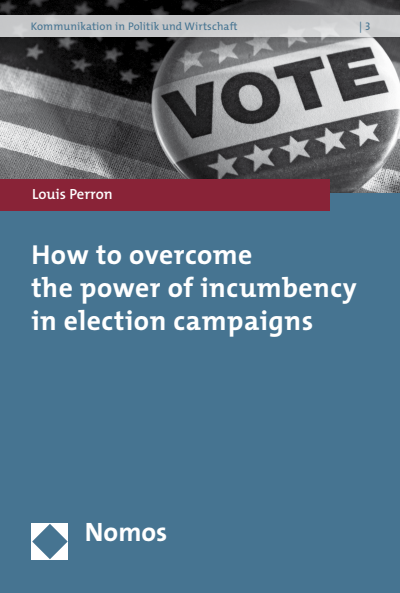
How to overcome the power of incumbency in election campaigns
- Autor:innen:
- Reihe:
- Kommunikation in Politik und Wirtschaft, Band 3
- Verlag:
- 2010
Zusammenfassung
Wie können Herausforderer gegen Amtsinhaber Wahlen gewinnen? Das vorliegende Buch beantwortet diese Frage durch einen Vergleich vier erfolgreicher Herausforderer mit vier erfolglosen.
Publikation durchsuchen
Bibliographische Angaben
- Auflage
- 1/2010
- Copyrightjahr
- 2010
- ISBN-Print
- 978-3-8329-5853-4
- ISBN-Online
- 978-3-8452-2628-6
- Verlag
- Nomos, Baden-Baden
- Reihe
- Kommunikation in Politik und Wirtschaft
- Band
- 3
- Sprache
- Englisch
- Seiten
- 296
- Produkttyp
- Monographie
Inhaltsverzeichnis
KapitelSeiten
- Titelei/Inhaltsverzeichnis Kein Zugriff Seiten 2 - 10Autor:innen:
- FIGURES Kein Zugriff Seiten 11 - 11Autor:innen:
- TABLES Kein Zugriff Seiten 12 - 13Autor:innen:
- BOXES Kein Zugriff Seiten 14 - 14Autor:innen:
- INTRODUCTION Kein Zugriff Seiten 15 - 26Autor:innen:
- OVERVIEW OF THE EXISTING WORKS ABOUT ELECTION CAMPAIGNS Kein Zugriff Seiten 27 - 32Autor:innen:
- Reservations of political science towards the study of campaigns Kein Zugriff Seiten 33 - 37Autor:innen:
- Ethical concerns regarding political marketing Kein Zugriff Seiten 37 - 39Autor:innen:
- Definition, evolution and advantage of the political marketing approach Kein Zugriff Seiten 39 - 44Autor:innen:
- Phase 1 of an election campaign: The exploration of the political demand Kein Zugriff Seiten 45 - 47Autor:innen:
- Phase 2 of an election campaign: The creation of the political offer Kein Zugriff Seiten 47 - 52Autor:innen:
- Promotion of the political offer: Communication dimension Kein Zugriff Seiten 52 - 54Autor:innen:
- Promotion of the political offer: Strategy and management dimension Kein Zugriff Seiten 54 - 56Autor:innen:
- The power of incumbency campaigns Kein Zugriff Seiten 57 - 60Autor:innen:
- Hypothesis 1: A coherent message that shows contrast and focuses on the call for change Kein Zugriff Seiten 60 - 66Autor:innen:
- Hypothesis 2: Creating the impression of representing mainstream values Kein Zugriff Seiten 66 - 67Autor:innen:
- Hypothesis 3: Timing and intensity strategies Kein Zugriff Seiten 67 - 70Autor:innen:
- Hypothesis 4: Challenger campaign quality Kein Zugriff Seiten 70 - 74Autor:innen:
- The limitations of the methods: How to decide if a campaign was successful or not? Kein Zugriff Seiten 75 - 76Autor:innen:
- The cases for the American campaign style: The U.S. elections of 1992 and 2004 Kein Zugriff Seiten 76 - 81Autor:innen:
- The cases for the Latin American style: Brazilian elections of 1998 and 2002 Kein Zugriff Seiten 81 - 82Autor:innen:
- The cases for the East Asian campaign styles: Philippine elections in 1998 and 2004 Kein Zugriff Seiten 82 - 84Autor:innen:
- The cases for the Western European campaign style: The German elections of 1994 and 1998 Kein Zugriff Seiten 84 - 85Autor:innen:
- The methodology of the interviews Kein Zugriff Seiten 85 - 90Autor:innen:
- The state and the consolidation of democracy Kein Zugriff Seiten 91 - 97Autor:innen:
- The political culture Kein Zugriff Seiten 97 - 102Autor:innen:
- The political system Kein Zugriff Seiten 102 - 105Autor:innen:
- The electoral system Kein Zugriff Seiten 105 - 108Autor:innen:
- The party system Kein Zugriff Seiten 108 - 114Autor:innen:
- Access to television and advertising Kein Zugriff Seiten 114 - 118Autor:innen:
- Turnout culture Kein Zugriff Seiten 118 - 119Autor:innen:
- The legal and regulation environment of election campaigns Kein Zugriff Seiten 119 - 121Autor:innen:
- The election campaign industry Kein Zugriff Seiten 121 - 122Autor:innen:
- Summary: A global typology of campaign styles Kein Zugriff Seiten 122 - 124Autor:innen:
- The vulnerability of the two incumbents: Bush Sr. and Bush Jr. Kein Zugriff Seiten 125 - 127Autor:innen:
- The campaign of Bill Clinton in 1992 Kein Zugriff Seiten 127 - 132Autor:innen:
- The campaign of John Kerry in 2004 Kein Zugriff Seiten 132 - 135Autor:innen:
- The strategies of the incumbents and how the challengers reacted to it Kein Zugriff Seiten 135 - 142Autor:innen:
- The vulnerability of the incumbents Kein Zugriff Seiten 142 - 143Autor:innen:
- The campaign of Lula in 1998 Kein Zugriff Seiten 143 - 144Autor:innen:
- The campaign of Lula in 2002 Kein Zugriff Seiten 144 - 145Autor:innen:
- The strategies of the incumbents and how the challenger reacted to it Kein Zugriff Seiten 145 - 147Autor:innen:
- The vulnerability of the incumbents Kein Zugriff Seiten 147 - 149Autor:innen:
- The campaign of Joseph Estrada in 1998 Kein Zugriff Seiten 149 - 151Autor:innen:
- The campaign of Fernando Poe Jr. in 2004 Kein Zugriff Seiten 151 - 152Autor:innen:
- The campaigns of the incumbents and how the challengers reacted to it Kein Zugriff Seiten 152 - 157Autor:innen:
- The vulnerability of the incumbent, Helmut Kohl Kein Zugriff Seiten 157 - 158Autor:innen:
- The campaign of Rudolf Scharping in 1994 Kein Zugriff Seiten 158 - 161Autor:innen:
- The campaign of Gerhard Schröder in 1998 Kein Zugriff Seiten 161 - 163Autor:innen:
- The strategies of the incumbent and how the challengers reacted to it Kein Zugriff Seiten 163 - 166Autor:innen:
- Summary and conclusion Kein Zugriff Seiten 166 - 170Autor:innen:
- The cases of the US Kein Zugriff Seiten 171 - 175Autor:innen:
- The cases of Brazil Kein Zugriff Seiten 175 - 180Autor:innen:
- The cases of the Philippines Kein Zugriff Seiten 180 - 182Autor:innen:
- The cases of Germany Kein Zugriff Seiten 182 - 185Autor:innen:
- Summary and conclusion Kein Zugriff Seiten 185 - 188Autor:innen:
- The timing of the campaigns Kein Zugriff Seiten 189 - 192Autor:innen:
- The intensity of the campaigns Kein Zugriff Seiten 192 - 197Autor:innen:
- The timing of the campaigns Kein Zugriff Seiten 197 - 199Autor:innen:
- The intensity of the campaigns Kein Zugriff Seiten 199 - 201Autor:innen:
- The timing of the campaigns Kein Zugriff Seiten 201 - 202Autor:innen:
- The intensity of the campaigns Kein Zugriff Seiten 202 - 205Autor:innen:
- The timing of the campaigns Kein Zugriff Seiten 205 - 206Autor:innen:
- The intensity of the campaigns Kein Zugriff Seiten 206 - 208Autor:innen:
- Summary and conclusion Kein Zugriff Seiten 208 - 212Autor:innen:
- The cases of the USA Kein Zugriff Seiten 213 - 219Autor:innen:
- The cases of Brazil Kein Zugriff Seiten 219 - 222Autor:innen:
- The cases of the Philippines Kein Zugriff Seiten 222 - 226Autor:innen:
- The cases of Germany Kein Zugriff Seiten 226 - 229Autor:innen:
- Summary and conclusion Kein Zugriff Seiten 229 - 232Autor:innen:
- Summary of the results and additional example Kein Zugriff Seiten 233 - 239Autor:innen:
- A strategy for vulnerable incumbents (with additional examples) Kein Zugriff Seiten 239 - 244Autor:innen:
- Practical implications Kein Zugriff Seiten 244 - 246Autor:innen:
- Future research Kein Zugriff Seiten 246 - 248Autor:innen:
- APPENDIX I: INTERVIEW GUIDE POLITICAL CONSULTANTS Kein Zugriff Seiten 249 - 262Autor:innen:
- APPENDIX II: LIST OF INTERVIEWED POLITICAL CONSULTANTS Kein Zugriff Seiten 263 - 264Autor:innen:
- BIBLIOGRAPHY Kein Zugriff Seiten 265 - 296Autor:innen: