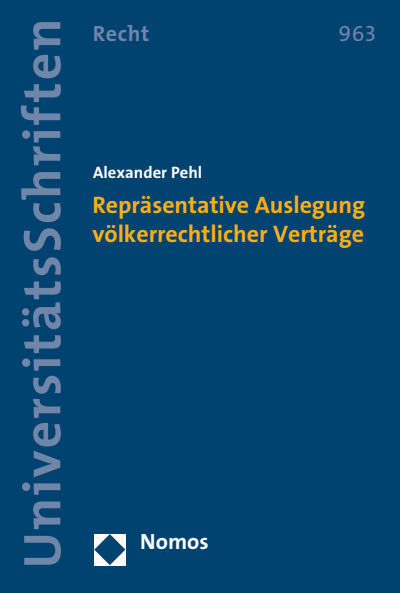
Repräsentative Auslegung völkerrechtlicher Verträge
- Autor:innen:
- Reihe:
- Nomos Universitätsschriften - Recht, Band 963
- Verlag:
- 2019
Zusammenfassung
Unmittelbar den Vertragsparteien zurechenbare und in diesem Sinne repräsentative Auslegung ist geeignet, die Vertragsanwendung in enge, vorhersehbare Bahnen zu lenken. Sie spielt angesichts der Neigung internationaler Gerichte und Schiedsgerichte zu einer dynamischen Auslegung eine besondere Rolle.
Eine solche repräsentative Vertragsauslegung ist vor allem im Bereich des internationalen Wirtschaftsrechts vorgesehen. Das WTO-Übereinkommen, das IWF-Statut und insbesondere eine ganze Reihe neuerer Investitions- und Handelsabkommen enthalten spezielle Auslegungsklauseln. Daneben räumt die Wiener Vertragsrechtskonvention in Art. 31 Abs. 3 lit. a Übereinkünften der Vertragsparteien eine wesentliche Rolle bei der Vertragsauslegung ein.
Dieses Werk beleuchtet die Hintergründe repräsentativer Vertragsauslegung, untersucht ihre Wirkung, die Mechanismen ihres Zustandekommens, lotet ihre Grenzen aus und beurteilt schließlich, ob es sich dabei um ein sinnvolles Instrument handelt.
Schlagworte
Publikation durchsuchen
Bibliographische Angaben
- Auflage
- 1/2019
- Copyrightjahr
- 2019
- ISBN-Print
- 978-3-8487-6011-4
- ISBN-Online
- 978-3-7489-0131-0
- Verlag
- Nomos, Baden-Baden
- Reihe
- Nomos Universitätsschriften - Recht
- Band
- 963
- Sprache
- Deutsch
- Seiten
- 381
- Produkttyp
- Monographie
Inhaltsverzeichnis
- Titelei/Inhaltsverzeichnis Kein Zugriff Seiten 1 - 18
- Einleitung Kein Zugriff Seiten 19 - 25
- I. Wandel der Bedeutung völkerrechtlicher Akteure Kein Zugriff
- 1. Extensive Auslegung der EMRK Kein Zugriff
- 2. Kritik an Investor-Staat Schiedsgerichten Kein Zugriff
- 1. Mehr Staatskontrolle im Bereich des Menschenrechtsschutzes Kein Zugriff
- 2. Mehr Staatskontrolle im Investitionsschutzrecht Kein Zugriff
- IV. Auslegung durch Repräsentanten der Vertragsstaaten als Instrument zur Rückgewinnung der Staatskontrolle Kein Zugriff
- V. Definition des Untersuchungsgegenstands Kein Zugriff
- I. Materielle Auslegungskriterien in Art. 31 WVRK Kein Zugriff
- 1. An der Auslegung eines völkerrechtlichen Vertrags beteiligte Akteure Kein Zugriff
- 2. Art. 31 Abs. 3 lit. a und b WVRK Kein Zugriff
- a) Autoritative Auslegung Kein Zugriff
- b) Authentische Auslegung Kein Zugriff
- c) Abgrenzung: Autorität v. Authentizität Kein Zugriff
- d) Repräsentative Auslegung Kein Zugriff
- 1. Unsichere Rechtslage Kein Zugriff
- a) Der Vertrag als originärer Ausdruck des Parteiwillens Kein Zugriff
- b) Erneuerung des Parteienwillens durch konsensgetragene Auslegung Kein Zugriff
- a) Die Pflicht zur „Berücksichtigung“ von Auslegungsvereinbarungen der Vertragsstaaten nach Art. 31 Abs. 3 Wiener Vertragsrechtskonvention Kein Zugriff
- aa) Bindung der sekundären Auslegung an Art. 31 WVRK Kein Zugriff
- bb) Doppelte Absicherung sekundärer Auslegung über Art. 31 WVRK Kein Zugriff
- c) Zwischenergebnis Kein Zugriff
- IV. Autorität nicht authentischer repräsentativer Auslegung Kein Zugriff
- V. Zwischenergebnis Kein Zugriff
- I. Dynamischer Vertragsschluss Kein Zugriff
- 1. Das Konzept der dynamischen Vertragsauslegung Kein Zugriff
- a) Erstes Szenario: historischer, aber kein zeitgenössischer Konsens Kein Zugriff
- b) Zweites Szenario: historischer und zeitgenössischer Konsens Kein Zugriff
- III. Zwischenergebnis Kein Zugriff
- a) „Übereinkunft“ Kein Zugriff
- b) „zwischen den Vertragsparteien“ Kein Zugriff
- c) „über die Auslegung des Vertrags oder die Anwendung seiner Bestimmungen“ Kein Zugriff
- d) „spätere“ Kein Zugriff
- a) „Übung“ Kein Zugriff
- b) „bei der Anwendung des Vertrags“ Kein Zugriff
- c) „spätere“ Kein Zugriff
- d) „Übereinstimmung“ Kein Zugriff
- e) „der Vertragsparteien“ Kein Zugriff
- f) „über seine Auslegung“ Kein Zugriff
- a) Untersuchungsgegenstand Kein Zugriff
- b) Art. 1131 Abs. 2 NAFTA als Vorbild für Auslegungsklauseln im Investitionsschutzrecht Kein Zugriff
- a) Typ 1: Auslegung durch die Vertragsstaaten selbst Kein Zugriff
- b) Typ 2: Auslegung durch ein Vertragsorgan Kein Zugriff
- aa) Konsultationsklauseln Kein Zugriff
- bb) Eingebettete Auslegungsvereinbarungen Kein Zugriff
- cc) Allgemeine Bemerkungen Kein Zugriff
- a) Initiative und Initiativrecht Kein Zugriff
- b) Sachlicher Anwendungsbereich: Auslegungsfragen Kein Zugriff
- c) Persönlicher Anwendungsbereich Kein Zugriff
- 4. Fallstudie: Auslegungsklauseln in Freihandelsabkommen der Europäischen Union Kein Zugriff
- 1. Unmittelbares Handeln der Vertragsstaaten Kein Zugriff
- aa) Zustandekommen ausdrücklicher Auslegungsvereinbarungen unmittelbar durch die Vertragsstaaten Kein Zugriff
- (1) Vertragsübergreifende Übung Kein Zugriff
- (2) Einlassungen von Vertragsstaaten in Schiedsverfahren Kein Zugriff
- (3) Revisionsverhandlungen Kein Zugriff
- (4) Rüge der Arbeit des Schiedsgerichts gegenüber der ICSID Kein Zugriff
- cc) Zweck von Auslegungsklauseln ohne Delegation und Institutionalisierung Kein Zugriff
- b) Institutionalisierte Auslegung durch die Vertragsstaaten Kein Zugriff
- 3. Kein Konsens: „European consensus“ und „international consensus“ Kein Zugriff
- 4. Zwischenergebnis Kein Zugriff
- 1. Delegation Kein Zugriff
- 2. Delegierte repräsentative Auslegung Kein Zugriff
- 3. Zwischenergebnis Kein Zugriff
- V. Konkurrenzen Kein Zugriff
- a) Investorenrechte: prozessuale Rechte und materielle Rechte Kein Zugriff
- aa) Eine kleine Dogmatik des Vertrags zugunsten Dritter im Privatrecht Kein Zugriff
- bb) Übertragung der privatrechtlichen Lehren auf das Investitionsschutzrecht Kein Zugriff
- a) Investitionsschutz, Investitionsanreize und Wohlstandsförderung Kein Zugriff
- b) Entpolitisierung Kein Zugriff
- c) Modifikation der Ziele von Investitionsschutzabkommen durch neue Präambeln Kein Zugriff
- a) Vertrauensschutz und die Ziele des Investitionsschutzes Kein Zugriff
- b) Schutz legitimer Erwartungen Kein Zugriff
- c) Begründetheit der Erwartungen von Investoren Kein Zugriff
- aa) Die schiedsgerichtliche Rezeption der Auslegung von Art. 1105 NAFTA durch die Free Trade Commission im Jahr 2001 Kein Zugriff
- (1) Die Entscheidung des Obergerichts in Singapur Kein Zugriff
- (2) Die Entscheidung des Berufungsgerichts in Singapur Kein Zugriff
- cc) Die Umgehung der „Bindungsfrage“ in CME v. Czech Republic Kein Zugriff
- dd) Zwischenergebnis Kein Zugriff
- b) Vertragliche Vorgaben für die zeitliche Wirkung von Auslegungsvereinbarungen Kein Zugriff
- c) Zeitliche Klarstellungfunktion in Vorschriften über eingebettete Auslegungsvereinbarungen Kein Zugriff
- 5. Zwischenergebnis Kein Zugriff
- 1. Rechtsnatur der Schiedsvereinbarung Kein Zugriff
- 2. Das Verhältnis von Staaten und Investor-Staat Schiedsgerichten Kein Zugriff
- a) Waffengleichheit im Verfahren Kein Zugriff
- b) Schutz vor einer Vereinnahmung des Verfahrens durch eine Verfahrenspartei: nemo iudex esse in causa sua Kein Zugriff
- 4. Zwischenergebnis Kein Zugriff
- 1. Repräsentative Vertragsauslegung und Vertragsänderung Kein Zugriff
- a) Einer informellen Änderung im Wege stehende Vertragsbestimmungen Kein Zugriff
- b) Delegation der Auslegungs- nicht aber der Vertragsänderungsmacht Kein Zugriff
- c) Unzulässigkeit vertragsändernder Übung Kein Zugriff
- d) Umgehung nationaler Verfahren zur Änderung völkerrechtlicher Verträge Kein Zugriff
- e) Zwischenergebnis Kein Zugriff
- 3. Objektive Kriterien für die Unterscheidung von repräsentativer Vertragsauslegung und Vertragsänderung Kein Zugriff
- a) Überprüfbarkeit repräsentativer Auslegung durch Gerichte und Schiedsgerichte Kein Zugriff
- b) Im Zweifel: Vermutung zugunsten einer Auslegung Kein Zugriff
- 5. Zwischenergebnis Kein Zugriff
- I. Bestimmtheit der Auslegungsvereinbarung Kein Zugriff
- II. Ansehen des Auslegenden Kein Zugriff
- III. Klarheit der Rechtslage Kein Zugriff
- IV. Konstanz und Kohärenz der Auslegung Kein Zugriff
- V. Zwischenergebnis Kein Zugriff
- I. Verträge zwischen Präzision und Flexibilität Kein Zugriff
- II. Vorhersehbarkeit und Transparenz Kein Zugriff
- III. Wie sinnvoll ist eine repräsentative Auslegung? Kein Zugriff
- I. Zusammenfassung der Ergebnisse Kein Zugriff
- II. Eine Formel für die Zukunft der repräsentativen Auslegung Kein Zugriff
- III. Ausblick Kein Zugriff
- I. Literatur Kein Zugriff
- 1. Entscheidungen des Internationalen Gerichtshofs Kein Zugriff
- 2. Entscheidungen des Europäischen Gerichtshofs für Menschenrechte Kein Zugriff
- 3. Investitionsschiedssprüche Kein Zugriff
- 4. Sonstige internationale Rechtsprechung Kein Zugriff
- 5. Nationale Gerichtsentscheidungen Kein Zugriff
- III. Offizielle Dokumente Kein Zugriff
- IV. Gesetze und völkerrechtliche Verträge Kein Zugriff
Literaturverzeichnis (241 Einträge)
Es wurden keine Treffer gefunden. Versuchen Sie einen anderen Begriff.
- Abbot, Kenneth W./Keohane, Robert O./Moravcsik, Andrew/Slaughter, Anne-Marie/Snidal, Duncan, „The Concept of Legalization“, IO 54 (2000), S. 401. Google Scholar öffnen DOI: 10.5771/9783748901310
- Alivizatos, Nicos C., „Judges as Veto Players“, in: Döring, Herbert (Hrsg.), Parliaments and Majority Rule in Western Europe, 1995 (Campus Verlag, Frankfurt am Main), S. 566. Google Scholar öffnen DOI: 10.5771/9783748901310
- Alschner, Wolfgang, „Americanization of the BIT Universe: The Influence of Friendship, Commerce and Navigation (FCN) Treaties on Modern Investment Treaty Law“, Goettingen Journal of International Law 5 (2013), S. 455. Google Scholar öffnen DOI: 10.5771/9783748901310
- Alschner, Wolfgang, „The Return of the Home State and the Rise of 'Embedded' Investor-State Arbitration“, in: Lalani, Shaheeza/Polanco Lazo, Rodrigo (Hrsg.), The Role of the State in Investor-State Arbitration, 2014 (Brill Nijhoff, Leiden, Boston), S. 192. Google Scholar öffnen DOI: 10.5771/9783748901310
- Alter, Karen J., „Agents or Trustees? International Court in their Political Context“, EJIR 14 (2008), S. 33. Google Scholar öffnen DOI: 10.5771/9783748901310
- Alvarez, José E., „The Once and Future Foreign Investment Regime“, in: Arsanjani, Mahnoush H./Cogan, Jacob K./Sloane, Robert/Wiessner, Siegfried (Hrsg.), Looking to the Future, 2010 (Nijhoff, Leiden (u.a.)), S. 607. Google Scholar öffnen DOI: 10.5771/9783748901310
- Alvarez, José E., „Why are We ‘Re-Calibrating’ Our Investment Treaties?“, World Arbitration & Mediation Review 4 (2010), S. 143. Google Scholar öffnen DOI: 10.5771/9783748901310
- Alvarez, José E., „Comparison U.S. Model BIT (1984 and U.S. Model BIT (2004)“, TDM 7 (2010). Google Scholar öffnen DOI: 10.5771/9783748901310
- Alvarez, José E., „The Return of the State“, Minnesota Journal of International Law 20 (2011), S. 223. Google Scholar öffnen DOI: 10.5771/9783748901310
- Alvarez, José E., „Limits of Change by Way of Subsequent Agreements and Practice“, in: Nolte, Georg (Hrsg.), Treaties and Subsequent Practice, 2013 (Oxford University Press, Oxford), S. 123. Google Scholar öffnen DOI: 10.5771/9783748901310
- Alvarez, José E./Khamsi, Kathryn, „The Argentine Crisis and Foreign Investors: A Glimpse into the Heart of the Investment Regime“, in: Sauvant, Karl P. (Hrsg.), The Yearbook on International Investment Law and Policy 2008/2009, 2009 (Oxford University Press, Oxford), S. 379. Google Scholar öffnen DOI: 10.5771/9783748901310
- Arnauld, Andreas von, Völkerrecht, 2. Aufl., 2014 (C.F. Müller, Heidelberg). Google Scholar öffnen DOI: 10.5771/9783748901310
- Arsanjani, Mahnoush H./Reisman, Michael W., „Interpreting Treaties for the Benefit of Third Parties: The 'Salvors' Doctrine' and the Use of Legislative History in Investment Treaties“, AJIL 104 (2010), S. 597. Google Scholar öffnen DOI: 10.5771/9783748901310
- Aust, Anthony, Modern Treaty Law and Practice, 3. Aufl., 2013 (Cambridge University Press, Cambridge). Google Scholar öffnen DOI: 10.5771/9783748901310
- Barak, Aharon, Purposive Interpretation in Law, 2005 (Princeton University Press, Princeton, Oxford). Google Scholar öffnen DOI: 10.5771/9783748901310
- Bates, Ed, The Evolution of the European Convention on Human Rights: From its Inception to the Creation of a Permanent Court of Human Rights, 2010 (Oxford University Press, Oxford). Google Scholar öffnen DOI: 10.5771/9783748901310
- Bayer, Walter, Der Vertrag zugunsten Dritter: Neuere Dogmengeschichte, Anwendungsbereich, dogmatische Strukturen, 1995 (Mohr Siebeck, Tübingen). Google Scholar öffnen DOI: 10.5771/9783748901310
- Bernhardt, Rudolf, „Interpretation and Implied (Tacit) Modification of Treaties: Comments on Arts. 27, 28, 29 and 38 of the ILC's 1966 Draft Articles on the Law of Treaties“, ZaöRV 27 (1967), S. 491. Google Scholar öffnen DOI: 10.5771/9783748901310
- Bernhardt, Rudolf, „Anmerkungen zur Rechtsfortbildung und Rechtsschöpfung durch internationale Gerichte“, in: Ginther, Konrad/Hafner, Gerhard/Lang, Winfried/Neuhold, Hanspeter/Sucharipa-Behrmann, Lilly (Hrsg.), Völkerrecht zwischen normativem Anspruch und politischer Realität, 1994 (Duncker & Humblot, Berlin), S. 11. Google Scholar öffnen DOI: 10.5771/9783748901310
- Bernhardt, Rudolf, „Evolutive Treaty Interpretation, Especially of the European Convention on Human Rights“, German Yearbook of International Law 42 (1999), S. 11. Google Scholar öffnen DOI: 10.5771/9783748901310
- Beyme, Klaus von, Die politischen Theorien der Gegenwart: Eine Einführung, 7. Aufl., 1992 (VS Verlag für Sozialwissenschaften, Wiesbaden). Google Scholar öffnen DOI: 10.5771/9783748901310
- Bianchi, Andrea, „Textual Interpretation and (International) Law Reading: the Myth of (In)Determinacy and the Genealogy of Meaning“, in: Bekker, Pieter H. F./Dolzer, Rudolf/Waibel, Michael (Hrsg.), Making Transnational Law Work in the Global Economy, 2010 (Cambridge University Press, Cambridge), S. 34. Google Scholar öffnen DOI: 10.5771/9783748901310
- Bjorge, Eirik, The Evolutionary Interpretation of Treaties, 2014 (Oxford University Press, Oxford). Google Scholar öffnen DOI: 10.5771/9783748901310
- Bjorklund, Andrea K., „The Enduring But Unwelcome Role of Party Intent in Treaty Interpretation“, AJIL Unbound 112 (2018), S. 44. Google Scholar öffnen DOI: 10.5771/9783748901310
- Bleckmann, Albert, Völkerrecht, 2001 (Nomos, Baden-Baden). Google Scholar öffnen DOI: 10.5771/9783748901310
- Bogdandy, Armin von/Venzke, Ingo, In wessen Namen? Internationale Gerichte in Zeiten globalen Regierens, 2014 (Suhrkamp, Berlin). Google Scholar öffnen DOI: 10.5771/9783748901310
- Bos, Maarten, „Theory and Practice of Treaty Interpretation (II)“, Netherlands International Law Review 26 (1980), S. 135. Google Scholar öffnen DOI: 10.5771/9783748901310
- Bossuyt, Marc, „Should the Strasbourg Court Exercise More Self-Restraint? On the Extension of the Jurisdiction of the European Court of Human Rights to Social Security Regulations“, HRLJ 28 (2007), S. 321. Google Scholar öffnen DOI: 10.5771/9783748901310
- Böth, Katharina, Evolutive Auslegung völkerrechtlicher Verträge: Eine Untersuchung zu Voraussetzungen und Grenzen in Anbetracht der Praxis internationaler Streitbeilegungsinstitutionen, 2013 (Duncker & Humblot, Berlin). Google Scholar öffnen DOI: 10.5771/9783748901310
- Bowett, Derek W., „Estoppel before International Tribunals and Its Relation to Acquiescence“, BYIL 33 (1957), S. 176. Google Scholar öffnen DOI: 10.5771/9783748901310
- Bowring, Bill, „Russia's Cases in the ECtHR and the Question of Implementation“, in: Mälksoo, Lauri/Benedek, Wolfgang (Hrsg.), Russia and the European Court of Human Rights, 2017 (Cambridge University Press, Cambridge), S. 188. Google Scholar öffnen DOI: 10.5771/9783748901310
- Boyle, Alan E., „Some Reflections on the Relationship of Treaties and Soft Law“, International and Comparative Law Quarterly 48 (1999), S. 901. Google Scholar öffnen DOI: 10.5771/9783748901310
- Boyle, Alan E./Chinkin, Christine M., The Making of International Law, 2007 (Oxford University Press, Oxford). Google Scholar öffnen DOI: 10.5771/9783748901310
- Bradley, Curtis A./Kelley, Judith G., „The Concept of International Delegation“, Law and Contemporary Problems 71 (2008), S. 1. Google Scholar öffnen DOI: 10.5771/9783748901310
- Braun, Tillmann R., Ausprägungen der Globalisierung: der Investor als partielles Subjekt im Internationalen Investitionsrecht: Qualität und Grenzen dieser Wirkungseinheit, 1. Aufl., 2012 (Nomos, Baden-Baden). Google Scholar öffnen DOI: 10.5771/9783748901310
- Broches, Aron, „The Convention on the Settlement of Investment Disputes between States and Nationals of Other States“, Recueil des Cours Vol. 136 (1987), S. 331. Google Scholar öffnen DOI: 10.5771/9783748901310
- Brower, Charles N., „NAFTA's Investment Chapter: Dynamic Laboratory, Failed Experiments, and Lessons for the FTAA“, ASIL Proceedings 97 (2003), S. 251. Google Scholar öffnen DOI: 10.5771/9783748901310
- Brower, Charles N./Blanchard, Sadie, „What's in a Meme? The Truth about Investor-State Arbitration: Why It Need Not, and Must Not, Be Repossessed by States“, Columbia Journal of Transnational Law 52 (2014), S. 689. Google Scholar öffnen DOI: 10.5771/9783748901310
- Brower, Charles H., II, „Investor-States Disputes under NAFTA: The Empire Strikes Back“, Columbia Journal of Transnational Law 40 (2001), S. 43. Google Scholar öffnen DOI: 10.5771/9783748901310
- Brower, Charles H., II, „Why the FTC Notes of Interpretation Constitute a Partial Amendment of NAFTA Article 1105“, Virginia Journal of International Law 46 (2006), S. 347. Google Scholar öffnen DOI: 10.5771/9783748901310
- Brown, Chester, „International Investment Agreements: History, Approaches, Schools“, in: Bungenberg, Marc/Griebel, Jörn/Hobe, Stephan/Reinisch, August (Hrsg.), International Investment Law, 2015 (Nomos, C.H. Beck, Hart, Baden-Baden), S. 153. Google Scholar öffnen DOI: 10.5771/9783748901310
- Brownlie, Ian, Principles of Public International Law, 6. Aufl., 2003 (Oxford University Press, Oxford). Google Scholar öffnen DOI: 10.5771/9783748901310
- Brudner, Alan/Nadler, Jennifer M., The Unity of the Ccommon Law, 2. Aufl., 2013 (Oxford University Press, Oxford). Google Scholar öffnen DOI: 10.5771/9783748901310
- Buergenthal, Thomas, „The U.N. Human Rights Committee“, Max Planck UNYB 5 (2001), S. 341. Google Scholar öffnen DOI: 10.5771/9783748901310
- Bungenberg, Marc/Griebel, Jörn/Hobe, Stephan/Reinisch, August (Hrsg.), International Investment Law, 2015 (Nomos, C.H. Beck, Hart, Baden-Baden). Google Scholar öffnen DOI: 10.5771/9783748901310
- Burbergs, Maris, „How the Right to Respect for Private and Family Life, Home and Correspondence Became the Nursery in which New Rights Are Born: Article 8 ECHR“, in: Brems, Eva/Gerards, Janneke (Hrsg.), Shaping Rights in the ECHR, 2014 (Cambridge University Press, Cambridge), S. 315. Google Scholar öffnen DOI: 10.5771/9783748901310
- Cameron, Iain, „Treaties, Declarations of Interpretation“, in: R. Wolfrum (Hrsg.), Max Planck Encyclopedia of Public International Law, 2008 (Oxford University Press). Google Scholar öffnen DOI: 10.5771/9783748901310
- Caplan, Lee M./Sharpe, Jeremy K., „United States“, in: Brown, Chester (Hrsg.), Commentaries on Selected Model Investment Treaties, 2013 (Oxford University Press, Oxford), S. 755. Google Scholar öffnen DOI: 10.5771/9783748901310
- Cheng, Bin, General Principles of Law as Applied by International Courts and Tribunals, 1953, Neuauflage 2006 (Cambridge University Press, Cambridge). Google Scholar öffnen DOI: 10.5771/9783748901310
- Chinkin, Christine M., „The Challenge of Soft Law: Development and Change in International Law“, International and Comparative Law Quarterly 38 (1989). Google Scholar öffnen DOI: 10.5771/9783748901310
- Choudhury, Barnali, „Evolution or Devolution: Defining Fair and Equitable Treatment in International Investment Law“, Journal of World Investment & Trade 6 (2005), S. 297. Google Scholar öffnen DOI: 10.5771/9783748901310
- Collier, John G./Lowe, Vaughan, The Settlement of Disputes in International Law: Institutions and Procedures, 1999 (Oxford University Press, Oxford). Google Scholar öffnen DOI: 10.5771/9783748901310
- Colman, Andrew M., A Dictionary of Psychology, 4. Aufl., 2015 (Oxford University Press, Oxford). Google Scholar öffnen DOI: 10.5771/9783748901310
- Crawford, James, Brownlie's Principles of Public International Law, 8. Aufl., 2012 (Oxford University Press, Oxford). Google Scholar öffnen DOI: 10.5771/9783748901310
- Crema, Luigi, „Subsequent Agreements and Subsequent Practice within and outside the Vienna Convention“, in: Nolte, Georg (Hrsg.), Treaties and Subsequent Practice, 2013 (Oxford University Press, Oxford), S. 13. Google Scholar öffnen DOI: 10.5771/9783748901310
- Dahm, Georg/Delbrück, Jost/Wolfrum, Rüdiger, Völkerrecht, Band I/3, 2. Aufl., 2002 (Walter De Gruyter, Berlin). Google Scholar öffnen DOI: 10.5771/9783748901310
- Djeffal, Christian, Static and Evolutive Treaty Interpretation: A Functional Reconstruction, 2016 (Cambridge University Press, Cambridge). Google Scholar öffnen DOI: 10.5771/9783748901310
- Dolzer, Rudolf/Schreuer, Christoph, Principles of International Investment Law, 2. Aufl., 2012 (Oxford University Press, Oxford). Google Scholar öffnen DOI: 10.5771/9783748901310
- Dolzer, Rudolf/Stevens, Margrete, Bilateral Investment Treaties, 1995 (Martinus Nij¬hoff Publishers, The Hague, Boston, London). Google Scholar öffnen DOI: 10.5771/9783748901310
- Dopagne, Frédéric, in: Corten, Olivier/Klein, Pierre (Hrsg.), The Vienna Conventions on the Law of Treaties, 2011 (Oxford University Press, Oxford), Art. 28. Google Scholar öffnen DOI: 10.5771/9783748901310
- Dörr, Oliver, in: Dörr, Oliver/Schmalenbach, Kirsten (Hrsg.), Vienna Convention on the Law of Treaties, 2012 (Springer, Berlin, Heidelberg), Art. 31. Google Scholar öffnen DOI: 10.5771/9783748901310
- Douglas, Zachary, „The Hybrid Foundations of Investment Treaty Arbitration“, BYIL 74 (2003), S. 151. Google Scholar öffnen DOI: 10.5771/9783748901310
- Douglas, Zachary, The International Law of Investment Claims, 2009 (Cambridge University Press, Cambridge). Google Scholar öffnen DOI: 10.5771/9783748901310
- Duden Online, „authentisch“, abrufbar unter: www.duden.de/node/645408/revisions/1669414/view (zuletzt geprüft am: 05. Januar 2019). Google Scholar öffnen DOI: 10.5771/9783748901310
- Duden Online, „autoritativ“, abrufbar unter: www.duden.de/node/651334/revisions/1132710/view (zuletzt geprüft am: 05. Januar 2019). Google Scholar öffnen DOI: 10.5771/9783748901310
- Duden Online, „Deutung“, abrufbar unter: www.duden.de/node/706868/revisions/1327586/view (zuletzt geprüft am: 05. Januar 2019). Google Scholar öffnen DOI: 10.5771/9783748901310
- Dumberry, Patrick, The Formation and Identification of Rules of Customary International Law in International Investment Law, 2016 (Cambridge University Press, Cambridge, UK). Google Scholar öffnen DOI: 10.5771/9783748901310
- Dzehtsiarou, Kanstantsin, European Consensus and the Legitimacy of the European Court of Human Rights, 2015 (Cambridge University Press, Cambridge). Google Scholar öffnen DOI: 10.5771/9783748901310
- Easterbrook, Frank H., „Legal Interpretation and the Power of the Judiciary“, Harvard Journal of Law and Public Policy 7 (1984), S. 87. Google Scholar öffnen DOI: 10.5771/9783748901310
- Ehlermann, Claus-Dieter/Ehring, Lothar, „The Authoritative Interpretation under Article IX:2 of the Agreement Establishing the World Trade Organization: Current Law, Practice and Possible Improvements“, Journal of International Economic Law 8 (2005), S. 803. Google Scholar öffnen DOI: 10.5771/9783748901310
- Elsig, Manfred/Pollack, Mark A., „Agents, Trustees, and International Courts: The Politics of Judicial Appointment at the World Trade Organization“, EJIR 20 (2014), S. 391. Google Scholar öffnen DOI: 10.5771/9783748901310
- Ewing-Chow, Michael/James Losari, Junianto, „Which Is to Be the Master? Extra-Arbitral Interpretative Procedures for IIAs“, in: Kalicki, Jean E./Joubin-Bret, Anna (Hrsg.), Reshaping the Investor-State Dispute Settlement System, 2015 (BRILL, Leiden), S. 91. Google Scholar öffnen DOI: 10.5771/9783748901310
- Fauchald, Ole K., „The Legal Reasoning of ICSID Tribunals: An Empirical Analysis“, EJIL 19 (2008), S. 301. Google Scholar öffnen DOI: 10.5771/9783748901310
- Fish, Stanley, „Intention Is All There Is: A Critical Analysis of Aharon Barak's Purposive Interpretation in Law“, Cardozo Law Review 29 (2008), S. 1109. Google Scholar öffnen DOI: 10.5771/9783748901310
- Fitzmaurice, Gerald, „The Law and Procedure of the International Court of Justice 1951-4: Treaty Interpretation and Other Treaty Points“, BYIL 33 (1957), S. 203. Google Scholar öffnen DOI: 10.5771/9783748901310
- Forst, Rainer, „The Justification of Human Rights and the Basic Right to Justification: A Reflexive Approach“, Ethics 120 (2010), S. 711. Google Scholar öffnen DOI: 10.5771/9783748901310
- Gardiner, Richard K., Treaty Interpretation, 2. Aufl., 2015 (Oxford University Press, Oxford). Google Scholar öffnen DOI: 10.5771/9783748901310
- Gáspár-Szilágyi, Szilárd, „Binding Committee Interpretations in the EU's New Free Trade and Investment Agreements“, Europ. Invest. L. & Arb. Rev. 2 (2017), S. 90. Google Scholar öffnen DOI: 10.5771/9783748901310
- Gazzini, Tarcisio, Interpretation of International Investment Treaties, 2016 (Hart Publishing, Oxford, Portland). Google Scholar öffnen DOI: 10.5771/9783748901310
- Ginsburg, Tom, „Political Constraints on International Courts“, in: Romano, Cesare P. R./Alter, Karen J./Shany, Yuval (Hrsg.), The Oxford Handbook of International Adjudication, 2013 (Oxford University Press, Oxford), S. 483. Google Scholar öffnen DOI: 10.5771/9783748901310
- Gold, Joseph, „The Interpretation by the International Monetary Fund of Its Articles of Agreement“, International and Comparative Law Quarterly 3 (1954), S. 256. Google Scholar öffnen DOI: 10.5771/9783748901310
- Gold, Joseph, „Interpretation by the International Monetary Fund of Its Articles of Agreement II“, International and Comparative Law Quarterly 16 (1967), S. 289. Google Scholar öffnen DOI: 10.5771/9783748901310
- Goldie, Louis F. E., „The Critical Date“, International and Comparative Law Quarterly 12 (1963), S. 1251. Google Scholar öffnen DOI: 10.5771/9783748901310
- Gordon, Kathryn/Pohl, Joachim, „Investment Treaties over Time: Treaty Practice and Interpretation in a Changing World“, OECD Working Papers on International Investment, 2015/02, abrufbar unter: www.oecd.org/daf/inv/investment-policy/WP-2015-02.pdf (zuletzt geprüft am: 05. Januar 2019). Google Scholar öffnen DOI: 10.5771/9783748901310
- Gottwald, Peter, in: Säcker, Franz J./Rixecker, Roland/Oetker, Hartmut/Limperg, Bettina (Hrsg.), Münchener Kommentar zum Bürgerlichen Gesetzbuch, Band 2, 7. Aufl., 2016 (C.H. Beck, München), § 328. Google Scholar öffnen DOI: 10.5771/9783748901310
- Griebel, Jörn, Internationales Investitionsrecht: Lehrbuch für Studium und Praxis, 2008 (C.H. Beck, München). Google Scholar öffnen DOI: 10.5771/9783748901310
- Grotius, Hugo, De Iure Belli Ac Pacis Libri Tres : In quibus ius naturae & Gentium, item iuris publici praecipua explicantur, 1625 (Nicolaus Buon, Parisii). Google Scholar öffnen DOI: 10.5771/9783748901310
- Hafner, Gerhard, „Subsequent Agreements and Practice: Between Interpretation, Informal Modification and Formal Amendment“, in: Nolte, Georg (Hrsg.), Treaties and Subsequent Practice, 2013 (Oxford University Press, Oxford), S. 105. Google Scholar öffnen DOI: 10.5771/9783748901310
- Harris, David J./O'Boyle, Michael, Warbrick, Colin, Law of the European Convention on Human Rights, 3. Aufl., 2014 (Oxford University Press, Oxford). Google Scholar öffnen DOI: 10.5771/9783748901310
- Hathaway, Oona A./Nix, Haley/Sanghvi, Saurabh/Solow, Sara, „Tacit Amendments“ (15. November 2011), abrufbar unter: law.yale.edu/system/files/documents/pdf/cglc/TacitAmendments.pdf (zuletzt geprüft am: 05. Januar 2019). Google Scholar öffnen DOI: 10.5771/9783748901310
- Helfer, Laurence R., „The Burdens and Benefits of Brighton“, ESIL Reflections, Vol. 1, Issue 1 (2012), abrufbar unter: esil-sedi.eu/node/138 (zuletzt geprüft am: 05. Januar 2019). Google Scholar öffnen DOI: 10.5771/9783748901310
- Helfer, Laurence R./Slaughter, Anne-Marie, „Why States Create International Tribunals: A Response to Professors Posner and Yoo“, California Law Review 93 (2005), S. 899. Google Scholar öffnen DOI: 10.5771/9783748901310
- Herdegen, Matthias, „Interpretation in International Law“, in: R. Wolfrum (Hrsg.), Max Planck Encyclopedia of Public International Law, 2. Aufl., 2013 (Oxford University Press, Oxford). Google Scholar öffnen DOI: 10.5771/9783748901310
- Herdegen, Matthias, The Dynamics of International Law in a Globalised World: Cosmopolitan Values, Constructive Consent and Diversity of Legal Cultures, 2016 (Vittorio Klostermann, Frankfurt am Main). Google Scholar öffnen DOI: 10.5771/9783748901310
- Herdegen, Matthias, Principles of International Economic Law, 2. Aufl., 2016 (Oxford University Press, Oxford, New York). Google Scholar öffnen DOI: 10.5771/9783748901310
- Herdegen, Matthias, Internationales Wirtschaftsrecht, 11. Aufl., 2017 (C.H. Beck, München). Google Scholar öffnen DOI: 10.5771/9783748901310
- Herdegen, Matthias, Völkerrecht, 17. Aufl., 2018 (C.H. Beck, München). Google Scholar öffnen DOI: 10.5771/9783748901310
- Hexner, Ervin P., „Interpretation by Public International Organizations of Their Basic Instruments“, AJIL 53 (1959), S. 341. Google Scholar öffnen DOI: 10.5771/9783748901310
- Hölken, Christoph, Systemische Integration von Investitionsschutzabkommen. Google Scholar öffnen DOI: 10.5771/9783748901310
- Jacob, Marc/Schill, Stephan W., „Dair and Equitable Treatment: Content, Practice, Method“, in: Bungenberg, Marc/Griebel, Jörn/Hobe, Stephan/Reinisch, August (Hrsg.), International Investment Law, 2015 (Nomos, C.H. Beck, Hart, Baden-Baden), S. 700. Google Scholar öffnen DOI: 10.5771/9783748901310
- Jaime, Margie-Lys, „Relying upon Parties' Interpretation in Treaty-Based Investor-State Dispute Settlement: Filling the Gaps in International Investment Agreements“, Georgetown Journal of International Law 46 (2014), S. 261. Google Scholar öffnen DOI: 10.5771/9783748901310
- Janoschek, Christian, in: Bamberger, Heinz G./Roth, Herbert/Hau, Wolfgang/Poseck, Roman (Hrsg.), Beck'scher Online Kommentar BGB, 2017 (C.H. Beck, München), § 328. Google Scholar öffnen DOI: 10.5771/9783748901310
- Jennings, Robert Y./Watts, Arthur (Hrsg.), Oppenheim's International Law, Vol. I, Parts 2-4, 9. Aufl., 1992 (Longman, Harlow). Google Scholar öffnen DOI: 10.5771/9783748901310
- Johnson, Lise/Razbaeva, Merim, „State Control over Interpretation of Investment Treaties“, Columbia University Academic Commons (2014), abrufbar unter: ccsi.columbia.edu/files/2014/04/State_control_over_treaty_interpretation_FINAL-April-5_2014.pdf (zuletzt geprüft am: 16. März 2018). Google Scholar öffnen DOI: 10.5771/9783748901310
- Kammerhofer, Jörg, Uncertainty in International Law: A Kelsenian perspective, 2011 (Routledge, New York). Google Scholar öffnen DOI: 10.5771/9783748901310
- Karl, Wolfram, Vertrag und spätere Praxis im Völkerrecht: Zum Einfluß der Praxis auf Inhalt und Bestand völkerrechtlicher Verträge, 1983 (Springer, Berlin/Heidelberg). Google Scholar öffnen DOI: 10.5771/9783748901310
- Kau, Marcel, in: W. Vitzthum/A. Proelß (Hrsg.), Völkerrecht, 7. Aufl., 2016 (Walter De Gruyter). Google Scholar öffnen DOI: 10.5771/9783748901310
- Kaufmann-Kohler, Gabrielle, „Interpretive Powers of the NAFTA Free Trade Commission“, in: Gaillard, Emmanuel/Bachand, Frédéric (Hrsg.), Fifteen Years of NAFTA Chapter 11 Arbitration, 2011 (JurisNet, Huntington, NY), S. 175. Google Scholar öffnen DOI: 10.5771/9783748901310
- Kelsen, Hans, Reine Rechtslehre: Einleitung in die rechtswissenschaftliche Problematik, 1934, Neudruck 1994 (Scientia Verlag, Aalen). Google Scholar öffnen DOI: 10.5771/9783748901310
- Kennedy, David, „The Mystery of Global Governance“, Ohio Northern University Law Review 34 (2008), S. 827. Google Scholar öffnen DOI: 10.5771/9783748901310
- Kirkman, Courtney C., „Fair and Equitable Treatment: Methanex v. United States and the Narrowing Scope of NAFTA Article 1105“, Law and Policy in International Business 34 (2002), S. 343. Google Scholar öffnen DOI: 10.5771/9783748901310
- Klabbers, Jan, „The Redundancy of Soft Law“, Nordic Journal of International Law 65 (1996), S. 167. Google Scholar öffnen DOI: 10.5771/9783748901310
- Klabbers, Jan, „On Rationalism in Politics: Interpretation of Treaties and the World Trade Organization“, Nordic Journal of International Law 74 (2005), S. 405. Google Scholar öffnen DOI: 10.5771/9783748901310
- Kläger, Roland, 'Fair and equitable treatment' in International Investment Law, 2011 (Cambridge University Press, Cambridge). Google Scholar öffnen DOI: 10.5771/9783748901310
- Koch, Hans-Joachim/Rüßmann, Helmut, Juristische Begründungslehre, 1982 (C.H. Beck, München). Google Scholar öffnen DOI: 10.5771/9783748901310
- Kolb, Robert, The Law of Treaties: An Introduction, 2016 (Edward Elgar Publishing, Cheltenham, UK/Northhampton, MA, USA). Google Scholar öffnen DOI: 10.5771/9783748901310
- Kotuby, Charles T., Jr./Sobota, Luke A., General Principles of Law and International Due Process: Principles and Norms Applicable in Transnational Disputes, 2017 (Oxford University Press, New York). Google Scholar öffnen DOI: 10.5771/9783748901310
- Kreß, Claus, Gewaltverbot und Selbstverteidigungsrecht nach der Satzung der Vereinten Nationen bei staatlicher Verwicklung in Gewaltakte Privater, 1995 (Duncker & Humblot, Berlin). Google Scholar öffnen DOI: 10.5771/9783748901310
- Kulick, Andreas, „About the Order of Cart and Horse, Among Other Things: Estoppel in the Jurisprudence of International Investment Arbitration Tribunals“, EJIL 27 (2016), S. 107. Google Scholar öffnen DOI: 10.5771/9783748901310
- Kulick, Andreas, „State-State Investment Arbitration as a Means of Reassertion of Control: From Antagonism to Dialogue“, in: Kulick, Andreas (Hrsg.), Reassertion of Control over the Investment Treaty Regime, 2017 (Cambridge University Press), S. 128. Google Scholar öffnen DOI: 10.5771/9783748901310
- Kulick, Andreas, „Reassertion of Control: An Introduction“, in: Kulick, Andreas (Hrsg.), Reassertion of Control over the Investment Treaty Regime, 2017 (Cambridge University Press), S. 3. Google Scholar öffnen DOI: 10.5771/9783748901310
- Laird, Ian A., „Betrayal, Shock and Outrage: Recent Developments in NAFTA Article 1105“, Asper Review of International Business and Trade Law 3 (2003), S. 185. Google Scholar öffnen DOI: 10.5771/9783748901310
- Lalive, Pierre A., „The Doctrine of Acquired Rights“, in: International and Comparative Law Center (Hrsg.), Rights and Duties of Private Investors Abroad, 1965 (M. Bender, Albany, NY), S. 145. Google Scholar öffnen DOI: 10.5771/9783748901310
- Lange, Felix, „Art. 59 Abs. 2 S. 1 GG im Lichte von Brexit und IStGH-Austritt: Zur Parlamentarisierung der Kündigung völkerrechtlicher Verträge“, AöR 142 (2017), S. 442. Google Scholar öffnen DOI: 10.5771/9783748901310
- Lauterpacht, Elihu/Greenwood, Christopher J. (Hrsg.), International Law Reports: Consolidated Tables of Cases, Volumes 1-125, 2004 (Cambridge University Press). Google Scholar öffnen DOI: 10.5771/9783748901310
- Lauterpacht, Hersch, Private Law Sources and Analogies of International Law: With Special Reference to International Arbitration, 1927, Neuauflage 2002 (Lawbook Exchange, Union, New Jersey). Google Scholar öffnen DOI: 10.5771/9783748901310
- Lehner, Moris, in: Vogel, Klaus/Lehner, Moris, Doppelbesteuerungsabkommen der Bundesrepublik Deutschland auf dem Gebiet der Steuern vom Einkommen und Vermögen, 6. Aufl., 2015 (C.H. Beck, München), Grundlagen des Abkommensrechts. Google Scholar öffnen DOI: 10.5771/9783748901310
- Lévesque, Céline, „Influences on the Canadian FIPA Model and the US Model BIT: NAFTA Chapter 11 and Beyond“, CYIL 44 (2006), S. 249. Google Scholar öffnen DOI: 10.5771/9783748901310
- Lévesque, Céline/Newcombe, Andrew, „Canada“, in: Brown, Chester (Hrsg.), Commentaries on Selected Model Investment Treaties, 2013 (Oxford University Press, Oxford), S. 53. Google Scholar öffnen DOI: 10.5771/9783748901310
- Linderfalk, Ulf, On the Interpretation of Treaties: The Modern International Law as Expressed in the 1969 Vienna Convention on the Law of Treaties, 2007 (Springer, Dordrecht). Google Scholar öffnen DOI: 10.5771/9783748901310
- Little, Alison, „PM: Giving prisoners vote makes me feel sick“, Daily Express, 04. November 2010, abrufbar unter: www.express.co.uk/news/uk/209397/PM-Giving-prisoners-vote-makes-me-feel-sick (zuletzt geprüft am: 05. Januar 2019). Google Scholar öffnen DOI: 10.5771/9783748901310
- Magraw, Kendra, „Investor-State Disputes and the Rise of Recourse to State Party Pleadings As Subsequent Agreements or Subsequent Practice under the Vienna Convention on the Law of Treaties“, ICSID Review 30 (2015), S. 142. Google Scholar öffnen DOI: 10.5771/9783748901310
- Mahbubani, Kishore, „Multilateral Diplomacy“, in: Cooper, Andrew F./Heine, Jorge/Thakur, Ramesh (Hrsg.), The Oxford handbook of modern diplomacy, 2015 (Oxford University Press, Oxford), S. 248. Google Scholar öffnen DOI: 10.5771/9783748901310
- Markert, Lars, Streitschlichtungsklauseln in Investitionsschutzabkommen: Zur Notwendigkeit der Differenzierung von jurisdiction und admissibility in Investitionsschiedsverfahren, 2010 (Nomos, Baden-Baden). Google Scholar öffnen DOI: 10.5771/9783748901310
- Marques Antunes, Nuno S., „Acquiescence“, in: R. Wolfrum (Hrsg.), Max Planck Encyclopedia of Public International Law, 2. Aufl., 2013 (Oxford University Press). Google Scholar öffnen DOI: 10.5771/9783748901310
- Matiation, Stefan, „Arbitration with Two Twists: Loewen v. United States and Free Trade Commission Intervention in NAFTA Chapter 11 Disputes“, University of Pennsylvania Journal of International Economic Law 24 (2003), S. 451. Google Scholar öffnen DOI: 10.5771/9783748901310
- McLachlan, Campbell/Shore, Laurence/Weiniger, Matthew, International Investment Arbitration: Substantive Principles, 2. Aufl., 2017 (Oxford University Press, Oxford). Google Scholar öffnen DOI: 10.5771/9783748901310
- Mechlem, Kerstin, „Treaty Bodies and the Interpretation of Human Rights“, Vanderbilt J. Transnat'l L. 49 (2009), S. 905. Google Scholar öffnen DOI: 10.5771/9783748901310
- Meron, Theodor, The Humanization of International Law, 2006 (Martinus Nijhoff Publishers, Leiden/Boston). Google Scholar öffnen DOI: 10.5771/9783748901310
- Methymaki, Eleni/Tzanakopoulos, Antonios, „Masters of Puppets? Reassertion of Control through Joint Investment Treaty Interpretation“, in: Kulick, Andreas (Hrsg.), Reassertion of Control over the Investment Treaty Regime, 2017 (Cambridge University Press), S. 155. Google Scholar öffnen DOI: 10.5771/9783748901310
- Miles, Kate, Origins of International Investment Law: Empire, Environment and the Safeguarding of Capital, 2015 (Cambridge University Press, Cambridge). Google Scholar öffnen DOI: 10.5771/9783748901310
- Moloo, Rahim, „When Actions Speak Louder than Words: The Relevance of Subsequent Party Conduct to Treaty Interpretation“, Berkeley Journal of International Law 31 (2013), S. 39. Google Scholar öffnen DOI: 10.5771/9783748901310
- Montesquieu, Charles-Louis d. S. de, De l’Esprit des Loix, Tome Premier, 1748 (Barillot & Fils, Genf). Google Scholar öffnen DOI: 10.5771/9783748901310
- Morlok, Martin, „Neue Erkenntnisse und Entwicklungen aus sprach- und rechtswissenschaftlicher Sicht“, in: Ehrenzeller, Bernhard/Gomez, Peter/Kotzur, Markus/Thürer, Daniel/Vallender, Klaus A. (Hrsg.), Präjudiz und Sprache, 2008 (Dike, Zürich/St. Gallen), S. 27. Google Scholar öffnen DOI: 10.5771/9783748901310
- Mowbray, Alastair, „Between the Will of the Contracting Parties and the Needs of Today: Extending the Scope of Convention Rights and Freedoms beyond what Have Been Foreseen by the Drafters of the ECHR“, in: Brems, Eva/Gerards, Janneke (Hrsg.), Shaping Rights in the ECHR, 2014 (Cambridge University Press, Cambridge), S. 17. Google Scholar öffnen DOI: 10.5771/9783748901310
- Muchlinski, Peter, „Negotiating New Generation International Investment Agreements: New Sustainable Development Oriented Initiatives“, in: Hindelang, Steffen/Krajewski, Markus (Hrsg.), Shifting Paradigms in International Investment Law, 2016 (Oxford University Press, Oxford), S. 41. Google Scholar öffnen DOI: 10.5771/9783748901310
- Müller, Jörg P., Vertrauensschutz im Völkerrecht, 1971 (Carl Heymanns, Köln). Google Scholar öffnen DOI: 10.5771/9783748901310
- Murphy, Sean D., „The Relevance of Subsequent Agreement and Subsequent Practice for the Interpretation of Treaties“, in: Nolte, Georg (Hrsg.), Treaties and Subsequent Practice, 2013 (Oxford University Press, Oxford), S. 82. Google Scholar öffnen DOI: 10.5771/9783748901310
- Murray, Rachel/Long, Debra, The Implementation of the Findings of the African Commission on Human and Peoples' Rights, 2015 (Cambridge University Press, Cambridge). Google Scholar öffnen DOI: 10.5771/9783748901310
- Newcombe, Andrew/Paradell, Lluís, Law and Practice of Investment Treaties: Standards of Treatment, 2009 (Kluwer Law International, Alphen aan den Rijn). Google Scholar öffnen DOI: 10.5771/9783748901310
- Nolte, Georg, „Jurisprudence of the International Court of Justice and Arbitral Tribunals of Ad Hoc Jurisdiction Relating to Subsequent Agreements and Subsequent Practice: Introductory Report for the ILC Study Group on Treaties over Time“, in: Nolte, Georg (Hrsg.), Treaties and Subsequent Practice, 2013 (Oxford University Press, Oxford), S. 169. Google Scholar öffnen DOI: 10.5771/9783748901310
- Nottage, Luke, „Investor-State Arbitration Policy and Practice in Australia“, Investor-State Arbitration Series, No. 6 (Juni 2016), abrufbar unter: www.cigionline.org/sites/default/files/isa_paper_series_no.6oct6web.pdf (zuletzt geprüft am: 05. Januar 2019). Google Scholar öffnen DOI: 10.5771/9783748901310
- Odendahl, Kerstin, in: Dörr, Oliver/Schmalenbach, Kirsten (Hrsg.), Vienna Convention on the Law of Treaties, 2012 (Springer, Berlin, Heidelberg), Art. 30. Google Scholar öffnen DOI: 10.5771/9783748901310
- Oeter, Stefan, in: Hilf, Meinhard/Oeter, Stefan (Hrsg.), WTO-Recht, 2. Aufl., 2010 (Nomos, Baden-Baden), S. 141. Google Scholar öffnen DOI: 10.5771/9783748901310
- Oppenheim, Lassa, International Law: A Treatise, Vol. I, 3. Aufl., herausgegeben von R. Roxburgh, 2005 (Lawbook Exchange, Clark, New Jersey), Originalausgabe: 1920 (Longman, Green and Co.). Google Scholar öffnen DOI: 10.5771/9783748901310
- Orrego-Vicuña, Francisco, „Law Making in a Global Society: Does Consent Still Matter?“, in: Bröhmer, Jürgen/Bieber, Roland/Calliess, Christian/Langenfeld, Christine/Weber, Stefan/Wolf, Joachim (Hrsg.), Internationale Gemeinschaft und Menschenrechte, 2005 (Carl Heymanns, Köln), S. 191. Google Scholar öffnen DOI: 10.5771/9783748901310
- Paet, Daniel/Windsor, Matthew, „Playing the Game of Interpretation: On Meaning and Metaphor in International Law“, in: Bianchi, Andrea/Paet, Daniel/Windsor, Matthew (Hrsg.), Interpretation in International Law, 2015 (Oxford University Press, Oxford), S. 1. Google Scholar öffnen DOI: 10.5771/9783748901310
- Pan, Eric J., „Authoritative Interpretation of Agreements: Developing More Responsive International Administrative Regimes“, Harvard International Law Journal 38 (1997), S. 503. Google Scholar öffnen DOI: 10.5771/9783748901310
- Paparinskis, Martins, „The Limits of Depoliticisation in Contemporary Investor-State Arbitration“, in: J. Crawford/S. Nouwen (Hrsg.), Select Proceedings of the European Society of International Law, Vol. 3, 2010 (Hart Publishing), abrufbar unter: ssrn.com/abstract=1716833. Google Scholar öffnen DOI: 10.5771/9783748901310
- Paparinskis, Martins, „Masters and Guardians of International Investment Law: How to Play the Game of Reassertion“, in: Kulick, Andreas (Hrsg.), Reassertion of Control over the Investment Treaty Regime, 2017 (Cambridge University Press), S. 30. Google Scholar öffnen DOI: 10.5771/9783748901310
- Parlett, Kate, The Individual in the International Legal System: Continuity and Change in International Law, 2011 (Cambridge University Press, Cambridge). Google Scholar öffnen DOI: 10.5771/9783748901310
- Paulsson, Jan, „Arbitration Without Privity“, ICSID Review – Foreign Investment Law Journal 10 (1995), S. 232. Google Scholar öffnen DOI: 10.5771/9783748901310
- Peters, Anne, „Precommitment Theory Applied to International Law: Between Sovereignty and Tiviality“, University of Illinois Law Review 2008, S. 239. Google Scholar öffnen DOI: 10.5771/9783748901310
- Peters, Anne, Jenseits der Menschenrechte: Die Rechtsstellung des Individuums im Völkerrecht, 2014 (Mohr Siebeck, Tübingen). Google Scholar öffnen DOI: 10.5771/9783748901310
- Petersmann, Ernst-Ulrich, „Judicial Standards of Review and Administration of Justice in Trade and Investment Law and Adjudication“, in: Gruszczynski, Lukasz/Werner, Wouter (Hrsg.), Deference in International Courts and Tribunals, 2014 (Oxford University Press, Oxford), S. 19. Google Scholar öffnen DOI: 10.5771/9783748901310
- Pietrowski, Robert, „Evidence in International Arbitration“, Arbitration International 22 (2006), S. 373. Google Scholar öffnen DOI: 10.5771/9783748901310
- Pohl, Joachim/Mashigo, Kekeletso/Nohen, Alexis, „Dispute Settlement Provisions in International Investment Agreements: A Large Sample Survey“, OECD Working Papers on International Investment, 2012/02, abrufbar unter: www.oecd.org/daf/inv/investment-policy/WP-2012_2.pdf (zuletzt geprüft am: 05. Januar 2019). Google Scholar öffnen DOI: 10.5771/9783748901310
- Posner, Eric A./Yoo, John C., „A Theory of International Adjudication“, Chicago Law & Economics, Olin Working Paper No. 206, UC Berkeley Public Law Research Paper No. 146 (2004), abrufbar unter: chicagounbound.uchicago.edu/law_and_economics/19/ (zuletzt geprüft am: 05. Januar 2019). Google Scholar öffnen DOI: 10.5771/9783748901310
- Posner, Eric A./Yoo, John C., „Judicial Independence in International Tribunals“, California Law Review 93 (2005), S. 1. Google Scholar öffnen DOI: 10.5771/9783748901310
- Potestà, Michele, „State-to-State Dispute Settlement Pursuant to Bilateral Investment Treaties: Is There Potential?“, in: Boschiero, Nerina (Hrsg.), International courts and the development of international law, 2013 (Asser Press, Springer, Den Haag), S. 753. Google Scholar öffnen DOI: 10.5771/9783748901310
- Potestà, Michele, „Legitimate Expectations in Investment Treaty Law: Understanding the Roots and the Limits of a Controversial Concept“, ICSID Review 28 (2013), S. 88. Google Scholar öffnen DOI: 10.5771/9783748901310
- Price, Daniel M., „Some Observations on Chapter Eleven of NAFTA“, Hastings International and Comparative Law Review 23 (2000), S. 421. Google Scholar öffnen DOI: 10.5771/9783748901310
- Puppe, Ingeborg, Kleine Schule des juristischen Denkens, 3. Aufl., 2014 (Vandenhoeck & Ruprecht; UTB, Göttingen, Stuttgart). Google Scholar öffnen DOI: 10.5771/9783748901310
- Rawls, John, Eine Theorie der Gerechtigkeit, 19. Aufl., 2014 (Suhrkamp, Frankfurt am Main). Google Scholar öffnen DOI: 10.5771/9783748901310
- Reinisch, August, in: Tietje, Christian (Hrsg.), Internationales Wirtschaftsrecht, 2. Aufl., 2015 (Walter De Gruyter, Berlin), S. 398. Google Scholar öffnen DOI: 10.5771/9783748901310
- Ress, Georg, „Verfassungsrechtliche Auswirkungen der Fortentwicklung völkerrechtlicher Verträge: Überlegungen zum Verhältnis des Grundgesetzes zur Europäischen Wirtschaftsgemeinschaft und zur Europäischen Menschenrechtskonvention“, in: Fürst, Walther/Herzog, Roman/Umbach, Dieter C. (Hrsg.), Festschrift für Wolfgang Zeidler, Band 2, 1987 (Walter De Gruyter, Berlin), S. 1775. Google Scholar öffnen DOI: 10.5771/9783748901310
- Roberts, Anthea, „Power and Persuasion in Investment Treaty Interpretation: The Dual Role of States“, AJIL 104 (2010), S. 179. Google Scholar öffnen DOI: 10.5771/9783748901310
- Roberts, Anthea, „Subsequent Agreements and Practice: The Battle over Interpretive Power“, in: Nolte, Georg (Hrsg.), Treaties and Subsequent Practice, 2013 (Oxford University Press, Oxford), S. 95. Google Scholar öffnen DOI: 10.5771/9783748901310
- Roberts, Anthea, „Clash of Paradigms: Actors and Analogies Shaping the Investment Treaty System“, AJIL 107 (2013), S. 45. Google Scholar öffnen DOI: 10.5771/9783748901310
- Roberts, Anthea, „State-to-State Investment Treaty Arbitration: A Hybrid Theory of Interdependent Rights and Shared Interpretive Authority“, Harvard International Law Journal 55 (2014), S. 1. Google Scholar öffnen DOI: 10.5771/9783748901310
- Roberts, Anthea, „Triangular Treaties: The Extent and Limits of Investment Treaty Rights“, Harvard International Law Journal 56 (2015), S. 353. Google Scholar öffnen DOI: 10.5771/9783748901310
- Robertson, A. H./Merrills, J. G., Human Rights in the World: An Introduction to the Study of the International Protection of Human Rights, 4. Aufl., 1996 (Manchester University Press, Manchester). Google Scholar öffnen DOI: 10.5771/9783748901310
- Romano, Cesare P. R., „Trial and Error in International Judicilization“, in: Romano, Cesare P. R./Alter, Karen J./Shany, Yuval (Hrsg.), The Oxford Handbook of International Adjudication, 2013 (Oxford University Press, Oxford), S. 112. Google Scholar öffnen DOI: 10.5771/9783748901310
- Salacuse, Jeswald W., The Law of Investment Treaties, 2. Aufl., 2015 (Oxford University Press, Oxford). Google Scholar öffnen DOI: 10.5771/9783748901310
- Sauer, Heiko, „Die NATO und das Verfassungsrecht: neues Konzept – alte Fragen“, ZaöRV 62 (2002), S. 317. Google Scholar öffnen DOI: 10.5771/9783748901310
- Savigny, Friedrich C. von, System des heutigen Römischen Rechts, 1840 (Veit und Comp., Berlin). Google Scholar öffnen DOI: 10.5771/9783748901310
- Schabas, William, The European Convention on Human Rights: A Commentary, 2015 (Oxford University Press, Oxford). Google Scholar öffnen DOI: 10.5771/9783748901310
- Schill, Stephan W., The Multilateralization of International Investment Law, 2013 (Cambridge University Press, s.l.). Google Scholar öffnen DOI: 10.5771/9783748901310
- Schöbener, Burkhard/Herbst, Jochen/Perkams, Markus, Internationales Wirtschaftsrecht, 2010 (C.F. Müller, Heidelberg). Google Scholar öffnen DOI: 10.5771/9783748901310
- Schorkopf, Frank, Staatsrecht der internationalen Beziehungen, 2017 (C.H. Beck, München). Google Scholar öffnen DOI: 10.5771/9783748901310
- Schreuer, Christoph, „Calvo's Grandchildren: The Return of Local Remedies in Investment Arbitration“, The Law and Practice of International Courts and Tribunals 4 (2005), S. 1. Google Scholar öffnen DOI: 10.5771/9783748901310
- Schreuer, Christoph, „Fair and Equitable Treatment in Arbitral Practice“, Journal of World Investment & Trade 6 (2005), S. 357. Google Scholar öffnen DOI: 10.5771/9783748901310
- Schreuer, Christoph, „Consent to Arbitration“, in: Muchlinski, Peter/Ortino, Federico/Schreuer, Christoph (Hrsg.), The Oxford Handbook of International Investment Law, 2008 (Oxford University Press, Oxford), S. 830. Google Scholar öffnen DOI: 10.5771/9783748901310
- Schreuer, Christoph, The ICSID Convention: A Commentary, 2. Aufl., 2009 (Cambridge University Press, Cambridge). Google Scholar öffnen DOI: 10.5771/9783748901310
- Schreuer, Christoph, „Diversity and Harmonization on Treaty Interpretation in Investment Law“, in: Fitzmaurice, Malgosia/Elias, Olufemi/Merkouris, Panos (Hrsg.), Treaty Interpretation and the Vienna Convention on the Law of Treaties, 2010 (Martinus Nijhoff Publishers, Leiden/Boston), S. 129. Google Scholar öffnen DOI: 10.5771/9783748901310
- Schreuer, Christoph, „The Future of International Investment Law“, in: Bungenberg, Marc/Griebel, Jörn/Hobe, Stephan/Reinisch, August (Hrsg.), International Investment Law, 2015 (Nomos, C.H. Beck, Hart, Baden-Baden), S. 1904. Google Scholar öffnen DOI: 10.5771/9783748901310
- Schreuer, Christoph/Weiniger, Matthew, „A Doctrine of Precedent?“, in: Muchlinski, Peter/Ortino, Federico/Schreuer, Christoph (Hrsg.), The Oxford Handbook of International Investment Law, 2008 (Oxford University Press, Oxford), S. 1188. Google Scholar öffnen DOI: 10.5771/9783748901310
- Schubert, Sophia/Kosow, Hannah, „Das Konzept der Deutungsmacht: Ein Beitrag zur gegenwärtigen Machtdebatte in der Politischen Theorie?“, ÖZP 36 (2007), S. 39. Google Scholar öffnen DOI: 10.5771/9783748901310
- Schwarzenberger, Georg, International Law and Legal Order, 1971 (Stevens & Son, London). Google Scholar öffnen DOI: 10.5771/9783748901310
- Shaw, Malcolm N., International Law, 8. Aufl., 2017 (Cambridge University Press, Cambridge). Google Scholar öffnen DOI: 10.5771/9783748901310
- Simma, Bruno, „Miscellaneous Thoughts on Subsequent Agreements and Practice“, in: Nolte, Georg (Hrsg.), Treaties and Subsequent Practice, 2013 (Oxford University Press, Oxford), S. 46. Google Scholar öffnen DOI: 10.5771/9783748901310
- Sinclair, Ian, The Vienna Convention on the Law of Treaties, 2. Aufl., 1984 (Manchester University Press, Manchester). Google Scholar öffnen DOI: 10.5771/9783748901310
- Sornarajah, Muthucumaraswamy, The International Law on Foreign Investment, 4. Aufl., 2017 (Cambridge University Press, Cambridge/New York). Google Scholar öffnen DOI: 10.5771/9783748901310
- Stein, Torsten/Buttlar, Christian v./Kotzur, Markus, Völkerrecht, 14. Aufl., 2017 (Verlag Franz Vahlen, München). Google Scholar öffnen DOI: 10.5771/9783748901310
- Stone Sweet, Alec/Grisel, Florian, The Evolution of International Arbitration: Judicialization, Governance, Legitimacy, 2017 (Oxford University Press, Oxford/New York). Google Scholar öffnen DOI: 10.5771/9783748901310
- Thomas, J. C., „A Reply to Professor Brower“, Columbia Journal of Transnational Law 40 (2002), S. 433. Google Scholar öffnen DOI: 10.5771/9783748901310
- Tietje, Christian, in: Tietje, Christian (Hrsg.), Internationales Wirtschaftsrecht, 2. Aufl., 2015 (Walter De Gruyter, Berlin), S. 158. Google Scholar öffnen DOI: 10.5771/9783748901310
- Titi, Catharine, „Non-Adjudicatory State-State Mechanisms in Investment Dispute Prevention and Dispute Settlement: Joint Interpretations, Filters and Focal Points“, Brazilian Journal of International Law 14 (2017), S. 37. Google Scholar öffnen DOI: 10.5771/9783748901310
- Tomuschat, Christian, „Der 11. September 2001 und seine rechtlichen Konsequenzen“, EuGRZ (2001), S. 535. Google Scholar öffnen DOI: 10.5771/9783748901310
- Trevino, Clovis J., „State-to-State Investment Treaty Arbitration and the Interplay with Investor–State Arbitration Under the Same Treaty“, Journal of International Dispute Settlement 4 (2013). Google Scholar öffnen DOI: 10.5771/9783748901310
- Tudor, Ioana, The Fair and Equitable Treatment Standard in the International Law of Foreign Investment, 2008 (Oxford University Press, Oxford). Google Scholar öffnen DOI: 10.5771/9783748901310
- Úbeda de Torres, Amaya, Democracia y Derechos Humanos en Europa y en América: Estudio Comparado de los Sistemas Europeo e Interamericano de Protección de los Derechos Humanos, 2007 (Reus, Madrid). Google Scholar öffnen DOI: 10.5771/9783748901310
- Vagts, Detlev, „Foreword to the Backlash Against Investment Arbitration“, in: Waibel, Michael/Kaushal, Asha/Chung, Kyo-Hwa L./Balchin, Claire (Hrsg.), The Backlash Against Investment Arbitration, 2010 (Kluwer Law International, Alphen aan den Rijn), S. xxiii. Google Scholar öffnen DOI: 10.5771/9783748901310
- van Aaken, Anne, „Interpretational Methods as an Instrument of Control in International Investment Law“, ASIL Proceedings 108 (2014), S. 196. Google Scholar öffnen DOI: 10.5771/9783748901310
- van Aaken, Anne, „Delegating Interpretative Authority in Investment Treaties: The Case of Joint Administrative Commissions“, in: Kalicki, Jean E./Joubin-Bret, Anna (Hrsg.), Reshaping the Investor-State Dispute Settlement System, 2015 (BRILL, Leiden), S. 21. Google Scholar öffnen DOI: 10.5771/9783748901310
- van Damme, Isabelle, Treaty Interpretation by the WTO Appellate Body, 2009 (Oxford University Press, Oxford). Google Scholar öffnen DOI: 10.5771/9783748901310
- van Harten, Gus, „The European Commission and UNCTAD Reform Agendas: Do They Ensure Independence, Openness, and Fairness in Investor-State Arbitration?“, in: Hindelang, Steffen/Krajewski, Markus (Hrsg.), Shifting Paradigms in International Investment Law, 2016 (Oxford University Press, Oxford), S. 128. Google Scholar öffnen DOI: 10.5771/9783748901310
- Vanberg, Georg, „Legislative-Judicial Relations: A Game-Theoretic Approach to Constitutional Review“, AJPS 45 (2001), S. 346. Google Scholar öffnen DOI: 10.5771/9783748901310
- Vandevelde, Kenneth J., U.S. International Investment Agreements, 2009 (Oxford University Press, Oxford). Google Scholar öffnen DOI: 10.5771/9783748901310
- Vattel, Emer de, Le Droit des Gens au Principes de la Loi Naturelle: Appliqués à la conduite et aux affaires des Nations et des Souverains, Tome I, 1758 (London). Google Scholar öffnen DOI: 10.5771/9783748901310
- Venzke, Ingo, How Interpretation Makes International Law: On Semantic Change and Normative Twists, 2014 (Oxford University Press, New York). Google Scholar öffnen DOI: 10.5771/9783748901310
- Villiger, Mark E., Commentary on the 1969 Vienna Convention on the Law of Treaties, 2009 (Martinus Nijhoff Publishers, Leiden/Boston). Google Scholar öffnen DOI: 10.5771/9783748901310
- Vitzthum, Wolfgang, in: W. Vitzthum/A. Proelß (Hrsg.), Völkerrecht, 7. Aufl., 2016 (Walter De Gruyter, Berlin). Google Scholar öffnen DOI: 10.5771/9783748901310
- Voon, Tania/Mitchell, Andrew/Munro, James, „Parting Ways: The Impact of Mutual Termination of Investment Treaties on Investor Rights“, ICSID Review (2014), S. 451. Google Scholar öffnen DOI: 10.5771/9783748901310
- Vranes, Erich, „Lex Superior, Lex Specialis, Lex Posterior: Zur Rechtsnatur der 'Konfliktlösungsregeln'“, ZaöRV 65 (2005), S. 391. Google Scholar öffnen DOI: 10.5771/9783748901310
- Waibel, Michael, „Investment Arbitration: Jurisdiction and Admissibility“, in: Bungenberg, Marc/Griebel, Jörn/Hobe, Stephan/Reinisch, August (Hrsg.), International Investment Law, 2015 (Nomos, C.H. Beck, Hart, Baden-Baden), S. 1212. Google Scholar öffnen DOI: 10.5771/9783748901310
- Wälde, Thomas W., „Interpreting Investment Treaties: Experiences and Examples“, in: Binder, Christina/Kriebaum, Ursula/Reinisch, August/Wittich, Stephan (Hrsg.), International Investment Law for the 21st Century, 2009 (Oxford University Press, Oxford), S. 724. Google Scholar öffnen DOI: 10.5771/9783748901310
- Wälde, Thomas W., „'Equality of Arms' in Investment Arbitration: Procedural Challenges“, in: Yannaca-Small, Katia (Hrsg.), Arbitration under International Investment Agreements, 2010 (Oxford University Press, Oxford), S. 161. Google Scholar öffnen DOI: 10.5771/9783748901310
- Wälde, Thomas W., „Procedural Challenges in Investment Arbitration under the Shadow of the Dual Role of the State: Asymmetries and Tribunals' Duty to Ensure, Pro-actively, the Equality of Arms“, Arbitration International 26 (2010), S. 3. Google Scholar öffnen DOI: 10.5771/9783748901310
- Waldock, C. Humphrey M., „The European Convention for the Protection of Human Rights and Fundamental Freedoms“, Fifth Anniversary of the Coming into Force of the ECHR, Brussels Exhibition (Council of Europe, 1959), abgedruckt in: British Yearbook of International Law 34 (1958), S. 356. Google Scholar öffnen DOI: 10.5771/9783748901310
- Weber, Max, Wirtschaft und Gesellschaft, 1922 (Mohr, Tübingen). Google Scholar öffnen DOI: 10.5771/9783748901310
- Weeramantry, J. R., Treaty Interpretation in Investment Arbitration, 2012 (Oxford University Press, Oxford). Google Scholar öffnen DOI: 10.5771/9783748901310
- Weiler, Todd, „NAFTA Article 1105 and the Free Trade Commission: Just Sour Grapes, or Something More Serious“, International Business Lawyer 29 (2001), S. 491. Google Scholar öffnen DOI: 10.5771/9783748901310
- Weiler, Todd, The Interpretation of International Investment Law: Equality, Discrimination and Minimum Standards of Treatment in Historical Context, 2013 (BRILL, Leiden). Google Scholar öffnen DOI: 10.5771/9783748901310
- Wet, Erika de, „The Rise and Fall of the Tribunal of the Southern African Development Community: Implications for Dispute Settlement in Southern Africa“, ICSID Review 28 (2013), S. 45. Google Scholar öffnen DOI: 10.5771/9783748901310
- Wildhaber, Luzius, „Precedent in the European Court of Human Rights“, in: Mahoney, Paul (Hrsg.), Protection des Droits de l'Homme: la Perspective Européenne, 2000 (Carl Heymanns, Köln), S. 1529. Google Scholar öffnen DOI: 10.5771/9783748901310
- Wolfke, Karol, „Treaties and Custom: Aspects of Interrelation“, in: Klabbers, Jan/Lefeber, René (Hrsg.), Essays on the Law of Treaties, 1998 (Martinus Nijhoff Publishers, The Hague, Boston, London), S. 31. Google Scholar öffnen DOI: 10.5771/9783748901310
- Woolfrey, Sean, „The Emergence of a New Approach to Investment Protection in South Africa“, in: Hindelang, Steffen/Krajewski, Markus (Hrsg.), Shifting Paradigms in International Investment Law, 2016 (Oxford University Press, Oxford), S. 266. Google Scholar öffnen DOI: 10.5771/9783748901310
- Yackee, Jason W., „Conceptual Difficulties in the Empirical Study of Bilateral Investment Treaties“, Brooklyn Journal of International Law 33 (2008), S. 405. Google Scholar öffnen DOI: 10.5771/9783748901310
- Yasseen, Mustafa K., „L'Interprétation des Traités d'après la Convention de Vienne sur le Droit des Traités“, Recueil des Cours Vol. 151 (1976), S. 1. Google Scholar öffnen DOI: 10.5771/9783748901310
- Yun-I, Kim, „Investment Law and the Individual“, in: Bungenberg, Marc/Griebel, Jörn/Hobe, Stephan/Reinisch, August (Hrsg.), International Investment Law, 2015 (Nomos, C.H. Beck, Hart, Baden-Baden), S. 1585. Google Scholar öffnen DOI: 10.5771/9783748901310