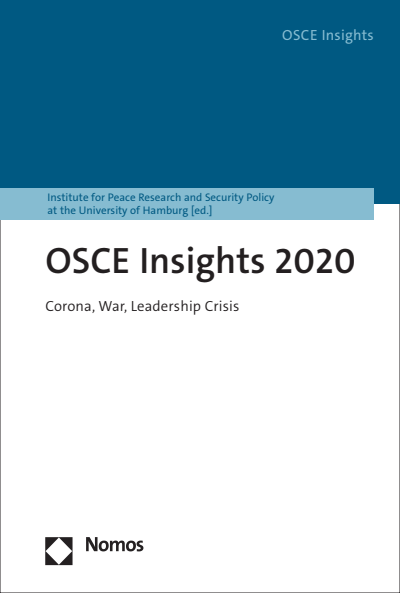
OSCE Insights 2020
Corona, War, Leadership Crisis- Herausgeber:innen:
- Verlag:
- 2020
Zusammenfassung
Die Beiträge der OSCE Insights untersuchen verschiedene Krisen, mit denen die Organisation während des Jahres 2020 konfrontiert war. Themen sind u. a. die Vermittlung der Minsk-Gruppe im Konflikt über Bergkarabach und die Frage, inwiefern Anti-Corona-Gesetze und Praktiken mit dem Verhaltenskodex zu Politisch-Militärischen Aspekten der Sicherheit vereinbar sind. Die AutorInnen untersuchen weiterhin Instrumente der OSZE beim Konfliktzyklus, die Rolle der OSZE beim Kampf gegen Antisemitismus, den immer geringeren Spielraum bei der Unterstützung demokratischer Polizeiarbeit in Zentralasien, Vertrauensbildung in der Rüstungskontrolle, gesellschaftliche Wahrnehmungen des Konflikts in der Ostukraine, die Beziehungen zwischen der OSZE und dem Europarat sowie die Bemühungen Kasachstans um ein Konnektivitätszentrum.
Mit Beiträgen vonAndrew Baker, Cornelius Friesendorf, Frank Evers, André Härtel, Marietta König, Sebastian Mayer, Michael Raith, Filip Ejdus, Alexandre Lambert, Thomas Schmidt, Marina Dolcetta Lorenzini, Anna Hess Sargsyan, Philip Remler, Richard Giragosian, Sergey Rastoltsev und Benjamin Schaller.
Schlagworte
Publikation durchsuchen
Bibliographische Angaben
- Auflage
- 1/2020
- Copyrightjahr
- 2020
- ISBN-Print
- 978-3-8487-7830-0
- ISBN-Online
- 978-3-7489-2233-9
- Verlag
- Nomos, Baden-Baden
- Sprache
- Englisch
- Seiten
- 12
- Produkttyp
- Sammelband
Inhaltsverzeichnis
- Cover Pages/Table of ContentsSeiten 1 - 6 Download Kapitel (PDF)
- Introduction to OSCE Insights 2020: The OSCE in Crisis Mode Seiten 7 - 12Autor:innen:Download Kapitel (PDF)
- Autor:innen:Download Kapitel (PDF)
- IntroductionAutor:innen:
- Autor:innen:
- Types of international police assistanceAutor:innen:
- Policing in Central AsiaAutor:innen:
- Autor:innen:
- Understanding the limitations of the OSCEAutor:innen:
- Controlling the OSCEAutor:innen:
- Autor:innen:
- Challenges in improving human securityAutor:innen:
- Autor:innen:
- Law enforcement support as an inroad?Autor:innen:
- Conclusions and recommendationsAutor:innen:
- Autor:innen:Download Kapitel (PDF)
- IntroductionAutor:innen:
- Addressing Jewish community security concernsAutor:innen:
- Defining antisemitismAutor:innen:
- Challenges posed by the OSCE’s structure and working methodsAutor:innen:
- Prospects for the futureAutor:innen:
- Autor:innen:Download Kapitel (PDF)
- IntroductionAutor:innen:
- Conceptual foundationsAutor:innen:
- Picking up the signals: Early warning and situational awarenessAutor:innen:
- Early action and crisis management: Learning lessons for the futureAutor:innen:
- The crown jewel of the toolbox: The facilitation of peaceful conflict resolutionAutor:innen:
- Focusing on sustainability: Structural prevention and peacebuildingAutor:innen:
- Sharing expertise and knowledge: Leveraging partnershipsAutor:innen:
- ConclusionAutor:innen:
- Autor:innen:Download Kapitel (PDF)
- IntroductionAutor:innen:
- The concept of connectivityAutor:innen:
- The OSCE and connectivityAutor:innen:
- Kazakhstan’s OSCE connectivity ambitionsAutor:innen:
- Norm resistance and leadership ambitionsAutor:innen:
- Conclusions and RecommendationsAutor:innen:
- Autor:innen: | |Download Kapitel (PDF)
- IntroductionAutor:innen: | |
- Relevant OSCE normsAutor:innen: | |
- States of emergency and the use of armed forces in the Covid-19 pandemicAutor:innen: | |
- Conclusion and policy recommendationsAutor:innen: | |
- Autor:innen: | | |Download Kapitel (PDF)
- IntroductionAutor:innen: | | |
- Autor:innen: | | |
- ArmeniaAutor:innen: | | |
- AzerbaijanAutor:innen: | | |
- Minsk Group activity since 1992Autor:innen: | | |
- Political effects of the recent fightingAutor:innen: | | |
- Autor:innen: | | |
- Prospects for negotiationsAutor:innen: | | |
- The Minsk Group going forwardAutor:innen: | | |
- ConclusionAutor:innen: | | |
- Autor:innen:Download Kapitel (PDF)
- IntroductionAutor:innen:
- Trust, but verify: Shortcomings of a traditional approach to CSBMsAutor:innen:
- Understanding military confidence building at the implementation levelAutor:innen:
- Rethinking military confidence building in EuropeAutor:innen:
- Concluding remarks and policy recommendationsAutor:innen:
- Autor:innen: | | |Download Kapitel (PDF)
- IntroductionAutor:innen: | | |
- MethodologyAutor:innen: | | |
- BackgroundAutor:innen: | | |
- Autor:innen: | | |
- Autor:innen: | | |
- Position 1: “Hard re-integration and restoration of the status quo ante”Autor:innen: | | |
- Position 2: “Territorial integrity and the national interest”Autor:innen: | | |
- Position 3: “Soft reintegration and the restoration of statehood”Autor:innen: | | |
- Shared interests: Socio-economic survival and mobilityAutor:innen: | | |
- Autor:innen: | | |
- Position 4: “Independence or unification with Russia”Autor:innen: | | |
- Position 5: “Transitional autonomy and soft independence”Autor:innen: | | |
- Shared interests: a positive presence of the Ukrainian state serving popular needsAutor:innen: | | |
- Autor:innen: | | |
- Autor:innen: | | |
- RecommendationsAutor:innen: | | |
- a) to the Ukrainian governmentAutor:innen: | | |
- b) to the Russian government and NGCA de facto authoritiesAutor:innen: | | |
- Autor:innen: | | |
- RecommendationsAutor:innen: | | |
- a) to the Ukrainian governmentAutor:innen: | | |
- b) to the OSCE, the Ukrainian government and civil society organizationsAutor:innen: | | |
- c) to the Russian government and NGCA de facto authoritiesAutor:innen: | | |
- Autor:innen: | | |
- RecommendationsAutor:innen: | | |
- a) to the OSCE and the Ukrainian and Russian governmentsAutor:innen: | | |
- b) to the Ukrainian governmentAutor:innen: | | |
- c) to the Russian Government and NGCA de facto authoritiesAutor:innen: | | |
- Autor:innen: | |Download Kapitel (PDF)
- IntroductionAutor:innen: | |
- Autor:innen: | |
- Established modalitiesAutor:innen: | |
- Fixed modalities of high-level communicationAutor:innen: | |
- Flexible interaction at the working levelAutor:innen: | |
- Uneven cooperation in the fieldAutor:innen: | |
- Autor:innen: | |
- High-level reluctanceAutor:innen: | |
- Structural differencesAutor:innen: | |
- Autor:innen: | |
- Improving high-level communicationAutor:innen: | |
- Supporting interaction in the fieldAutor:innen: | |