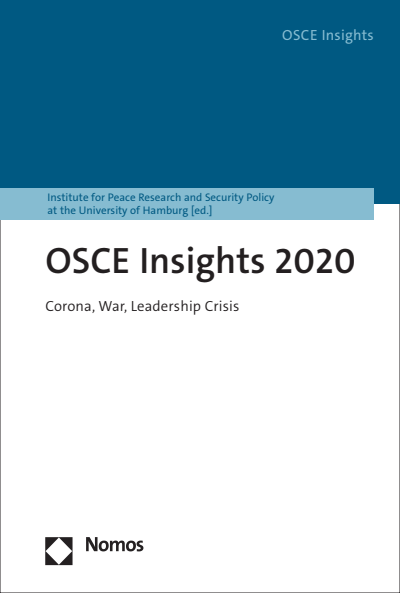
OSCE Insights 2020
Corona, War, Leadership Crisis- Editors:
- Publisher:
- 2020
Summary
The contributions to the 2020 edition of OSCE Insights examine the various crises the OSCE faced during that year. Themes include the efforts of the Minsk Group to manage the conflict over Nagorno-Karabakh and the implications of anti-coronavirus measures for the OSCE Code of Conduct on Politico-Military Aspects of Security. Furthermore, authors analyse OSCE conflict cycle tools, the OSCE’s role in the fight against antisemitism, the increasingly limited space for supporting democratic police governance in Central Asia, trust-building in the field of arms control, societal views on the conflict in Eastern Ukraine, relations between the OSCE and the Council of Europe, and Kazakhstan’s aspirations for hosting a connectivity center.
With contributions byAndrew Baker, Cornelius Friesendorf, Frank Evers, André Härtel, Marietta König, Sebastian Mayer, Michael Raith, Filip Ejdus, Alexandre Lambert, Thomas Schmidt, Marina Dolcetta Lorenzini, Anna Hess Sargsyan, Philip Remler, Richard Giragosian, Sergey Rastoltsev and Benjamin Schaller.
Keywords
Search publication
Bibliographic data
- Edition
- 1/2020
- Copyright Year
- 2020
- ISBN-Print
- 978-3-8487-7830-0
- ISBN-Online
- 978-3-7489-2233-9
- Publisher
- Nomos, Baden-Baden
- Language
- English
- Pages
- 12
- Product Type
- Edited Book
Table of contents
- Cover Pages/Table of ContentsPages 1 - 6 Download chapter (PDF)
- Introduction to OSCE Insights 2020: The OSCE in Crisis Mode Pages 7 - 12Authors:Download chapter (PDF)
- Authors:Download chapter (PDF)
- IntroductionAuthors:
- Authors:
- Types of international police assistanceAuthors:
- Policing in Central AsiaAuthors:
- Authors:
- Understanding the limitations of the OSCEAuthors:
- Controlling the OSCEAuthors:
- Authors:
- Challenges in improving human securityAuthors:
- Authors:
- Law enforcement support as an inroad?Authors:
- Conclusions and recommendationsAuthors:
- Authors:Download chapter (PDF)
- IntroductionAuthors:
- Addressing Jewish community security concernsAuthors:
- Defining antisemitismAuthors:
- Challenges posed by the OSCE’s structure and working methodsAuthors:
- Prospects for the futureAuthors:
- Authors:Download chapter (PDF)
- IntroductionAuthors:
- Conceptual foundationsAuthors:
- Picking up the signals: Early warning and situational awarenessAuthors:
- Early action and crisis management: Learning lessons for the futureAuthors:
- The crown jewel of the toolbox: The facilitation of peaceful conflict resolutionAuthors:
- Focusing on sustainability: Structural prevention and peacebuildingAuthors:
- Sharing expertise and knowledge: Leveraging partnershipsAuthors:
- ConclusionAuthors:
- Authors:Download chapter (PDF)
- IntroductionAuthors:
- The concept of connectivityAuthors:
- The OSCE and connectivityAuthors:
- Kazakhstan’s OSCE connectivity ambitionsAuthors:
- Norm resistance and leadership ambitionsAuthors:
- Conclusions and RecommendationsAuthors:
- Authors: | |Download chapter (PDF)
- IntroductionAuthors: | |
- Relevant OSCE normsAuthors: | |
- States of emergency and the use of armed forces in the Covid-19 pandemicAuthors: | |
- Conclusion and policy recommendationsAuthors: | |
- Authors: | | |Download chapter (PDF)
- IntroductionAuthors: | | |
- Authors: | | |
- ArmeniaAuthors: | | |
- AzerbaijanAuthors: | | |
- Minsk Group activity since 1992Authors: | | |
- Political effects of the recent fightingAuthors: | | |
- Authors: | | |
- Prospects for negotiationsAuthors: | | |
- The Minsk Group going forwardAuthors: | | |
- ConclusionAuthors: | | |
- Authors:Download chapter (PDF)
- IntroductionAuthors:
- Trust, but verify: Shortcomings of a traditional approach to CSBMsAuthors:
- Understanding military confidence building at the implementation levelAuthors:
- Rethinking military confidence building in EuropeAuthors:
- Concluding remarks and policy recommendationsAuthors:
- Authors: | | |Download chapter (PDF)
- IntroductionAuthors: | | |
- MethodologyAuthors: | | |
- BackgroundAuthors: | | |
- Authors: | | |
- Authors: | | |
- Position 1: “Hard re-integration and restoration of the status quo ante”Authors: | | |
- Position 2: “Territorial integrity and the national interest”Authors: | | |
- Position 3: “Soft reintegration and the restoration of statehood”Authors: | | |
- Shared interests: Socio-economic survival and mobilityAuthors: | | |
- Authors: | | |
- Position 4: “Independence or unification with Russia”Authors: | | |
- Position 5: “Transitional autonomy and soft independence”Authors: | | |
- Shared interests: a positive presence of the Ukrainian state serving popular needsAuthors: | | |
- Authors: | | |
- Authors: | | |
- RecommendationsAuthors: | | |
- a) to the Ukrainian governmentAuthors: | | |
- b) to the Russian government and NGCA de facto authoritiesAuthors: | | |
- Authors: | | |
- RecommendationsAuthors: | | |
- a) to the Ukrainian governmentAuthors: | | |
- b) to the OSCE, the Ukrainian government and civil society organizationsAuthors: | | |
- c) to the Russian government and NGCA de facto authoritiesAuthors: | | |
- Authors: | | |
- RecommendationsAuthors: | | |
- a) to the OSCE and the Ukrainian and Russian governmentsAuthors: | | |
- b) to the Ukrainian governmentAuthors: | | |
- c) to the Russian Government and NGCA de facto authoritiesAuthors: | | |
- Authors: | |Download chapter (PDF)
- IntroductionAuthors: | |
- Authors: | |
- Established modalitiesAuthors: | |
- Fixed modalities of high-level communicationAuthors: | |
- Flexible interaction at the working levelAuthors: | |
- Uneven cooperation in the fieldAuthors: | |
- Authors: | |
- High-level reluctanceAuthors: | |
- Structural differencesAuthors: | |
- Authors: | |
- Improving high-level communicationAuthors: | |
- Supporting interaction in the fieldAuthors: | |