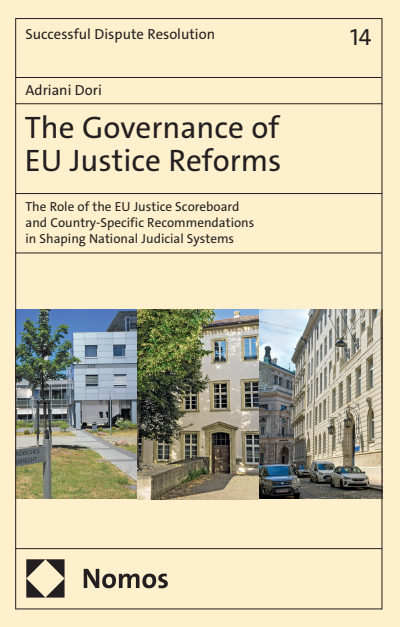
The Governance of EU Justice Reforms
The Role of the EU Justice Scoreboard and Country-Specific Recommendations in Shaping National Judicial Systems- Autor:innen:
- Reihe:
- Successful Dispute Resolution, Band 14
- Verlag:
- 2025
Zusammenfassung
Dieses bahnbrechende Werk verändert unser Verständnis der prozessualen Rechtswissenschaft, indem es aufzeigt, wie EU-Soft-Law-Instrumente und politische Prozesse subtil, aber wirkungsvoll nationale Justizsysteme umgestalten. Es bietet die erste tiefgehende rechtliche und empirische Analyse dieser Instrumente und verbindet rechtliche Analyse sowie doktrinäre Erkenntnisse mit politischer Ökonomie, empirischer Rechtsforschung und Datenkritik. Dieser interdisziplinäre Ansatz in die prozessuale Rechtswissenschaft deckt neue Dynamiken zwischen Recht, politischer Steuerung und datengestützten Reformen auf und beleuchtet, wie diese Modelle der justizielle Governance weltweit exportiert werden. Ein Muss für Wissenschaftler in den Bereichen EU-Recht, Zivilprozessrecht, Rechtstheorie und öffentliche Politik.
Schlagworte
Publikation durchsuchen
Bibliographische Angaben
- Auflage
- 1/2025
- Copyrightjahr
- 2025
- ISBN-Print
- 978-3-7560-1569-6
- ISBN-Online
- 978-3-7489-4552-9
- Verlag
- Nomos, Baden-Baden
- Reihe
- Successful Dispute Resolution
- Band
- 14
- Sprache
- Englisch
- Seiten
- 625
- Produkttyp
- Monographie
Inhaltsverzeichnis
- Titelei/Inhaltsverzeichnis Kein Zugriff Seiten 1 - 34
- 1. Procedural Law in Context Kein Zugriff
- 2. Towards a Game-Changer in Procedural Legal Science Kein Zugriff
- 3. The Thesis’s Contribution Kein Zugriff
- 1.1 Introductory remarks Kein Zugriff
- 1.2.1 The rule of law and the “Copenhagen dilemma” Kein Zugriff
- 1.2.2.1 The political procedure of Article 7 TEU Kein Zugriff
- 1.2.2.2.1 Limitations Kein Zugriff
- 1.2.2.2.2 The CJEU’s contribution Kein Zugriff
- 1.2.2.3 The Cooperation and Verification Mechanism (CVM) Kein Zugriff
- 1.2.2.4 Interim conclusions Kein Zugriff
- 1.2.3 Three rule-of-law crises as catalysers for developments Kein Zugriff
- 1.2.4 Towards new rule-of-law protection mechanisms Kein Zugriff
- 1.2.5 The role of the Justice Scoreboard within the rule-of-law debate Kein Zugriff
- 1.3.1 The European Semester Kein Zugriff
- 1.3.2 Timetable and key elements Kein Zugriff
- 1.4.1 The “Justice for Growth” agenda Kein Zugriff
- 1.4.2 Judicial reforms within the context of the EU economic governance Kein Zugriff
- 1.4.3 The role of the Justice Scoreboard in fostering judicial reforms Kein Zugriff
- 1.5 Conclusions Kein Zugriff
- 2.1 Introductory remarks Kein Zugriff
- 2.2.1 Justice reforms and legislative activities Kein Zugriff
- 2.2.2.1 Caseload Kein Zugriff
- 2.2.2.2 Disposition time Kein Zugriff
- 2.2.2.3 Clearance rate Kein Zugriff
- 2.2.2.4 Average length of proceedings (in specific areas of EU law) Kein Zugriff
- 2.2.2.5 Over-time developments Kein Zugriff
- 2.2.3.1.1 Financial parameters for litigants Kein Zugriff
- 2.2.3.1.2 Courts’ communication policies Kein Zugriff
- 2.2.3.1.3 Promotion and use of ADR Kein Zugriff
- 2.2.3.2.1 Human resources Kein Zugriff
- 2.2.3.2.2 Financial resources Kein Zugriff
- 2.2.3.3 Assessment tools Kein Zugriff
- 2.2.3.4 Training Kein Zugriff
- 2.2.3.5 Standards Kein Zugriff
- 2.2.3.6 Over-time developments Kein Zugriff
- 2.2.4.1 Perceived (de facto) judicial independence Kein Zugriff
- 2.2.4.2 Structural (de jure) judicial independence Kein Zugriff
- 2.2.4.3 Over-time developments Kein Zugriff
- 2.3.1.1 Aim Kein Zugriff
- 2.3.1.2 Limitations: The soft-law nature of the Justice Scoreboard Kein Zugriff
- 2.3.2.1 Aim Kein Zugriff
- 2.3.2.2 Limitations Kein Zugriff
- 2.3.3.1 Aim Kein Zugriff
- 2.3.3.2 Limitations: The heterogeneity of national judicial statistics Kein Zugriff
- 2.4 Conclusions Kein Zugriff
- 3.1 Introductory remarks Kein Zugriff
- 3.2.1 The involvement in the creation process Kein Zugriff
- 3.2.2 The tense cooperation with DG Justice Kein Zugriff
- 3.2.3 Data contribution Kein Zugriff
- 3.2.4 Methodology Kein Zugriff
- 3.2.5 Data limitations Kein Zugriff
- 3.2.6 Added value Kein Zugriff
- 3.2.7.1 The political dimension Kein Zugriff
- 3.2.7.2 The lack of neutrality Kein Zugriff
- 3.2.7.3 The political use of the CEPEJ findings Kein Zugriff
- 3.3.1 Involvement Kein Zugriff
- 3.3.2 Data contribution Kein Zugriff
- 3.3.3 Methodology Kein Zugriff
- 3.3.4 Data limitations Kein Zugriff
- 3.3.5 Added value Kein Zugriff
- 3.4.1 Involvement Kein Zugriff
- 3.4.2 Operation Kein Zugriff
- 3.4.3 Data contribution Kein Zugriff
- 3.4.4 Methodology Kein Zugriff
- 3.4.5 Data limitations Kein Zugriff
- 3.4.6 Added value Kein Zugriff
- 3.5.1 Background information Kein Zugriff
- 3.5.2 Involvement Kein Zugriff
- 3.5.3 Data contribution Kein Zugriff
- 3.5.4 Methodology Kein Zugriff
- 3.5.5.1 The importance of the appearance of independence Kein Zugriff
- 3.5.5.2 The formation of perceptions Kein Zugriff
- 3.5.5.3 The importance of comparisons Kein Zugriff
- 3.5.5.4 Understanding and using the data Kein Zugriff
- 3.5.6 Added value Kein Zugriff
- 3.5.7.1 The reasons behind the politicisation of the Scoreboard data Kein Zugriff
- 3.5.7.2 Perceived judicial independence in domestic and EU politics Kein Zugriff
- 3.5.7.3 Perceived judicial independence and the monopoly of State’s judicial services Kein Zugriff
- 3.6.1.1 Eurostat Kein Zugriff
- 3.6.1.2 The “Expert Group on Money Laundering and Terrorist Financing” Kein Zugriff
- 3.6.1.3 Others Kein Zugriff
- 3.6.2.1 The Global Competitiveness Report (GCR) Kein Zugriff
- 3.6.2.2 The Doing Business Report Kein Zugriff
- 3.6.2.3 Field studies Kein Zugriff
- 3.7 Main trends in the data providers Kein Zugriff
- 3.8 Conclusions Kein Zugriff
- 4.1 Introductory remarks Kein Zugriff
- 4.2.1 Before the first Scoreboard publication Kein Zugriff
- 4.2.2.1 The resolution of 3 July 2013 on the situation of fundamental rights: standards and practices in Hungary Kein Zugriff
- 4.2.2.2 The annual report on the situation of fundamental rights in the EU for 2012 Kein Zugriff
- 4.2.2.3 The resolution of 4 February 2014 on the EU Justice Scoreboard – civil and administrative justice in the Member States Kein Zugriff
- 4.2.2.4 The resolution of 12 March 2014 on evaluation of justice in relation to criminal justice and the rule of law Kein Zugriff
- 4.2.2.5 MEPs Parliamentary Questions (PQs) Kein Zugriff
- 4.2.2.6 Interim conclusions Kein Zugriff
- 4.2.3 The shift in the Commission’s narrative of 2014 Kein Zugriff
- 4.2.4.1 The situation in Hungary Kein Zugriff
- 4.2.4.2 The situation in Poland Kein Zugriff
- 4.2.4.3 The situation in Bulgaria and Romania Kein Zugriff
- 4.2.4.4 Interim conclusions Kein Zugriff
- 4.2.5.1 The Commission’s judicial and political actions against Poland Kein Zugriff
- 4.2.5.2 The CJEU’s involvement via the preliminary reference procedure Kein Zugriff
- 4.2.5.3 The Scoreboard’s contribution Kein Zugriff
- 4.2.6 The European Parliament’s resolution of 29 May 2018 Kein Zugriff
- 4.2.7 The post-2018 Scoreboard formation and the road ahead Kein Zugriff
- 4.3.1 Legislative activities Kein Zugriff
- 4.3.2 The lack of contextualisation of efficiency trends Kein Zugriff
- 4.3.3 Judicial and economic efficiency Kein Zugriff
- 4.3.4 The input of judicial systems as a question of quality Kein Zugriff
- 4.3.5 The prices for accessing national judicial markets: between efficiency and rule-of-law protection Kein Zugriff
- 4.3.6 Indexing, scoring and ranking in selected areas Kein Zugriff
- 4.3.7 Measuring judicial independence and capturing drifts to illiberalism Kein Zugriff
- 4.3.8 Missing links Kein Zugriff
- 4.4 Conclusions Kein Zugriff
- 5.1 Introductory remarks Kein Zugriff
- 5.2.1 The Scoreboard input for the rule of law Kein Zugriff
- 5.2.2 The Scoreboard input for instigating judicial reforms Kein Zugriff
- 5.2.3 The subtle Europeanisation of judicial policies within and outside of the European AFSJ Kein Zugriff
- 5.2.4 The (de-)politicisation and proceduralisation of the Scoreboard findings Kein Zugriff
- 5.3 What can be measured? Kein Zugriff
- 5.4.1 Timetable Kein Zugriff
- 5.4.2 The Country Reports Kein Zugriff
- 5.4.3 The assessment of national justice systems in the Country Reports Kein Zugriff
- 5.4.4 The production of Justice-CSRs Kein Zugriff
- 5.4.5 The monitoring instruments to measure the CSRs’ implementation progress Kein Zugriff
- 5.5 Conclusions Kein Zugriff
- 6.1 Introductory remarks Kein Zugriff
- 6.2.1 Country-Specific Recommendations Kein Zugriff
- 6.2.2 Country Reports Kein Zugriff
- 6.2.3 Secondary sources Kein Zugriff
- 6.2.4 Interim conclusions Kein Zugriff
- 6.3 The legal basis and non-binding (?) character of CSRs Kein Zugriff
- 6.4 The policy directions of CSRs Kein Zugriff
- 6.5 The phrasing of CSRs Kein Zugriff
- 6.6.1 The Commission’s narrative Kein Zugriff
- 6.6.2 Questioning the official narrative Kein Zugriff
- 6.6.3 Interim conclusions Kein Zugriff
- 6.7 The inner structure of CSRs Kein Zugriff
- 6.8.1 The Commission’s distinction between reform actions and reform outcomes Kein Zugriff
- 6.8.2 The Commission’s qualitative measurements Kein Zugriff
- 6.8.3 The Commission’s standard aggregated method Kein Zugriff
- 6.8.4 The problems of data aggregation Kein Zugriff
- 6.8.5 The inefficiencies of the implemented changes Kein Zugriff
- 6.8.6 Interim conclusions Kein Zugriff
- 6.9 The Effectiveness of CSRs Kein Zugriff
- 6.10 Conclusions Kein Zugriff
- 7.1 Introductory remarks Kein Zugriff
- 7.2 The cross-sectoral linkages of Justice-CSRs Kein Zugriff
- 7.3.1.1 Type A Justice-CSRs Kein Zugriff
- 7.3.1.2 Type B Justice-CSRs Kein Zugriff
- 7.3.1.3 Type C Justice-CSRs Kein Zugriff
- 7.3.2 Using the subject matter as a criterion Kein Zugriff
- 7.3.2 Quantifying recommendations: A granular approach and its implications Kein Zugriff
- 7.3.4 Interim conclusions: CSRs addressing Justice in a narrow and broad sense Kein Zugriff
- 7.4.1 The “addressees” of Justice-CSRs Kein Zugriff
- 7.4.2 The “monitored” Member States Kein Zugriff
- 7.4.3 Reporting challenges and playing with numbers Kein Zugriff
- 7.4.4 Interim conclusions Kein Zugriff
- 7.5.1 Justice-CSRs for “addressees” Kein Zugriff
- 7.5.2 Justice-CSRs for the “monitored” Member States Kein Zugriff
- 7.5.3 Interim conclusions Kein Zugriff
- 7.6 Questioning the Commission’s narrative Kein Zugriff
- 7.7 Conclusions Kein Zugriff
- 8.1 Introductory remarks Kein Zugriff
- 8.2 The legal basis of Justice-CSRs Kein Zugriff
- 8.3 The subject matters of Justice-CSRs Kein Zugriff
- 8.4.1 General data Kein Zugriff
- 8.4.2 Distribution by country and subject matter Kein Zugriff
- 8.4.3.1.1 EMU membership Kein Zugriff
- 8.4.3.1.2 EU 15 membership Kein Zugriff
- 8.4.3.2.1 The Justice Scoreboard’s unsuitability to test correlations Kein Zugriff
- 8.4.3.2.2 The length for enforcing contracts Kein Zugriff
- 8.4.3.2.3 Violations of Article 6 ECHR Kein Zugriff
- 8.4.3.3 Economic factors Kein Zugriff
- 8.5.1 Understanding and measuring effectiveness of Justice-CSRs Kein Zugriff
- 8.5.2 General data Kein Zugriff
- 8.5.3 The accuracy of the Commission’s assessment Kein Zugriff
- 8.5.4 Implementation by legal basis Kein Zugriff
- 8.5.5.1 EMU membership Kein Zugriff
- 8.5.5.2 EU 15 membership Kein Zugriff
- 8.5.6 Implementation by subject matter Kein Zugriff
- 8.5.7.1 Implementation progress Kein Zugriff
- 8.5.7.2 Implementation points and rate Kein Zugriff
- 8.5.7.3 Implementation by country and legal basis Kein Zugriff
- 8.5.7.4 Implementation by budget spending for the judiciary Kein Zugriff
- 8.5.8 The naming-and-shaming effect Kein Zugriff
- 8.6 Conclusions Kein Zugriff
- 9.1 Introductory remarks Kein Zugriff
- 9.2 Why do Justice-CSRs neglect some subject matters? Kein Zugriff
- 9.3 How badly should countries perform to receive a Justice-CSR? Kein Zugriff
- 9.4 Recommendations and state sovereignty: How intrusive are Justice-CSRs? Kein Zugriff
- 9.5 The low-profile approach behind recommendations: Justice-CSRs under the radar Kein Zugriff
- 9.6.1 Tackling issues of judicial independence through Justice-CSRs Kein Zugriff
- 9.6.2 Improving Justice after accession: CSRs and new EU members Kein Zugriff
- 9.6.3 The example of Hungary Kein Zugriff
- 9.6.4 The example of Poland Kein Zugriff
- 9.6.5 The use of Justice-CSRs as a policy tool: Main takeaways Kein Zugriff
- 9.7 Conclusions Kein Zugriff
- Summary Conclusions Kein Zugriff Seiten 551 - 558
- Bibliography Kein Zugriff Seiten 559 - 625