Monographie Open Access Vollzugriff
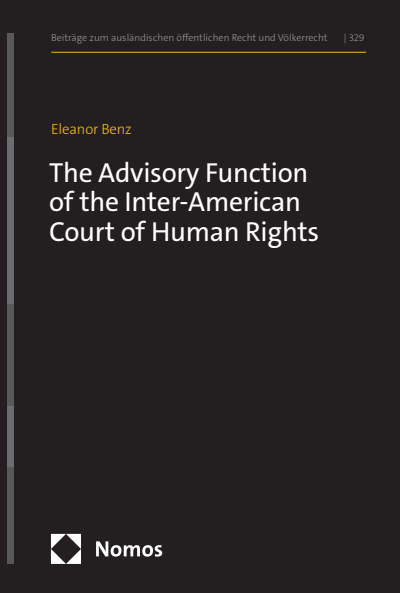
The Advisory Function of the Inter-American Court of Human Rights
- Autor:innen:
- Reihe:
- Beiträge zum ausländischen öffentlichen Recht und Völkerrecht, Band 329
- Verlag:
- 2024
Zusammenfassung
Wie müssen die Rechte gleichgeschlechtlicher Paare sichergestellt werden und welche umweltrechtlichen Verpflichtungen folgen aus dem Recht auf Leben und auf körperliche Unversehrtheit? Mit so unterschiedlichen und weitreichenden Fragen wie diesen befasst sich der Interamerikanische Gerichtshof für Menschenrechte regelmäßig im Rahmen seiner Gutachtenfunktion. Das Buch stellt die erste umfassende, nicht-spanischsprachige Abhandlung dieser Gutachtenfunktion dar. Es analysiert den Umfang der Gutachtenjurisdiktion und die Verfahrenspraxis des Gerichtshofs im Vergleich mit der anderer internationaler Gerichtshöfe. Außerdem wird die rechtliche Wirkung der Gutachten und die Frage, wann der Gerichtshof Gutachtenanfragen ablehnen sollte, untersucht.
Schlagworte
Publikation durchsuchen
Bibliographische Angaben
- Auflage
- 1/2024
- Copyrightjahr
- 2024
- ISBN-Print
- 978-3-7560-1443-9
- ISBN-Online
- 978-3-7489-1980-3
- Verlag
- Nomos, Baden-Baden
- Reihe
- Beiträge zum ausländischen öffentlichen Recht und Völkerrecht
- Band
- 329
- Sprache
- Englisch
- Seiten
- 0
- Produkttyp
- Monographie
Inhaltsverzeichnis
KapitelSeiten
- Titelei/InhaltsverzeichnisSeiten 1 - 22 Download Kapitel (PDF)
- IntroductionSeiten 23 - 32 Download Kapitel (PDF)
- Chapter 1: The IACtHR as part of the inter-American human rights systemSeiten 33 - 42 Download Kapitel (PDF)
- A. Advisory opinions in general
- I. England
- II. United States of America
- III. Canada and India
- IV. Latin American states
- V. Permanent Court of International Justice
- VI. International Court of Justice
- VII. Intermediate conclusion
- I. The idea to create a binding American Human Rights Convention
- II. Draft of the Inter-American Council of Jurists
- III. Chilean draft convention
- IV. Draft of the Inter-American Commission on Human Rights
- V. 1969 Specialized Inter-American Conference
- VI. Rejection of an optional advisory jurisdiction in the draft Statute
- VII. Concluding summary
- I. OAS member states
- II. OAS organs including the IACHR
- 1. National courts
- 2. National parliaments
- 3. Non-governmental organizations
- 4. Other regional organizations independent of the OAS
- IV. Authority to render advisory opinions proprio motu?
- I. Article 64 (1): “The interpretation of…”
- II. “… this Convention”
- 1. OC-1/82
- 2. Interpretation of soft law instruments and references to customary international law
- 3. Concluding summary
- IV. Article 64 (2): Compatibility of domestic laws
- I. Clarification and reduction
- 1. OC-23/17
- 2. OC-24/17
- 3. Extension of the subject matter upon request of amici
- I. Advisory jurisdiction of the IACtHR compared to the ICJ’s advisory jurisdiction
- II. Advisory jurisdiction of the IACtHR compared to the ECtHR’s advisory jurisdiction
- III. Advisory jurisdiction of the IACtHR compared to the AfrCtHPR’s advisory jurisdiction
- IV. Overview over the advisory and related jurisdiction of several international courts and the trend towards preliminary ruling procedures
- A. Written admissibility requirements
- B. Submission and notification of a request
- 1. First rejection
- 2. Second rejection
- 3. Third rejection
- 4. Fourth rejection
- 5. Fifth rejection
- 6. Sixth rejection
- aa) OC-3/83
- bb) OC-14/94
- cc) Intermediate conclusion
- aa) OC-13/93
- bb) OC-15/97
- cc) OC-19/05
- dd) Combined analysis in light of OC-5/85
- aa) OC-16/99
- bb) OC-23/17
- cc) OC-24/17
- dd) OC-28/21
- ee) Intermediate conclusion
- (1) OC-16/99
- (2) OC-23/17
- bb) Conflict with a state not party to the OAS
- (1) OC-18/03
- (2) OC-21/14
- (3) OC-26/20
- (4) OC-28/21
- dd) Intermediate conclusion
- 2. Political debates, controversies and proceedings at the national level
- 3. Issues on which the Court has already ruled in its jurisprudence
- 4. Abstract speculations without a foreseeable application to specific situations
- a) Requests by the Commission relating to a dispute with states
- b) Requests by states relating to a dispute with the Commission
- c) Requests by the Commission relating to petitions pending before it
- d) Requests by states relating to petitions pending before the Commission
- e) Requests related to conflicts between states
- 2. Political debates, controversies and proceedings at the national level
- 3. Issues on which the Court has already ruled in its jurisprudence
- 4. Abstract speculations without a foreseeable application to specific situations
- IV. Concluding summary
- D. Composition of the Court in advisory proceedings
- E. Written proceedings
- F. Role of amici
- G. Public hearing
- H. Delivery and publication of the final advisory opinion
- I. Average length of the advisory proceedings
- I. Exclusion of national judges
- II. Separate decision on jurisdiction and admissibility / preliminary objections
- III. Accelerated procedure
- IV. Creation of a preliminary ruling procedure
- K. Conclusion
- I. Permanent Court of International Justice
- II. International Court of Justice
- III. Intermediate conclusion
- I. Legal nature and effects of the advisory opinions as conceived by the constituent instruments
- 1. Origins and foundation of the doctrine
- 2. Legal basis of the doctrine
- a) Case of Aguado-Alfaro: Ex officio exercise within the spheres of competence
- b) Case of Boyce et al.: Conventionality control includes constitutional norms
- c) Case of Radilla Pacheco: Duty of consistent interpretation
- d) Case of Cabrera García and Montiel Flores: Extension on all state authorities
- e) Extension of the control on all human rights treaties
- f) Gelman case: Conventionality control and the binding effects of the Court’s decisions
- g) OC-21/14: Inclusion of advisory opinions in the material controlante
- 4. Summary and conclusion
- 1. Early years
- 2. Acknowledgment of “undeniable legal effects”
- 3. Inclusion of advisory opinions in the doctrine of conventionality control
- 4. Evaluation and intermediate conclusion
- a) Views held before the advisory opinions’ inclusion in the doctrine of conventionality control
- b) Contemporary voices
- c) Evaluation and intermediate conclusion
- aa) Faúndez Ledesma
- bb) Salvioli
- cc) Roa
- dd) Zelada
- aa) Costa Rica
- bb) Ecuador
- cc) Peru
- c. Evaluation and intermediate conclusion
- a) Res interpretata versus res judicata
- b) Legal basis and the applicability of res interpretata to advisory opinions
- c) Formation of res interpretata
- aa) Arguments against the strict understanding of res interpretata
- bb) Problems of a too lax understanding of res interpretata
- cc) Suggested understanding of res interpretata
- e) Res interpretata and the asymmetries in the inter-American human rights system
- f) Evaluation and intermediate conclusion
- C. Final summary and conclusion
- A. Present
- B. Future
- Advisory opinions
- Contentious cases
- Orders/Resolutions of the Court
- Requests for advisory opinions
- B. IACHR
- Advisory opinions
- Contentious cases
- Advisory opinions
- Contentious cases
- Advisory opinions
- Contentious cases
- F. AfrCtHPR
- G. CJEU
- H. ICTY
- I. Special Court for Sierra Leone
- J. ITLOS
- K. Arbitral awards
- Chile
- Colombia
- Costa Rica
- Ecuador
- Germany
- Mexico
- Peru
- United States of America
- BibliographySeiten 451 - 466 Download Kapitel (PDF)
- General publications of the Court
- Procedural documents from advisory proceedings before the Court
- B. IACHR
- C. OAS documents
- D. Documents from Europe
- E. League of Nations and PCIJ
- F. United Nations and ICJ
- G. Newspaper articles and websites
- H. Miscellaneous