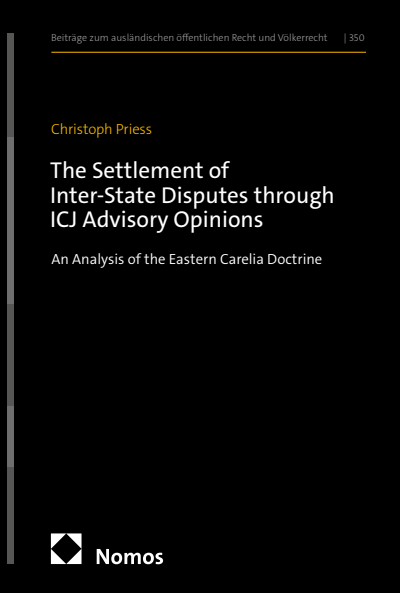
The Settlement of Inter-State Disputes through ICJ Advisory Opinions
An Analysis of the Eastern Carelia Doctrine- Autor:innen:
- Reihe:
- Beiträge zum ausländischen öffentlichen Recht und Völkerrecht, Band 350
- Verlag:
- 2026
Zusammenfassung
Dieses Buch bietet eine eingehende Analyse der Beziehung zwischen dem Grundsatz der einvernehmlichen Streitbeilegung im Völkerrecht und der Gutachtenfunktion des Internationalen Gerichtshofs (IGH). 2019 veröffentlichte der IGH sein Chagos-Gutachten. Darin stellte er fest, dass der Chagos-Archipel zu Mauritius gehört und die Verwaltung des Archipels durch das Vereinigte Königreich völkerrechtswidrig ist. In dem Verfahren bezogen sich das Vereinigte Königreich und Richterin Donoghue auf die Ostkarelien-Doktrin. Die Doktrin von 1923 besagt: Der Gerichtshof gibt kein Gutachten ab, wenn er damit die Grundregel aushebeln würde, dass Staaten nur mit ihrer Zustimmung Streitigkeiten vor Gericht klären müssen. Dieser Titel erscheint auch Open Access.
Publikation durchsuchen
Bibliographische Angaben
- Auflage
- 1/2026
- Copyrightjahr
- 2026
- ISBN-Print
- 978-3-7560-4164-0
- ISBN-Online
- 978-3-7489-7114-6
- Verlag
- Nomos, Baden-Baden
- Reihe
- Beiträge zum ausländischen öffentlichen Recht und Völkerrecht
- Band
- 350
- Sprache
- Englisch
- Seiten
- 411
- Produkttyp
- Monographie
Inhaltsverzeichnis
- Preface
- Table of abbreviations
- IntroductionSeiten 23 - 28 Download Kapitel (PDF)
- A. The international judicial landscape before the 20th century
- I. Relationship between the PCIJ and the League of Nations: Between formal independence and organic connection
- II. The PCIJ’s advisory jurisdiction
- III. Early criticism against the legal effects of PCIJ advisory opinions
- IV. Converging the Court’s advisory and contentious procedure: Rules of the Court and revision of the PCIJ Statute
- C. The collapse of the League of Nations and the beginning of a new world order
- I. Dumbarton Oaks Conversations (August to September 1944)
- II. Washington Committee of Jurists (9 to 20 April 1945)
- III. San Francisco Conference (25 April to 26 June 1945)
- E. Conclusions on the history of the advisory function
- I. Background
- II. Article 17 and the Council’s competence to request advisory opinions from the PCIJ
- III. The birth of the Eastern Carelia doctrine by obiter dictum
- IV. Propriety of giving the requested advisory opinion
- V. Interim conclusions: (un)limited application of the Eastern Carelia ‘precedent’
- I. Background
- II. PCIJ reaffirms Eastern Carelia doctrine even where Article 17 is fulfilled
- C. Conclusions on the origins of the Eastern Carelia doctrine
- I. Background
- II. Bulgaria, Hungary, and Romania challenge the Court’s jurisdiction
- III. Judges Azevedo, Krylov, Winiarski, and Zoričić agree with the objections
- 1. Jurisdiction and state consent
- 2. Discretionary nature of the advisory competence
- V. Conclusion: Bringing the Eastern Carelia doctrine into the UN era
- I. Background
- II. ICJ focuses on the object and purpose of the request
- C. Judgments of the ILO Administrative Tribunal case (1956)
- I. Background
- II. South Africa invokes the Eastern Carelia precedent
- III. Focus on the object and purpose of the request for an advisory opinion
- I. Background
- II. Spain invokes incompatibility of advisory opinion with judicial character of the ICJ
- III. The ICJ’s standard of discretion
- IV. Decolonization as an inherently multilateral matter
- V. Judge Gros on the conditions of a bilateral dispute
- VI. Conclusion
- I. Background
- II. UNGA’s permanent responsibility for the Israeli-Palestinian conflict places matter in “broader frame of reference”
- III. Access to necessary information and evidence
- IV. The ICJ addresses the international responsibility of Israel
- V. Legal consequences for states other than Israel and the UN
- I. Background
- II. ICJ gives deference to requesting organ assuming its need for an advisory opinion
- I. Background
- 1. UK and others: Giving an advisory opinion violates the Eastern Carelia doctrine
- 2. Mauritius and others: Advisory opinion concerns decolonization, not a territorial dispute
- 3. Germany proposes compromise
- 1. Court majority
- 2. Separate opinions and Declarations by Vice-President Xue and Judges Gaja, Iwasawa, and Salam
- a) Dissenting opinion by Judge Donoghue
- b) Declaration by Judge Tomka
- c) Declaration by Judge Gevorgian
- I. Background
- II. ICJ pays lip service to Eastern Carelia doctrine
- I. The Eastern Carelia doctrine’s overarching function: safeguarding the integrity of the Court’s judicial function
- II. The Eastern Carelia’s three-pronged test: Bilateral dispute, lack of consent, dispute settlement by means of the advisory opinion procedure
- III. Abandoning or continuing the Eastern Carelia doctrine?
- 1. Article 47-procedure
- 2. Protocol 16-procedure
- II. Use of ECtHR advisory opinions to settle inter-state disputes
- I. Overview of the IACtHR’s advisory jurisdiction
- 1. Death Penalty case (1983)
- 2. Consular Assistance case (1999)
- 3. Environment and Human Rights case (2017)
- 4. Asylum as a Human Right case (2018)
- III. Interim conclusions
- I. Overview of the ACtHPR’s advisory jurisdiction
- II. Use of ACtHPR advisory opinions to settle inter-state disputes
- 1. Seabed Disputes Chamber
- 2. ITLOS
- 1. Seabed Disputes Chamber
- 2. ITLOS
- III. Interim conclusions
- E. Conclusions on the Eastern Carelia doctrine before other ICs
- A. Relevant provisions
- I. Basic rules of treaty interpretation
- II. Principle of specialty and principle of implied powers
- 1. Authorization
- a) ICJ interprets “scope of activities” narrowly
- b) Applying the “scope of activities” limitation to the UNSC and the UNGA
- c) Relationship between the UNGA and the UNSC
- 1. Political questions
- 2. Questions of fact, historical questions, interpretation of the UN Charter
- I. Grammatical interpretation
- 1. Provisions governing the scope of activities of the UNGA and UNSC
- 2. No consent requirement in Articles 66–68 ICJ Statute
- 3. Rules of the Court expressly refer to inter-state disputes
- 1. Subsequent agreements relating to the use of ICJ advisory opinions to settle international disputes
- a) UNGA requests for advisory opinions on inter-state disputes
- b) Practice of the Court
- c) Practice of States Parties
- IV. Object and purpose
- V. Preparatory work of the UNC and ICJ Statute
- VI. Interim conclusions on state consent
- I. “Discretion” of the PCIJ under the League’s Covenant
- II. The ICJ’s standard of “discretion”
- 1. Discretionalist school
- 2. Eclecticist school
- 3. School of denial
- IV. Interim conclusions
- I. The concept of “judicial power” in Germany
- a) Decision-making body
- b) Subject-matter of the decision
- c) Standard of decision-making
- d) Decision-making procedure
- e) Effects of the decision
- 2. Tasks of domestic courts
- 1. US Supreme Court
- a) The FCC’s advisory opinion in the context of German rearmament
- b) Content of the advisory opinion
- c) Removal of the FCC advisory procedure
- d) Relevance for the ICJ’s advisory procedure
- IV. Interim conclusions
- I. Defining “judicial function” as judicial characteristics
- a) First supporting task: law-finding task
- b) Second supporting task: Fact-finding task
- a) Stabilizing normative expectations
- b) Law-making
- c) Control
- III. Interim conclusions
- 1. Jurisdiction of states
- 2. Jurisdiction clauses in human rights treaties
- 3. Jurisdiction of international courts and tribunals
- 1. General and special jurisdiction
- 2. Abstract and concrete jurisdiction
- 3. Personal, material, temporal, and spatial jurisdiction
- 1. Binding decisions as an exercise of jurisdiction
- a) Binding force
- b) Res judicata
- a) Intervention
- b) In matters essentially within the domestic jurisdiction
- 4. Sovereign equality of states
- IV. Interim conclusions
- 1. Content of the Monetary Gold doctrine
- 2. Doctrinal justification of the Monetary Gold doctrine
- 3. Applying the rationale of the Monetary Gold doctrine to advisory proceedings
- a) Legal formalist approaches
- b) Normative approaches
- c) Sociological approaches
- d) Compliance studies and performance-based approaches
- e) Practice-based approaches
- 2. Formal and normative authority of ICJ advisory opinions
- a) A practice-based approach to studying the authority of ICJ advisory opinions
- (1) Reactions by Israel
- (2) Reactions by the UNGA and other UN organs
- (1) Obligations of third states not to recognize and support the Wall regime
- (a) The Brita case
- (b) The Organisation juive européenne case
- cc) Conclusions on the Wall advisory opinion
- aa) Narrow authority: Reactions by the UK, Mauritius and the UN
- (1) ITLOS Special Chamber judgment
- (2) Analysis
- cc) Conclusions on the Chagos advisory opinion
- E. Conclusions on the justifications for the Eastern Carelia doctrine
- A. Conclusion
- B. Summary
- PostscriptSeiten 383 - 386 Download Kapitel (PDF)
- A. Decisions and advisory opinions of general international courts and arbitral tribunals
- B. Decisions and advisory opinions of regional human rights courts
- C. Decisions of national and supranational courts
- BibliographySeiten 395 - 410 Download Kapitel (PDF)