, um zu prüfen, ob Sie einen Vollzugriff auf diese Publikation haben.
Ausgabe Teilzugriff

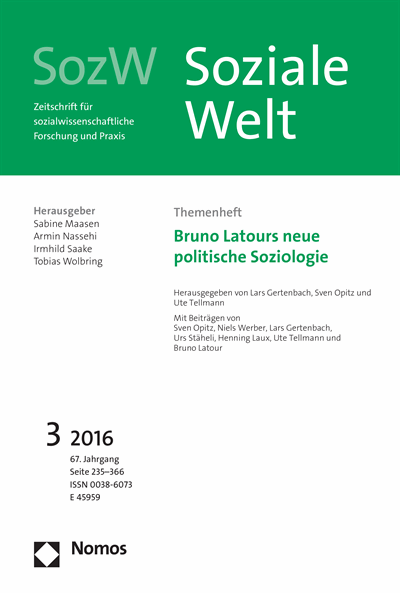
Jahrgang 67 (2016), Heft 3

SozW Soziale Welt
Autor:innen:
Zeitschrift:
SozW Soziale Welt
Verlag:
 2016

Über die Zeitschrift

Die Soziale Welt ist eine der großen, auch im Ausland gelesenen Fachzeitschriften innerhalb der deutschen Soziologie. Sie bringt empirische und theoretische Arbeiten aus allen Bereichen des Faches und versucht auf diese Weise, die Entwicklung der Soziologie einerseits zu spiegeln und ihr andererseits auch neue Impulse zu geben. Dies geschieht neben den viermal pro Jahr erscheinenden regulären Heften auch durch die Arbeit an Sonderbänden mit einheitlicher Thematik. Die Zeitschrift "Soziale Welt" wendet sich an Soziologen, Sozialwissenschaftler, Interessierte allgemein. Homepage: www.soziale-welt.de

Publikation durchsuchen


Bibliographische Angaben

ISSN-Print
0038-6073
ISSN-Online
2942-3414
Verlag
Nomos, Baden-Baden
Sprache
Deutsch
Produkttyp
Ausgabe

Artikel

Cover der Ausgabe: SozW Soziale Welt Jahrgang 67 (2016), Heft 3
Artikel
Teilzugriff
Seite 235 - 236
Nomos Verlagsgesellschaft mbH & Co. KG, Baden-Baden 2016

Cover der Ausgabe: SozW Soziale Welt Jahrgang 67 (2016), Heft 3
Artikel
Vollzugriff

Seite 237 - 248
Nomos Verlagsgesellschaft mbH & Co. KG, Baden-Baden 2016
Autor:innen:

Cover der Ausgabe: SozW Soziale Welt Jahrgang 67 (2016), Heft 3
Artikel
Vollzugriff

Seite 249 - 266
Sowohl Bruno Latour als auch Ulrich Beck verwenden die Kategorie des Kosmopolitischen, um die Bildung neuer Formen von Kollektivität zu erfassen. Dieser Beitrag arbeitet heraus, wie die Autoren dabei die Dimensionen des Sozialen und des Politischen...
Nomos Verlagsgesellschaft mbH & Co. KG, Baden-Baden 2016
Autor:innen:

Cover der Ausgabe: SozW Soziale Welt Jahrgang 67 (2016), Heft 3
Artikel
Vollzugriff

Seite 267 - 280
In den 1990er Jahren kommt es zu einer fundamentalen Kritik Bruno Latours an Niklas Luhmanns Soziologie der Moderne. Der Gegensatz zwischen Laborstudien und Systemtheorie scheint unüberwindbar zu sein. Mein Text spielt den Einwand zunächst zurück...
Nomos Verlagsgesellschaft mbH & Co. KG, Baden-Baden 2016
Autor:innen:

Cover der Ausgabe: SozW Soziale Welt Jahrgang 67 (2016), Heft 3
Artikel
Vollzugriff

Seite 281 - 298
Im Zentrum des Aufsatzes steht die Auseinandersetzung mit dem Politischen bei Bruno Latour. Angesichts zahlreicher Unklarheiten und divergierender Einschätzungen in Bezug auf den Gehalt seiner politischen Theorie zielt der Aufsatz auf eine...
Nomos Verlagsgesellschaft mbH & Co. KG, Baden-Baden 2016
Autor:innen:

Cover der Ausgabe: SozW Soziale Welt Jahrgang 67 (2016), Heft 3
Artikel
Vollzugriff

Seite 299 - 312
Dieser Aufsatz beschäftigt sich mit der Rolle von Konnektivität und Diskonnektivität in Bruno Latours unterschiedlichen Konzeptionen des Politischen. Die gemeinsame Grundlage von Latours unterschiedlichen Fassungen des Politischen ist die...
Nomos Verlagsgesellschaft mbH & Co. KG, Baden-Baden 2016
Autor:innen:

Cover der Ausgabe: SozW Soziale Welt Jahrgang 67 (2016), Heft 3
Artikel
Vollzugriff

Seite 313 - 332
Der Text verdichtet erstmals die vielschichtigen Beiträge Bruno Latours im Bereich der politischen Soziologie zu einem integrativen Prozessmodell mit ökologischem Leitmotiv. Auf dieser Grundlage wird die von Latour anvisierte Kreuzung zwischen...
Nomos Verlagsgesellschaft mbH & Co. KG, Baden-Baden 2016
Autor:innen:

Cover der Ausgabe: SozW Soziale Welt Jahrgang 67 (2016), Heft 3
Artikel
Vollzugriff

Seite 333 - 352
Dieser Artikel befasst sich mit dem Verhältnis von politischer Ökologie und Ökonomie im Werk von Bruno Latour. Der Ausgangpunkt ist die Beobachtung, dass Latour die Praktiken der Kalkulation, des Messens und des Wertens in den Mittelpunkt rückt,...
Nomos Verlagsgesellschaft mbH & Co. KG, Baden-Baden 2016
Autor:innen:

Cover der Ausgabe: SozW Soziale Welt Jahrgang 67 (2016), Heft 3
Artikel
Vollzugriff

Seite 353 - 364
Nomos Verlagsgesellschaft mbH & Co. KG, Baden-Baden 2016

Cover der Ausgabe: SozW Soziale Welt Jahrgang 67 (2016), Heft 3
Artikel
Teilzugriff
Seite 365 - 366
Nomos Verlagsgesellschaft mbH & Co. KG, Baden-Baden 2016

Literaturverzeichnis (283 Einträge)

  1. Beck, Ulrich/Grande, Edgar (2010): Jenseits des methodologischen Nationalismus. Außereuropäische und europäische Varianten der Zweiten Moderne, in: Soziale Welt 61, S. 187–216. Google Scholar öffnen doi.org/10.5771/0038-6073-2016-3-237
  2. Beck, Ulrich/Latour, Bruno/Selchow, Sabine (2014): Die Apokalypse duldet keinen Sachzwang. Ein Gespräch mit Ulrich Beck und Bruno Latour, in: Frankfurter Allgemeine Zeitung, 15. Mai 2014, S. 14, abrufbar unter: http://www.faz.net/-gsf-7pc6 j. Google Scholar öffnen doi.org/10.5771/0038-6073-2016-3-237
  3. Callon, Michel/Latour, Bruno (2006): Die Demontage des großen Leviathans. Wie Akteure die Makrostruktur ihrer Realität bestimmen und Soziologen ihnen dabei helfen, in: Andréa Belliger/David J. Krieger (Hrsg.), ANThology. Ein einführendes Handbuch zur Akteur-Netzwerk-Theorie. Bielefeld: transcript, S. 75–101. Google Scholar öffnen doi.org/10.5771/0038-6073-2016-3-237
  4. Crutzen, Paul J. (2002): Geology of Mankind, in: Nature 415, S. 23. Google Scholar öffnen doi.org/10.5771/0038-6073-2016-3-237
  5. Davis, Heather/Latour, Bruno (2015): Diplomacy in the Face of Gaia. Bruno Latour in conversation with Heather Davis, in: Heather Davis/Etienne Turpin (Hrsg.), Art in the Anthropocene: Encounters Among Aesthetics, Politics, Environments and Epistemologies. London: Open Humanities Press, S. 43–56. Google Scholar öffnen doi.org/10.5771/0038-6073-2016-3-237
  6. Dewey, John (1996): Die Öffentlichkeit und ihre Probleme, Bodenheim: Philo Verlagsgesellschaft. Google Scholar öffnen doi.org/10.5771/0038-6073-2016-3-237
  7. Gertenbach, Lars (2015): Entgrenzungen der Soziologie. Bruno Latour und der Konstruktivismus, Weilerswist: Velbrück. Google Scholar öffnen doi.org/10.5771/0038-6073-2016-3-237
  8. Gertenbach, Lars (2016): Die Wissenschaften als Laboratorium der Soziologie. Zur Rolle der Science Studies bei der Reformulierung von Sozial- und Gesellschaftstheorie bei Bruno Latour, in: Stephan Lessenich (Hrsg.), Routinen der Krise – Krise der Routinen, Verhandlungen des 37. Kongresses der Deutschen Gesellschaft für Soziologie 2014, abrufbar unter: http://publikationen.soziologie.de/index. php/kongressband/article/view/104. Google Scholar öffnen doi.org/10.5771/0038-6073-2016-3-237
  9. Hämäläinen, Nora/Lehtonen, Turo-Kimmo (2016): Latour’s empirical metaphysics, in: Distinktion: Scandinavian Journal of Social Theory, online publication before print, S. 1–18. Google Scholar öffnen doi.org/10.5771/0038-6073-2016-3-237
  10. Harman, Graham (2014): Bruno Latour. Reassembling the Political, London: Pluto Press. Google Scholar öffnen doi.org/10.5771/0038-6073-2016-3-237
  11. Kneer, Georg/Schroer, Markus/Schüttpelz, Erhard (Hrsg.) (2008): Bruno Latours Kollektive. Kontrover- sen zur Entgrenzung des Sozialen, Frankfurt am Main: Suhrkamp. Google Scholar öffnen doi.org/10.5771/0038-6073-2016-3-237
  12. Lamla, Jörn (2016): [POL]: Die Politik der Moderne(n), in: Henning Laux (Hrsg.), Bruno Latours Sozio- logie der „Existenzweisen“. Einführung und Diskussion. Bielefeld: transcript, S. 79–94. Google Scholar öffnen doi.org/10.5771/0038-6073-2016-3-237
  13. Latour, Bruno (1988): The Pasteurization of France, Cambridge, Mass./London: Harvard University Press. Latour, Bruno (1996 a): Portrait eines Biologen als wilder Kapitalist, in: Ders.: Der Berliner Schlüssel. Google Scholar öffnen doi.org/10.5771/0038-6073-2016-3-237
  14. Erkundungen eines Liebhabers der Wissenschaften. Berlin: Akademie Verlag, S. 113–144. Google Scholar öffnen doi.org/10.5771/0038-6073-2016-3-237
  15. Latour, Bruno (1996 b): Das moralische Gewicht eines Schlüsselanhängers, in: Ders.: Der Berliner Schlüssel. Erkundungen eines Liebhabers der Wissenschaften. Berlin: Akademie Verlag, S. 53–61. Google Scholar öffnen doi.org/10.5771/0038-6073-2016-3-237
  16. Latour, Bruno (2001): Das Parlament der Dinge. Für eine politische Ökologie, Frankfurt am Main: Suhr- kamp. Google Scholar öffnen doi.org/10.5771/0038-6073-2016-3-237
  17. Latour, Bruno (2004): Krieg der Welten – wie wäre es mit Frieden?, Berlin: Merve. Google Scholar öffnen doi.org/10.5771/0038-6073-2016-3-237
  18. Latour, Bruno (2005): What Is Given in Experience? A Review of Isabelle Stengers’ „Penser Avec Whitehead“, in: Boundary 2 32, S. 223–237. Google Scholar öffnen doi.org/10.5771/0038-6073-2016-3-237
  19. Latour, Bruno (2006): Die Macht der Assoziation, in: Andréa Belliger/David J. Krieger (Hrsg.), ANTho- logy. Ein einführendes Handbuch zur Akteur-Netzwerk-Theorie. Bielefeld: transcript, S. 195–212. Google Scholar öffnen doi.org/10.5771/0038-6073-2016-3-237
  20. Latour, Bruno (2007 a): Eine neue Soziologie für eine neue Gesellschaft. Einführung in die Akteur-Netzwerk-Theorie, Frankfurt am Main: Suhrkamp. Google Scholar öffnen doi.org/10.5771/0038-6073-2016-3-237
  21. Latour, Bruno (2007 b): How to Think Like a State, in: Wim van de Donk (Hrsg.), The Thinking State. The Hague: Scientific Council for Government Policy, S. 19–32. Google Scholar öffnen doi.org/10.5771/0038-6073-2016-3-237
  22. Latour, Bruno (2007 c): Turning Around Politics: A Note on Gerard de Vries’ Paper, in: Social Studies of Science 37, S. 811–820. Google Scholar öffnen doi.org/10.5771/0038-6073-2016-3-237
  23. Latour, Bruno (2008 a): What is the Style of Matters of Concern?, Assen: Van Gorcum. Google Scholar öffnen doi.org/10.5771/0038-6073-2016-3-237
  24. Latour, Bruno (2008 b): Wir sind nie modern gewesen. Versuch einer symmetrischen Anthropologie, Frankfurt am Main: Suhrkamp. Google Scholar öffnen doi.org/10.5771/0038-6073-2016-3-237
  25. Latour, Bruno (2010): Coming out as a philosopher, in: Social Studies of Science 40, S. 599–608. Latour, Bruno (2013): Versuch eines „kompositionistischen Manifests“, in: Zeitschrift für Theoretische Google Scholar öffnen doi.org/10.5771/0038-6073-2016-3-237
  26. Soziologie 2, S. 8–30. Google Scholar öffnen doi.org/10.5771/0038-6073-2016-3-237
  27. Latour, Bruno (2014 a): Another way to compose the common world, in: HAU. Journal of Ethnography Theory 4, S. 301–317. Google Scholar öffnen doi.org/10.5771/0038-6073-2016-3-237
  28. Latour, Bruno (2014 b): Existenzweisen. Eine Anthropologie der Modernen, Berlin: Suhrkamp. Google Scholar öffnen doi.org/10.5771/0038-6073-2016-3-237
  29. Latour, Bruno (2014 c): Agency at the Time of the Anthropocene, in: New Literary History 45, S. 1–18. Latour, Bruno (2015): Face à Gaïa. Huit conférences sur le Nouveau Régime Climatique, Paris: La Découverte. Google Scholar öffnen doi.org/10.5771/0038-6073-2016-3-237
  30. Latour, Bruno (2016): Onus Orbis Terrarum: About a Possible Shift in the Definition of Sovereignty, in: Millennium – Journal of International Studies 44, S. 305–320. Google Scholar öffnen doi.org/10.5771/0038-6073-2016-3-237
  31. Latour, Bruno/Miranda, Carolina (2015): À métaphysique, métaphysique et demie. L’Enquête sur les modes d'existence forme-t-elle un système?, in: Les Temps Modernes 70, S. 72–85. Google Scholar öffnen doi.org/10.5771/0038-6073-2016-3-237
  32. Latour, Bruno/Salter, Mark B./Walters, William (2016): Bruno Latour Encounters International Relations: An Interview, in: Millennium – Journal of International Studies, online publication before print. Google Scholar öffnen doi.org/10.5771/0038-6073-2016-3-237
  33. Latour, Bruno/Woolgar, Steve (1986): Laboratory Life. The Construction of Scientific Facts, Princeton: Princeton University Press. Google Scholar öffnen doi.org/10.5771/0038-6073-2016-3-237
  34. Laux, Henning (2011): Das Parlament der Dinge. Zur Dekonstruktion einer Rezeptionsblockade, in: Soziologische Revue 34, S. 285–297. Google Scholar öffnen doi.org/10.5771/0038-6073-2016-3-237
  35. Laux, Henning (Hrsg.) (2016): Bruno Latours Soziologie der „Existenzweisen“. Einführung und Diskussion, Bielefeld: transcript. Google Scholar öffnen doi.org/10.5771/0038-6073-2016-3-237
  36. Lindemann, Gesa (2009): Bruno Latour – Von der Wissenschaftsforschung zur Expertokratie, in: Sebastian Gießmann/Ulrike Brunotte/Franz Mauelshagen/Hartmut Böhme/Christoph Wulf (Hrsg.), Politische Ökologie. Zeitschrift für Kulturwissenschaften. Heft 2/2009. Bielefeld: transcript, S. 113–118. Google Scholar öffnen doi.org/10.5771/0038-6073-2016-3-237
  37. Marres, Noortje (2005): Issues Spark a Public into Being. A Key But Often Forgotten Point of the Lippmann-Dewey Debate, in: Bruno Latour/Peter Weibel (Hrsg.), Making Things Public. Atmospheres of Democracy. London: MIT Press, S. 208–217. Google Scholar öffnen doi.org/10.5771/0038-6073-2016-3-237
  38. Noys, Benjamin (2010): The Persistence of the Negative. A Critique of Contemporary Continental Theory, Edinburgh: Edinburgh University Press. Google Scholar öffnen doi.org/10.5771/0038-6073-2016-3-237
  39. Opitz, Sven (2015): Die Vermischung der Gesellschaft: Hybridität und Moral in der Systemtheorie, in: Thomas Kron (Hg.), Soziale Hybridität – hybride Sozialität. Weilerswist: Velbrück 2015, S. 247-266. Google Scholar öffnen doi.org/10.5771/0038-6073-2016-3-237
  40. Opitz, Sven/Tellmann, Ute (2015): Europe as Infrastructure: On the Operative Community, in: South Atlantic Quarterly 114, S. 171-190. Google Scholar öffnen doi.org/10.5771/0038-6073-2016-3-237
  41. Schäfer, Himar (2013): Die Instabilität der Praxis. Reproduktion und Transformation des Sozialen in der Praxistheorie, Weilerswist: Velbrück. Google Scholar öffnen doi.org/10.5771/0038-6073-2016-3-237
  42. Schmidgen, Henning (2011): Bruno Latour zur Einführung, Hamburg: Junius Verlag. Google Scholar öffnen doi.org/10.5771/0038-6073-2016-3-237
  43. Schmitt, Carl (2011): Der Nomos der Erde im Völkerrecht des Jus Publicum Europeaeum, 5. Aufl., Berlin: Duncker & Humblot. Google Scholar öffnen doi.org/10.5771/0038-6073-2016-3-237
  44. Smith, Anthony D. (1983): Nationalism and Classical Social Theory, in: The British Journal of Sociology 34, S. 19–38. Google Scholar öffnen doi.org/10.5771/0038-6073-2016-3-237
  45. Stengers, Isabelle (2005): The Cosmopolitical Proposal, in: Bruno Latour/Peter Weibel (Hrsg.), Making Things Public. Cambridge, Mass.: MIT Press, S. 994–1003. Google Scholar öffnen doi.org/10.5771/0038-6073-2016-3-237
  46. Stengers, Isabelle (2011): Cosmopolitics II, Minneapolis: University of Minnesota Press. Google Scholar öffnen doi.org/10.5771/0038-6073-2016-3-237
  47. Werber, Niels (2015): Gaias Geopolitik, in: Merkur. Deutsche Zeitschrift für europäisches Denken 69, S. 59–67. Google Scholar öffnen doi.org/10.5771/0038-6073-2016-3-237
  48. Anderson, Benedict (1991): Imagined Communities: Reflections on the Origins and Spread of Nationalism, London. Google Scholar öffnen doi.org/10.5771/0038-6073-2016-3-249
  49. Beck, Ulrich (2002 a): The Cosmopolitan Society and its Enemies, in: Theory, Culture & Society 19,. 17-44. Google Scholar öffnen doi.org/10.5771/0038-6073-2016-3-249
  50. Beck, Ulrich (2002 b): The Terrorist Threat: World Risk Society Revisited, in: Theory, Culture & Society 19, S. 39-55. Google Scholar öffnen doi.org/10.5771/0038-6073-2016-3-249
  51. Beck, Ulrich (2005): Neither Order Nor Peace: A Response to Bruno Latour, in: Common Knowledge 11, S. 1-7. Google Scholar öffnen doi.org/10.5771/0038-6073-2016-3-249
  52. Beck, Ulrich (2007 a): Weltrisikogesellschaft. Auf der Suche nach der verlorenen Sicherheit, Frankfurt / Main. Google Scholar öffnen doi.org/10.5771/0038-6073-2016-3-249
  53. Beck, Ulrich (2007 b): The Cosmopolitan Condition: Why Methodological Nationalism Fails, in: Theory, Culture & Society 24, S. 286-290. Google Scholar öffnen doi.org/10.5771/0038-6073-2016-3-249
  54. Beck, Ulrich (2009): Critical Theory of World Risk Society: A Cosmopolitan Vision, in: Constellations 16, S. 3-22. Google Scholar öffnen doi.org/10.5771/0038-6073-2016-3-249
  55. Beck, Ulrich / Blok, Anders / Tyfield, Dacid / Zhang, Joy YueYue (2013): Cosmopolitan Communities of Climate Risk: Conceptual and Empirical Suggestions for a New Research Agenda, in: Global Networks 13, S. 1-21. Google Scholar öffnen doi.org/10.5771/0038-6073-2016-3-249
  56. Beck, Ulich / Grande, Edgar (2007): Das kosmopolitische Europa, Frankfurt / Main. Google Scholar öffnen doi.org/10.5771/0038-6073-2016-3-249
  57. Beck, Ulrich / Levy, Daniel (2013): Cosmopolitanized Nations: Re-Imagining Collectivity in World Risk Society, in: Theory, Culture & Society 30, S. 3-31. Google Scholar öffnen doi.org/10.5771/0038-6073-2016-3-249
  58. Beck, Ulrich / Latour, Bruno (2014): „Die Apokalypse duldet keinen Sachzwang“, in: Frankfurter Allgemeine Zeitung vom 15. Mai 2014, online verfügbar unter: http://www.faz.net/aktuell/feuilleton/debat ten/ulrich-beck-und-bruno-latour-zur-klimakatastrophe-12939499.html, letztes Abrufdatum: 6.10.2015. Google Scholar öffnen doi.org/10.5771/0038-6073-2016-3-249
  59. Beck, Ulrich / Rosa, Hartmut (2014): Eskalation der Nebenfolgen: Kosmopolitisierung, Beschleunigung und globale Risikosteigerung, in: Jörn Lamla et al. (Hrsg.), Handbuch der Soziologie, München, S. 465-474. Google Scholar öffnen doi.org/10.5771/0038-6073-2016-3-249
  60. Beck, Ulrich / Snaider, Natan (2006): Unpacking Cosmopolitanism for the Social Sciences: A Research Agenda, in: British Journal of Sociology 57, S. 1-23. Google Scholar öffnen doi.org/10.5771/0038-6073-2016-3-249
  61. Bedorf, Thomas / Röttgers, Kurt (Hrsg.) (2010): Das Politische und die Politik, Berlin. Google Scholar öffnen doi.org/10.5771/0038-6073-2016-3-249
  62. Bröckling, Ulrich / Feustel, Robert (Hrsg.) (2012): Das Politische Denken. Zeitgenössische Positionen, Bielefeld 2012. Google Scholar öffnen doi.org/10.5771/0038-6073-2016-3-249
  63. Bröckling, Ulrich et al. (Hrsg.) (2015): Das Andere der Ordnung. Theorien des Exzeptionellen, Weilerswist. Google Scholar öffnen doi.org/10.5771/0038-6073-2016-3-249
  64. Clark, Nigel (2014): Geo-Politics and the Disaster of the Anthropocene, in: The Sociological Review 62, S. 19-37. Google Scholar öffnen doi.org/10.5771/0038-6073-2016-3-249
  65. Collier, Stephen (2008): Enacting Catastrophe: Preparedness, Insurance, Budgetary Rationalization, in: Economy and Society 37, S. 224-250. Google Scholar öffnen doi.org/10.5771/0038-6073-2016-3-249
  66. Deleuze, Gilles (1992): Differenz und Wiederholung, München. Google Scholar öffnen doi.org/10.5771/0038-6073-2016-3-249
  67. Ericson, Richard / Doyle, Aaron (2004): Catastrophe Risk, Insurance and Terrorism, in: Economy and Society 33, S. 135-173. Google Scholar öffnen doi.org/10.5771/0038-6073-2016-3-249
  68. Fine, Robert / Boon, Vivienne (2007): Cosmopolitanism: Between Past and Future, in: European Journal of Social Theory 10, S. 5-16. Google Scholar öffnen doi.org/10.5771/0038-6073-2016-3-249
  69. Honig, Bonnie (1993): Political Theory and the Displacement of Politics, Ithaca. Google Scholar öffnen doi.org/10.5771/0038-6073-2016-3-249
  70. Kant, Immanuel (1977): Schriften zur Anthropologie, Geschichtsphilosophie, Politik und Pädagogik, Bd. 1, Frankfurt / Main. Google Scholar öffnen doi.org/10.5771/0038-6073-2016-3-249
  71. Kron, Thomas (2015): Reflexiver Terrorismus, Weilerswist. Google Scholar öffnen doi.org/10.5771/0038-6073-2016-3-249
  72. Latour, Bruno (2001): Das Parlament der Dinge. Für eine politische Ökologie, Frankfurt / Main. Latour, Bruno (2004 a): Krieg der Welten – wie wäre es mit Frieden?, Berlin. Google Scholar öffnen doi.org/10.5771/0038-6073-2016-3-249
  73. Latour, Bruno (2004 b): Whose Cosmos, Which Cosmopolitics? Comments on the Peace Terms of Ulrich Beck, in: Common Knowledge 10, S. 450-462. Google Scholar öffnen doi.org/10.5771/0038-6073-2016-3-249
  74. Latour, Bruno (2005): From Realpolitik to Dingpolitik or How to Make Things Public, in Bruno Latour / Peter Weibel (Hrsg.), Making Things Public. Atmospheres of Democracy, Cambridge, S. 4-31. Google Scholar öffnen doi.org/10.5771/0038-6073-2016-3-249
  75. Latour, Bruno (2007): Eine neue Soziologie für eine neue Gesellschaft. Einführung in die Akteur-Netz- werk-Theorie, Frankfurt / Main. Google Scholar öffnen doi.org/10.5771/0038-6073-2016-3-249
  76. Latour, Bruno (2010): An Attempt at a „Compositionist Manifesto“, in: New Literary History 41, S. 471-490. Google Scholar öffnen doi.org/10.5771/0038-6073-2016-3-249
  77. Latour, Bruno (2013): Facing Gaia: Six Lectures on the Political Theology of Nature, Manuskript, Video online verfügbar unter: http://www.bruno-latour.fr/node/487, letztes Abrufdatum: 27.8.2015. Google Scholar öffnen doi.org/10.5771/0038-6073-2016-3-249
  78. Latour, Bruno (2014 a): War and Peace in an Age of Ecological Conflicts, in: Revue Juridique de l’Environnement 1, S. 51-63. Google Scholar öffnen doi.org/10.5771/0038-6073-2016-3-249
  79. Latour, Bruno (2014 b): How to Make Sure Gaia is not a God of Totality? With Special Attention to Toby Tyrell’s Book „On Gaia“, in: Theory, Culture and Society (i.E.), Manuskript online verfügbar unter: http://www.bruno-latour.fr/sites/default/files/138-THOUSAND-NAMES.pdf, letztes Abrufdatum: 27.8.2015. Google Scholar öffnen doi.org/10.5771/0038-6073-2016-3-249
  80. Latour, Bruno (2014 c): Agency at the Time of the Anthropocene, in: New Literary History 45, S. 1-18. Latour, Bruno (2014 d): Another Way to Compose the Common World, in: HAU – Journal of Ethnographic Google Scholar öffnen doi.org/10.5771/0038-6073-2016-3-249
  81. Theory 4, S. 301-307. Google Scholar öffnen doi.org/10.5771/0038-6073-2016-3-249
  82. Latour, Bruno (2015): Telling Friends from Foes at the Time of the Anthroposcene, in: Clive Hamilton / Christophe Bonneuil / François Gemenne (Hrsg.), The Anthropocene and the Global Environment Crisis Google Scholar öffnen doi.org/10.5771/0038-6073-2016-3-249
  83. – Rethinking Modernity in a New Epoch, London, S. 145-155. Google Scholar öffnen doi.org/10.5771/0038-6073-2016-3-249
  84. Lovelock, James (2009): The Vanishing Face of Gaia. A Final Warning, New York. Google Scholar öffnen doi.org/10.5771/0038-6073-2016-3-249
  85. Luhmann, Niklas (1993): Gesellschaftsstruktur und Semantik. Studien zur Wissenssoziologie der modernen Gesellschaft, Bd. 2, Frankfurt / Main. Google Scholar öffnen doi.org/10.5771/0038-6073-2016-3-249
  86. Luhmann, Niklas (2005): Soziologische Aufklärung 5: Konstruktivistische Perspektiven, Wiesbaden. Marchart, Oliver (2005): Neu beginnen. Hannah Arendt, die Revolution und die Globalisierung, Wien. Marchart, Oliver (2013): Das unmögliche Objekt. Eine postfundamentalistische Theorie der Gesellschaft, Google Scholar öffnen doi.org/10.5771/0038-6073-2016-3-249
  87. Berlin. Google Scholar öffnen doi.org/10.5771/0038-6073-2016-3-249
  88. Morin, Marie-Eve (2009): Cohabitating in the Globalised World: Peter Sloterdijk’s Global Foams and Bruno Latour’s Cosmopolitics, in: Environment and Planning D 27, S. 58-72. Google Scholar öffnen doi.org/10.5771/0038-6073-2016-3-249
  89. Opitz, Sven / Tellmann, Ute (2012): Global Territories: Zones of Economic and Legal Dis/Connectivity, in: Distinktion 13, S. 261-282. Google Scholar öffnen doi.org/10.5771/0038-6073-2016-3-249
  90. Rancière, Jacques (2008): Zehn Thesen zur Politik, Berlin – Zürich. Google Scholar öffnen doi.org/10.5771/0038-6073-2016-3-249
  91. Sassen, Saskia (2008): Das Paradox des Nationalen: Territorium, Autorität und Rechte im globalen Zeitalter, Frankfurt / Main. Google Scholar öffnen doi.org/10.5771/0038-6073-2016-3-249
  92. Schillmeier, Michael (2011): Unbuttoning Normalcy – On Cosmopolitical Events, in: The Sociological Review 59, S. 514-534. Google Scholar öffnen doi.org/10.5771/0038-6073-2016-3-249
  93. Schmitt, Carl (1963): Der Begriff des Politischen. Text von 1932 mit einem Vorwort und drei Corrollarien, Berlin. Google Scholar öffnen doi.org/10.5771/0038-6073-2016-3-249
  94. Simmel, Georg (1992): Soziologie. Untersuchung über die Formen der Vergesellschaftung, Gesamtausgabe Band 11, hg. von Otthein Rammstedt, Frankfurt / Main. Google Scholar öffnen doi.org/10.5771/0038-6073-2016-3-249
  95. Stengers, Isabell (2008): Spekulativer Konstruktivismus. Mit einem Vorwort von Bruno Latour, Berlin. Watson, Matthew C. (2014): Derrida, Stengers, Latour, and Subalternist Cosmopolitics, in: Theory, Culture & Society 31, S. 75-98. Google Scholar öffnen doi.org/10.5771/0038-6073-2016-3-249
  96. Werber, Niels (2014): Geopolitik zur Einführung, Hamburg. Google Scholar öffnen doi.org/10.5771/0038-6073-2016-3-249
  97. Kaldeway, David (2014): Wahrheit und Nützlichkeit. Selbstbeschreibungen der Wissenschaft zwischen Autonomie und gesellschaftlicher Relevanz, Bielefeld. Google Scholar öffnen doi.org/10.5771/0038-6073-2016-3-267
  98. Knorr-Cetina, Karin (1992): Zur Unterkomplexität der Differenzierungstheorie. Empirische Anfragen an die Systemtheorie", in: Zeitschrift für Soziologie 21, S. 406-419. Google Scholar öffnen doi.org/10.5771/0038-6073-2016-3-267
  99. Latour, Bruno (2010): Das Parlament der Dinge [1999], Frankfurt / Main. Google Scholar öffnen doi.org/10.5771/0038-6073-2016-3-267
  100. Latour, Bruno (2007): Eine neue Soziologie für eine neue Gesellschaft. Einführung in die Akteur-Netzwerk-Theorie [2005], Frankfurt / Main. Google Scholar öffnen doi.org/10.5771/0038-6073-2016-3-267
  101. Latour, Bruno (2014): Existenzweisen. Eine Anthropologie der Modernen, Berlin. Google Scholar öffnen doi.org/10.5771/0038-6073-2016-3-267
  102. Latour, Bruno (2013): Facing Gaia. Six lectures on the political theology of nature. Being the Gifford Lectures on Natural Religion, 18th-28th of February, online verfügbar unter: http://www.bruno-latour.fr/sites/default/files/downloads/GIFFORD-SIX-LECTURES_1.pdf%5D, letztes Abrufdatum: 1.8.2016. Google Scholar öffnen doi.org/10.5771/0038-6073-2016-3-267
  103. Latour, Bruno (1998): Wir sind nie modern gewesen. Versuch einer symmetrischen Anthropologie [1991], Frankfurt / Main. Google Scholar öffnen doi.org/10.5771/0038-6073-2016-3-267
  104. Latour, Bruno / Harmon, Graham / Erderly, Peter (2011): The Prince and the Wolf: Latour and Harman at the LSE, Winchester / GB – Washington D.C. Google Scholar öffnen doi.org/10.5771/0038-6073-2016-3-267
  105. Lindemann, Gesa (2008): ‚Allons enfants et faits de la patrie...‘. Über Latours Sozial- und Gesellschafts- theorie sowie seinen Beitrag zur Rettung der Welt, in: Georg Kneer / Markus Schroer / Erhard Schüttpelz (Hrsg.), Bruno Latours Kollektive. Kontroversen zur Entgrenzung des Sozialen, Frankfurt / Main, S. 339-360. Google Scholar öffnen doi.org/10.5771/0038-6073-2016-3-267
  106. Luhmann, Niklas (1997): Die Gesellschaft der Gesellschaft, Frankfurt / Main. Luhmann, Niklas (1983): Legitimation durch Verfahren [1969], Frankfurt / Main. Google Scholar öffnen doi.org/10.5771/0038-6073-2016-3-267
  107. Luhmann, Niklas (1988): Ökologische Kommunikation. Kann sich die moderne Gesellschaft auf ökologische Gefährdungen einstellen?, Opladen. Google Scholar öffnen doi.org/10.5771/0038-6073-2016-3-267
  108. Luhmann, Niklas (1987): Soziale Systeme. Grundriß einer allgemeinen Theorie [1984], Frankfurt / Main. Schmitt, Carl (1932): Der Begriff des Politischen, Berlin. Google Scholar öffnen doi.org/10.5771/0038-6073-2016-3-267
  109. Schmitt, Carl (1991 a): Der Begriff des Politischen [1932], Berlin. Schmitt, Carl (1997): Der Nomos der Erde [1950], Berlin. Google Scholar öffnen doi.org/10.5771/0038-6073-2016-3-267
  110. Schmitt, Carl (1969): Gesetz und Urteil. Eine Untersuchung zum Problem der Rechtspraxis [1912], München. Google Scholar öffnen doi.org/10.5771/0038-6073-2016-3-267
  111. Schmitt, Carl (1991 b): Glossarium. Aufzeichnungen der Jahre 1947-1951, Stuttgart. Schmitt, Carl (1991 c): Politische Romantik [1925], Berlin. Google Scholar öffnen doi.org/10.5771/0038-6073-2016-3-267
  112. Schmitt, Carl (1992): Theorie des Partisanen. Zwischenbemerkung zum Begriff des Politischen [1963], Berlin. Google Scholar öffnen doi.org/10.5771/0038-6073-2016-3-267
  113. Schmitt, Carl (1988 a): Totaler Feind, totaler Krieg, totaler Staat [1937], in: Positionen und Begriffe im Kampf mit Weimar – Genf – Versailles, Berlin, S. 268-273. Google Scholar öffnen doi.org/10.5771/0038-6073-2016-3-267
  114. Schmitt, Carl (1988 b): Über das Verhältnis der Begriffe Krieg und Feind [1938], in: Positionen und Begriffe im Kampf mit Weimar – Genf – Versailles. 1923-1939, Berlin, S. 278-285. Google Scholar öffnen doi.org/10.5771/0038-6073-2016-3-267
  115. Schmitt, Carl (2003): Verfassungslehre [1928], Berlin. Google Scholar öffnen doi.org/10.5771/0038-6073-2016-3-267
  116. Wagner, Gerald (1996): Signaturen der Wissensgesellschaften – ein Konferenzbericht in: Soziale Welt 47, S. 480-484. Google Scholar öffnen doi.org/10.5771/0038-6073-2016-3-267
  117. Werber, Niels (2014): Geopolitik. Zur Einführung, Hamburg. Google Scholar öffnen doi.org/10.5771/0038-6073-2016-3-267
  118. Willke, Helmut (1978): Systemtheorie und Handlungstheorie, in: Zeitschrift für Soziologie 4S, S. 380-389. Google Scholar öffnen doi.org/10.5771/0038-6073-2016-3-267
  119. Austin, John L. (1972): Zur Theorie der Sprechakte, Stuttgart. Google Scholar öffnen doi.org/10.5771/0038-6073-2016-3-281
  120. Beck, Ulrich / Latour, Bruno / Selchow, Sabine (2014): Die Apokalypse duldet keinen Sachzwang. Ein Gespräch mit Ulrich Beck und Bruno Latour, in: Frankfurter Allgemeine Zeitung vom 15. Mai 2014, H. 112, S. 14. Google Scholar öffnen doi.org/10.5771/0038-6073-2016-3-281
  121. Boltanski, Luc / Thévenot, Laurent (2007): Über die Rechtfertigung. Eine Soziologie der kritischen Urteilskraft, Hamburg. Google Scholar öffnen doi.org/10.5771/0038-6073-2016-3-281
  122. Bröckling, Ulrich / Feustel, Robert (Hrsg.)(2010 a): Das Politische denken. Zeitgenössische Positionen, Bielefeld. Google Scholar öffnen doi.org/10.5771/0038-6073-2016-3-281
  123. Bröckling, Ulrich / Feustel, Robert (2010 b): Einleitung: Das Politische denken, in: Dies. (Hrsg.), Das Politische denken. Zeitgenössische Positionen, Bielefeld, S. 7-18. Google Scholar öffnen doi.org/10.5771/0038-6073-2016-3-281
  124. Caillé, Alain (2001): Une politique de la nature sans politique. À propos de Politique de la nature de Bruno Latour, in: MAUSS 17, S. 94-116. Google Scholar öffnen doi.org/10.5771/0038-6073-2016-3-281
  125. Callon, Michel (2006): Die Sozio-Logik der Übersetzung. Auseinandersetzungen und Verhandlungen zur Bestimmung von Problematischem und Unproblematischem, in: Andréa Belliger / David J. Krieger (Hrsg.), ANThology. Ein einführendes Handbuch zur Akteur-Netzwerk-Theorie, Bielefeld, S. 51-74. Google Scholar öffnen doi.org/10.5771/0038-6073-2016-3-281
  126. Choat, Simon (2014): Book Review: An Inquiry into Modes of Existence. An Anthropology of the Moderns, by Bruno Latour, in: Global Discourse, S. 1-4. Google Scholar öffnen doi.org/10.5771/0038-6073-2016-3-281
  127. Cuntz, Michael (2009): Aktanten – Shiften – Programme oder: Wie Latours ANT Greimas verschiebt, in: Sprache und Literatur 40, S. 21-44. Google Scholar öffnen doi.org/10.5771/0038-6073-2016-3-281
  128. Davis, Heather / Latour, Bruno (2015): The Amoderns: Thoughts on an Impossible Project. A Feature Interview with Bruno Latour, online abrufbar unter: http://amodern.net/article/amoderns-impossible-project/, letztes Abrufdatum: 5.7.2016. Google Scholar öffnen doi.org/10.5771/0038-6073-2016-3-281
  129. Gertenbach, Lars (2015): Entgrenzungen der Soziologie. Bruno Latour und der Konstruktivismus, Weilerswist. Google Scholar öffnen doi.org/10.5771/0038-6073-2016-3-281
  130. Gertenbach, Lars (2016): [REF] Referenz als Existenzweise. Die Wissenschaften und die Übersetzung der Welt, in: Henning Laux (Hrsg.), Bruno Latours Soziologie der ‚Existenzweisen‘. Einführung und Diskussion, Bielefeld, S. 57-78. Google Scholar öffnen doi.org/10.5771/0038-6073-2016-3-281
  131. Harman, Graham (2014): Bruno Latour. Reassembling the Political, London. Google Scholar öffnen doi.org/10.5771/0038-6073-2016-3-281
  132. Høstaker, Roar (2005): Latour – Semiotics and Science Studies, in: Science Studies 18, S. 5-25. Google Scholar öffnen doi.org/10.5771/0038-6073-2016-3-281
  133. Lamla, Jörn (2013): Arenen des demokratischen Experimentalismus. Zur Konvergenz von nordamerikanischem und französischem Pragmatismus, in: Berliner Journal für Soziologie 23, S. 345-365. Google Scholar öffnen doi.org/10.5771/0038-6073-2016-3-281
  134. Latour, Bruno (1987): Science in Action. How to Follow Scientists and Engineers through Society, Cambridge/Mass. Google Scholar öffnen doi.org/10.5771/0038-6073-2016-3-281
  135. Latour, Bruno (1988): The Pasteurization of France, Cambridge / MA. Google Scholar öffnen doi.org/10.5771/0038-6073-2016-3-281
  136. Latour, Bruno (1996 a): On actor-network theory. A few clarifications, in: Soziale Welt 47, S. 369-381. Google Scholar öffnen doi.org/10.5771/0038-6073-2016-3-281
  137. Latour, Bruno (1996 b): Ein neuer Empirismus, ein neuer Realismus. Bruno Latour im Gespräch mit Gustav Roßler, in: Mittelweg 36. Zeitschrift des Hamburger Instituts für Sozialforschung 6, S. 40-52. Google Scholar öffnen doi.org/10.5771/0038-6073-2016-3-281
  138. Latour, Bruno (2001): Das Parlament der Dinge. Für eine politische Ökologie, Frankfurt / Main. Google Scholar öffnen doi.org/10.5771/0038-6073-2016-3-281
  139. Latour, Bruno (2002): Pasteur und Pouchet. Die Heterogenese der Wissenschaftsgeschichte, in: Michel Serres (Hrsg.), Elemente einer Geschichte der Wissenschaften, Frankfurt / Main, S. 749-789. Google Scholar öffnen doi.org/10.5771/0038-6073-2016-3-281
  140. Latour, Bruno (2003 a): What if we Talked Politics a Little?, in: Contemporary Political Theory 2, S. 143-164. Google Scholar öffnen doi.org/10.5771/0038-6073-2016-3-281
  141. Latour, Bruno (2003 b): Die Versprechen des Konstruktivismus, in: Jörg Huber (Hrsg.), Person/Schauplatz. Interventionen 12, Wien – New York, S. 183-208. Google Scholar öffnen doi.org/10.5771/0038-6073-2016-3-281
  142. Latour, Bruno (2004): Krieg der Welten – wie wäre es mit Frieden?, Berlin. Google Scholar öffnen doi.org/10.5771/0038-6073-2016-3-281
  143. Latour, Bruno (2005): Von der Realpolitik zur Dingpolitik oder Wie man Dinge öffentlich macht, Berlin. Latour, Bruno (2007 a): Turning Around Politics: A Note on Gerard de Vries’ Paper, in: Social Studies of Google Scholar öffnen doi.org/10.5771/0038-6073-2016-3-281
  144. Science 37, S. 811-820. Google Scholar öffnen doi.org/10.5771/0038-6073-2016-3-281
  145. Latour, Bruno (2007 b): Eine neue Soziologie für eine neue Gesellschaft. Einführung in die Akteur-Netzwerk-Theorie, Frankfurt / Main. Google Scholar öffnen doi.org/10.5771/0038-6073-2016-3-281
  146. Latour, Bruno (2007 c): Elend der Kritik. Vom Krieg um Fakten zu Dingen von Belang, Zürich – Berlin. Latour, Bruno (2007 d): How to Think Like a State, in: Wim van de Donk (Hrsg.), The Thinking State. The Hague: Scientific Council for Government Policy, S. 19-32. Google Scholar öffnen doi.org/10.5771/0038-6073-2016-3-281
  147. Latour, Bruno (2008): What is the Style of Matters of Concern?, Assen. Google Scholar öffnen doi.org/10.5771/0038-6073-2016-3-281
  148. Latour, Bruno (2010 a): Coming out as a philosopher, in: Social Studies of Science 40, S. 599-608. Google Scholar öffnen doi.org/10.5771/0038-6073-2016-3-281
  149. Latour, Bruno (2010 b): The Making of Law. An Ethnography of the Conseil d’Etat, Cambridge. Google Scholar öffnen doi.org/10.5771/0038-6073-2016-3-281
  150. Latour, Bruno (2010 c): A Plea for Earthly Sciences, in: Judith Burnett / Syd Jeffers / Graham Thomas (Hrsg.), New Social Connections. Sociology’s Subjects and Objects, Hampshire, S. 72-84. Google Scholar öffnen doi.org/10.5771/0038-6073-2016-3-281
  151. Latour, Bruno (2011): Reflections on Etienne Souriau’s Les différents modes d’existence, in: Levi Bryant / Nick Srnicek / Graham Harman (Hrsg.), The Speculative Turn. Continental Materialism and Realism, Melbourne, S. 304-333. Google Scholar öffnen doi.org/10.5771/0038-6073-2016-3-281
  152. Latour, Bruno (2013 a): Facing Gaia. Six lectures on the political theology of nature (Gifford Lectures on Natural Religion), Edinburgh, 18th-28th of February 2013, online abrufbar unter: www.bruno-latour.fr, letztes Abrufdatum: 1.6.2015. Google Scholar öffnen doi.org/10.5771/0038-6073-2016-3-281
  153. Latour, Bruno (2013 b): Biography of an inquiry: On a book about modes of existence, in: Social Studies of Science 43, S. 287-301. Google Scholar öffnen doi.org/10.5771/0038-6073-2016-3-281
  154. Latour, Bruno (2013 c): Den Kühen ihre Farbe zurückgeben. Von der ANT und der Soziologie der Übersetzung zum Projekt der Existenzweisen. Bruno Latour im Interview mit Michael Cuntz und Lorenz Engell, in: Zeitschrift für Medien- und Kulturforschung 5, S. 83-100. Google Scholar öffnen doi.org/10.5771/0038-6073-2016-3-281
  155. Latour, Bruno (2014 b): Another way to compose the common world, in: Journal of Ethnography Theory 4, S. 301-317. Google Scholar öffnen doi.org/10.5771/0038-6073-2016-3-281
  156. Latour, Bruno (2014 a): Existenzweisen. Eine Anthropologie der Modernen, Berlin. Google Scholar öffnen doi.org/10.5771/0038-6073-2016-3-281
  157. Latour, Bruno / Miranda, Carolina (2015): À métaphysique, métaphysique et demie. L’Enquête sur les modes d’existence forme-t-elle un système?, in: Les Temps Modernes, Jg. 70, H. 682, S. 72-85. Google Scholar öffnen doi.org/10.5771/0038-6073-2016-3-281
  158. Laux, Henning (2011): Das Parlament der Dinge. Zur Dekonstruktion einer Rezeptionsblockade, in: Soziologische Revue 34, S. 285-297. Google Scholar öffnen doi.org/10.5771/0038-6073-2016-3-281
  159. Law, John (1992): Notes on the theory of the actor-network: Ordering, strategy, and heterogeneity, in: Systems Practice 5, S. 379-393. Google Scholar öffnen doi.org/10.5771/0038-6073-2016-3-281
  160. Lemke, Thomas (2010): „Waffen sind an der Garderobe abzugeben“. Bruno Latours Entwurf einer politischen Ökologie, in: Ulrich Bröckling / Robert Feustel (Hrsg.), Das Politische denken. Zeitgenössische Positionen, Bielefeld, S. 273-293. Google Scholar öffnen doi.org/10.5771/0038-6073-2016-3-281
  161. Lindemann, Gesa (2009): Bruno Latour – Von der Wissenschaftsforschung zur Expertokratie, in: Sebastian Gießmann / Ulrike Brunotte / Franz Mauelshagen / Hartmut Böhme / Christoph Wulf (Hrsg.), Politische Ökologie. Zeitschrift für Kulturwissenschaften 2, Bielefeld, S. 113-118. Google Scholar öffnen doi.org/10.5771/0038-6073-2016-3-281
  162. Luhmann, Niklas (1991): Die Wissenschaft der Gesellschaft, 2. Aufl., Frankfurt / Main. Luhmann, Niklas (1998): Die Gesellschaft der Gesellschaft. Erster Teilband, Frankfurt / Main. Google Scholar öffnen doi.org/10.5771/0038-6073-2016-3-281
  163. Marchart, Oliver (2010): Die politische Differenz. Zum Denken des Politischen bei Nancy, Lefort, Badiou, Laclau und Agamben, Frankfurt / Main. Google Scholar öffnen doi.org/10.5771/0038-6073-2016-3-281
  164. Marres, Noortje (2005): Issues Spark a Public into Being. A Key But Often Forgotten Point of the Lippmann-Dewey Debate, in: Bruno Latour / Peter Weibel (Hrsg.), Making Things Public. Atmospheres of Democracy, London, S. 208-217. Google Scholar öffnen doi.org/10.5771/0038-6073-2016-3-281
  165. Marres, Noortje (2007): The Issues Deserve More Credit. Pragmatist Contributions to the Study of Public Involvement in Controversy, in: Social Studies of Science 37, S. 759-780. Google Scholar öffnen doi.org/10.5771/0038-6073-2016-3-281
  166. Noys, Benjamin (2010): The Persistence of the Negative. A Critique of Contemporary Continental Theory, Edinburgh. Google Scholar öffnen doi.org/10.5771/0038-6073-2016-3-281
  167. Parsons, Talcott (1975): Die Entstehung der Theorie des sozialen Systems. Ein Bericht zur Person, in: Talcott Parsons / Edward Shils / Paul F. Lazarsfeld (Hrsg.), Soziologie – autobiographisch. Drei kritische Berichte zur Entwicklung einer Wissenschaft, Stuttgart, S. 1-68. Google Scholar öffnen doi.org/10.5771/0038-6073-2016-3-281
  168. Plessner, Helmuth (1981): Grenzen der Gemeinschaft. Eine Kritik des sozialen Radikalismus, in: Ders., Macht und menschliche Natur. Gesammelte Schriften V, Frankfurt / Main, S. 7-133. Google Scholar öffnen doi.org/10.5771/0038-6073-2016-3-281
  169. Schmitt, Carl (1996): Der Begriff des Politischen. Text von 1932 mit einem Vorwort und drei Corollarien, Google Scholar öffnen doi.org/10.5771/0038-6073-2016-3-281
  170. 6. Aufl., Berlin. Google Scholar öffnen doi.org/10.5771/0038-6073-2016-3-281
  171. Schroer, Markus (2008): Vermischen, Vermitteln, Vernetzen. Bruno Latours Soziologie der Gemenge und Gemische im Kontext, in: Georg Kneer / Markus Schroer / Erhard Schüttpelz (Hrsg.), Bruno Latours Kollektive. Kontroversen zur Entgrenzung des Sozialen, Frankfurt / Main, S. 361-398. Google Scholar öffnen doi.org/10.5771/0038-6073-2016-3-281
  172. Serres, Michel (1994): Der Naturvertrag, Frankfurt / Main. Google Scholar öffnen doi.org/10.5771/0038-6073-2016-3-281
  173. Serres, Michel (1997): The Troubadour of Knowledge, Ann Arbor. Google Scholar öffnen doi.org/10.5771/0038-6073-2016-3-281
  174. Simondon, Gilbert (2012): Die Existenzweise technischer Objekte, Zürich – Berlin. Souriau, Étienne (2009): Les différents modes d’existence, Paris. Google Scholar öffnen doi.org/10.5771/0038-6073-2016-3-281
  175. Stengers, Isabelle (2008): Der kosmopolitische Vorschlag, in: Dies.: Spekulativer Konstruktivismus. Berlin, S. 153-185. Google Scholar öffnen doi.org/10.5771/0038-6073-2016-3-281
  176. Stengers, Isabelle (2011): Cosmopolitics II, Minneapolis. Google Scholar öffnen doi.org/10.5771/0038-6073-2016-3-281
  177. Waelbers, Katinka / Dorstewitz, Philipp (2014): Ethics in Actor Networks, or: What Latour Could Learn from Darwin and Dewey, in: Science and Engineering Ethics 20, S. 23-40. Google Scholar öffnen doi.org/10.5771/0038-6073-2016-3-281
  178. Wainwright, Joel (2005): Politics of nature: A review of three recent works by Bruno Latour, in: Capitalism, Nature, Socialism 16, S. 115-122. Google Scholar öffnen doi.org/10.5771/0038-6073-2016-3-281
  179. Werber, Niels (2015): Gaias Geopolitik, in: Merkur. Deutsche Zeitschrift für europäisches Denken 69, S. 59-67. Google Scholar öffnen doi.org/10.5771/0038-6073-2016-3-281
  180. White, Richard (1991): The Middle Ground. Indians, Empires, and Republics in the Great Lakes Region, 1650-1815, Cambridge. Google Scholar öffnen doi.org/10.5771/0038-6073-2016-3-281
  181. White, Richard (2016): The Middle Ground: The Clash of Empires, in: Bruno Latour (Hrsg.), Reset Modernity!, Cambridge / MA – London, S. 420-425. Google Scholar öffnen doi.org/10.5771/0038-6073-2016-3-281
  182. Whittle, Andrea / Spicer, André (2008): Is Actor Network Theory Critique?, in: Organization Studies 29, S. 611-629. Google Scholar öffnen doi.org/10.5771/0038-6073-2016-3-281
  183. Amar, Akhil Reed / Lerner, Renee Lettow (1995): Fifth Amendment First Principles: The Self-Incrimination Clause, in: Faculty Scholarship Series 1, S. 857-927. Google Scholar öffnen doi.org/10.5771/0038-6073-2016-3-299
  184. Baudrillard, Jean (2010): Im Schatten der schweigenden Mehrheiten, Berlin. Benjamin, Walter (1983): Das Passagenwerk, Frankfurt / Main. Google Scholar öffnen doi.org/10.5771/0038-6073-2016-3-299
  185. Boltanski, Luc / Chiapello, Eve (2003): Der neue Geist des Kapitalismus, Konstanz. Google Scholar öffnen doi.org/10.5771/0038-6073-2016-3-299
  186. Callon, Michel / Rabeharisoa, Vololona (2004): Gino’s lesson on humanity: genetics, mutual entanglements and the sociologist’s role, in: Economy and Society 33 / 1, S. 1-27. Google Scholar öffnen doi.org/10.5771/0038-6073-2016-3-299
  187. Ciarelli, Sara (2003): Pre-Arrest Silence: Minding the Gap between Fourth Amendment Stops and Fifth Amendment Custody, in: Journal of Criminal Law and Criminology 93 / 2, S. 651-680. Google Scholar öffnen doi.org/10.5771/0038-6073-2016-3-299
  188. Cole, Andrew (2013): The Call of Things. A Critique of Object-Oriented Ontologies, in: Minnesota Review 80, S. 106-118. Google Scholar öffnen doi.org/10.5771/0038-6073-2016-3-299
  189. Conry, Chris (2013): What Does it Mean to Not Participate?, online verfügbar unter: http://blogs.walker-art.org/visualarts/files/2013/05/Defining-Non-Participation.pdf, letztes Abrufdatum: 20.8.2015. Google Scholar öffnen doi.org/10.5771/0038-6073-2016-3-299
  190. Constable, Marianne (2005): Just Silences. The Limits and Possibilities of Modern Law, Oxford. Deleuze, Gilles (1997): Mediators, in: ders., Negotiations 1972-1990, New York. Google Scholar öffnen doi.org/10.5771/0038-6073-2016-3-299
  191. Esteve, Mary (2003): The Aesthetics and Politics of Crowds in American Literature, Cambridge. Google Scholar öffnen doi.org/10.5771/0038-6073-2016-3-299
  192. Frank, Jason (2007): Aesthetic Democracy: Walt Whitman and the Poetry of the People, in: Review of Politics 69 / 2, S. 402-430. Google Scholar öffnen doi.org/10.5771/0038-6073-2016-3-299
  193. Goede, de, Marieke (2012): Fighting the Network: A Critique of the Network as a Security Technology,in: Distinktion 13 / 3, S. 215-232. Google Scholar öffnen doi.org/10.5771/0038-6073-2016-3-299
  194. Habermas, Jürgen (1992): Faktizität und Geltung, Frankfurt / Main. Google Scholar öffnen doi.org/10.5771/0038-6073-2016-3-299
  195. Ingold, Tim (2008): When ANT meets SPIDER: Social Theory for Anthropods, in: Carl Knappett / Lambros Malafouris (Hrsg.), Material Agency, Berlin, S. 209-215. Google Scholar öffnen doi.org/10.5771/0038-6073-2016-3-299
  196. Latour, Bruno (1987): Science in Action: How to Follow Scientists and Engineers Through Society, Cambridge / MA. Google Scholar öffnen doi.org/10.5771/0038-6073-2016-3-299
  197. Latour, Bruno (1988): The Pasteurization of France, Cambridge / MA. Google Scholar öffnen doi.org/10.5771/0038-6073-2016-3-299
  198. Latour, Bruno (1996): On Actor-Network-Theory: A few clarifications, in: Soziale Welt 47, S. 369-381. Google Scholar öffnen doi.org/10.5771/0038-6073-2016-3-299
  199. Latour, Bruno (2004 a). Politics of Nature: How to Bring the Sciences into Democracy, Cambridge / MA. Google Scholar öffnen doi.org/10.5771/0038-6073-2016-3-299
  200. Latour Bruno (2004 b): Scientific Objects and Legal Objectivity, in: Martha Mundy / Alain Pottage (Hrsg.), Law, Anthropology and the Constitution of the Social: Making Persons and Things, Cambridge, S. 73-113. Google Scholar öffnen doi.org/10.5771/0038-6073-2016-3-299
  201. Latour, Bruno (2005): Re-Assembling the Social, New York. Google Scholar öffnen doi.org/10.5771/0038-6073-2016-3-299
  202. Latour, Bruno (2005 b): From Realpolitik to Dingpolitik. In: Latour, Bruno / Weibel, Peter (Hg.): Making Things Public: Atmospheres of Democracy, Cambridge / MA. Google Scholar öffnen doi.org/10.5771/0038-6073-2016-3-299
  203. Latour, Bruno (2010 a): Das Parlament der Dinge, Frankfurt / Main. Google Scholar öffnen doi.org/10.5771/0038-6073-2016-3-299
  204. Latour, Bruno (2010 b): Eine neue Soziologie für eine neue Gesellschaft, Frankfurt / Main. Latour, Bruno (2013). An Inquiry into Modes of Existence, Cambridge / MA. Google Scholar öffnen doi.org/10.5771/0038-6073-2016-3-299
  205. Lindemann, Gesa (2009): Bruno Latour – von der Wissenschaftsforschung zur Expertokratie, in: Zeitschrift für Kulturwissenschaften 2, S. 113-118. Google Scholar öffnen doi.org/10.5771/0038-6073-2016-3-299
  206. Mol, Annemarie / Law, John (1994): Regions, Networks and Fluids: Anaemia and Social Topology, in: Social Studies of Science, 24 / 4, S. 641-671. Google Scholar öffnen doi.org/10.5771/0038-6073-2016-3-299
  207. Palladino, Paolo / Moreira, Tiego (2006): On Silence and the Constitution of the Political Community, in: Theory & Event 9 / 2, online verfügbar unter: http://muse.jhu.edu/journals/theory_and_event/v 009/9.2palladino_moreira.html, letztes Abrufdatum: 9.8.2016. Google Scholar öffnen doi.org/10.5771/0038-6073-2016-3-299
  208. Papadopoulos, Dimitris (2010): Alter-Ontologies: Towards a constituent politics in technoscience, in: Social Studies of Science 41 / 2, S. 177-201. Google Scholar öffnen doi.org/10.5771/0038-6073-2016-3-299
  209. Stäheli, Urs (2013): Entnetzt Euch! Praktiken und Ästhetiken der Anschlusslosigkeit, in: Mittelweg 36, Zeitschrift des Hamburger Instituts für Sozialforschung 22 / 4, S. 3-28. Google Scholar öffnen doi.org/10.5771/0038-6073-2016-3-299
  210. Wainwright, Joel (2005): Politics of Nature: A Review of Three Recent Works by Bruno Latour in: Capitalism, Nature, Socialism 16 / 1, S. 115-122. Google Scholar öffnen doi.org/10.5771/0038-6073-2016-3-299
  211. Allmendinger, Jutta / Hinz, Thomas (Hrsg.) (2002): Organisationssoziologie, in: Kölner Zeitschrift für Soziologie und Sozialpsychologie Sonderheft 42. Wiesbaden. Google Scholar öffnen doi.org/10.5771/0038-6073-2016-3-313
  212. Anderson, Benedict (2002): Imagined Communities: Reflections on the Origin and Spread of Nationalism, London. Google Scholar öffnen doi.org/10.5771/0038-6073-2016-3-313
  213. Apelt, Maja / Tacke, Veronika (2011): Handbuch Organisationstypen, Wiesbaden. Google Scholar öffnen doi.org/10.5771/0038-6073-2016-3-313
  214. Beck, Ulrich (1986): Risikogesellschaft. Auf dem Weg in eine andere Moderne, Frankfurt / Main. Google Scholar öffnen doi.org/10.5771/0038-6073-2016-3-313
  215. Beck, Ulrich / Latour, Bruno (2014): Die Apokalypse duldet keinen Sachzwang. Ein Gespräch von Sabine Selchow mit Ulrich Beck und Bruno Latour, in: Frankfurter Allgemeine Zeitung vom 15.5.2014, S. 14. Google Scholar öffnen doi.org/10.5771/0038-6073-2016-3-313
  216. Blok, Anders (2013): Pragmatic Sociology as Political Ecology: On the many Worths of Nature(s), in: European Journal of Social Theory 16, S. 492-509. Google Scholar öffnen doi.org/10.5771/0038-6073-2016-3-313
  217. Bourdieu, Pierre (1996): Die Logik der Felder, in: Ders. (Hrsg.), Reflexive Anthropologie, Frankfurt / Main, S. 124-147. Google Scholar öffnen doi.org/10.5771/0038-6073-2016-3-313
  218. Brand, Ulrich (2014): Degrowth: Der Beginn einer Bewegung?, in: Blätter für deutsche und internationale Politik, S. 29-32. Google Scholar öffnen doi.org/10.5771/0038-6073-2016-3-313
  219. Derrida, Jacques (2003): Schurken. Zwei Essays über die Vernunft, Frankfurt / Main. Google Scholar öffnen doi.org/10.5771/0038-6073-2016-3-313
  220. Dörre, Klaus (2014): Intelligent wachsen? Hoffnungen wider die Tretmühle der Akkumulation, in: WSI- Mitteilungen. Themenheft: Grenzen des Wachstums – Grenzen des Kapitalismus? 67, S. 562-563. Google Scholar öffnen doi.org/10.5771/0038-6073-2016-3-313
  221. Gießmann, Sebastian et al. (Hrsg.) (2009): Politische Ökologie, in: Zeitschrift für Kulturwissenschaften Heft 2, Bielefeld. Google Scholar öffnen doi.org/10.5771/0038-6073-2016-3-313
  222. Lamla, Jörn (2013): Arenen des demokratischen Experimentalismus: Zur Konvergenz von nordamerikanischem und französischem Pragmatismus, in: Berliner Journal für Soziologie 23, S. 345-365. Google Scholar öffnen doi.org/10.5771/0038-6073-2016-3-313
  223. Latour, Bruno (1991): Wir sind nie modern gewesen. Versuch einer symmetrischen Anthropologie, Frankfurt / Main. Google Scholar öffnen doi.org/10.5771/0038-6073-2016-3-313
  224. Latour, Bruno (1999 a): Das Parlament der Dinge. Für eine politische Ökologie, Frankfurt / Main. Google Scholar öffnen doi.org/10.5771/0038-6073-2016-3-313
  225. Latour, Bruno (1999 b): Die Hoffnung der Pandora. Untersuchungen zur Wirklichkeit der Wissenschaft, Frankfurt / Main. Google Scholar öffnen doi.org/10.5771/0038-6073-2016-3-313
  226. Latour, Bruno (2003): What if we Talked Politics a Little?, in: Contemporary Political Theory 2, S. 143-164. Google Scholar öffnen doi.org/10.5771/0038-6073-2016-3-313
  227. Latour, Bruno (2004): Whose Cosmos, Which Cosmopolitics? Comments on the Peace Terms of Ulrich Beck, in: Common Knowledge 10, S. 450-462. Google Scholar öffnen doi.org/10.5771/0038-6073-2016-3-313
  228. Latour, Bruno (2005): From Realpolitik to Dingpolitik or How to Make Things Public, in: Latour, Bruno / Peter Weibel (Hrsg.), Making things public: atmospheres of democracy, Cambridge, S. 14-42. Google Scholar öffnen doi.org/10.5771/0038-6073-2016-3-313
  229. Latour, Bruno (2007 a): Turning Around Politics. A Note on Gerard de Vries’ Paper, in: Paper for Social Studies of Science, S. 811-818. Google Scholar öffnen doi.org/10.5771/0038-6073-2016-3-313
  230. Latour, Bruno (2007 b): How to Think like a State, in: Wim Van De Donk (Hrsg.), The Thinking State, Den Haag, S. 19-32. Google Scholar öffnen doi.org/10.5771/0038-6073-2016-3-313
  231. Latour, Bruno (2013): Kosmokoloss. Eine Tragikomödie über das Klima und den Erdball; Hörspiel auf Basis des Theaterstücks „Cosmocolosse: a project of Gaia Global Circus“, produziert vom Bayerischen Rundfunk, online verfügbar unter: www.br.de/radio/bayern2/sendungen/hoerspiel-und-medienkunst/hoerspiel-klima-krise-anthropozaen-latour100.html, letztes Abrufdatum: 4.8.2016. Google Scholar öffnen doi.org/10.5771/0038-6073-2016-3-313
  232. Latour, Bruno (2014 a): Versuch eines „Kompositionistischen Manifests“, in: Zeitschrift für Theoretische Soziologie 2, S. 8-30. Google Scholar öffnen doi.org/10.5771/0038-6073-2016-3-313
  233. Latour, Bruno (2014 b): Existenzweisen. Eine Anthropologie der Modernen, Berlin. Latour, Bruno (2015): Huit conférences sur le Nouveau Régime Climatique, Paris. Google Scholar öffnen doi.org/10.5771/0038-6073-2016-3-313
  234. Latour, Bruno / Weibel, Peter (Hrsg.) (2005): Making Things Public. Atmospheres of Democracy, Cambridge. Google Scholar öffnen doi.org/10.5771/0038-6073-2016-3-313
  235. Laux, Henning (2011): Das Parlament der Dinge. Zur Dekonstruktion einer Rezeptionsblockade, in: Soziologische Revue 34, S. 285-297. Google Scholar öffnen doi.org/10.5771/0038-6073-2016-3-313
  236. Laux, Henning (2016): Die politische Theorie der Akteur-Netzwerke: Bruno Latour, in: André Brodocz / Gary S. Schaal (Hrsg.), Politische Theorien der Gegenwart, Band 3, Opladen, S. 442-474. Google Scholar öffnen doi.org/10.5771/0038-6073-2016-3-313
  237. Lindemann, Gesa (2014): Weltzugänge. Die mehrdimensionale Ordnung des Sozialen, Weilerswist. Luhmann, Niklas (1984): Soziale Systeme. Grundriß einer allgemeinen Theorie, Frankfurt / Main. Luhmann, Niklas (2015): Politische Soziologie, hrsg. v. André Kieserling, Berlin. Google Scholar öffnen doi.org/10.5771/0038-6073-2016-3-313
  238. Rosa, Hartmut (2016): Resonanz. Eine Soziologie der Weltbeziehung, Berlin. Google Scholar öffnen doi.org/10.5771/0038-6073-2016-3-313
  239. Schroer, Markus (2008): Vermischen, Vermitteln, Vernetzen. Bruno Latours Soziologie der Gemenge und Gemische im Kontext, in: Georg Kneer / Markus Schroer / Erhard Schüttpelz (Hrsg.), Bruno Latours Kollektive. Kontroversen zur Entgrenzung des Sozialen, Frankfurt / Main, S. 361-398. Google Scholar öffnen doi.org/10.5771/0038-6073-2016-3-313
  240. Schroer, Markus (2015): Erde, Klima, Territorien – Konturen einer Geosoziologie, in: Merkur: Deutsche Zeitschrift für europäisches Denken 69, S. 93-102. Google Scholar öffnen doi.org/10.5771/0038-6073-2016-3-313
  241. Welzer, Harald (2008): Klimakriege. Wofür im 21. Jahrhundert getötet wird, Frankfurt / Main. Google Scholar öffnen doi.org/10.5771/0038-6073-2016-3-313
  242. Wittgenstein, Ludwig (1989): Tractatus logico-philosophicus. Tagebücher 1914-1916, Philosophische Untersuchungen, Werkausgabe Band 1, Frankfurt / Main. Google Scholar öffnen doi.org/10.5771/0038-6073-2016-3-313
  243. Barry, Andrew (2001): Political Machines. Governing a Technological Society, London. Bennet, Jane (2010): Vibrant Matter. A Political Ecology of Things, Durham. Google Scholar öffnen doi.org/10.5771/0038-6073-2016-3-333
  244. Braun, Bruce / Whatmore, Sarah J. (Hrsg.) (2010): Political Matter. Technoscience, Democracy, and Public Life, Minneapolis. Google Scholar öffnen doi.org/10.5771/0038-6073-2016-3-333
  245. Callon, Michel (1999): Actor‐Network Theory – The Market Test, in: The Sociological Review 47, S. 181-195. Google Scholar öffnen doi.org/10.5771/0038-6073-2016-3-333
  246. Callon, Michel (1998): An Essay on Framing and Overflowing: Economic Externalities Revisited by Sociology, in: The Sociological Review 46, S. 244-269. Google Scholar öffnen doi.org/10.5771/0038-6073-2016-3-333
  247. Callon, Michel / Muniesa, Fabian (2005): Peripheral Vision. Economic Markets as Calculative Collective Devices, in: Organization Studies 26, S. 1229-1250. Google Scholar öffnen doi.org/10.5771/0038-6073-2016-3-333
  248. Callon, Michel / Millo, Yuval / Muniesa, Fabian (2007): Market Devices, Oxford. Canguilhem, Georges (2001): The Living and its Milieu, in: Grey Room 3, S. 7-31. Google Scholar öffnen doi.org/10.5771/0038-6073-2016-3-333
  249. De Vries, Gerard (2007): What is Political in Sub-Politics? How Aristotle might help STS, in: Social Studies of Science 37, S. 781-809. Google Scholar öffnen doi.org/10.5771/0038-6073-2016-3-333
  250. Espeland, Wendy Nelson / Stevens, Mitchell L. (1998): Commensuration as a Social Process, in: Annual Review of Sociology 24, S. 313-343. Google Scholar öffnen doi.org/10.5771/0038-6073-2016-3-333
  251. Espeland, Wendy Nelson / Stevens, Mitchell L. (2008): A Sociology of Quantification, in: European Journal of Sociology 49, S. 401-436. Google Scholar öffnen doi.org/10.5771/0038-6073-2016-3-333
  252. Fourcade, Marion (2011): Cents and Sensibility: Economic Valuation and the Nature of „Nature“, in: American Journal of Sociology 116, S. 1721-1777. Google Scholar öffnen doi.org/10.5771/0038-6073-2016-3-333
  253. Fraser, Mariam (2006): The ethics of Reality and Virtual Reality: Latour, Facts and Values, in: History of the Human Sciences 19, S. 45-72. Google Scholar öffnen doi.org/10.5771/0038-6073-2016-3-333
  254. Frost, Samantha (2008): Lessons from a Materialist Thinker. Hobbesian Reflections on Ethics and Politics, Stanford. Google Scholar öffnen doi.org/10.5771/0038-6073-2016-3-333
  255. Gertenbach, Lars (2015): Entgrenzungen der Soziologie. Bruno Latour und der Konstruktivismus, Weilerswist. Google Scholar öffnen doi.org/10.5771/0038-6073-2016-3-333
  256. Hebekus, Uwe / Matala de Mazza, Ethel / Koschorke, Albrecht (Hrsg.) (2003): Das Politische. Figurenlehre des sozialen Körpers nach der Romantik, München. Google Scholar öffnen doi.org/10.5771/0038-6073-2016-3-333
  257. Heintz, Bettina (2010): Numerische Differenz. Überlegungen zu einer Soziologie des (quantitativen) Ver- gleichs, in: Zeitschrift für Soziologie 39, S. 162-181. Google Scholar öffnen doi.org/10.5771/0038-6073-2016-3-333
  258. Koschorke, Albrecht / Lüdemann, Susanne / Frank, Thomas / Matala de Mazza, Ethel (2007): Der fiktive Staat. Konstruktionen des politischen Körpers in der Geschichte Europas, Frankfurt / Main. Google Scholar öffnen doi.org/10.5771/0038-6073-2016-3-333
  259. Krippner, Greta (2011): Capitalizing on Crisis, Cambridge. Google Scholar öffnen doi.org/10.5771/0038-6073-2016-3-333
  260. Lasswell, Harold Dwight (1936): Politics. Who gets What, When, How, New York. Google Scholar öffnen doi.org/10.5771/0038-6073-2016-3-333
  261. Latour, Bruno / Callon, Michel (1997): „Thou shall not calculate!“ or How to Symmetricalize Gift and Capital. Unpublizierte Übersetzung von „Tu ne calculeras pas“ ou Comment Symétriser le Don et le Capital, in: La Revue du M.A.U.S.S. 9, online verfügbar unter: http://www.bruno-latour.fr/sites/defau lt/files/downloads/P-71%20CAPITALISME-MAUSS-GB.pdf, letztes Abrufdatum: 04.08.2016. Google Scholar öffnen doi.org/10.5771/0038-6073-2016-3-333
  262. Latour, Bruno (2001): Das Parlament der Dinge. Für eine politische Ökologie, Frankfurt / Main. Google Scholar öffnen doi.org/10.5771/0038-6073-2016-3-333
  263. Latour, Bruno (2005 a): What is Given in Experience? A Review of Isabelle Stengers’ Penser avec Whitehead, in: Boundary 2, 32, S. 222-237. Google Scholar öffnen doi.org/10.5771/0038-6073-2016-3-333
  264. Latour, Bruno (2005 b): From Realpolitik to Dingpolitik – An Introduction to Making Things Public, in Bruno Latour / Peter Weibel (Hrsg.) Making Things Public – Atmospheres of Democracy. Catalogue of the show at ZKM. Cambridge, MA. . Google Scholar öffnen doi.org/10.5771/0038-6073-2016-3-333
  265. Latour, Bruno (2007): Turning Around Politics: A Note on Gerard de Vries’ Paper, in: Social Studies of Science 37, S. 811-820. Google Scholar öffnen doi.org/10.5771/0038-6073-2016-3-333
  266. Latour, Bruno / Lépinay, Vincent (2010): Die Ökonomie als Wissenschaft der leidenschaftlichen Interessen: eine Einführung in die ökonomische Anthropologie Gabriel Tardes, Berlin. Google Scholar öffnen doi.org/10.5771/0038-6073-2016-3-333
  267. Latour, Bruno (2013): Facing Gaia. Six lectures on the political theology of nature (Gifford Lectures on Natural Religion), Edinburgh. Google Scholar öffnen doi.org/10.5771/0038-6073-2016-3-333
  268. Latour, Bruno (2014): Existenzweisen. Eine Anthropologie der Modernen, Berlin. Google Scholar öffnen doi.org/10.5771/0038-6073-2016-3-333
  269. Latour, Bruno (2015): Telling Friends from Foes in the Time of the Anthropocene, in: Clive Hamilton (Hrsg.), The Anthropocene and the Global Environmental Crisis: Rethinking Modernity in a new Epoch. Abingdon, S. 145-155. Google Scholar öffnen doi.org/10.5771/0038-6073-2016-3-333
  270. Lemke, Thomas (2010): „Waffen sind an der Garderobe abzugeben“. Bruno Latours Entwurf einer politischen Ökologie, in: Ulrich Bröckling / Robert Feustel (Hrsg.), Das Politische denken. Zeitgenössische Positionen. Bielefeld, S. 273-293. Google Scholar öffnen doi.org/10.5771/0038-6073-2016-3-333
  271. Lindemann, Gesa (2009): Bruno Latour – Von der Wissenschaftsforschung zur Expertokratie, in: Sebastian Gießmann / Ulrike Brunotte / Franz Mauelshagen / Hartmut Böhme / Christoph Wulf (Hrsg.), Politische Ökologie. Zeitschrift für Kulturwissenschaften Heft 2 / 2009. Bielefeld, S. 113-118. Google Scholar öffnen doi.org/10.5771/0038-6073-2016-3-333
  272. Luhmann, Niklas (1996): „Kann die Moderne Gesellschaft sich auf ökologische Gefährdungen einstellen?“, in: Kai-Uwe Hellmann (Hrsg.), Protest. Systemtheorie und soziale Bewegungen, Frankfurt / Main, S. 46-63. Google Scholar öffnen doi.org/10.5771/0038-6073-2016-3-333
  273. Manow, Philip (2008): Im Schatten des Königs. Die politische Anatomie Demokratischer Repräsentation, Frankfurt / Main. Google Scholar öffnen doi.org/10.5771/0038-6073-2016-3-333
  274. Marres, Noortje (2013): Why Political Ontology Must be Experimentalized: On Eco-Show Homes as Devices of Participation Social Studies of Science 43, S. 1-27. Google Scholar öffnen doi.org/10.5771/0038-6073-2016-3-333
  275. McGee, Kyle (2014): Bruno Latour. The Normativity of Networks, Oxon. Google Scholar öffnen doi.org/10.5771/0038-6073-2016-3-333
  276. Opitz, Sven/Tellmann, Ute (2015): Europe as Infrastructure. On the Operative Community, in: South Atlantic Quaterly 114, S. 171-190. Google Scholar öffnen doi.org/10.5771/0038-6073-2016-3-333
  277. Pignarre, Philippe / Stengers, Isabelle (2011): Capitalist Sorcery, Basingstoke. Google Scholar öffnen doi.org/10.5771/0038-6073-2016-3-333
  278. Stengers, Isabelle (2002): Penser avec Whitehead. Une Libre et Sauvage Création de Concepts, Paris. Stengers, Isabelle (2010): Cosmopolitics I, Minneapolis. Google Scholar öffnen doi.org/10.5771/0038-6073-2016-3-333
  279. Stengers, Isabelle (2011): Cosmopolitics II, Minneapolis. Google Scholar öffnen doi.org/10.5771/0038-6073-2016-3-333
  280. Tellmann, Ute (2016): Organisieren, Verbinden, Moralisieren. Latours Soziologie des Ökonomischen, in: Henning Laux (Hrsg.): Bruno Latours Soziologie der „Existenzweisen“. Einführung und Diskussion, Bielefeld, S. 431-449. Google Scholar öffnen doi.org/10.5771/0038-6073-2016-3-333
  281. Viveiros de Castro, Eduardo (2012): Cosmological Perspectivism in Amazonia and Elsewhere. Four Lectures given in the Department of Social Anthropology, Cambridge University. HAU Masterclass Series Vol. 1, online verfügbar unter: http://haubooks.org/viewbook/masterclass1/front_matter.pdf, letztes Abrufdatum: 04.08. 2016. Google Scholar öffnen doi.org/10.5771/0038-6073-2016-3-333
  282. Wainwright, Joel (2005): Politics of Nature: A Review of Three Recent Works by Bruno Latour, in: Capitalism, Nature, Socialism 16, S. 115-122. Google Scholar öffnen doi.org/10.5771/0038-6073-2016-3-333
  283. Woolgar, Steve / Lezaun, Javier (2013): The Wrong Bin Bag: A Turn to Ontology in Science and Technology Studies, in: Social Studies of Science 43, S. 321-340. Google Scholar öffnen doi.org/10.5771/0038-6073-2016-3-333

Neuesten Ausgaben

SozW Soziale Welt
Alle Ausgaben anzeigen
Cover der Ausgabe: SozW Soziale Welt Jahrgang 76 (2025), Heft 4
Ausgabe Teilzugriff
Zeitschrift für sozialwissenschaftliche Forschung. The German Sociological Review
Jahrgang 76 (2025), Heft 4
Cover der Ausgabe: SozW Soziale Welt Jahrgang 76 (2025), Heft 3
Ausgabe Teilzugriff
Zeitschrift für sozialwissenschaftliche Forschung. The German Sociological Review
Jahrgang 76 (2025), Heft 3
Cover der Ausgabe: SozW Soziale Welt Jahrgang 76 (2025), Heft 1-2
Ausgabe Teilzugriff
Zeitschrift für sozialwissenschaftliche Forschung. The German Sociological Review
Jahrgang 76 (2025), Heft 1-2
Cover der Ausgabe: SozW Soziale Welt Jahrgang 75 (2024), Heft 4
Ausgabe Teilzugriff
Zeitschrift für sozialwissenschaftliche Forschung. The German Sociological Review
Jahrgang 75 (2024), Heft 4
Cover der Ausgabe: SozW Soziale Welt Jahrgang 75 (2024), Heft 3
Ausgabe Kein Zugriff
Zeitschrift für sozialwissenschaftliche Forschung. The German Sociological Review
Jahrgang 75 (2024), Heft 3