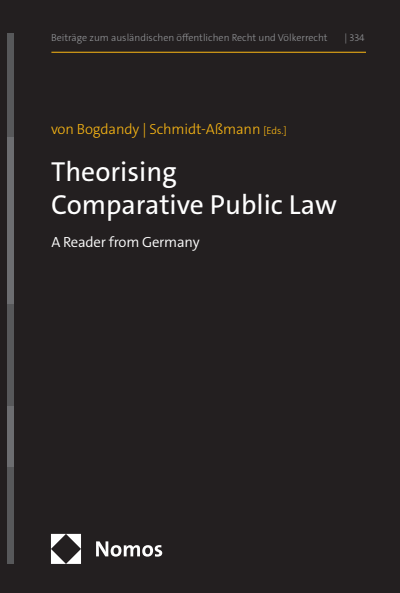
Theorising Comparative Public Law
A Reader from Germany- Editors:
- |
- Series:
- Beiträge zum ausländischen öffentlichen Recht und Völkerrecht, Volume 334
- Publisher:
- 2024
Summary
The book brings together contributions to theorising comparative public law in order to highlight its distinctive features. Nationality was an important criterion in the selection of the many possible contributions. This is because the presentation of contributions from Germany is the second aim of this work. Comparative constitutional law (as well as international law or European public law) is still characterised by national traditions and contexts. Taking these traditions and contexts into account, however controversial they may be, helps to create a transnational but rooted field of comparative public law. Such rootedness is valuable in a world that celebrates diversity and self-determination. With contributions bySusanne Baer | Maxim Bönnemann | Philipp Dann | Günter Frankenberg | Rainer Grote | Peter Häberle | Michaela Hailbronner | Peter M. Huber | Uwe Kischel | Markus Kotzur | Anne Peters | Michael Riegner | Christoph Schönberger | Eberhard Schmidt-Aßmann | Heiner Schwenke | Karl-Peter Sommermann | Armin von Bogdandy | Andreas Voßkuhle
Keywords
Search publication
Bibliographic data
- Edition
- 1/2024
- Copyright Year
- 2024
- ISBN-Print
- 978-3-7560-0599-4
- ISBN-Online
- 978-3-7489-3903-0
- Publisher
- Nomos, Baden-Baden
- Series
- Beiträge zum ausländischen öffentlichen Recht und Völkerrecht
- Volume
- 334
- Language
- English
- Pages
- 514
- Product Type
- Edited Book
Table of contents
- Titelei/InhaltsverzeichnisPages 1 - 8 Download chapter (PDF)
- Authors:Download chapter (PDF)
- A. Introduction
- 1. Growing Interest in the Comparison of Political and Administrative Cultures
- 2. Universalism versus Culturalism
- 3. Relativization of the Own Political and Legal System
- 1. The Special Interest in Anglo-American Law
- 2. The Role of French Law Studies for the Systemization of Administrative Law
- 3. Public Law Comparison as an Own Field of Research
- 1. The Identification and Development of Common Administrative Law Principles
- 2. The Need for Comparative Knowledge for Administrative Cooperation and the Creation of Inter-operational Structures
- 3. The Emergence of a Transnational Science of Administrative Law
- E. Perspectives for the Further Development of Comparative Administrative Law in Germany
- Authors:Download chapter (PDF)
- A. Introduction
- B. ‘Constitution’ (a Legal Positivist Inventory)
- 1. Domestic
- 2. A Constitutional Outlook for Europe – Elements of European Legal Culture
- a) Keywords on the Matter of ‘Culture’
- b) Initial Distinctions
- c) Culture in the Constitution: Cultural Constitutional Law
- d) Cultural Constitutional Law in the EU
- 1. Initial Propositions
- 2. Insights
- 3. Reservations and Limits
- 4. The Limitations of Constitutions
- E. Outlook: the ‘Future’ of the National Constitution in a Globalised World
- Authors:Download chapter (PDF)
- A. Comparing as ‘Thinking out of the Box’
- B. In-between ‘Mission Impossible’ and ‘Mission Accomplished’: On the Potential of Law Comparison
- C. Comparative Perspectives
- D. Connecting Through Comparison
- E. To Conclude: Know Thyself - so Compare!
- Authors: |Download chapter (PDF)
- A. Introduction
- 1. Enlightenment
- 2. Historicism
- 3. Intra- and Transnational Unification
- 4. Functionalism
- a) Cultural Framework-Relativism
- Relativism Defined
- Objections against Cultural Relativism
- Objections against Cultural Framework-Relativism
- Objections against Moral Relativism
- a) The Post-modernist Argument
- b) Refutation
- a) The Post-Modernist Argument
- b) Refutation
- a) The Post-modernist Argument
- b) Discussion
- a) The Post-Modernist Critique
- b) Discussion
- 1. With Post-modernism: Heightened Reflexivity
- 2. Against Post-modernism: Objectivity through Mutual Critique and Intercultural Division of Labour
- 3. Beyond Post-modernism: Interdisciplinarity and Intercultural Hermeneutics
- Authors: | |Download chapter (PDF)
- A. Introduction and Argument
- 1. The Notion of the Global South and its Use in Neighbouring Disciplines
- 2. The Global South in Comparative Constitutional Law: A Brief Intellectual History
- a) Comparative Constitutional Law for the Global South
- b) Comparative Constitutional Law with the Global South
- c) Comparative Constitutional Law from the GS
- 1. Context: The Colonial Experience and Geopolitical Asymmetries
- a) Constitutionalism as Socio-Economic Transformation
- b) Constitutionalism as Site of Struggle About Political Organization
- c) Constitutionalism as Denial of and Access to Justice
- 1. Epistemic Reflexivity
- 2. Methodological Pluralism
- 3. Institutional Diversification, Collaboration, Slow Comparison
- E. Conclusion
- Authors:Download chapter (PDF)
- A. Claim and Program
- 1. European Law
- 2. European Society
- 3. The Role of Comparison
- 4. The Bases for Comparison
- 5. European Public Law, Old and New
- 1. Common Developments and Multiple Modernities
- 2. On Judicial Power
- 3. The European Role of National Courts
- D. Outlook: The Comparative Setting and Academic Identities
- Authors:Download chapter (PDF)
- A. The Current Methodological Discussion
- 1. The Detailed Critique of Functionalism
- a) Social Sciences to Save Comparative Law
- b) Some Theory of Science: Analytical and Historical Questions
- C. The Contextual Response
- 1. The Basic Idea of Functionalist Thinking
- 2. The Limits of Functionalism
- 3. Two Ways of Thinking
- 4. The Contextual Approach in Brief
- 1. Civil Law and Common Law
- 2. And the Rest of the World ...
- F. Conclusion
- Authors:Download chapter (PDF)
- A. Introduction
- B. Administrative Law and the Rule of Law Paradigm in the Late Nineteenth Century
- C. Turn to the ‘Verfassungsstaat’ Paradigm in the Post-War Era
- 1. Reemergence of Religion as a Major Issue in Comparative Public Law
- 2. Rise of Transformative Constitutionalism
- 3. Emergence of Environmental Constitutionalism
- E. Conclusion
- Authors:Download chapter (PDF)
- A. Introduction
- 1. Domestic Applicability
- 2. Legal Harmonisation
- 3. Universality?
- 4. Codification
- 5. Historico-Political Particularity
- 6. Methodological Reflectivity
- 1. Ideologies of Comparative Administrative Law
- 2. Tasks, Instruments, and Forms
- a) An Inquiry into the Types of Exchange Processes
- b) Scope and Objects of Transplants
- c) On Legal Scholarship’s Appraisal of Transplants
- 1. Early 19th Century and the Dawn of Comparative Public Law in Europe
- 2. Comparative Administrative Law in Germany
- 3. French Administrative Law: Archetype but not Prototype
- 4. Anglo-American Administrative Law at the Margins
- 5. Legal Positivism and the Fading of Comparative Administrative Law
- 6. Early 20th Century Comparative Administrative Law
- 7. Comparative Administrative Law since 1945
- E. Comparative Administrative Law Beyond Methodological Nationalism and Convergence Euphoria
- Authors:Download chapter (PDF)
- A. Introduction
- 1. The Varying Breadth of Conceptual Understanding
- 2. Different ‘Conceptual Ideas’
- 1. Connection to the Administration as an Institution
- 2. Specific Orientation Towards Norms
- 1. Basic Structure
- 2. Values
- 1. Comparative Law – Not Cultural Comparison
- 2. Networks as Forms of Reception
- 3. Tools for a Rough Orientation: ‘Legal Families’ and ‘Administrative Cultures’
- 1. Classic Topics
- 2. Context-Sensitive Treatment: Inspiration From Administrative Science
- a) Preliminary Considerations
- b) Governance Perspective
- c) Internationalization of Administrative Law
- d) ‘Information-Based’ Administrative Law
- 1. Scholarly Project
- 2. Practical Objectives
- a) The Notice-and-Comment Procedure of the Administrative Procedure Act (APA)
- b) Independent Agencies
- H. Conclusion: Comparative Administrative Law – A Process of Shared Learning
- Authors:Download chapter (PDF)
- A. Introduction
- B. From ‘Transplant’ to Transfer
- C. The Grammar of Legal Transfer (I): Concepts and Typologies
- 1. Initial Circumstances of Transfer
- 2. Decontextualization
- 3. Transfer as Globalization
- 4. Recontextualization: Risks and Side-effects
- 5. Recontextualization: Results
- a) Historical Idiosyncrasy
- b) Cultural Specificity
- c) Political Deviance
- 2. The Oddity of a Right to Bear Arms
- 3. Local, Regional, Global Items of Law
- F. Merchants of Transfer
- Authors:Download chapter (PDF)
- 1. Historical Foundations
- 2. Dwindling Importance in the Case-Law of the Court of Justice
- 1. Origins in the Treaties
- a) Human Dignity as the Archimedean Point of All Three Catalogues
- b) Comparable Structure and Function of Fundamental Rights
- c) Largely Congruent Content
- 3. Mutual Influence of the Fundamental Right Guarantees
- a) Constitutional Limits on Open Statehood and Constitutional Identity
- b) National Reservations of Review
- C. Identification of a Common Constitutional Tradition
- D. Consequences
- Authors:Download chapter (PDF)
- A. Introduction
- 1. The Scope of Comparative Constitutional Law
- 2. The Use of Comparative Law in the Court
- 1. The Increase in Comparative Constitutional Law Scholarship
- 2. Constitutional Comparison and Academic Support
- 1. Legitimacy
- 2. Jurisdictional Limits
- 3. Motives
- 1. No Methodologically Sound Concept
- 2. Constitutional Comparison as Part of a Permanent Judicial Dialogue
- F. Conclusion: Constitutional Comparison and Judicial Self-Reflection
- Authors:Download chapter (PDF)
- A. Introduction
- B. Who “Owns” a Court
- 1. Urgent Calls to Understand the Institution
- 2. A Good Court?
- 1. A Court’s Independence
- 2. The Standing of Constitutional Courts
- E. Embedded Constitutionalism
- F. Courts that Deserve the Label
- Authors:Download chapter (PDF)
- A. Introduction
- B. Transformative Constitutionalism
- 1. Beyond the United States: The German Case
- 2. The Indian Case
- 1. Judicial Processes
- 2. Language
- 3. Standards of Reasoning
- 4. Conclusion
- 1. Risks and Challenges
- 2. Taking the Best of Both Worlds?
- F. Conclusion