Book Titles Open Access Full access
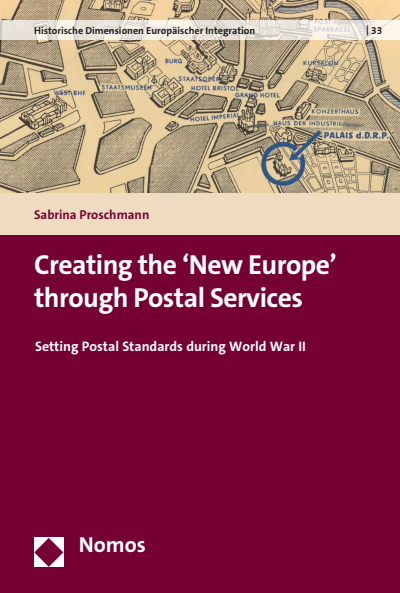
Creating the ‘New Europe’ through Postal Services
Setting Postal Standards during World War II- Authors:
- Series:
- Historische Dimensionen Europäischer Integration, Volume 33
- Publisher:
- 2022
Summary
This thesis analyses the European Postal and Telecommunications Union, founded in Vienna in October 1942 under the leadership of the Axis powers. Both technocratic internationalism and the propaganda term ‘New Europe’ found points of contact there. The German postal administration authority used the union to extend Germany’s domestic postal system to intra-European postal services and to ensure German supremacy in the new postal Europe. After the war, a respective regional postal organisation was founded in both the Eastern and Western European blocs in the late 1950s. The content of the standardisation envisaged through this measure did not differ much in both blocs, but the way in which the standardisation was carried out did.
Keywords
Search publication
Bibliographic data
- Copyright year
- 2022
- ISBN-Print
- 978-3-7560-0411-9
- ISBN-Online
- 978-3-7489-3662-6
- Publisher
- Nomos, Baden-Baden
- Series
- Historische Dimensionen Europäischer Integration
- Volume
- 33
- Language
- English
- Pages
- 322
- Product type
- Book Titles
Table of contents
ChapterPages
- Titelei/InhaltsverzeichnisPages 1 - 8 Download chapter (PDF)
- List of Abbreviations Pages 9 - 10 Download chapter (PDF)
- Acknowledgements Pages 11 - 12 Download chapter (PDF)
- Introduction Pages 13 - 44 Download chapter (PDF)
- International infrastructure cooperation and technocratism
- The New Europe’ propaganda
- From propaganda to concrete projects: conflict or cooperation?
- The German actors: between life-long public servants to fast climbers in the profession
- Setting the agenda to create a European postal union within the Reichspostministerium (1940-1941)
- Presenting the project to the world outside the Reichspost
- The European Postal and Telecommunications Union as an Axis project – From a working group for European telecommunications to a European postal union (1940-1941)
- Bilateral agreements as a tool of integrating the occupied and dependent countries into the EPTU
- Opening the envisioned union to the rest of Europe: Successes and failures
- Conclusion
- A technocratic congress in buildings with war stories
- The opening session and the discursive framework of the congress
- The first general assembly and the organisational frame of the congress
- The organisation of the European Postal and Telecommunications Union between continuities and discontinuities with the Universal Postal Union
- The ‘New Postal Europe’ as a ‘German Postal Europe’?
- The closing session and the return of political rhetoric
- Informing the experts and the users of the new postal regime
- The view on the European Postal and Telecommunications Union from the outside
- Stamps as messengers of the European Postal and Telecommunications Union
- Conclusion
- Implementing the European Postal and Telecommunications Union’s agreement
- Continuing the standardisation efforts within the European Postal and Telecommunications Union
- Keeping the union together and enlarging it
- A last failed attempt to keep the European Postal and Telecommunications Union going – the congress planned for 1944
- New regimes in Europe, new initiatives for restricted postal unions
- Continuities in technocratic questions, discontinuities in political aspects
- Stamps – still (not) the messenger of cooperation
- Actors in the post-war postal Europe and their connection to the European Postal and Telecommunications Union
- Conclusion
- General Conclusion Pages 273 - 282 Download chapter (PDF)
- Appendix Pages 283 - 300 Download chapter (PDF)
- Bibliography Pages 301 - 312 Download chapter (PDF)
- Sources Pages 313 - 320 Download chapter (PDF)
- List of Tables Pages 321 - 321 Download chapter (PDF)
- List of Figures Pages 322 - 322 Download chapter (PDF)