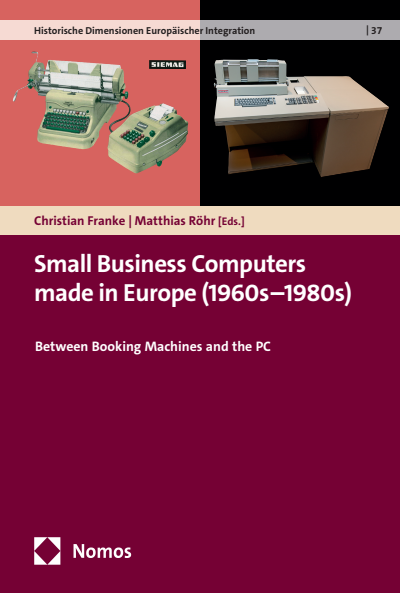
Small Business Computers made in Europe (1960s–1980s)
Between Booking Machines and the PC- Editors:
- |
- Series:
- Historische Dimensionen Europäischer Integration, Volume 37
- Publisher:
- 2024
Summary
The technical and economic history of data technologies tends to focus on the US history of mainframes and personal computers. From this perspective, genuinely European developments in data processing are often declared to be non-innovative marginal phenomena. However, long before the triumph of the PC, with its version of “mid-range computing”, the European office machine industry brought computers into offices “. This volume analyzes how office machines were developed into computers in Europe in the 1960s and successfully sold on European markets, until the PC became a universal office machine in the 1980s. From the perspective of companies, national, and European Community industrial and research policies, it shows this European path into the computer age. With contributions byChristian Berg | Christian Franke | Michael Homberg | Armin Müller | Matthias Röhr
Keywords
Search publication
Bibliographic data
- Copyright year
- 2024
- ISBN-Print
- 978-3-7560-1489-7
- ISBN-Online
- 978-3-7489-2025-0
- Publisher
- Nomos, Baden-Baden
- Series
- Historische Dimensionen Europäischer Integration
- Volume
- 37
- Language
- English
- Pages
- 152
- Product type
- Edited Book
Table of contents
- Titelei/InhaltsverzeichnisPages 1 - 6 Download chapter (PDF)
- Matthias Röhr Download chapter (PDF)
- 1. Introduction
- 2. Historical background
- 3. From office machines to computers: the advent of medium data technology
- 4. The end of the niche – The 1970s
- 5. Break-up in the 1980s
- 6. Conclusion
- 7. Bibliography
- Christian Franke Download chapter (PDF)
- 1. Introduction
- 2. Unidata: A turning point in the EC’s IT policy
- a) Considering a new approach: the Commission’s IT task force
- b) Esprit I
- c) Esprit II
- 4. Conclusion
- 5. Bibliography
- Christian Berg Download chapter (PDF)
- 1. Introduction
- 2. Starting with the Nixdorf 820
- 3. The next generation: magnetic disk storage
- 4. From a niche to mass markets
- 5. Nixdorf 's response to the new challenges
- 6. An abrupt end
- 7. Bibliography
- Armin Müller Download chapter (PDF)
- 1. Introduction
- 2. Roots and beginnings
- 3. Entering the business machine industry
- 4. On the way to the first Kienzle computer
- 5. Close cooperation with Nixdorf
- 6. In the boom and crisis years of medium data technology
- 7. The end of the Kienzle computer business
- 8. Bibliography
- Matthias Röhr Download chapter (PDF)
- 1. Introduction
- 2. Origins of Hohner
- 3. A producer of medium data technology
- 4. Conclusion and end
- 5. Bibliography
- Christian Franke Download chapter (PDF)
- 1. Introduction
- 2. Production site characteristics at Eiserfeld, South Westphalia
- a) The beginnings of production in Eiserfeld
- b) External expertise and the entry into data processing
- c) Specialization and extension
- d) Joint ventures and international cooperation as answers to the American challenge
- e) Specialization and expansion within the Philips group
- f ) Competition with the PC and networking of devices
- 4. Conclusion
- 5. Bibliography
- Michael Homberg Download chapter (PDF)
- 1. Computers in the Federal Republic of Germany around 1970
- 2. Scaling Data Services: Governmental Policies and Corporate Interests in Digital Networks and Centralized Hardware Solutions
- 3. Centralize or Decentralize Computing? The 1970s as a Digital Transition Period
- 4. Conclusion
- 5. Bibliography
- Annex
- List of authorsPages 151 - 152 Download chapter (PDF)