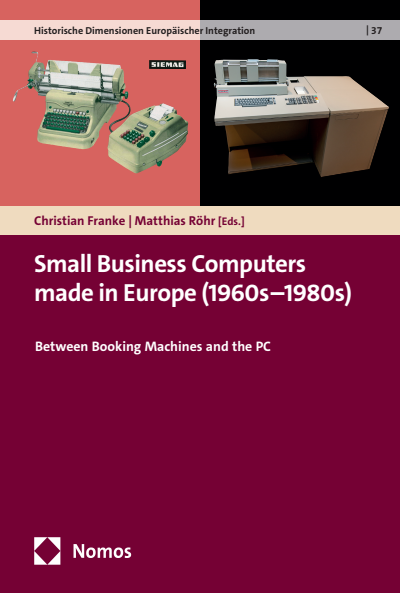
Small Business Computers made in Europe (1960s–1980s)
Between Booking Machines and the PC- Herausgeber:innen:
- |
- Reihe:
- Historische Dimensionen Europäischer Integration, Band 37
- Verlag:
- 2024
Zusammenfassung
Die Technik- und Wirtschaftsgeschichte des Computers konzentriert sich in der Regel auf die US-amerikanische Geschichte von Großrechnern und dem PC. Genuin europäische Entwicklungen in der Datenverarbeitung werden aus dieser Perspektive oft zu nicht-innovativen Randerscheinungen erklärt. Doch mit der „mittleren Datentechnik“ brachte die europäische Büromaschinenindustrie Computer schon lange vor dem Siegeszug des PCs in die Büros. Dieser Band analysiert, wie sich im Europa der 1960er Jahre Büromaschinen zu Computern entwickelten und erfolgreich auf europäischen Märkten verkauft wurden, bis der PC in den 1980er Jahren zur universellen Büromaschine wurde. Aus der Perspektive von Unternehmen sowie nationaler und der europäischen Industrie- und Forschungspolitik wird dieser europäische Weg ins Computerzeitalter nachgezeichnet. Mit Beiträgen vonChristian Berg | Christian Franke | Michael Homberg | Armin Müller | Matthias Röhr
Schlagworte
Publikation durchsuchen
Bibliographische Angaben
- Copyrightjahr
- 2024
- ISBN-Print
- 978-3-7560-1489-7
- ISBN-Online
- 978-3-7489-2025-0
- Verlag
- Nomos, Baden-Baden
- Reihe
- Historische Dimensionen Europäischer Integration
- Band
- 37
- Sprache
- Englisch
- Seiten
- 152
- Produkttyp
- Sammelband
Inhaltsverzeichnis
- Titelei/InhaltsverzeichnisSeiten 1 - 6 Download Kapitel (PDF)
- Matthias Röhr Download Kapitel (PDF)
- 1. Introduction
- 2. Historical background
- 3. From office machines to computers: the advent of medium data technology
- 4. The end of the niche – The 1970s
- 5. Break-up in the 1980s
- 6. Conclusion
- 7. Bibliography
- Christian Franke Download Kapitel (PDF)
- 1. Introduction
- 2. Unidata: A turning point in the EC’s IT policy
- a) Considering a new approach: the Commission’s IT task force
- b) Esprit I
- c) Esprit II
- 4. Conclusion
- 5. Bibliography
- Christian Berg Download Kapitel (PDF)
- 1. Introduction
- 2. Starting with the Nixdorf 820
- 3. The next generation: magnetic disk storage
- 4. From a niche to mass markets
- 5. Nixdorf 's response to the new challenges
- 6. An abrupt end
- 7. Bibliography
- Armin Müller Download Kapitel (PDF)
- 1. Introduction
- 2. Roots and beginnings
- 3. Entering the business machine industry
- 4. On the way to the first Kienzle computer
- 5. Close cooperation with Nixdorf
- 6. In the boom and crisis years of medium data technology
- 7. The end of the Kienzle computer business
- 8. Bibliography
- Matthias Röhr Download Kapitel (PDF)
- 1. Introduction
- 2. Origins of Hohner
- 3. A producer of medium data technology
- 4. Conclusion and end
- 5. Bibliography
- Christian Franke Download Kapitel (PDF)
- 1. Introduction
- 2. Production site characteristics at Eiserfeld, South Westphalia
- a) The beginnings of production in Eiserfeld
- b) External expertise and the entry into data processing
- c) Specialization and extension
- d) Joint ventures and international cooperation as answers to the American challenge
- e) Specialization and expansion within the Philips group
- f ) Competition with the PC and networking of devices
- 4. Conclusion
- 5. Bibliography
- Michael Homberg Download Kapitel (PDF)
- 1. Computers in the Federal Republic of Germany around 1970
- 2. Scaling Data Services: Governmental Policies and Corporate Interests in Digital Networks and Centralized Hardware Solutions
- 3. Centralize or Decentralize Computing? The 1970s as a Digital Transition Period
- 4. Conclusion
- 5. Bibliography
- Annex
- List of authorsSeiten 151 - 152 Download Kapitel (PDF)