, to see if you have full access to this publication.
Monograph No access
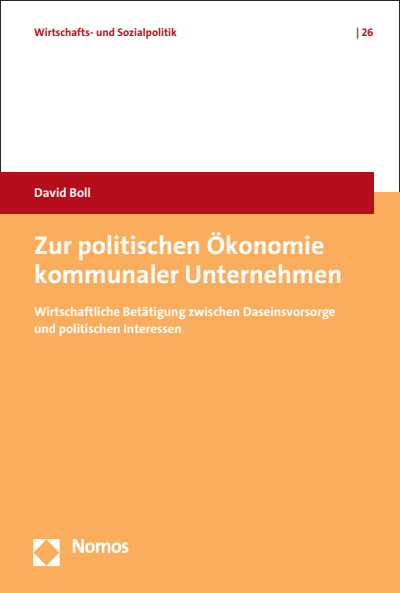
Zur politischen Ökonomie kommunaler Unternehmen
Wirtschaftliche Betätigung zwischen Daseinsvorsorge und politischen Interessen- Authors:
- Series:
- Wirtschafts- und Sozialpolitik, Volume 26
- Publisher:
- 2022
Keywords
Search publication
Bibliographic data
- Copyright Year
- 2022
- ISBN-Print
- 978-3-8487-8892-7
- ISBN-Online
- 978-3-7489-2947-5
- Publisher
- Nomos, Baden-Baden
- Series
- Wirtschafts- und Sozialpolitik
- Volume
- 26
- Language
- German
- Pages
- 237
- Product Type
- Monograph
Table of contents
ChapterPages
- Titelei/Inhaltsverzeichnis No access Pages 1 - 18
- 1.1 Motivation No access
- 1.2 Aufbau der Arbeit No access
- 2.1 Einordnung in das föderale System No access
- Eigenbetrieb No access
- Anstalt des öffentlichen Rechts No access
- Zweckverband (z.B. § 13 GKZ BW; § 11 GKG LSA) No access
- GmbH No access
- AG No access
- 2.2.1.3 Fazit Rechtsformwahl und kommunaler Einfluss No access
- 2.2.2 Branchen No access
- 2.2.3 Eignerstatus No access
- 2.3.1 Was legitimiert öffentliche Unternehmen? No access
- 2.3.2 Umfrage zur Bürgermeinung öffentlicher Unternehmen No access
- 2.3.3.1 Literaturübersicht No access
- Ökonomische Überlegungen – H1 No access
- Daseinsvorsorge – H2 No access
- Ideologie – H3 No access
- Vertrauen in Politiker – H4 No access
- Soziale Verantwortung – H5 No access
- Eigennutz – H6 No access
- 2.3.3.3.1 Datenstruktur No access
- 2.3.3.3.2 Ergebnisse No access
- 2.3.4 Zwischenfazit No access
- 3.1 Das Schema des institutionalisierten Prinzipal-Agenten-Problems No access
- 3.2 Politiker – Geschäftsführung kommunaler Unternehmen No access
- 3.3.1.1 Theorie No access
- 3.3.1.2 Status Quo der empirischen Literatur No access
- Common Pool No access
- War of attrition No access
- Veto-Spieler No access
- 3.3.2.2 Status Quo der empirischen Literatur No access
- 3.3.3.1 Theorie No access
- 3.3.3.2 Status Quo der empirischen Literatur No access
- 3.3.4 Hypothesen No access
- 3.3.5 Behavioral political economy – eine verhaltensökonomische Perspektive auf die Beziehung zwischen Bürger und Politiker No access
- 4.1.1 Beschreibung der Datenquellen und ihrer Aufbereitung No access
- 4.1.2 Investitionstätigkeit: Maß und Deskriptives No access
- 4.1.3 Wahlzyklen: Maß und Deskriptives No access
- 4.1.4 Interessenfragmentierung: Maß und Deskriptives No access
- 4.1.5 Ideologie: Maß und Deskriptives No access
- 4.1.6 Weitere Einflussfaktoren und Kontrollvariablen No access
- 4.2 Untersuchung politischer Variablen in Panelregressionen No access
- 4.3.1 Methodisches Vorgehen No access
- 4.3.2.1 Generelle Einflüsse von Wahljahren No access
- 4.3.2.2 Brancheneffekte No access
- 4.3.3 Diskussion: Politische Konjunkturzyklen No access
- 4.4.1 Methodisches Vorgehen No access
- 4.4.2.1 Generelle Einflüsse der Interessenfragmentierung No access
- 4.4.2.2 Weitere fixe Effekte Varianten No access
- 4.4.2.3 Nichtlinearitäten No access
- 4.4.2.4 Brancheneffekte No access
- 4.4.2.5 Interessenfragmentierung im Wahlzyklus No access
- 4.4.2.6 Robustheitstest No access
- 4.4.3 Diskussion: Interessenfragmentierung No access
- 4.5.1 Methodisches Vorgehen No access
- 4.5.2.1 Anteile und Mehrheiten im OLS No access
- 4.5.2.2 Regression-Discontinuity-Design No access
- 4.5.2.3 Interaktionseffekte No access
- 4.5.2.4 Brancheneffekte No access
- 4.5.2.5 Bürgermeisterideologien No access
- 4.5.3 Diskussion Parteiideologien No access
- 5.1 Einordnung der Ergebnisse No access
- 5.2 Ableitung von Implikationen No access
- 5.3 Fazit No access
- Anhang 1: Ergebnisse der Regressionen zur Erklärung von Privatisierung und Instrumentalfunktion (OLS-Schätzungen) No access
- Anhang 2: Literaturübersicht über empirische Studien zu Interessenfragmentierung in politischen Gremien No access
- Anhang 3: Ergebnisse zu den Regressionen zum ENP differenziert nach Branchen No access
- Anhang 4: Robustheitsuntersuchung zu potenziellen Messfehlern des ENP No access
- Anhang 5: Ergebnisse zu den Regressionen linker Anteile im Gemeinderat differenziert nach Branchen No access
- Anhang 6: Ergebnisse zu den Regressionen linker Mehrheiten im Gemeinderat differenziert nach Branchen No access
- 7. Literaturverzeichnis No access Pages 225 - 237
Bibliography (218 entries)
No match found. Try another term.
- Akerlof, G. A. (1970). The Market for "Lemons": Quality Uncertainty and the Market Mechanism. Quarterly Journal of Economics, S. 488-500. Open Google Scholar DOI: 10.5771/9783748929475
- Akhmedov, A., & Zhuravskaya, E. (2004). Opportunistic Political Cycles: Test in a Young Democracy Setting. The Quarterly Journal of Economics 119, S. 1301–1338. Open Google Scholar DOI: 10.5771/9783748929475
- Alesina, A. (1987). Policy in a Two-Party System as a Repeated Game. The Quarterly Journal of Economics, Vol. 102, No. 3, S. 651-678. Open Google Scholar DOI: 10.5771/9783748929475
- Alesina, A., & Drazen, A. (1991). Why Are Stabilizations Delayed? The American Economic Review, Vol. 81, No. 5, S. 1170-1188. Open Google Scholar DOI: 10.5771/9783748929475
- Alesina, A., & La Ferrara, E. (2005). Ethnic Diversity and Economic Performance. Journal of Economic Literature 43, S. 762-800. Open Google Scholar DOI: 10.5771/9783748929475
- Alesina, A., & Paradisi, M. (2017). Political budget cycles: Evidence from Italian cities. Economics & Politics 29, S. 157-177. Open Google Scholar DOI: 10.5771/9783748929475
- Alesina, A., & Roubini, N. (1992). Political Cycles in OECD Economies. The Review of Economic Studies 59, S. 663-688. Open Google Scholar DOI: 10.5771/9783748929475
- Alesina, A., & Tabellini, G. (1990). A Positive Theory of Fiscal Deficits and Government Debt. Review of Economic Studies 57, S. 403-414. Open Google Scholar DOI: 10.5771/9783748929475
- Alesina, A., Cohen, G. D., & Roubini, N. (1992). Macroeconomic policy and elections in OECD democracies. Economics and Politics 4, S. 1-30. Open Google Scholar DOI: 10.5771/9783748929475
- Alesina, A., Roubini, N., & Cohen, G. D. (1997). Political Cycls and the Macroeconomy. Cambridge, Massachusetts: The MIT Press. Open Google Scholar DOI: 10.5771/9783748929475
- Alexandre, H., & Charreaux, G. (2004). Efficiency of French privatizations: a dynamic vision. Journal of Corporate Finance 10, S. 467 – 494. Open Google Scholar DOI: 10.5771/9783748929475
- Allers, M., de Haan, J., & Sterks, C. (2001). Partisan influence on the local tax burden in the Netherlands. Public Choice 106, S. 351–363. Open Google Scholar DOI: 10.5771/9783748929475
- Angrist, J. D., & Pischke, J.-S. (2009). Mostly Harmless Econometrics. New Jersey: Princeton University Press. Open Google Scholar DOI: 10.5771/9783748929475
- Angrist, J. D., & Pischke, J.-S. (2015). Mastering 'Metrics - The Patch from Cause to Effect. Princeton: Princeton University Press. Open Google Scholar DOI: 10.5771/9783748929475
- Arellano, M., & Bond, S. (1991). Some Tests of Specification for Panel Data: Monte Carlo Evidence and an Application to Employment Equations. Review of Economic Studies 58, S. 277-297. Open Google Scholar DOI: 10.5771/9783748929475
- Artés, J., & Jurado, I. (2015). Fiscal Deficits and Type of Government: A Study of Spanish Local Elections. In N. Scholfield, & G. Caballero, The Political Economy of Governance - Institutions, Political Performance and Elections (S. 363-376). Heidelberg: Springer. Open Google Scholar DOI: 10.5771/9783748929475
- Ashworth, J., Geys, B., & Heyndels, B. (2005). GovernmentWeakness and Local Public Debt - Development in Flemish Municipalities. International Tax and Public Finance 12, S. 395-422. Open Google Scholar DOI: 10.5771/9783748929475
- Ashworth, J., Geys, B., & Heyndels, B. (2006). Determinants of tax innovation: The case of environmental taxes in Flemish municipalities. European Journal of Political Economy 22, S. 223–247. Open Google Scholar DOI: 10.5771/9783748929475
- Bacchiocchi, E., Florio, M., & Gambaro, M. (2011). Telecom reformsintheEU: Pricesandconsumers’satisfaction. Telecommunications Policy, S. 382–396. Open Google Scholar DOI: 10.5771/9783748929475
- Baltagi, B. H. (2005). Econometric analysis of panel data. New York: Wiley. Open Google Scholar DOI: 10.5771/9783748929475
- Barro, R. J. (1973). The control of politicians: an economic model. Public Choice 14, S. 19-42. Open Google Scholar DOI: 10.5771/9783748929475
- Baskaran, T. (2013). Coalition governments, cabinet size, and the common pool problem: Evidence from the German states. European Journal of Political Economy, 32, S. 356–376. Open Google Scholar DOI: 10.5771/9783748929475
- Baßeler, U., Heinrich, J., & Utecht, B. (2010). Grundlagen und Probleme der Volkswirtschaft. Stuttgart: Schäffer-Poeschel Verlag. Open Google Scholar DOI: 10.5771/9783748929475
- Battaglio, R. P. (2009). Privatization and Citizen Preferences: A Cross-National Analysis of Demand for Private Versus Public Provision of Services in Three Industries. Administration & Society 41(1), pp. 38-66. Open Google Scholar DOI: 10.5771/9783748929475
- Bel, G., Raudla, R., Rodrigues, M., & Tavares, A. F. (2018). These rules are made for spending: testing and extending the law of 1/n. Public Choice, S. 41–60. Open Google Scholar DOI: 10.5771/9783748929475
- Benito, B., Bastida, F., & Vicente, C. (2013). Municipal elections and cultural expenditure. Journal of Cultural Economics, Volume 37, Issue 1, S. 3–32. Open Google Scholar DOI: 10.5771/9783748929475
- Blankart, C. B. (2017). Öffentliche Finanzen in der Demokratie: Eine Einführung in die Finanzwissenschaft. München: Verlag Vahlen. Open Google Scholar DOI: 10.5771/9783748929475
- Boll, D., & Sidki, M. (2021). The influence of political fragmentation on public enterprises: Evidence from German municipalities. European Journal of Political Economy 67, S. 101972. Open Google Scholar DOI: 10.5771/9783748929475
- Boll, D., Müller, H., & Sidki, M. (2020). Bilanzpolitik in kommunalen Unternehmen. Zeitschrift für öffentliche und gemeinwirtschaftliche Unternehmen (ZögU) 43, S. 479-505. Open Google Scholar DOI: 10.5771/9783748929475
- Borge, L.-E. (2005). Strong politicians, small deficits: evidence from Norwegian local governments. European Journal of Political Economy, Vol. 21, S. 325–344. Open Google Scholar DOI: 10.5771/9783748929475
- Bortolotti, B., & Pinotti, P. (2008). Delayed privatization. Public Choice 136, S. 331–351. Open Google Scholar DOI: 10.5771/9783748929475
- Bremeier, W., Brinckmann, H., & Killian, W. (2006). Public Governance kommunaler Unternehmen. Düsseldorf: Hans-Böckler-Stiftung. Open Google Scholar DOI: 10.5771/9783748929475
- Breunig, R., & Rocaboy, Y. (2008). Per-capita public expenditures and population size: a non-parametric analysis using French data. Public Choice 136, S. 429-445. Open Google Scholar DOI: 10.5771/9783748929475
- Brosio, G., & Marchese, C. (1988). The growth of government under redistributive rules: A long term study of the Italian case. Public Finanance Quarterly, vol. 16 No. 4, S. 439-463. Open Google Scholar DOI: 10.5771/9783748929475
- Brüning, C. (2011). Regie- und Eigenbetriebe. In T. Mann, & G. Püttner, Handbuch der kommunalen Wissenschaft und Praxis 2. Kommunale Wirtschaft. (S. 149-172). Heidelberg: Springer. Open Google Scholar DOI: 10.5771/9783748929475
- Buchanan, J. M., & Musgrave, R. A. (1999). Public Finance and Public Choice: Two Contrasting Visions of the State. MIT Press. Open Google Scholar DOI: 10.5771/9783748929475
- Bund der Steuerzahler. (2017). Die öffentliche Verschwendung: Schwarzbuch des Bundes der Steuerzahler. Wiesbaden: Präsidium des Bundes der Steuerzahler. Open Google Scholar DOI: 10.5771/9783748929475
- Bund der Steuerzahler. (2020). Das Schwarzbuch - Die öffentliche Verschwendung 2020/21. Bonn: Bonner Universitäts-Buchdruckerei. Open Google Scholar DOI: 10.5771/9783748929475
- Bundesfinanzhof. (2020). Pressemitteilung Nr. 8 vom 06. Februar 2020. Open Google Scholar DOI: 10.5771/9783748929475
- Bundesministerium der Finanzen. (2017). Auf den Punkt. Bund-Länder-Finanzen. Von https://www.bundesfinanzministerium.de/: https://www.bundesfinanzministerium.de/Content/DE/000-PAPIERKORB/2017-08-26-auf-den-punkt-bund-laender-finanzen.pdf?__blob=publicationFile&v=6 abgerufen Open Google Scholar DOI: 10.5771/9783748929475
- Busemeyer, M. R. (2009). Social democrats and the new partisan politics of public investment in education. Journal of European Public Policy 16, S. 107–126. Open Google Scholar DOI: 10.5771/9783748929475
- Capalbo, F., Frino, A., Mollica, V., & Palumbo, R. (2014). Accrual-based earnings management in state owned companies. Accounting, Auditing & Accountability Journal, S. 1026–1040. Open Google Scholar DOI: 10.5771/9783748929475
- Chen, R., El Ghoul, S., Guedhami, O., & Wang, H. (2017). Do state and foreign ownership affect investment efficiency? Evidence from privatizations. Journal of Corporate Finance, S. 408-421. Open Google Scholar DOI: 10.5771/9783748929475
- Chortareas, G., Logothetisb, V., & Papandreou, A. A. (2016). Political budget cycles and reelection prospects in Greece's municipalities. European Journal of Political Economy 43, S. 1-13. Open Google Scholar DOI: 10.5771/9783748929475
- Coenenberg, A. G., Haller, A., & Schultze, W. (2015). Jahresabschluss und Jahresabschlussanalyse : Betriebswirtschaftliche, handelsrechtliche, steuerrechtliche und internationale Grundlagen. 24. Auflage. Stuttgart: Schäffer-Poeschel Verlag. Open Google Scholar DOI: 10.5771/9783748929475
- Cooper, J. C., & Kovacic, W. E. (2012). Behavioral economics: implications for regulatory behavior. Journal of Regulatory Economics 41, S. 41-58. Open Google Scholar DOI: 10.5771/9783748929475
- Cornett, M. M., Guo, L., Khaksari, S., & Tehranian, H. (2010). The impact of state ownership on performance differences in privately-owned versus state-owned banks: An international comparison. Journal of Financial Intermediation, S. 74-94. Open Google Scholar DOI: 10.5771/9783748929475
- Cox, H., & Kirchhoff, U. (1981). Die Instrumentalfunktion öffentlicher Unternehmen. Wirtschaftsdienst, S. 234-241. Open Google Scholar DOI: 10.5771/9783748929475
- Cronauge, U. (2016). Kommunale Unternehmen. Berlin: Erich Schmidt Verlag. Open Google Scholar DOI: 10.5771/9783748929475
- Cusack, T. R. (1997). Partisan Politics and Public Finance: Changes in Public Spending in the Industrialized. Public Choice, Vol. 91, No. 3/4, S. 375-395. Open Google Scholar DOI: 10.5771/9783748929475
- Dahl, C. H. (2014). Parties and institutions: empirical evidence on veto players and the growth of government. Public Choice, S. 415–433. Open Google Scholar DOI: 10.5771/9783748929475
- Daily, C., Dalton, D., & Cannella, A. (2003). Corporate Governance: Decades of Dialogue and Data. Academy of Management Review, 28 (3), S. 371-382. Open Google Scholar DOI: 10.5771/9783748929475
- De Haan, J., & Sturm, J. E. (1994). Political and institutional determinants of fiscal policy in the European Community. Public Choice 80, S. 157-172. Open Google Scholar DOI: 10.5771/9783748929475
- De Haan, J., & Sturm, J.-E. (1997). Political and economic determinants of OECD budget deficits and government expenditures: A reinvestigation. European Journal of Political Economy 13, S. 739-750. Open Google Scholar DOI: 10.5771/9783748929475
- De Haan, J., Sturm, J.-E., & Beekhuis, G. (1999). The weak government thesis: Some new evidence. Public Choice 101, S. 163–176. Open Google Scholar DOI: 10.5771/9783748929475
- Debus, M., & Gross, M. (2015). Coalition formation at the local level: Institutional constraints, party policy conflict, and office-seeking political parties. Party Politics, S. 1-15. Open Google Scholar DOI: 10.5771/9783748929475
- Denisova, I., Eller, M., Frye, T., & Zhuravskaya, E. (2012). Everyone hates privatization, but why? Survey evidence from 28 post-communist countries. Journal of Comparative Economics, S. 44-61. Open Google Scholar DOI: 10.5771/9783748929475
- Denisova, I., Eller, M., Frye, T., & Zhuravskaya, E. (2012). Everyone hates privatization, but why? Survey evidence from 28 post-communist countries. Journal of Comparative Economics 40(1), pp. 44-61. Open Google Scholar DOI: 10.5771/9783748929475
- Dewenter, K. L., & Malatesta, P. H. (2001). State-Owned and Privately Owned Firms: An Empirical Analysis of Profitability, Leverage, and Labor Intensity. The American Economic Review, Vol. 91, No. 1, S. 320-334. Open Google Scholar DOI: 10.5771/9783748929475
- Döring, T. (2015). Öffentliche Finanzen und Verhaltensökonomik - Zur Psychologie der beudgetwirksamen Staatstätigkeit. Wiesbaden: Springer Gabler. Open Google Scholar DOI: 10.5771/9783748929475
- Downs, A. (1957). An Economic Theory of Political Action in a Democracy. Journal of Political Economy, S. 135-150. Open Google Scholar DOI: 10.5771/9783748929475
- Drazen, A., & Eslava, M. (2010). Electoral manipulation via voter-friendly spending: Theory and evidence. Journal of development economics 92(1), S. 39-52. Open Google Scholar DOI: 10.5771/9783748929475
- Dubois, E. (2016). Political business cycles 40 years after Nordhaus. Public Choice, S. 235–259. Open Google Scholar DOI: 10.5771/9783748929475
- Durant, R. F., & Legge, J. S. (2001). Politics, Public Opinion, and Privatization: A Test of Competing Theories in Great Britain. Public Organization Review, S. 75-95. Open Google Scholar DOI: 10.5771/9783748929475
- Durant, R. F., & Legge, J. S. (2002). Politics, Public Opinion, und Privatization in France: Assessing the Calculus of Consent for Market Reforms. Public Administration Review, S. 307-323. Open Google Scholar DOI: 10.5771/9783748929475
- Ebinger, F., Zabler, S., Person, C., Niemann, F.-S., & Geißler, R. (2018). Wirksame Finanzaufsicht über die Kommunen. Dimensionen und Determinanten der Umsetzungspraxis. der moderne staat – Zeitschrift für Public Policy, Recht und Management 11, S. 167-189. Open Google Scholar DOI: 10.5771/9783748929475
- Edeling, T. (2008). Institutionelle Umbrüche im öffentlichen Sektor: Das Ende der kommunalen Daseinsvorsorge? In R. Sackmann, B. Jonda, & M. Reinhold, Demographie als Herausforderung für den öffentlichen Sektor (S. 144-162). Wiesbaden: VS Verlag für Sozialwissenschaften. Open Google Scholar DOI: 10.5771/9783748929475
- Edin, P.-A., & Ohlsson, H. (1991). Political determinants of budget deficits: Coalition effects versus minority effects*. European Economic Review 35, S. 1597-1603. Open Google Scholar DOI: 10.5771/9783748929475
- Egger, P., & Koethenbuerger, M. (2010). Government Spending and Legislative Organization: Quasi-Experimental Evidence from Germany. American Economic Journal: Applied Economics, Vol. 2, No. 4, S. 200-212. Open Google Scholar DOI: 10.5771/9783748929475
- Eichhorn, P. (2003). New Governance bei öffentlichen Unternehmen. In J. Harms, & C. Richard, Die Ökonomisierung des öffentlichen Sektors: Instrumente und Trends (S. 175-181). Baden-Baden: Nomos. Open Google Scholar DOI: 10.5771/9783748929475
- Eichler, S., & Hofmann, M. (2013). Sovereign default risk and decentralization: Evidence for emerging markets. European Journal of Political Economy 32, S. 113–134. Open Google Scholar DOI: 10.5771/9783748929475
- Eldenburg, L. G., Gunny, K. A., Hee, K. W., & Soderstrom, N. (2011). Earnings Management Using Real Activities: Evidence from Nonprofit Hospitals. The accounting review, S. 1605–1630. Open Google Scholar DOI: 10.5771/9783748929475
- Erlei, M., Leschke, M., & Sauerland, D. (2007). Neue Institutionenökonomik. Stuttgart: Schäffer-Poeschel Verlag. Open Google Scholar DOI: 10.5771/9783748929475
- Europäische Kommission. (2016). Die Europäische Union erklärt: Wettbewerb. Von https://op.europa.eu/: http://publications.europa.eu/resource/cellar/8200c251-aa42-11e6-aab7-01aa75ed71a1.0003.02/DOC_1 abgerufen Open Google Scholar DOI: 10.5771/9783748929475
- Expertenkommission D-PCGM. (2021). Deutscher Public Corporate Governance-Musterkodex (D-PCGM). Hrsg. Ulf Papenfuß/Klaus-Michael Ahrend/Kristin Wagner-Krechlok, in der Fassung vom 15. Januar 2021. Open Google Scholar DOI: 10.5771/9783748929475
- Fatas, E., Neugebauer, T., & Tamborero, P. (2007). Experiment, How Politicians Make Decisions: A Political Choice. Journal of Economics 92, S. 167–196. Open Google Scholar DOI: 10.5771/9783748929475
- Fernandez, S., Smith, C., & Wenger, J. (2006). Employment, Privatization, and Managerial Choice: Does Contracting Out Reduce Public Sector Employment? Journal of Policy Analysis and Management, S. 57-77. Open Google Scholar DOI: 10.5771/9783748929475
- Ferreira, F., & Gyourko, J. (2009). Do political Parties matter? Evidence from U.S. Cities. The Quarterly Journal of Economics, S. 399-422. Open Google Scholar DOI: 10.5771/9783748929475
- Fiorio, C. V., Florio, M., & Perucca, G. (2013). User satisfaction and the organization of local public transport: Evidence from European cities. Transport Policy, S. 209-218. Open Google Scholar DOI: 10.5771/9783748929475
- Foremny, D., Freier, R., Moessinger, M.-D., & Yeter, M. (2018). Overlapping political budget cycles. Public Choice, S. 1-27. Open Google Scholar DOI: 10.5771/9783748929475
- Foucault, M., Madies, T., & Paty, S. (2008). Public spending interactions and local politics. Empirical evidence from French municipalities. Public Choice 137, S. 57–80. Open Google Scholar DOI: 10.5771/9783748929475
- Freier, R., & Grass, V. (2013). Kommunale Verschuldung in Deutschland: Struktur verstehen - Risiken abschätzen. DIW Wochenbericht 16/2013, S. 13-21. Open Google Scholar DOI: 10.5771/9783748929475
- Freier, R., & Odendahl, C. (2012). Do absolute majorities spend less? Evidence from Germany. Discussion Papers 1239. DIW Berlin, German Institute for Economic Research. Open Google Scholar DOI: 10.5771/9783748929475
- Freier, R., & Odendahl, C. (2015). Do parties matter? Estimating the effect of political power in multi-party systems. European Economic Review 80, S. 310-328. Open Google Scholar DOI: 10.5771/9783748929475
- Furubotn, E. G., & Richter, R. (2005). Institutions and Economic Theory: The Contribution of the New Institutional Economics. Ann Arbor, Michigan: The University of Michigan Press. Open Google Scholar DOI: 10.5771/9783748929475
- Galasso, V. (2014). The role of political partisanship during economic crises. Public Choice 158, S. 143–165. Open Google Scholar DOI: 10.5771/9783748929475
- Galli, E., & Rossi, S. P. (2002). Political budget cycles: The case of the Western German Länder. Public Choice 110, S. 283-303. Open Google Scholar DOI: 10.5771/9783748929475
- Garcia-Zamor, J.-C., & Noll, S. (2009). Privatization of Public Services in Leipzig: A Balancing Act between efficiency and Legitimacy. Public Organiz Rev, S. 83-99. Open Google Scholar DOI: 10.5771/9783748929475
- Garmann, S. (2014). Do government ideology and fragmentation matter for reducing CO2-emissions? Empirical evidence from OECD countries. Ecological Economics 105, S. 1-10. Open Google Scholar DOI: 10.5771/9783748929475
- Gerber, E. R., & Hopkins, D. J. (2011). When Mayors Matter: Estimating the Impact of Mayoral Partisanship on City Policy. American Journal of Political Science 55, S. 326–339. Open Google Scholar DOI: 10.5771/9783748929475
- Gerlit, R., & Krcmar, H. (2020). Der Bürgerhaushalt. Beteiligungsbarrieren aus Unternehmenssicht. In A. Lorenz, C. P. Hoffmann, & U. H. (Hrsg.), Partizipation für alle und alles? Fallstricke, Grenzen und Möglichkeiten (S. 113-126). Wiesbaden: Springer. Open Google Scholar DOI: 10.5771/9783748929475
- Geys, B. (2007). Government Weakness and Local Public Debt Cycles: Evidence from Flemish Municipalities. Local Government Studies 33, S. 239-253. Open Google Scholar DOI: 10.5771/9783748929475
- Glöckner, A., & Mühlenkamp, H. (2009). Die kommunale Finanzkontrolle - Eine Darstellung und Analyse des Systems zur finanziellen Kontrolle von Kommunen. Zeitschrift für Planung & Unternehmenssteuerung 19, S. 397–420. Open Google Scholar DOI: 10.5771/9783748929475
- Goeminne, S., & Smolders, C. (2014). Politics and Public Infrastructure Investments in Local Governments: Empirical Evidence from Flemish Municipalities (1996–2009). Local Government Studies 40, S. 182-202. Open Google Scholar DOI: 10.5771/9783748929475
- Goeminne, S., Geys, B., & Smolders, C. (2008). Political fragmentation and projected tax revenues: evidence from Flemish municipalities. International Tax and Public Finance, S. 297–315. Open Google Scholar DOI: 10.5771/9783748929475
- Goldeng, E., Grünfeld, L. A., & Benito, G. R. (2008). The Performance Differential between Private and State Owned Enterprises: The Roles of Ownership, Management and Market Structure. Journal of Management Studies 45, S. 1244-1273. Open Google Scholar DOI: 10.5771/9783748929475
- Greene, W. H. (2019). Econometric Analysis. New York: Pearson. Open Google Scholar DOI: 10.5771/9783748929475
- Grundei, J. (2008). Aremanagers agents or stewards of their principals? Journal für Betriebswirtschaftslehre 58, S. 141–166. Open Google Scholar DOI: 10.5771/9783748929475
- Gupta, S., Liu, E. X., & Mulas-Granados, C. (2016). Now or later? The political economy of public investment in democracies. European Journal of Political Economy, S. 101–114. Open Google Scholar DOI: 10.5771/9783748929475
- Hanna, T. M. (2018). The Next Economic Settlement: The Return of Public Ownership. Renewal, 26(2), S. 17-32. Open Google Scholar DOI: 10.5771/9783748929475
- Hansen, S. W. (2014). Common pool size and project size: an empirical test on expenditures using Danish municipal mergers. Public Choice, S. 3–21. Open Google Scholar DOI: 10.5771/9783748929475
- Hau, H., & Thum, M. (2009). Subprime crisis and board (in-) competence: private versuspublic banks in Germany. Economic Policy, S. 701–752. Open Google Scholar DOI: 10.5771/9783748929475
- Hausman, J. A. (1978). Specification Tests in Econometrics. Econometrica Vol. 46, No. 6, S. 1251-1271. Open Google Scholar DOI: 10.5771/9783748929475
- Heinemann, F., Janeba, E., Moessinger, M.-D., Schröder, C., & Streif, F. (2014). Föderalismus-Präferenzen in den deutschen Landesparlamenten. Perspektiven der Wirtschaftspolitik 15, S. 56-74. Open Google Scholar DOI: 10.5771/9783748929475
- Herwartz, H., & Theilen, B. (2014). Health Care and Ideology: A Reconsideration of Political Determinants of Public Health Care Funding in the OECD. Health Economics 23, S. 225-240. Open Google Scholar DOI: 10.5771/9783748929475
- Herwartz, H., & Theilen, B. (2017). Ideology and redistribution through public spending. European Journal of Political Economy 46, S. 74-90. Open Google Scholar DOI: 10.5771/9783748929475
- Hibbs, D. A. (1977). Political Parties and Macroeconomic Policy . The American Political Science Review, Vol. 71, No. 4, S. 1467-1487 . Open Google Scholar DOI: 10.5771/9783748929475
- Hindriks, J., & Myles, G. D. (2006). Intermediate Public Economics. Cambridge, Massachusetts: MIT Press. Open Google Scholar DOI: 10.5771/9783748929475
- Hochhold, S., & Rudolph, B. (2009). Principal-Agent-Theorie. In M. S. (Hrsg.), & A. Meyer, Theorien und Methoden der Betriebswirtschaft. Handbuch für Wissenschaftler und Studierende 1 (S. 132-145). München: Verlag Franz Vahlen. Open Google Scholar DOI: 10.5771/9783748929475
- Institut für den öffentlichen Sektor. (2007). Die Qualifikation von Aufsichtsräten in öffentlichen Unternehmen. Open Google Scholar DOI: 10.5771/9783748929475
- Institut für den öffentlichen Sektor. (2011). Kriterien für die Rechtsformwahl von öffentlichen Unternehmen. Open Google Scholar DOI: 10.5771/9783748929475
- Institut für den öffentlichen Sektor. (2015). Geschäftsführung kommunaler Unternehmen: gesteuert oder autonom? Open Google Scholar DOI: 10.5771/9783748929475
- Institut für den öffentlichen Sektor. (2016). Die Geselschafterversammlung – zu Unrecht im Schatten des Aufsichtsrats? Open Google Scholar DOI: 10.5771/9783748929475
- Jegers, M. (2013). Do Nonprofit Organisations Manage Earnings? An Empirical Study. VOLUNTAS: International Journal of Voluntary and Nonprofit, S. 953–968. Open Google Scholar DOI: 10.5771/9783748929475
- Jensen, M. C., & Meckling, W. H. (1976). Theory of the firm: managerial behavior, agency costs and ownership structure. Journal of Financial Economics 3, S. 305-360. Open Google Scholar DOI: 10.5771/9783748929475
- Jordahl, H., & Liang, C.-Y. (2010). Merged municipalities, higher debt: on free-riding and the common pool problem in politics. Public Choice, S. 157–172. Open Google Scholar DOI: 10.5771/9783748929475
- Kahneman, D. (2003). Maps of Bounded Rationality: Psychology for Behavioral Economics. The American Economic Review, Vol. 93, S. 1449-1475. Open Google Scholar DOI: 10.5771/9783748929475
- Kahneman, D., & Tversky, A. (1979). Prospect Theory: An Analysis of Decision under Risk. Econometrica 47, S. 263-292. Open Google Scholar DOI: 10.5771/9783748929475
- Kasper, W., Streit, M. E., & Boettke, P. J. (2012). Institutional Economics - Property, Competition, Policies. Cheltenham: Edward Elgar. Open Google Scholar DOI: 10.5771/9783748929475
- Katsimi, M., & Sarantides, V. (2012). Do elections affect the composition of fiscal policy in developed, established democracies? Public Choice 151, S. 325–362. Open Google Scholar DOI: 10.5771/9783748929475
- Kneebone, R. D., & MCKenzie, K. J. (2001). Electoral and Partisan Cycles in Fiscal Policy: An Examination of Canadian Provinces. International Tax and Public Finance 8, S. 753–774. Open Google Scholar DOI: 10.5771/9783748929475
- Krause, T. A. (2015). Erklärungsfaktoren für die Managementautonomie in kommunalen Mehrheitsbeteiligungen: Eine empirische Studie. Potsdam, Dissertation: Publikationsserver der Universität Potsdam: http://nbn-resolving.de/urn:nbn:de:kobv:517-opus4-86503. Open Google Scholar DOI: 10.5771/9783748929475
- Kuran, T., & Sunstein, C. R. (1999). Availability Cascades and Risk Regulation. Stanford Law Review 51, S. 683-768. Open Google Scholar DOI: 10.5771/9783748929475
- La Porta, R., & López-De-Silanes, F. (1999). The Benefits of Privatization: Evidence from Mexico. Quarterly Journal of Economics, S. 1193-1242. Open Google Scholar DOI: 10.5771/9783748929475
- Laakso, M. (1979). "Effective" Numbers of Parties - A Measure with Application to West Europe. Comparative Political Studies, Vol. 12 No. 1, S. 3-27. Open Google Scholar DOI: 10.5771/9783748929475
- Lampropoulou, M. (2018). State-Owned Enterprises in Greece: The Evolution of a Paradigm 1996-2016. Annals of Public and Cooperative Economics, S. 491–526. Open Google Scholar DOI: 10.5771/9783748929475
- Le Maux, B., Rocaboy, Y., & Goodspeed, T. (2011). Political fragmentation, party ideology and public expenditures. Public Choice, 147, S. 43–67. Open Google Scholar DOI: 10.5771/9783748929475
- Lee, D. R., & Clark, J. R. (2018). Can behavioral economists improve economic rationality? Public Choice 174, S. 23-40. Open Google Scholar DOI: 10.5771/9783748929475
- Legatum Institute. (2017). Public opinion in the post-Brexit era: Economic attitudes in mordern Britain. Open Google Scholar DOI: 10.5771/9783748929475
- Legge, J. S., & Rainey, H. G. (2003). Privatization and Public Opinion in Germany. Public Organization Review: A Global Journal, S. 127–149. Open Google Scholar DOI: 10.5771/9783748929475
- Legge, J. S., & Rainey, H. G. (2003). Privatization and Public Opinion in Germany. Public Organization Review 3(2), pp. 127–149. Open Google Scholar DOI: 10.5771/9783748929475
- Lenk, T., & Sesselmeier, W. (2017). Teil V Nationale Finanz- und Wirtschaftspolitik. In R. Neubäumer, B. Hewel, & T. L. (Hrsg.), Volkswirtschaftslehre Grundlagen der Volkswirtschaftstheorie und Volkswirtschaftspolitik 6. Auflage (S. 375-498). Wiesbaden: Springer Gabler. Open Google Scholar DOI: 10.5771/9783748929475
- Leone, A. J., & van Horn, R. L. (2005). How do nonprofit hospitals manage earnings? Journal of Health Economics, S. 815–837. Open Google Scholar DOI: 10.5771/9783748929475
- Linde, J., & Vis, B. (2017). Do Politicians Take Risks Like the Rest of Us? An Experimental Test of Prospect Theory Under MPs. Political Psychology 38, S. 101-117. Open Google Scholar DOI: 10.5771/9783748929475
- MacDonald, L. (2008). The impact of government structure on local public expenditures. Public Choice, S. 457–473. Open Google Scholar DOI: 10.5771/9783748929475
- Mankiw, N. G., & Taylor, M. P. (2012). Grundzüge der Volkswirtschaftslehre. Stuttgart: Schäffer-Poeschel Verlag. Open Google Scholar DOI: 10.5771/9783748929475
- Mann, T. (2011). Kapitalgesellschaften. In T. Mann, & G. P. (Hrsg.), Handbuch der kommunalen Wissenschaft und Praxis - Band 2 Kommunale Wirtschaft (S. 207-246). Heidelberg: Springer. Open Google Scholar DOI: 10.5771/9783748929475
- Moessinger, M.-D. (2014). Do the personal characteristics of finance ministers affect changes in public debt? Public Choice 161, S. 183–207. Open Google Scholar DOI: 10.5771/9783748929475
- Monopolkommission. (2012/2013). Kommunale Wirtschaftstätigkeit und der Trend zur Rekommunalisierung. Auszug aus Hauptgutachten XX, Kapitel V. Open Google Scholar DOI: 10.5771/9783748929475
- Mueller, D. C. (2007). Public Choice III. Cambridge University Press: New York. Open Google Scholar DOI: 10.5771/9783748929475
- Mühlenkamp, H. (2019). Effizienzkonzepte, Effizienzmessung und Effizienzvergleiche bei öffentlichen Unternehmen. In H. Mühlenkamp, F. Schulz-Nieswandt, M. Krajewski, & L. T. (Hrsg.), Öffentliche Wirtschaft - Handbuch für Wissenschaft und Praxis (S. 339-384). Baden-Baden: Nomos. Open Google Scholar DOI: 10.5771/9783748929475
- Müller, A., Storesletten, K., & Zilibotti, F. (2016). The Political Color of Fiscal Responsibility. Journal of the European Economic Association 14, S. 252–302. Open Google Scholar DOI: 10.5771/9783748929475
- Myles, G. D. (2012). Public Economics. Cambridge: Cambridge University Press. Open Google Scholar DOI: 10.5771/9783748929475
- Nguyen, T., & Soobaroyen, T. (2018). Earnings Management by Non-Profit Organisations: Evidence from UK Charities. Australian Accounting Review, S. 124–142. Open Google Scholar DOI: 10.5771/9783748929475
- Niedersächsischer Landesrechnungshof. (13. 07 2021). https://www.lrh.niedersachsen.de/. Von https://www.lrh.niedersachsen.de/startseite/kommunalprufung/ueberoertliche-kommunalpruefung-97031.html abgerufen Open Google Scholar DOI: 10.5771/9783748929475
- Nierhaus, M. (2011). Selbstverwaltungsgarantie und wirtschaftliche Betätigung der Kommunen. In T. Mann, & G. P. (Hrsg.), Handbuch der kommunalen Wissenschaft und Praxis 2 - kommunale Wirtschaft (S. 35-55). Heidelberg: Springer. Open Google Scholar DOI: 10.5771/9783748929475
- Niskanen, W. A. (1968). The Peculiar Economics of Bureaucracy. American Economic Review, S. 293-305. Open Google Scholar DOI: 10.5771/9783748929475
- Niskanen, W. A. (1971). Bureaucarcy and Reperesentative Government. Chicago. Open Google Scholar DOI: 10.5771/9783748929475
- Nordhaus, W. D. (1975). The Political Business Cycle. The Review of Economic Studies, Vol. 42, No. 2, S. 169-190. Open Google Scholar DOI: 10.5771/9783748929475
- Oates, W. E. (1991). On The Measurement of Fiscal Illusion: A Survey. In W. E. Oates, Studies in fiscal federalism (S. 431-448). Edward Elgar Publishing. Open Google Scholar DOI: 10.5771/9783748929475
- Obinger, H., Schmitt, C., & Zohlnhöfer, R. (2013). Partisan Politics and Privatization in OECD Countries. Comparative Political Studies 47, S. 1294–1323. Open Google Scholar DOI: 10.5771/9783748929475
- Papenfuß, U., & Reichard, C. (2016). Gemischtwirtschaftliche Unternehmen zwischen öffentlichem Auftrag und Gewinnorientierung. In U. Papenfuß, & C. Reichard, Gemischtwirtschaftliche Unternehmen - Bestandsaufnahme und Perspektiven für Forschung und Praxis (S. 1-9). Baden-Baden: Zögu Beiheft 48. Open Google Scholar DOI: 10.5771/9783748929475
- Papenfuß, U., & Schaefer, C. (2017). Beteiligungsmanagement und Public Corporate Governance: Grundsachverhalte und Reformperspektiven. ZögU Zeitschrift für öffentliche und gemeinwirtschaftliche Unternehmen, Heft 2-3, S. 131-151. Open Google Scholar DOI: 10.5771/9783748929475
- Perotti, R., & Kontopoulos, Y. (2002). Fragmented fiscal policy. Journal of Public Economics 86, S. 191–222. Open Google Scholar DOI: 10.5771/9783748929475
- Petersen, M. A. (2008). Estimating Standard Errors in Finance Panel Data Sets: Comparing Approaches. Review of Financial Studies 22, S. 435-480. Open Google Scholar DOI: 10.5771/9783748929475
- Pettersson-Lidbom, P. (2008). Do Parties matter for Economic Outcomes? A Regression-Discontinuity Approach. Journal of the European Economic Association, S. 1037–1056. Open Google Scholar DOI: 10.5771/9783748929475
- Pint, E. M. (1991). Nationalization vs. regulation of monopolies. The effects of ownership on efficiency. Journal of Public Economics, 44, S. 131-164. Open Google Scholar DOI: 10.5771/9783748929475
- Pitschas, R., & Schoppa, K. (2011). Kriterien für die Wahl der Rechtsform. In T. Mann, & G. Püttner, Handbuch der kommunalen Wissenschaft und Praxis 2. Kommunale Wirtschaft (S. 105-148). Heidelberg: Springer. Open Google Scholar DOI: 10.5771/9783748929475
- Potrafke, N. (2017). Partisan politiks: The empirical evidence from OECD panel studies. Journal of Comparative Economics 45, S. 712–750. Open Google Scholar DOI: 10.5771/9783748929475
- Prichard, W. (2018). Electoral Competitiveness, Tax Bargaining and Political Incentives in Developing Countries: Evidence from Political Budget Cycles Affecting Taxation. British Journal of Political Science, S. 427-457. Open Google Scholar DOI: 10.5771/9783748929475
- Rechnungshof Rheinland-Pfalz. (13. 07 2021). https://rechnungshof.rlp.de/. Von https://rechnungshof.rlp.de/de/ueber-uns/aufgaben-und-arbeitsweise/ abgerufen Open Google Scholar DOI: 10.5771/9783748929475
- Reichard, C. (2012). Flucht aus der Kernverwaltung: Erfahrungen mit der Verselbständigung öffentlicher Einrichtungen. In M. Röber, Institutionelle Vielfalt und neue Unübersichtlichkeit (S. 55-68). Berlin: BWV - Berliner Wissenschafts-Verlag. Open Google Scholar DOI: 10.5771/9783748929475
- Reichard, C., & Röber, M. (2019). Organisationspolitische Optionen für öffentliche Aufgaben – Verselbständigung, Auslagerung und Privatisierung. In S. Veit, C. Reichard, & G. Wewer, Handbuch zur Verwaltungsreform (S. 263-274). Heidelberg: Springer. Open Google Scholar DOI: 10.5771/9783748929475
- Reid, B. G. (1998). Endogenous elections, electoral budget cycles and Canadian provincial governments. Public Choice, S. 35-48. Open Google Scholar DOI: 10.5771/9783748929475
- Ribbentrup, V., & Starck, A. (2021). Steuerlicher Querverbund. Public Services Newsletter PwC Ausgabe 2, März/April 2021, S. 17-18. Open Google Scholar DOI: 10.5771/9783748929475
- Rogoff, K. (1990). Equilibrium political budget cycles. American Economic Review 80(1), S. 21–36. Open Google Scholar DOI: 10.5771/9783748929475
- Rogoff, K., & Sibert, A. (1988). Elections and Macroeconomic Policy Cycles. Review of Economic Studies, S. 1-16. Open Google Scholar DOI: 10.5771/9783748929475
- Roodman, D. (2009). A Note on the Theme of Too Many Instruments. Oxford Bulletin of Economics and Statistics 71, S. 135-158. Open Google Scholar DOI: 10.5771/9783748929475
- Roodman, D. (2009). How to do xtabond2: An introduction to difference and system GMM in Stata. The Stata Journal 9, S. 86–136. Open Google Scholar DOI: 10.5771/9783748929475
- Roubini, N., & Sachs, J. D. (1989). Political and Economic Determinants of Budget Deficits in the Industrial Democracies. European Economic Review 33, S. 903-938. Open Google Scholar DOI: 10.5771/9783748929475
- Sachverständigenrat. (2017). Jahresgutachten 17/18. Für eine zukunftsorientierte Wirtschaftspolitik. Paderborn: Bonifatius GmbH Druck-Buch-Verlag. Open Google Scholar DOI: 10.5771/9783748929475
- Sack, D. (2019). Vom Staat zum Markt - Privatisierung aus politikwissenschaftlicher Perspektive. Wiesbaden: Springer. Open Google Scholar DOI: 10.5771/9783748929475
- Sakamoto, T. (2008). Economic Policy and Performance in Industrial Democracies - Party governments, central banks and the fiscal–monetary policy mix. London, New York: Routledge. Open Google Scholar DOI: 10.5771/9783748929475
- Sakurai, S. N., & Menezes-Filho, N. (2011). Opportunistic and partisan election cycles in Brazil: new evidence at the municipal level. Public Choice 148, S. 233–247. Open Google Scholar DOI: 10.5771/9783748929475
- Sapir, A., & Sekkat, K. (2002). Political cycles, fiscal deficits, and output spillovers in Europe. Public Choice 111, S. 195–205. Open Google Scholar DOI: 10.5771/9783748929475
- Schaefer, C., & Warm, S. (2018). Investitionsmanagement im speziellen Kontext gemischtwirtschaftlicher Unternehmen. In U. Papenfuß, & C. Reichard, Gemischtwirtschaftliche Unternehmen - Bestandsaufnahme und Perspektiven für Forschung und Praxis (S. 75-89). Baden-Baden: Zögu Beiheft 48. Open Google Scholar DOI: 10.5771/9783748929475
- Schäfer, S., & Zimmermann, H. (2011). Ausgabenvergleich zwischen Bundesländern - Die Rolle des Kommunalisierungsgrads. Wirtschaftsdienst, S. 249-256. Open Google Scholar DOI: 10.5771/9783748929475
- Schaltegger, C. A., & Feld, L. P. (2009). Do large cabinets favor large governments? Evidence on the fiscal commons problem for Swiss Cantons. Journal of Public Economics, S. 35-47. Open Google Scholar DOI: 10.5771/9783748929475
- Schmidt, N. (2011). Ausgliederung aus den Kernhaushalten: öffentliche Fonds, EInrichtungen und Unternehmen. Statistisches Bundesamt. Wirtschaft und Statistik. Februar 2011, S. 154-163. Open Google Scholar DOI: 10.5771/9783748929475
- Schneider, C. J. (2010). Fighting with one hand tied behind the back: political budget cycles in the West German states. Public Choice 142, S. 125–150. Open Google Scholar DOI: 10.5771/9783748929475
- Schnellenbach, J. (2017). Verhaltensökonomische Theorie der Politik und die Robustheit politischer Institutionen. List Forum für Wirtschafts- und Finanzpolitik v. 43, S. 197-219. Open Google Scholar DOI: 10.5771/9783748929475
- Schraml, A. (2011). Anstalten des öffentlichen Rechts. In T. Mann, & G. Püttner, Handbuch der kommunalen WIssenschaft und Praxis 2 kommunale Wirtschaft (S. 173-207). Heidelberg: Springer. Open Google Scholar DOI: 10.5771/9783748929475
- Schröter, E. (2019). New Public Management. In S. Veit, C. Reichard, & G. Wewer, Handbuch zur Verwaltungsreform (S. 115-126). Heidelberg: Springer. Open Google Scholar DOI: 10.5771/9783748929475
- Schuknecht, L. (2000). Fiscal policy cycles and public expenditure in developing countries. Public Choice 102, S. 115–130. Open Google Scholar DOI: 10.5771/9783748929475
- Schulz-Nieswandt, F. (2012). Der Querverbund im Kontext kommunalen Wirtschaftens. In D. Bräunig, & W. Gottschalk, Stadtwerke. Grundlagen, Rahmenbedingungen, Führung und Betrieb (S. 181-199). Baden-Baden: Nomos. Open Google Scholar DOI: 10.5771/9783748929475
- Schulz-Nieswandt, F. (2015). Sachzieldominanz in der kommunalen Daseinsvorsorge – Eine haltungspflegerische Erinnerung. ZögU 38. Jg. 2-3, S. 238-246. Open Google Scholar DOI: 10.5771/9783748929475
- Schwarting, G. (2010). Der Kommunale Haushalt. Berlin: Erich Schmidt Verlag. Open Google Scholar DOI: 10.5771/9783748929475
- Schwarting, G. (2019). Der kommunale Haushalt. Berlin: Erich Schmidt Verlag. Open Google Scholar DOI: 10.5771/9783748929475
- Shelton, C. A. (2014). Legislative budget cycles. Public Choice 159, S. 251–275. Open Google Scholar DOI: 10.5771/9783748929475
- Shepsle, K. A., & Weingast, B. R. (1981). Political Preferences für the Pork Barrel: A Generalization. American Journal of Political Science 25, S. 96-111. Open Google Scholar DOI: 10.5771/9783748929475
- Shi, M., & Svensson, J. (2003). Political Budget Cycles: A Review of Recent Developments. Nordic Journal of Political Economy 29, S. 67-76. Open Google Scholar DOI: 10.5771/9783748929475
- Shleifer, A. (1998). State versus Private Ownership. Journal of Economic Perspectives, S. 133–150. Open Google Scholar DOI: 10.5771/9783748929475
- Sidki, M., & Boll, D. (2019). What do citizens think about public enterprises? Subjective Survey Data on the Legitimacy of the economic activities of the german public sector. Annals of Public and Coorperative Economics, S. 615-639. Open Google Scholar DOI: 10.5771/9783748929475
- Statistisches Bundesamt. (2019). Finanzen und Steuern. Fachbegriffe der Finanz- und Personalstatistiken . Von https://www.destatis.de/: https://www.destatis.de/DE/Themen/Staat/Oeffentliche-Finanzen/fachbegriffe-finanz-personalstatistiken-pdf.pdf;jsessionid=4F2F66DFC8F168D763EF9A2D07B16B68.internet742?__blob=publicationFile abgerufen Open Google Scholar DOI: 10.5771/9783748929475
- Statistisches Bundesamt. (16. 07 2021). www.destatis.de. Von https://www.destatis.de/DE/Themen/Staat/Oeffentliche-Finanzen/Fonds-Einrichtungen-Unternehmen/Tabellen/jahresabschluesse-eigner.html abgerufen Open Google Scholar DOI: 10.5771/9783748929475
- Stock, J. H., & Watson, M. W. (2020). Introduction to Econometrics. Harlow: Pearson Education Limited. Open Google Scholar DOI: 10.5771/9783748929475
- Sunken, J., & Schubert, K. (2018). Ökonomische Theorien der Politik - Eine Einführung 2. Auflage. Wiesbaden: Springer. Open Google Scholar DOI: 10.5771/9783748929475
- Teorell, J. (2006). Political participation and three theories of democracy: A research inventory and agenda. European Journal of Political Research 45, S. 787-810. Open Google Scholar DOI: 10.5771/9783748929475
- Thaler, R. H., & Sunstein, C. R. (2008). Nudge: improving decisions about health, wealth, and happiness. New Haven, Conn.: Yale Univ. Press. Open Google Scholar DOI: 10.5771/9783748929475
- Theuvsen, L. (2012). Instrumentalfunkion von Stadtwerken. In D. Bräunig, & W. G. (Hrsg.), Stadtwerke. Grundlagen, Rahmenbedingungen, Führung und Betrieb (S. 101-123). Baden-Baden: Nomos. Open Google Scholar DOI: 10.5771/9783748929475
- Thiemeyer, T. (1975). Wirtschaftslehre öffentlicher Betriebe. Reinbeck bei Hamburg: Rowohlt. Open Google Scholar DOI: 10.5771/9783748929475
- Tsebelis, G. (1995a). Decision Making in Political Systems: Veto Players in Presidentialism, Parliamentarism, Multicameralism and Multipartyism. British Journal of Political Science, Vol. 25, No. 3, S. 289-325. Open Google Scholar DOI: 10.5771/9783748929475
- Tsebelis, G. (1995b). Veto Players and Law Production in Parliamentary Democracies. In H. D. (Ed.), Parliaments and Majority Rule in Western Europe (S. 83–111). Frankfurt: Campus Verlag. Open Google Scholar DOI: 10.5771/9783748929475
- Tsebelis, G. (1999). Veto Players and Law Production in Parliamentary Democracies: An Empirical Analysis. American Political Science Review, Vol. 93, No. 3, S. 591-608. Open Google Scholar DOI: 10.5771/9783748929475
- Veiga, L. C., & Veiga, F. J. (2007). Political business cycles at the municipal level. Public Choice 131, S. 45-64. Open Google Scholar DOI: 10.5771/9783748929475
- Verband kommunaler Unternehmen. (2005). Kommunale Unternehmen mit Verantwortung - Ergebnisse einer Umfrage unter Mitgliedern des Verbands kommunaler Unternehmen (VKU) zum Thema Corporate Social Responsibility (CSR). Open Google Scholar DOI: 10.5771/9783748929475
- Vergne, C. (2009). Democracy, elections and allocation of public expenditures in developing countries. European Journal of Political Economy 25, S. 63–77. Open Google Scholar DOI: 10.5771/9783748929475
- Villalonga, B. (2000). Privatization and efficiency: differentiating ownership effects from political, organizational, and dynamic effects. Journal of Economic Behavior & Organization, Vol. 42, S. 43–74. Open Google Scholar DOI: 10.5771/9783748929475
- Viscusi, W. K., & Gayer, T. (2015). Behavioral Public Choice: The Behavioral Paradox of Government Policy. Harvard Journal of Law & Public Policy, S. 973-1008. Open Google Scholar DOI: 10.5771/9783748929475
- Voigt, S. (2009). Institutionenökonomik. München: Wilhelm Fink. Open Google Scholar DOI: 10.5771/9783748929475
- Voszka, É. (2018). Nationalisation in Hungary in the Post-Crisis Years: A Specific Twist on a European Trend? Europe-Asia Studies. Open Google Scholar DOI: 10.5771/9783748929475
- Wägner, N. (2017). Statistics of Annual Accounts of Public Funds, Institutions and Enterprises 2003-2012. Deutsches Institut für Wirtschaftsforschung (DIW). Open Google Scholar DOI: 10.5771/9783748929475
- Warneke, M. (2020). Staatswirtschaft in den Ländern und Kommunen - eine aktuelle Bestandsaufnahme. Berlin: Deutsches Steuerzahlerinstitut des Bundes der Steuerzahler e.V. Open Google Scholar DOI: 10.5771/9783748929475
- Wehner, J. (2010). Cabinet structure and fiscal policy outcomes. European Journal of Political Research 49, S. 631–653. Open Google Scholar DOI: 10.5771/9783748929475
- Weingast, B. R., Shepsle, K. A., & Johnsen, C. (1981). The Political Economy of Benefits and Costs: A Neoclassical Approach to Distributive Politics. Journal of Political Economy, Vol. 89, No. 4, S. 642-664. Open Google Scholar DOI: 10.5771/9783748929475
- Williams, A. (1966). The optimal provision of public goods in a system of local government. Journal of Political Economy, S. 18-33. Open Google Scholar DOI: 10.5771/9783748929475
- Wooldridge, J. M. (2010). Econometric analysis of cross section and panel data. Cambridge, Massachusetts: MIT Press. Open Google Scholar DOI: 10.5771/9783748929475
- Zimmermann, H. (2009). Kommunalfinanzen - Eine Einführung in die finanzwissenschaftliche Analyse der kommunalen Finanzwirtschaft . Berlin: Berliner Wissenschafts-Verlag. Open Google Scholar DOI: 10.5771/9783748929475