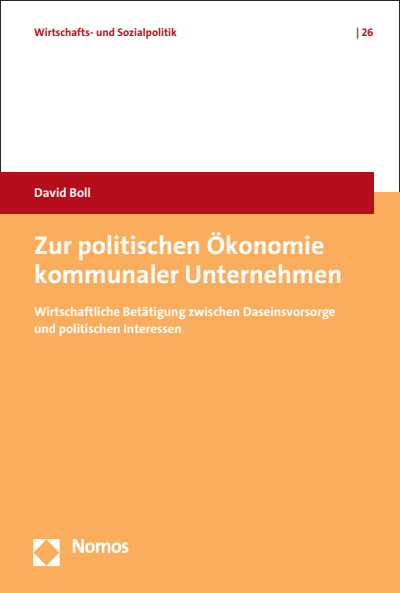
Zur politischen Ökonomie kommunaler Unternehmen
Wirtschaftliche Betätigung zwischen Daseinsvorsorge und politischen Interessen- Autor:innen:
- Reihe:
- Wirtschafts- und Sozialpolitik, Band 26
- Verlag:
- 2022
Zusammenfassung
Ergeben sich im Spannungsfeld kommunale Unternehmen – Kommunalpolitik – Bürger Fehlanreize? Diese Arbeit überträgt Ansätze aus der Public Choice Theorie auf Informationsprobleme und Anreizineffizienzen bei kommunalen Unternehmen. Der Autor untersucht empirisch mit Hilfe von multivariaten Regressionsanalysen den Einfluss der Kommunalpolitik auf das Investitionsverhalten der Unternehmen. Für den Untersuchungszeitraum (2002–2014) wird ein Datensatz, der 8.685 Unternehmen aus 3.237 Gemeinden und allen 13 deutschen Flächenländern umfasst, ausgewertet. Zentrales Ergebnis ist hierbei ein negativer Einfluss der Interessenfragmentierung im Gemeinderat auf die Investitionen je Einwohner der Unternehmen, der auf Investitionsblockaden hinweist.
Schlagworte
Publikation durchsuchen
Bibliographische Angaben
- Copyrightjahr
- 2022
- ISBN-Print
- 978-3-8487-8892-7
- ISBN-Online
- 978-3-7489-2947-5
- Verlag
- Nomos, Baden-Baden
- Reihe
- Wirtschafts- und Sozialpolitik
- Band
- 26
- Sprache
- Deutsch
- Seiten
- 237
- Produkttyp
- Monographie
Inhaltsverzeichnis
- Titelei/Inhaltsverzeichnis Kein Zugriff Seiten 1 - 18
- 1.1 Motivation Kein Zugriff
- 1.2 Aufbau der Arbeit Kein Zugriff
- 2.1 Einordnung in das föderale System Kein Zugriff
- Eigenbetrieb Kein Zugriff
- Anstalt des öffentlichen Rechts Kein Zugriff
- Zweckverband (z.B. § 13 GKZ BW; § 11 GKG LSA) Kein Zugriff
- GmbH Kein Zugriff
- AG Kein Zugriff
- 2.2.1.3 Fazit Rechtsformwahl und kommunaler Einfluss Kein Zugriff
- 2.2.2 Branchen Kein Zugriff
- 2.2.3 Eignerstatus Kein Zugriff
- 2.3.1 Was legitimiert öffentliche Unternehmen? Kein Zugriff
- 2.3.2 Umfrage zur Bürgermeinung öffentlicher Unternehmen Kein Zugriff
- 2.3.3.1 Literaturübersicht Kein Zugriff
- Ökonomische Überlegungen – H1 Kein Zugriff
- Daseinsvorsorge – H2 Kein Zugriff
- Ideologie – H3 Kein Zugriff
- Vertrauen in Politiker – H4 Kein Zugriff
- Soziale Verantwortung – H5 Kein Zugriff
- Eigennutz – H6 Kein Zugriff
- 2.3.3.3.1 Datenstruktur Kein Zugriff
- 2.3.3.3.2 Ergebnisse Kein Zugriff
- 2.3.4 Zwischenfazit Kein Zugriff
- 3.1 Das Schema des institutionalisierten Prinzipal-Agenten-Problems Kein Zugriff
- 3.2 Politiker – Geschäftsführung kommunaler Unternehmen Kein Zugriff
- 3.3.1.1 Theorie Kein Zugriff
- 3.3.1.2 Status Quo der empirischen Literatur Kein Zugriff
- Common Pool Kein Zugriff
- War of attrition Kein Zugriff
- Veto-Spieler Kein Zugriff
- 3.3.2.2 Status Quo der empirischen Literatur Kein Zugriff
- 3.3.3.1 Theorie Kein Zugriff
- 3.3.3.2 Status Quo der empirischen Literatur Kein Zugriff
- 3.3.4 Hypothesen Kein Zugriff
- 3.3.5 Behavioral political economy – eine verhaltensökonomische Perspektive auf die Beziehung zwischen Bürger und Politiker Kein Zugriff
- 4.1.1 Beschreibung der Datenquellen und ihrer Aufbereitung Kein Zugriff
- 4.1.2 Investitionstätigkeit: Maß und Deskriptives Kein Zugriff
- 4.1.3 Wahlzyklen: Maß und Deskriptives Kein Zugriff
- 4.1.4 Interessenfragmentierung: Maß und Deskriptives Kein Zugriff
- 4.1.5 Ideologie: Maß und Deskriptives Kein Zugriff
- 4.1.6 Weitere Einflussfaktoren und Kontrollvariablen Kein Zugriff
- 4.2 Untersuchung politischer Variablen in Panelregressionen Kein Zugriff
- 4.3.1 Methodisches Vorgehen Kein Zugriff
- 4.3.2.1 Generelle Einflüsse von Wahljahren Kein Zugriff
- 4.3.2.2 Brancheneffekte Kein Zugriff
- 4.3.3 Diskussion: Politische Konjunkturzyklen Kein Zugriff
- 4.4.1 Methodisches Vorgehen Kein Zugriff
- 4.4.2.1 Generelle Einflüsse der Interessenfragmentierung Kein Zugriff
- 4.4.2.2 Weitere fixe Effekte Varianten Kein Zugriff
- 4.4.2.3 Nichtlinearitäten Kein Zugriff
- 4.4.2.4 Brancheneffekte Kein Zugriff
- 4.4.2.5 Interessenfragmentierung im Wahlzyklus Kein Zugriff
- 4.4.2.6 Robustheitstest Kein Zugriff
- 4.4.3 Diskussion: Interessenfragmentierung Kein Zugriff
- 4.5.1 Methodisches Vorgehen Kein Zugriff
- 4.5.2.1 Anteile und Mehrheiten im OLS Kein Zugriff
- 4.5.2.2 Regression-Discontinuity-Design Kein Zugriff
- 4.5.2.3 Interaktionseffekte Kein Zugriff
- 4.5.2.4 Brancheneffekte Kein Zugriff
- 4.5.2.5 Bürgermeisterideologien Kein Zugriff
- 4.5.3 Diskussion Parteiideologien Kein Zugriff
- 5.1 Einordnung der Ergebnisse Kein Zugriff
- 5.2 Ableitung von Implikationen Kein Zugriff
- 5.3 Fazit Kein Zugriff
- Anhang 1: Ergebnisse der Regressionen zur Erklärung von Privatisierung und Instrumentalfunktion (OLS-Schätzungen) Kein Zugriff
- Anhang 2: Literaturübersicht über empirische Studien zu Interessenfragmentierung in politischen Gremien Kein Zugriff
- Anhang 3: Ergebnisse zu den Regressionen zum ENP differenziert nach Branchen Kein Zugriff
- Anhang 4: Robustheitsuntersuchung zu potenziellen Messfehlern des ENP Kein Zugriff
- Anhang 5: Ergebnisse zu den Regressionen linker Anteile im Gemeinderat differenziert nach Branchen Kein Zugriff
- Anhang 6: Ergebnisse zu den Regressionen linker Mehrheiten im Gemeinderat differenziert nach Branchen Kein Zugriff
- 7. Literaturverzeichnis Kein Zugriff Seiten 225 - 237
Literaturverzeichnis (218 Einträge)
Es wurden keine Treffer gefunden. Versuchen Sie einen anderen Begriff.
- Akerlof, G. A. (1970). The Market for "Lemons": Quality Uncertainty and the Market Mechanism. Quarterly Journal of Economics, S. 488-500. Google Scholar öffnen DOI: 10.5771/9783748929475
- Akhmedov, A., & Zhuravskaya, E. (2004). Opportunistic Political Cycles: Test in a Young Democracy Setting. The Quarterly Journal of Economics 119, S. 1301–1338. Google Scholar öffnen DOI: 10.5771/9783748929475
- Alesina, A. (1987). Policy in a Two-Party System as a Repeated Game. The Quarterly Journal of Economics, Vol. 102, No. 3, S. 651-678. Google Scholar öffnen DOI: 10.5771/9783748929475
- Alesina, A., & Drazen, A. (1991). Why Are Stabilizations Delayed? The American Economic Review, Vol. 81, No. 5, S. 1170-1188. Google Scholar öffnen DOI: 10.5771/9783748929475
- Alesina, A., & La Ferrara, E. (2005). Ethnic Diversity and Economic Performance. Journal of Economic Literature 43, S. 762-800. Google Scholar öffnen DOI: 10.5771/9783748929475
- Alesina, A., & Paradisi, M. (2017). Political budget cycles: Evidence from Italian cities. Economics & Politics 29, S. 157-177. Google Scholar öffnen DOI: 10.5771/9783748929475
- Alesina, A., & Roubini, N. (1992). Political Cycles in OECD Economies. The Review of Economic Studies 59, S. 663-688. Google Scholar öffnen DOI: 10.5771/9783748929475
- Alesina, A., & Tabellini, G. (1990). A Positive Theory of Fiscal Deficits and Government Debt. Review of Economic Studies 57, S. 403-414. Google Scholar öffnen DOI: 10.5771/9783748929475
- Alesina, A., Cohen, G. D., & Roubini, N. (1992). Macroeconomic policy and elections in OECD democracies. Economics and Politics 4, S. 1-30. Google Scholar öffnen DOI: 10.5771/9783748929475
- Alesina, A., Roubini, N., & Cohen, G. D. (1997). Political Cycls and the Macroeconomy. Cambridge, Massachusetts: The MIT Press. Google Scholar öffnen DOI: 10.5771/9783748929475
- Alexandre, H., & Charreaux, G. (2004). Efficiency of French privatizations: a dynamic vision. Journal of Corporate Finance 10, S. 467 – 494. Google Scholar öffnen DOI: 10.5771/9783748929475
- Allers, M., de Haan, J., & Sterks, C. (2001). Partisan influence on the local tax burden in the Netherlands. Public Choice 106, S. 351–363. Google Scholar öffnen DOI: 10.5771/9783748929475
- Angrist, J. D., & Pischke, J.-S. (2009). Mostly Harmless Econometrics. New Jersey: Princeton University Press. Google Scholar öffnen DOI: 10.5771/9783748929475
- Angrist, J. D., & Pischke, J.-S. (2015). Mastering 'Metrics - The Patch from Cause to Effect. Princeton: Princeton University Press. Google Scholar öffnen DOI: 10.5771/9783748929475
- Arellano, M., & Bond, S. (1991). Some Tests of Specification for Panel Data: Monte Carlo Evidence and an Application to Employment Equations. Review of Economic Studies 58, S. 277-297. Google Scholar öffnen DOI: 10.5771/9783748929475
- Artés, J., & Jurado, I. (2015). Fiscal Deficits and Type of Government: A Study of Spanish Local Elections. In N. Scholfield, & G. Caballero, The Political Economy of Governance - Institutions, Political Performance and Elections (S. 363-376). Heidelberg: Springer. Google Scholar öffnen DOI: 10.5771/9783748929475
- Ashworth, J., Geys, B., & Heyndels, B. (2005). GovernmentWeakness and Local Public Debt - Development in Flemish Municipalities. International Tax and Public Finance 12, S. 395-422. Google Scholar öffnen DOI: 10.5771/9783748929475
- Ashworth, J., Geys, B., & Heyndels, B. (2006). Determinants of tax innovation: The case of environmental taxes in Flemish municipalities. European Journal of Political Economy 22, S. 223–247. Google Scholar öffnen DOI: 10.5771/9783748929475
- Bacchiocchi, E., Florio, M., & Gambaro, M. (2011). Telecom reformsintheEU: Pricesandconsumers’satisfaction. Telecommunications Policy, S. 382–396. Google Scholar öffnen DOI: 10.5771/9783748929475
- Baltagi, B. H. (2005). Econometric analysis of panel data. New York: Wiley. Google Scholar öffnen DOI: 10.5771/9783748929475
- Barro, R. J. (1973). The control of politicians: an economic model. Public Choice 14, S. 19-42. Google Scholar öffnen DOI: 10.5771/9783748929475
- Baskaran, T. (2013). Coalition governments, cabinet size, and the common pool problem: Evidence from the German states. European Journal of Political Economy, 32, S. 356–376. Google Scholar öffnen DOI: 10.5771/9783748929475
- Baßeler, U., Heinrich, J., & Utecht, B. (2010). Grundlagen und Probleme der Volkswirtschaft. Stuttgart: Schäffer-Poeschel Verlag. Google Scholar öffnen DOI: 10.5771/9783748929475
- Battaglio, R. P. (2009). Privatization and Citizen Preferences: A Cross-National Analysis of Demand for Private Versus Public Provision of Services in Three Industries. Administration & Society 41(1), pp. 38-66. Google Scholar öffnen DOI: 10.5771/9783748929475
- Bel, G., Raudla, R., Rodrigues, M., & Tavares, A. F. (2018). These rules are made for spending: testing and extending the law of 1/n. Public Choice, S. 41–60. Google Scholar öffnen DOI: 10.5771/9783748929475
- Benito, B., Bastida, F., & Vicente, C. (2013). Municipal elections and cultural expenditure. Journal of Cultural Economics, Volume 37, Issue 1, S. 3–32. Google Scholar öffnen DOI: 10.5771/9783748929475
- Blankart, C. B. (2017). Öffentliche Finanzen in der Demokratie: Eine Einführung in die Finanzwissenschaft. München: Verlag Vahlen. Google Scholar öffnen DOI: 10.5771/9783748929475
- Boll, D., & Sidki, M. (2021). The influence of political fragmentation on public enterprises: Evidence from German municipalities. European Journal of Political Economy 67, S. 101972. Google Scholar öffnen DOI: 10.5771/9783748929475
- Boll, D., Müller, H., & Sidki, M. (2020). Bilanzpolitik in kommunalen Unternehmen. Zeitschrift für öffentliche und gemeinwirtschaftliche Unternehmen (ZögU) 43, S. 479-505. Google Scholar öffnen DOI: 10.5771/9783748929475
- Borge, L.-E. (2005). Strong politicians, small deficits: evidence from Norwegian local governments. European Journal of Political Economy, Vol. 21, S. 325–344. Google Scholar öffnen DOI: 10.5771/9783748929475
- Bortolotti, B., & Pinotti, P. (2008). Delayed privatization. Public Choice 136, S. 331–351. Google Scholar öffnen DOI: 10.5771/9783748929475
- Bremeier, W., Brinckmann, H., & Killian, W. (2006). Public Governance kommunaler Unternehmen. Düsseldorf: Hans-Böckler-Stiftung. Google Scholar öffnen DOI: 10.5771/9783748929475
- Breunig, R., & Rocaboy, Y. (2008). Per-capita public expenditures and population size: a non-parametric analysis using French data. Public Choice 136, S. 429-445. Google Scholar öffnen DOI: 10.5771/9783748929475
- Brosio, G., & Marchese, C. (1988). The growth of government under redistributive rules: A long term study of the Italian case. Public Finanance Quarterly, vol. 16 No. 4, S. 439-463. Google Scholar öffnen DOI: 10.5771/9783748929475
- Brüning, C. (2011). Regie- und Eigenbetriebe. In T. Mann, & G. Püttner, Handbuch der kommunalen Wissenschaft und Praxis 2. Kommunale Wirtschaft. (S. 149-172). Heidelberg: Springer. Google Scholar öffnen DOI: 10.5771/9783748929475
- Buchanan, J. M., & Musgrave, R. A. (1999). Public Finance and Public Choice: Two Contrasting Visions of the State. MIT Press. Google Scholar öffnen DOI: 10.5771/9783748929475
- Bund der Steuerzahler. (2017). Die öffentliche Verschwendung: Schwarzbuch des Bundes der Steuerzahler. Wiesbaden: Präsidium des Bundes der Steuerzahler. Google Scholar öffnen DOI: 10.5771/9783748929475
- Bund der Steuerzahler. (2020). Das Schwarzbuch - Die öffentliche Verschwendung 2020/21. Bonn: Bonner Universitäts-Buchdruckerei. Google Scholar öffnen DOI: 10.5771/9783748929475
- Bundesfinanzhof. (2020). Pressemitteilung Nr. 8 vom 06. Februar 2020. Google Scholar öffnen DOI: 10.5771/9783748929475
- Bundesministerium der Finanzen. (2017). Auf den Punkt. Bund-Länder-Finanzen. Von https://www.bundesfinanzministerium.de/: https://www.bundesfinanzministerium.de/Content/DE/000-PAPIERKORB/2017-08-26-auf-den-punkt-bund-laender-finanzen.pdf?__blob=publicationFile&v=6 abgerufen Google Scholar öffnen DOI: 10.5771/9783748929475
- Busemeyer, M. R. (2009). Social democrats and the new partisan politics of public investment in education. Journal of European Public Policy 16, S. 107–126. Google Scholar öffnen DOI: 10.5771/9783748929475
- Capalbo, F., Frino, A., Mollica, V., & Palumbo, R. (2014). Accrual-based earnings management in state owned companies. Accounting, Auditing & Accountability Journal, S. 1026–1040. Google Scholar öffnen DOI: 10.5771/9783748929475
- Chen, R., El Ghoul, S., Guedhami, O., & Wang, H. (2017). Do state and foreign ownership affect investment efficiency? Evidence from privatizations. Journal of Corporate Finance, S. 408-421. Google Scholar öffnen DOI: 10.5771/9783748929475
- Chortareas, G., Logothetisb, V., & Papandreou, A. A. (2016). Political budget cycles and reelection prospects in Greece's municipalities. European Journal of Political Economy 43, S. 1-13. Google Scholar öffnen DOI: 10.5771/9783748929475
- Coenenberg, A. G., Haller, A., & Schultze, W. (2015). Jahresabschluss und Jahresabschlussanalyse : Betriebswirtschaftliche, handelsrechtliche, steuerrechtliche und internationale Grundlagen. 24. Auflage. Stuttgart: Schäffer-Poeschel Verlag. Google Scholar öffnen DOI: 10.5771/9783748929475
- Cooper, J. C., & Kovacic, W. E. (2012). Behavioral economics: implications for regulatory behavior. Journal of Regulatory Economics 41, S. 41-58. Google Scholar öffnen DOI: 10.5771/9783748929475
- Cornett, M. M., Guo, L., Khaksari, S., & Tehranian, H. (2010). The impact of state ownership on performance differences in privately-owned versus state-owned banks: An international comparison. Journal of Financial Intermediation, S. 74-94. Google Scholar öffnen DOI: 10.5771/9783748929475
- Cox, H., & Kirchhoff, U. (1981). Die Instrumentalfunktion öffentlicher Unternehmen. Wirtschaftsdienst, S. 234-241. Google Scholar öffnen DOI: 10.5771/9783748929475
- Cronauge, U. (2016). Kommunale Unternehmen. Berlin: Erich Schmidt Verlag. Google Scholar öffnen DOI: 10.5771/9783748929475
- Cusack, T. R. (1997). Partisan Politics and Public Finance: Changes in Public Spending in the Industrialized. Public Choice, Vol. 91, No. 3/4, S. 375-395. Google Scholar öffnen DOI: 10.5771/9783748929475
- Dahl, C. H. (2014). Parties and institutions: empirical evidence on veto players and the growth of government. Public Choice, S. 415–433. Google Scholar öffnen DOI: 10.5771/9783748929475
- Daily, C., Dalton, D., & Cannella, A. (2003). Corporate Governance: Decades of Dialogue and Data. Academy of Management Review, 28 (3), S. 371-382. Google Scholar öffnen DOI: 10.5771/9783748929475
- De Haan, J., & Sturm, J. E. (1994). Political and institutional determinants of fiscal policy in the European Community. Public Choice 80, S. 157-172. Google Scholar öffnen DOI: 10.5771/9783748929475
- De Haan, J., & Sturm, J.-E. (1997). Political and economic determinants of OECD budget deficits and government expenditures: A reinvestigation. European Journal of Political Economy 13, S. 739-750. Google Scholar öffnen DOI: 10.5771/9783748929475
- De Haan, J., Sturm, J.-E., & Beekhuis, G. (1999). The weak government thesis: Some new evidence. Public Choice 101, S. 163–176. Google Scholar öffnen DOI: 10.5771/9783748929475
- Debus, M., & Gross, M. (2015). Coalition formation at the local level: Institutional constraints, party policy conflict, and office-seeking political parties. Party Politics, S. 1-15. Google Scholar öffnen DOI: 10.5771/9783748929475
- Denisova, I., Eller, M., Frye, T., & Zhuravskaya, E. (2012). Everyone hates privatization, but why? Survey evidence from 28 post-communist countries. Journal of Comparative Economics, S. 44-61. Google Scholar öffnen DOI: 10.5771/9783748929475
- Denisova, I., Eller, M., Frye, T., & Zhuravskaya, E. (2012). Everyone hates privatization, but why? Survey evidence from 28 post-communist countries. Journal of Comparative Economics 40(1), pp. 44-61. Google Scholar öffnen DOI: 10.5771/9783748929475
- Dewenter, K. L., & Malatesta, P. H. (2001). State-Owned and Privately Owned Firms: An Empirical Analysis of Profitability, Leverage, and Labor Intensity. The American Economic Review, Vol. 91, No. 1, S. 320-334. Google Scholar öffnen DOI: 10.5771/9783748929475
- Döring, T. (2015). Öffentliche Finanzen und Verhaltensökonomik - Zur Psychologie der beudgetwirksamen Staatstätigkeit. Wiesbaden: Springer Gabler. Google Scholar öffnen DOI: 10.5771/9783748929475
- Downs, A. (1957). An Economic Theory of Political Action in a Democracy. Journal of Political Economy, S. 135-150. Google Scholar öffnen DOI: 10.5771/9783748929475
- Drazen, A., & Eslava, M. (2010). Electoral manipulation via voter-friendly spending: Theory and evidence. Journal of development economics 92(1), S. 39-52. Google Scholar öffnen DOI: 10.5771/9783748929475
- Dubois, E. (2016). Political business cycles 40 years after Nordhaus. Public Choice, S. 235–259. Google Scholar öffnen DOI: 10.5771/9783748929475
- Durant, R. F., & Legge, J. S. (2001). Politics, Public Opinion, and Privatization: A Test of Competing Theories in Great Britain. Public Organization Review, S. 75-95. Google Scholar öffnen DOI: 10.5771/9783748929475
- Durant, R. F., & Legge, J. S. (2002). Politics, Public Opinion, und Privatization in France: Assessing the Calculus of Consent for Market Reforms. Public Administration Review, S. 307-323. Google Scholar öffnen DOI: 10.5771/9783748929475
- Ebinger, F., Zabler, S., Person, C., Niemann, F.-S., & Geißler, R. (2018). Wirksame Finanzaufsicht über die Kommunen. Dimensionen und Determinanten der Umsetzungspraxis. der moderne staat – Zeitschrift für Public Policy, Recht und Management 11, S. 167-189. Google Scholar öffnen DOI: 10.5771/9783748929475
- Edeling, T. (2008). Institutionelle Umbrüche im öffentlichen Sektor: Das Ende der kommunalen Daseinsvorsorge? In R. Sackmann, B. Jonda, & M. Reinhold, Demographie als Herausforderung für den öffentlichen Sektor (S. 144-162). Wiesbaden: VS Verlag für Sozialwissenschaften. Google Scholar öffnen DOI: 10.5771/9783748929475
- Edin, P.-A., & Ohlsson, H. (1991). Political determinants of budget deficits: Coalition effects versus minority effects*. European Economic Review 35, S. 1597-1603. Google Scholar öffnen DOI: 10.5771/9783748929475
- Egger, P., & Koethenbuerger, M. (2010). Government Spending and Legislative Organization: Quasi-Experimental Evidence from Germany. American Economic Journal: Applied Economics, Vol. 2, No. 4, S. 200-212. Google Scholar öffnen DOI: 10.5771/9783748929475
- Eichhorn, P. (2003). New Governance bei öffentlichen Unternehmen. In J. Harms, & C. Richard, Die Ökonomisierung des öffentlichen Sektors: Instrumente und Trends (S. 175-181). Baden-Baden: Nomos. Google Scholar öffnen DOI: 10.5771/9783748929475
- Eichler, S., & Hofmann, M. (2013). Sovereign default risk and decentralization: Evidence for emerging markets. European Journal of Political Economy 32, S. 113–134. Google Scholar öffnen DOI: 10.5771/9783748929475
- Eldenburg, L. G., Gunny, K. A., Hee, K. W., & Soderstrom, N. (2011). Earnings Management Using Real Activities: Evidence from Nonprofit Hospitals. The accounting review, S. 1605–1630. Google Scholar öffnen DOI: 10.5771/9783748929475
- Erlei, M., Leschke, M., & Sauerland, D. (2007). Neue Institutionenökonomik. Stuttgart: Schäffer-Poeschel Verlag. Google Scholar öffnen DOI: 10.5771/9783748929475
- Europäische Kommission. (2016). Die Europäische Union erklärt: Wettbewerb. Von https://op.europa.eu/: http://publications.europa.eu/resource/cellar/8200c251-aa42-11e6-aab7-01aa75ed71a1.0003.02/DOC_1 abgerufen Google Scholar öffnen DOI: 10.5771/9783748929475
- Expertenkommission D-PCGM. (2021). Deutscher Public Corporate Governance-Musterkodex (D-PCGM). Hrsg. Ulf Papenfuß/Klaus-Michael Ahrend/Kristin Wagner-Krechlok, in der Fassung vom 15. Januar 2021. Google Scholar öffnen DOI: 10.5771/9783748929475
- Fatas, E., Neugebauer, T., & Tamborero, P. (2007). Experiment, How Politicians Make Decisions: A Political Choice. Journal of Economics 92, S. 167–196. Google Scholar öffnen DOI: 10.5771/9783748929475
- Fernandez, S., Smith, C., & Wenger, J. (2006). Employment, Privatization, and Managerial Choice: Does Contracting Out Reduce Public Sector Employment? Journal of Policy Analysis and Management, S. 57-77. Google Scholar öffnen DOI: 10.5771/9783748929475
- Ferreira, F., & Gyourko, J. (2009). Do political Parties matter? Evidence from U.S. Cities. The Quarterly Journal of Economics, S. 399-422. Google Scholar öffnen DOI: 10.5771/9783748929475
- Fiorio, C. V., Florio, M., & Perucca, G. (2013). User satisfaction and the organization of local public transport: Evidence from European cities. Transport Policy, S. 209-218. Google Scholar öffnen DOI: 10.5771/9783748929475
- Foremny, D., Freier, R., Moessinger, M.-D., & Yeter, M. (2018). Overlapping political budget cycles. Public Choice, S. 1-27. Google Scholar öffnen DOI: 10.5771/9783748929475
- Foucault, M., Madies, T., & Paty, S. (2008). Public spending interactions and local politics. Empirical evidence from French municipalities. Public Choice 137, S. 57–80. Google Scholar öffnen DOI: 10.5771/9783748929475
- Freier, R., & Grass, V. (2013). Kommunale Verschuldung in Deutschland: Struktur verstehen - Risiken abschätzen. DIW Wochenbericht 16/2013, S. 13-21. Google Scholar öffnen DOI: 10.5771/9783748929475
- Freier, R., & Odendahl, C. (2012). Do absolute majorities spend less? Evidence from Germany. Discussion Papers 1239. DIW Berlin, German Institute for Economic Research. Google Scholar öffnen DOI: 10.5771/9783748929475
- Freier, R., & Odendahl, C. (2015). Do parties matter? Estimating the effect of political power in multi-party systems. European Economic Review 80, S. 310-328. Google Scholar öffnen DOI: 10.5771/9783748929475
- Furubotn, E. G., & Richter, R. (2005). Institutions and Economic Theory: The Contribution of the New Institutional Economics. Ann Arbor, Michigan: The University of Michigan Press. Google Scholar öffnen DOI: 10.5771/9783748929475
- Galasso, V. (2014). The role of political partisanship during economic crises. Public Choice 158, S. 143–165. Google Scholar öffnen DOI: 10.5771/9783748929475
- Galli, E., & Rossi, S. P. (2002). Political budget cycles: The case of the Western German Länder. Public Choice 110, S. 283-303. Google Scholar öffnen DOI: 10.5771/9783748929475
- Garcia-Zamor, J.-C., & Noll, S. (2009). Privatization of Public Services in Leipzig: A Balancing Act between efficiency and Legitimacy. Public Organiz Rev, S. 83-99. Google Scholar öffnen DOI: 10.5771/9783748929475
- Garmann, S. (2014). Do government ideology and fragmentation matter for reducing CO2-emissions? Empirical evidence from OECD countries. Ecological Economics 105, S. 1-10. Google Scholar öffnen DOI: 10.5771/9783748929475
- Gerber, E. R., & Hopkins, D. J. (2011). When Mayors Matter: Estimating the Impact of Mayoral Partisanship on City Policy. American Journal of Political Science 55, S. 326–339. Google Scholar öffnen DOI: 10.5771/9783748929475
- Gerlit, R., & Krcmar, H. (2020). Der Bürgerhaushalt. Beteiligungsbarrieren aus Unternehmenssicht. In A. Lorenz, C. P. Hoffmann, & U. H. (Hrsg.), Partizipation für alle und alles? Fallstricke, Grenzen und Möglichkeiten (S. 113-126). Wiesbaden: Springer. Google Scholar öffnen DOI: 10.5771/9783748929475
- Geys, B. (2007). Government Weakness and Local Public Debt Cycles: Evidence from Flemish Municipalities. Local Government Studies 33, S. 239-253. Google Scholar öffnen DOI: 10.5771/9783748929475
- Glöckner, A., & Mühlenkamp, H. (2009). Die kommunale Finanzkontrolle - Eine Darstellung und Analyse des Systems zur finanziellen Kontrolle von Kommunen. Zeitschrift für Planung & Unternehmenssteuerung 19, S. 397–420. Google Scholar öffnen DOI: 10.5771/9783748929475
- Goeminne, S., & Smolders, C. (2014). Politics and Public Infrastructure Investments in Local Governments: Empirical Evidence from Flemish Municipalities (1996–2009). Local Government Studies 40, S. 182-202. Google Scholar öffnen DOI: 10.5771/9783748929475
- Goeminne, S., Geys, B., & Smolders, C. (2008). Political fragmentation and projected tax revenues: evidence from Flemish municipalities. International Tax and Public Finance, S. 297–315. Google Scholar öffnen DOI: 10.5771/9783748929475
- Goldeng, E., Grünfeld, L. A., & Benito, G. R. (2008). The Performance Differential between Private and State Owned Enterprises: The Roles of Ownership, Management and Market Structure. Journal of Management Studies 45, S. 1244-1273. Google Scholar öffnen DOI: 10.5771/9783748929475
- Greene, W. H. (2019). Econometric Analysis. New York: Pearson. Google Scholar öffnen DOI: 10.5771/9783748929475
- Grundei, J. (2008). Aremanagers agents or stewards of their principals? Journal für Betriebswirtschaftslehre 58, S. 141–166. Google Scholar öffnen DOI: 10.5771/9783748929475
- Gupta, S., Liu, E. X., & Mulas-Granados, C. (2016). Now or later? The political economy of public investment in democracies. European Journal of Political Economy, S. 101–114. Google Scholar öffnen DOI: 10.5771/9783748929475
- Hanna, T. M. (2018). The Next Economic Settlement: The Return of Public Ownership. Renewal, 26(2), S. 17-32. Google Scholar öffnen DOI: 10.5771/9783748929475
- Hansen, S. W. (2014). Common pool size and project size: an empirical test on expenditures using Danish municipal mergers. Public Choice, S. 3–21. Google Scholar öffnen DOI: 10.5771/9783748929475
- Hau, H., & Thum, M. (2009). Subprime crisis and board (in-) competence: private versuspublic banks in Germany. Economic Policy, S. 701–752. Google Scholar öffnen DOI: 10.5771/9783748929475
- Hausman, J. A. (1978). Specification Tests in Econometrics. Econometrica Vol. 46, No. 6, S. 1251-1271. Google Scholar öffnen DOI: 10.5771/9783748929475
- Heinemann, F., Janeba, E., Moessinger, M.-D., Schröder, C., & Streif, F. (2014). Föderalismus-Präferenzen in den deutschen Landesparlamenten. Perspektiven der Wirtschaftspolitik 15, S. 56-74. Google Scholar öffnen DOI: 10.5771/9783748929475
- Herwartz, H., & Theilen, B. (2014). Health Care and Ideology: A Reconsideration of Political Determinants of Public Health Care Funding in the OECD. Health Economics 23, S. 225-240. Google Scholar öffnen DOI: 10.5771/9783748929475
- Herwartz, H., & Theilen, B. (2017). Ideology and redistribution through public spending. European Journal of Political Economy 46, S. 74-90. Google Scholar öffnen DOI: 10.5771/9783748929475
- Hibbs, D. A. (1977). Political Parties and Macroeconomic Policy . The American Political Science Review, Vol. 71, No. 4, S. 1467-1487 . Google Scholar öffnen DOI: 10.5771/9783748929475
- Hindriks, J., & Myles, G. D. (2006). Intermediate Public Economics. Cambridge, Massachusetts: MIT Press. Google Scholar öffnen DOI: 10.5771/9783748929475
- Hochhold, S., & Rudolph, B. (2009). Principal-Agent-Theorie. In M. S. (Hrsg.), & A. Meyer, Theorien und Methoden der Betriebswirtschaft. Handbuch für Wissenschaftler und Studierende 1 (S. 132-145). München: Verlag Franz Vahlen. Google Scholar öffnen DOI: 10.5771/9783748929475
- Institut für den öffentlichen Sektor. (2007). Die Qualifikation von Aufsichtsräten in öffentlichen Unternehmen. Google Scholar öffnen DOI: 10.5771/9783748929475
- Institut für den öffentlichen Sektor. (2011). Kriterien für die Rechtsformwahl von öffentlichen Unternehmen. Google Scholar öffnen DOI: 10.5771/9783748929475
- Institut für den öffentlichen Sektor. (2015). Geschäftsführung kommunaler Unternehmen: gesteuert oder autonom? Google Scholar öffnen DOI: 10.5771/9783748929475
- Institut für den öffentlichen Sektor. (2016). Die Geselschafterversammlung – zu Unrecht im Schatten des Aufsichtsrats? Google Scholar öffnen DOI: 10.5771/9783748929475
- Jegers, M. (2013). Do Nonprofit Organisations Manage Earnings? An Empirical Study. VOLUNTAS: International Journal of Voluntary and Nonprofit, S. 953–968. Google Scholar öffnen DOI: 10.5771/9783748929475
- Jensen, M. C., & Meckling, W. H. (1976). Theory of the firm: managerial behavior, agency costs and ownership structure. Journal of Financial Economics 3, S. 305-360. Google Scholar öffnen DOI: 10.5771/9783748929475
- Jordahl, H., & Liang, C.-Y. (2010). Merged municipalities, higher debt: on free-riding and the common pool problem in politics. Public Choice, S. 157–172. Google Scholar öffnen DOI: 10.5771/9783748929475
- Kahneman, D. (2003). Maps of Bounded Rationality: Psychology for Behavioral Economics. The American Economic Review, Vol. 93, S. 1449-1475. Google Scholar öffnen DOI: 10.5771/9783748929475
- Kahneman, D., & Tversky, A. (1979). Prospect Theory: An Analysis of Decision under Risk. Econometrica 47, S. 263-292. Google Scholar öffnen DOI: 10.5771/9783748929475
- Kasper, W., Streit, M. E., & Boettke, P. J. (2012). Institutional Economics - Property, Competition, Policies. Cheltenham: Edward Elgar. Google Scholar öffnen DOI: 10.5771/9783748929475
- Katsimi, M., & Sarantides, V. (2012). Do elections affect the composition of fiscal policy in developed, established democracies? Public Choice 151, S. 325–362. Google Scholar öffnen DOI: 10.5771/9783748929475
- Kneebone, R. D., & MCKenzie, K. J. (2001). Electoral and Partisan Cycles in Fiscal Policy: An Examination of Canadian Provinces. International Tax and Public Finance 8, S. 753–774. Google Scholar öffnen DOI: 10.5771/9783748929475
- Krause, T. A. (2015). Erklärungsfaktoren für die Managementautonomie in kommunalen Mehrheitsbeteiligungen: Eine empirische Studie. Potsdam, Dissertation: Publikationsserver der Universität Potsdam: http://nbn-resolving.de/urn:nbn:de:kobv:517-opus4-86503. Google Scholar öffnen DOI: 10.5771/9783748929475
- Kuran, T., & Sunstein, C. R. (1999). Availability Cascades and Risk Regulation. Stanford Law Review 51, S. 683-768. Google Scholar öffnen DOI: 10.5771/9783748929475
- La Porta, R., & López-De-Silanes, F. (1999). The Benefits of Privatization: Evidence from Mexico. Quarterly Journal of Economics, S. 1193-1242. Google Scholar öffnen DOI: 10.5771/9783748929475
- Laakso, M. (1979). "Effective" Numbers of Parties - A Measure with Application to West Europe. Comparative Political Studies, Vol. 12 No. 1, S. 3-27. Google Scholar öffnen DOI: 10.5771/9783748929475
- Lampropoulou, M. (2018). State-Owned Enterprises in Greece: The Evolution of a Paradigm 1996-2016. Annals of Public and Cooperative Economics, S. 491–526. Google Scholar öffnen DOI: 10.5771/9783748929475
- Le Maux, B., Rocaboy, Y., & Goodspeed, T. (2011). Political fragmentation, party ideology and public expenditures. Public Choice, 147, S. 43–67. Google Scholar öffnen DOI: 10.5771/9783748929475
- Lee, D. R., & Clark, J. R. (2018). Can behavioral economists improve economic rationality? Public Choice 174, S. 23-40. Google Scholar öffnen DOI: 10.5771/9783748929475
- Legatum Institute. (2017). Public opinion in the post-Brexit era: Economic attitudes in mordern Britain. Google Scholar öffnen DOI: 10.5771/9783748929475
- Legge, J. S., & Rainey, H. G. (2003). Privatization and Public Opinion in Germany. Public Organization Review: A Global Journal, S. 127–149. Google Scholar öffnen DOI: 10.5771/9783748929475
- Legge, J. S., & Rainey, H. G. (2003). Privatization and Public Opinion in Germany. Public Organization Review 3(2), pp. 127–149. Google Scholar öffnen DOI: 10.5771/9783748929475
- Lenk, T., & Sesselmeier, W. (2017). Teil V Nationale Finanz- und Wirtschaftspolitik. In R. Neubäumer, B. Hewel, & T. L. (Hrsg.), Volkswirtschaftslehre Grundlagen der Volkswirtschaftstheorie und Volkswirtschaftspolitik 6. Auflage (S. 375-498). Wiesbaden: Springer Gabler. Google Scholar öffnen DOI: 10.5771/9783748929475
- Leone, A. J., & van Horn, R. L. (2005). How do nonprofit hospitals manage earnings? Journal of Health Economics, S. 815–837. Google Scholar öffnen DOI: 10.5771/9783748929475
- Linde, J., & Vis, B. (2017). Do Politicians Take Risks Like the Rest of Us? An Experimental Test of Prospect Theory Under MPs. Political Psychology 38, S. 101-117. Google Scholar öffnen DOI: 10.5771/9783748929475
- MacDonald, L. (2008). The impact of government structure on local public expenditures. Public Choice, S. 457–473. Google Scholar öffnen DOI: 10.5771/9783748929475
- Mankiw, N. G., & Taylor, M. P. (2012). Grundzüge der Volkswirtschaftslehre. Stuttgart: Schäffer-Poeschel Verlag. Google Scholar öffnen DOI: 10.5771/9783748929475
- Mann, T. (2011). Kapitalgesellschaften. In T. Mann, & G. P. (Hrsg.), Handbuch der kommunalen Wissenschaft und Praxis - Band 2 Kommunale Wirtschaft (S. 207-246). Heidelberg: Springer. Google Scholar öffnen DOI: 10.5771/9783748929475
- Moessinger, M.-D. (2014). Do the personal characteristics of finance ministers affect changes in public debt? Public Choice 161, S. 183–207. Google Scholar öffnen DOI: 10.5771/9783748929475
- Monopolkommission. (2012/2013). Kommunale Wirtschaftstätigkeit und der Trend zur Rekommunalisierung. Auszug aus Hauptgutachten XX, Kapitel V. Google Scholar öffnen DOI: 10.5771/9783748929475
- Mueller, D. C. (2007). Public Choice III. Cambridge University Press: New York. Google Scholar öffnen DOI: 10.5771/9783748929475
- Mühlenkamp, H. (2019). Effizienzkonzepte, Effizienzmessung und Effizienzvergleiche bei öffentlichen Unternehmen. In H. Mühlenkamp, F. Schulz-Nieswandt, M. Krajewski, & L. T. (Hrsg.), Öffentliche Wirtschaft - Handbuch für Wissenschaft und Praxis (S. 339-384). Baden-Baden: Nomos. Google Scholar öffnen DOI: 10.5771/9783748929475
- Müller, A., Storesletten, K., & Zilibotti, F. (2016). The Political Color of Fiscal Responsibility. Journal of the European Economic Association 14, S. 252–302. Google Scholar öffnen DOI: 10.5771/9783748929475
- Myles, G. D. (2012). Public Economics. Cambridge: Cambridge University Press. Google Scholar öffnen DOI: 10.5771/9783748929475
- Nguyen, T., & Soobaroyen, T. (2018). Earnings Management by Non-Profit Organisations: Evidence from UK Charities. Australian Accounting Review, S. 124–142. Google Scholar öffnen DOI: 10.5771/9783748929475
- Niedersächsischer Landesrechnungshof. (13. 07 2021). https://www.lrh.niedersachsen.de/. Von https://www.lrh.niedersachsen.de/startseite/kommunalprufung/ueberoertliche-kommunalpruefung-97031.html abgerufen Google Scholar öffnen DOI: 10.5771/9783748929475
- Nierhaus, M. (2011). Selbstverwaltungsgarantie und wirtschaftliche Betätigung der Kommunen. In T. Mann, & G. P. (Hrsg.), Handbuch der kommunalen Wissenschaft und Praxis 2 - kommunale Wirtschaft (S. 35-55). Heidelberg: Springer. Google Scholar öffnen DOI: 10.5771/9783748929475
- Niskanen, W. A. (1968). The Peculiar Economics of Bureaucracy. American Economic Review, S. 293-305. Google Scholar öffnen DOI: 10.5771/9783748929475
- Niskanen, W. A. (1971). Bureaucarcy and Reperesentative Government. Chicago. Google Scholar öffnen DOI: 10.5771/9783748929475
- Nordhaus, W. D. (1975). The Political Business Cycle. The Review of Economic Studies, Vol. 42, No. 2, S. 169-190. Google Scholar öffnen DOI: 10.5771/9783748929475
- Oates, W. E. (1991). On The Measurement of Fiscal Illusion: A Survey. In W. E. Oates, Studies in fiscal federalism (S. 431-448). Edward Elgar Publishing. Google Scholar öffnen DOI: 10.5771/9783748929475
- Obinger, H., Schmitt, C., & Zohlnhöfer, R. (2013). Partisan Politics and Privatization in OECD Countries. Comparative Political Studies 47, S. 1294–1323. Google Scholar öffnen DOI: 10.5771/9783748929475
- Papenfuß, U., & Reichard, C. (2016). Gemischtwirtschaftliche Unternehmen zwischen öffentlichem Auftrag und Gewinnorientierung. In U. Papenfuß, & C. Reichard, Gemischtwirtschaftliche Unternehmen - Bestandsaufnahme und Perspektiven für Forschung und Praxis (S. 1-9). Baden-Baden: Zögu Beiheft 48. Google Scholar öffnen DOI: 10.5771/9783748929475
- Papenfuß, U., & Schaefer, C. (2017). Beteiligungsmanagement und Public Corporate Governance: Grundsachverhalte und Reformperspektiven. ZögU Zeitschrift für öffentliche und gemeinwirtschaftliche Unternehmen, Heft 2-3, S. 131-151. Google Scholar öffnen DOI: 10.5771/9783748929475
- Perotti, R., & Kontopoulos, Y. (2002). Fragmented fiscal policy. Journal of Public Economics 86, S. 191–222. Google Scholar öffnen DOI: 10.5771/9783748929475
- Petersen, M. A. (2008). Estimating Standard Errors in Finance Panel Data Sets: Comparing Approaches. Review of Financial Studies 22, S. 435-480. Google Scholar öffnen DOI: 10.5771/9783748929475
- Pettersson-Lidbom, P. (2008). Do Parties matter for Economic Outcomes? A Regression-Discontinuity Approach. Journal of the European Economic Association, S. 1037–1056. Google Scholar öffnen DOI: 10.5771/9783748929475
- Pint, E. M. (1991). Nationalization vs. regulation of monopolies. The effects of ownership on efficiency. Journal of Public Economics, 44, S. 131-164. Google Scholar öffnen DOI: 10.5771/9783748929475
- Pitschas, R., & Schoppa, K. (2011). Kriterien für die Wahl der Rechtsform. In T. Mann, & G. Püttner, Handbuch der kommunalen Wissenschaft und Praxis 2. Kommunale Wirtschaft (S. 105-148). Heidelberg: Springer. Google Scholar öffnen DOI: 10.5771/9783748929475
- Potrafke, N. (2017). Partisan politiks: The empirical evidence from OECD panel studies. Journal of Comparative Economics 45, S. 712–750. Google Scholar öffnen DOI: 10.5771/9783748929475
- Prichard, W. (2018). Electoral Competitiveness, Tax Bargaining and Political Incentives in Developing Countries: Evidence from Political Budget Cycles Affecting Taxation. British Journal of Political Science, S. 427-457. Google Scholar öffnen DOI: 10.5771/9783748929475
- Rechnungshof Rheinland-Pfalz. (13. 07 2021). https://rechnungshof.rlp.de/. Von https://rechnungshof.rlp.de/de/ueber-uns/aufgaben-und-arbeitsweise/ abgerufen Google Scholar öffnen DOI: 10.5771/9783748929475
- Reichard, C. (2012). Flucht aus der Kernverwaltung: Erfahrungen mit der Verselbständigung öffentlicher Einrichtungen. In M. Röber, Institutionelle Vielfalt und neue Unübersichtlichkeit (S. 55-68). Berlin: BWV - Berliner Wissenschafts-Verlag. Google Scholar öffnen DOI: 10.5771/9783748929475
- Reichard, C., & Röber, M. (2019). Organisationspolitische Optionen für öffentliche Aufgaben – Verselbständigung, Auslagerung und Privatisierung. In S. Veit, C. Reichard, & G. Wewer, Handbuch zur Verwaltungsreform (S. 263-274). Heidelberg: Springer. Google Scholar öffnen DOI: 10.5771/9783748929475
- Reid, B. G. (1998). Endogenous elections, electoral budget cycles and Canadian provincial governments. Public Choice, S. 35-48. Google Scholar öffnen DOI: 10.5771/9783748929475
- Ribbentrup, V., & Starck, A. (2021). Steuerlicher Querverbund. Public Services Newsletter PwC Ausgabe 2, März/April 2021, S. 17-18. Google Scholar öffnen DOI: 10.5771/9783748929475
- Rogoff, K. (1990). Equilibrium political budget cycles. American Economic Review 80(1), S. 21–36. Google Scholar öffnen DOI: 10.5771/9783748929475
- Rogoff, K., & Sibert, A. (1988). Elections and Macroeconomic Policy Cycles. Review of Economic Studies, S. 1-16. Google Scholar öffnen DOI: 10.5771/9783748929475
- Roodman, D. (2009). A Note on the Theme of Too Many Instruments. Oxford Bulletin of Economics and Statistics 71, S. 135-158. Google Scholar öffnen DOI: 10.5771/9783748929475
- Roodman, D. (2009). How to do xtabond2: An introduction to difference and system GMM in Stata. The Stata Journal 9, S. 86–136. Google Scholar öffnen DOI: 10.5771/9783748929475
- Roubini, N., & Sachs, J. D. (1989). Political and Economic Determinants of Budget Deficits in the Industrial Democracies. European Economic Review 33, S. 903-938. Google Scholar öffnen DOI: 10.5771/9783748929475
- Sachverständigenrat. (2017). Jahresgutachten 17/18. Für eine zukunftsorientierte Wirtschaftspolitik. Paderborn: Bonifatius GmbH Druck-Buch-Verlag. Google Scholar öffnen DOI: 10.5771/9783748929475
- Sack, D. (2019). Vom Staat zum Markt - Privatisierung aus politikwissenschaftlicher Perspektive. Wiesbaden: Springer. Google Scholar öffnen DOI: 10.5771/9783748929475
- Sakamoto, T. (2008). Economic Policy and Performance in Industrial Democracies - Party governments, central banks and the fiscal–monetary policy mix. London, New York: Routledge. Google Scholar öffnen DOI: 10.5771/9783748929475
- Sakurai, S. N., & Menezes-Filho, N. (2011). Opportunistic and partisan election cycles in Brazil: new evidence at the municipal level. Public Choice 148, S. 233–247. Google Scholar öffnen DOI: 10.5771/9783748929475
- Sapir, A., & Sekkat, K. (2002). Political cycles, fiscal deficits, and output spillovers in Europe. Public Choice 111, S. 195–205. Google Scholar öffnen DOI: 10.5771/9783748929475
- Schaefer, C., & Warm, S. (2018). Investitionsmanagement im speziellen Kontext gemischtwirtschaftlicher Unternehmen. In U. Papenfuß, & C. Reichard, Gemischtwirtschaftliche Unternehmen - Bestandsaufnahme und Perspektiven für Forschung und Praxis (S. 75-89). Baden-Baden: Zögu Beiheft 48. Google Scholar öffnen DOI: 10.5771/9783748929475
- Schäfer, S., & Zimmermann, H. (2011). Ausgabenvergleich zwischen Bundesländern - Die Rolle des Kommunalisierungsgrads. Wirtschaftsdienst, S. 249-256. Google Scholar öffnen DOI: 10.5771/9783748929475
- Schaltegger, C. A., & Feld, L. P. (2009). Do large cabinets favor large governments? Evidence on the fiscal commons problem for Swiss Cantons. Journal of Public Economics, S. 35-47. Google Scholar öffnen DOI: 10.5771/9783748929475
- Schmidt, N. (2011). Ausgliederung aus den Kernhaushalten: öffentliche Fonds, EInrichtungen und Unternehmen. Statistisches Bundesamt. Wirtschaft und Statistik. Februar 2011, S. 154-163. Google Scholar öffnen DOI: 10.5771/9783748929475
- Schneider, C. J. (2010). Fighting with one hand tied behind the back: political budget cycles in the West German states. Public Choice 142, S. 125–150. Google Scholar öffnen DOI: 10.5771/9783748929475
- Schnellenbach, J. (2017). Verhaltensökonomische Theorie der Politik und die Robustheit politischer Institutionen. List Forum für Wirtschafts- und Finanzpolitik v. 43, S. 197-219. Google Scholar öffnen DOI: 10.5771/9783748929475
- Schraml, A. (2011). Anstalten des öffentlichen Rechts. In T. Mann, & G. Püttner, Handbuch der kommunalen WIssenschaft und Praxis 2 kommunale Wirtschaft (S. 173-207). Heidelberg: Springer. Google Scholar öffnen DOI: 10.5771/9783748929475
- Schröter, E. (2019). New Public Management. In S. Veit, C. Reichard, & G. Wewer, Handbuch zur Verwaltungsreform (S. 115-126). Heidelberg: Springer. Google Scholar öffnen DOI: 10.5771/9783748929475
- Schuknecht, L. (2000). Fiscal policy cycles and public expenditure in developing countries. Public Choice 102, S. 115–130. Google Scholar öffnen DOI: 10.5771/9783748929475
- Schulz-Nieswandt, F. (2012). Der Querverbund im Kontext kommunalen Wirtschaftens. In D. Bräunig, & W. Gottschalk, Stadtwerke. Grundlagen, Rahmenbedingungen, Führung und Betrieb (S. 181-199). Baden-Baden: Nomos. Google Scholar öffnen DOI: 10.5771/9783748929475
- Schulz-Nieswandt, F. (2015). Sachzieldominanz in der kommunalen Daseinsvorsorge – Eine haltungspflegerische Erinnerung. ZögU 38. Jg. 2-3, S. 238-246. Google Scholar öffnen DOI: 10.5771/9783748929475
- Schwarting, G. (2010). Der Kommunale Haushalt. Berlin: Erich Schmidt Verlag. Google Scholar öffnen DOI: 10.5771/9783748929475
- Schwarting, G. (2019). Der kommunale Haushalt. Berlin: Erich Schmidt Verlag. Google Scholar öffnen DOI: 10.5771/9783748929475
- Shelton, C. A. (2014). Legislative budget cycles. Public Choice 159, S. 251–275. Google Scholar öffnen DOI: 10.5771/9783748929475
- Shepsle, K. A., & Weingast, B. R. (1981). Political Preferences für the Pork Barrel: A Generalization. American Journal of Political Science 25, S. 96-111. Google Scholar öffnen DOI: 10.5771/9783748929475
- Shi, M., & Svensson, J. (2003). Political Budget Cycles: A Review of Recent Developments. Nordic Journal of Political Economy 29, S. 67-76. Google Scholar öffnen DOI: 10.5771/9783748929475
- Shleifer, A. (1998). State versus Private Ownership. Journal of Economic Perspectives, S. 133–150. Google Scholar öffnen DOI: 10.5771/9783748929475
- Sidki, M., & Boll, D. (2019). What do citizens think about public enterprises? Subjective Survey Data on the Legitimacy of the economic activities of the german public sector. Annals of Public and Coorperative Economics, S. 615-639. Google Scholar öffnen DOI: 10.5771/9783748929475
- Statistisches Bundesamt. (2019). Finanzen und Steuern. Fachbegriffe der Finanz- und Personalstatistiken . Von https://www.destatis.de/: https://www.destatis.de/DE/Themen/Staat/Oeffentliche-Finanzen/fachbegriffe-finanz-personalstatistiken-pdf.pdf;jsessionid=4F2F66DFC8F168D763EF9A2D07B16B68.internet742?__blob=publicationFile abgerufen Google Scholar öffnen DOI: 10.5771/9783748929475
- Statistisches Bundesamt. (16. 07 2021). www.destatis.de. Von https://www.destatis.de/DE/Themen/Staat/Oeffentliche-Finanzen/Fonds-Einrichtungen-Unternehmen/Tabellen/jahresabschluesse-eigner.html abgerufen Google Scholar öffnen DOI: 10.5771/9783748929475
- Stock, J. H., & Watson, M. W. (2020). Introduction to Econometrics. Harlow: Pearson Education Limited. Google Scholar öffnen DOI: 10.5771/9783748929475
- Sunken, J., & Schubert, K. (2018). Ökonomische Theorien der Politik - Eine Einführung 2. Auflage. Wiesbaden: Springer. Google Scholar öffnen DOI: 10.5771/9783748929475
- Teorell, J. (2006). Political participation and three theories of democracy: A research inventory and agenda. European Journal of Political Research 45, S. 787-810. Google Scholar öffnen DOI: 10.5771/9783748929475
- Thaler, R. H., & Sunstein, C. R. (2008). Nudge: improving decisions about health, wealth, and happiness. New Haven, Conn.: Yale Univ. Press. Google Scholar öffnen DOI: 10.5771/9783748929475
- Theuvsen, L. (2012). Instrumentalfunkion von Stadtwerken. In D. Bräunig, & W. G. (Hrsg.), Stadtwerke. Grundlagen, Rahmenbedingungen, Führung und Betrieb (S. 101-123). Baden-Baden: Nomos. Google Scholar öffnen DOI: 10.5771/9783748929475
- Thiemeyer, T. (1975). Wirtschaftslehre öffentlicher Betriebe. Reinbeck bei Hamburg: Rowohlt. Google Scholar öffnen DOI: 10.5771/9783748929475
- Tsebelis, G. (1995a). Decision Making in Political Systems: Veto Players in Presidentialism, Parliamentarism, Multicameralism and Multipartyism. British Journal of Political Science, Vol. 25, No. 3, S. 289-325. Google Scholar öffnen DOI: 10.5771/9783748929475
- Tsebelis, G. (1995b). Veto Players and Law Production in Parliamentary Democracies. In H. D. (Ed.), Parliaments and Majority Rule in Western Europe (S. 83–111). Frankfurt: Campus Verlag. Google Scholar öffnen DOI: 10.5771/9783748929475
- Tsebelis, G. (1999). Veto Players and Law Production in Parliamentary Democracies: An Empirical Analysis. American Political Science Review, Vol. 93, No. 3, S. 591-608. Google Scholar öffnen DOI: 10.5771/9783748929475
- Veiga, L. C., & Veiga, F. J. (2007). Political business cycles at the municipal level. Public Choice 131, S. 45-64. Google Scholar öffnen DOI: 10.5771/9783748929475
- Verband kommunaler Unternehmen. (2005). Kommunale Unternehmen mit Verantwortung - Ergebnisse einer Umfrage unter Mitgliedern des Verbands kommunaler Unternehmen (VKU) zum Thema Corporate Social Responsibility (CSR). Google Scholar öffnen DOI: 10.5771/9783748929475
- Vergne, C. (2009). Democracy, elections and allocation of public expenditures in developing countries. European Journal of Political Economy 25, S. 63–77. Google Scholar öffnen DOI: 10.5771/9783748929475
- Villalonga, B. (2000). Privatization and efficiency: differentiating ownership effects from political, organizational, and dynamic effects. Journal of Economic Behavior & Organization, Vol. 42, S. 43–74. Google Scholar öffnen DOI: 10.5771/9783748929475
- Viscusi, W. K., & Gayer, T. (2015). Behavioral Public Choice: The Behavioral Paradox of Government Policy. Harvard Journal of Law & Public Policy, S. 973-1008. Google Scholar öffnen DOI: 10.5771/9783748929475
- Voigt, S. (2009). Institutionenökonomik. München: Wilhelm Fink. Google Scholar öffnen DOI: 10.5771/9783748929475
- Voszka, É. (2018). Nationalisation in Hungary in the Post-Crisis Years: A Specific Twist on a European Trend? Europe-Asia Studies. Google Scholar öffnen DOI: 10.5771/9783748929475
- Wägner, N. (2017). Statistics of Annual Accounts of Public Funds, Institutions and Enterprises 2003-2012. Deutsches Institut für Wirtschaftsforschung (DIW). Google Scholar öffnen DOI: 10.5771/9783748929475
- Warneke, M. (2020). Staatswirtschaft in den Ländern und Kommunen - eine aktuelle Bestandsaufnahme. Berlin: Deutsches Steuerzahlerinstitut des Bundes der Steuerzahler e.V. Google Scholar öffnen DOI: 10.5771/9783748929475
- Wehner, J. (2010). Cabinet structure and fiscal policy outcomes. European Journal of Political Research 49, S. 631–653. Google Scholar öffnen DOI: 10.5771/9783748929475
- Weingast, B. R., Shepsle, K. A., & Johnsen, C. (1981). The Political Economy of Benefits and Costs: A Neoclassical Approach to Distributive Politics. Journal of Political Economy, Vol. 89, No. 4, S. 642-664. Google Scholar öffnen DOI: 10.5771/9783748929475
- Williams, A. (1966). The optimal provision of public goods in a system of local government. Journal of Political Economy, S. 18-33. Google Scholar öffnen DOI: 10.5771/9783748929475
- Wooldridge, J. M. (2010). Econometric analysis of cross section and panel data. Cambridge, Massachusetts: MIT Press. Google Scholar öffnen DOI: 10.5771/9783748929475
- Zimmermann, H. (2009). Kommunalfinanzen - Eine Einführung in die finanzwissenschaftliche Analyse der kommunalen Finanzwirtschaft . Berlin: Berliner Wissenschafts-Verlag. Google Scholar öffnen DOI: 10.5771/9783748929475