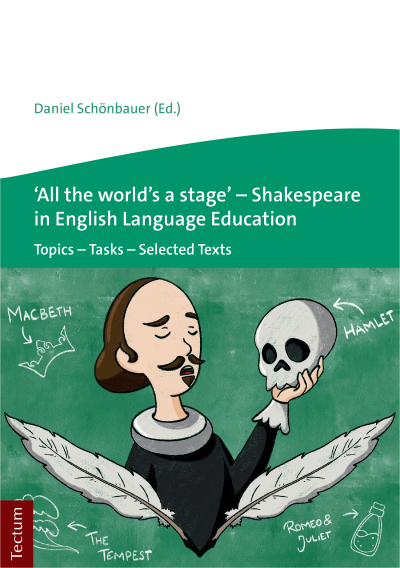
‘All the world’s a stage’ – Shakespeare in English Language Education
Topics – Tasks – Selected Texts- Editors:
- Publisher:
- 2021
Summary
If asked about which writer they associate with Anglophone literature, most students might come up with William Shakespeare, who has also become an integral part of British cultural identity. As a matter of fact, his works keep delighting audiences worldwide. However, EFL learners might struggle with the complexity and ambiguity of his plays and poetry. This anthology provides perspectives of how to read and teach Shakespeare. Thereby, it focusses on a variety of texts worth implementing in teaching units. The articles take the perspective of literary and cultural studies as base and aim at interconnecting it to major con-cepts and theories of teaching literature and culture and provides ideas of how to actively teach Shakespeare in class. With contributions byAlina Dresen, Julia Falter, Jessie-May Franken, Sophie Gnech, Svenja Harzem, Michelle Hausschild, Christina Kattwinkel, Ruth Kühsel, Dr. Imke Lichterfeld, Milena Niesen, Rahel Ovesiek, Daniel Schönbauer, Alina Tary, Sofia Ullah, Daniel Voges und Bernadette von Tongelen.
Keywords
Search publication
Bibliographic data
- Edition
- 1/2021
- Copyright Year
- 2021
- ISBN-Print
- 978-3-8288-4371-4
- ISBN-Online
- 978-3-8288-7352-0
- Publisher
- Tectum, Baden-Baden
- Language
- English
- Pages
- 190
- Product Type
- Edited Book
Table of contents
- Titelei/Inhaltsverzeichnis No access Pages 1 - 9
- Introduction: ‘All the world’s a stage’ – Shakespeare in English Language Education No access Pages 10 - 11Authors:
- Authors:
- 1 Introduction No accessAuthors:
- 2 The School Curriculum in Germany No accessAuthors:
- 3 Why Shakespeare? No accessAuthors:
- 4 Casting choices No accessAuthors:
- 5 The bastard Edmund in King Lear No accessAuthors:
- 6 Conclusion No accessAuthors:
- Bibliography No accessAuthors:
- 1 Introduction No access
- 2 Sonnet 20 – A Gender Riddle No access
- 3.1 Chances No access
- 3.2 Challenges No access
- 3.3 Suitability No access
- 4.1 Pre-Reading Activity No access
- 4.2 While-Reading Activity No access
- 4.3 Post-Reading Activity No access
- 5 Conclusion No access
- Bibliography No access
- 1 Introduction No access
- 2 Two Loves I Have – Reading and Teaching Sonnet 144 No access
- 3.1 Chances No access
- 3.2 Challenges No access
- 3.3 Suitability No access
- 4.1 Pre-Reading Activity No access
- 4.2 While-Reading Activity No access
- 4.3 Post-Reading Activity No access
- 5 Conclusion No access
- Bibliography No access
- 1 Introduction No access
- 2 Concepts in Much Ado About Nothing – An Analysis No access
- 3.1 Chances No access
- 3.2 Challenges No access
- 3.3 Suitability No access
- 4.1 Pre-Reading Activity No access
- 4.2 While-Reading Activity No access
- 4.3 Post-Reading Activity No access
- 5 Conclusion No access
- Bibliography No access
- 1 Introduction No access
- 2 Kenneth Branagh’s Hamlet: Content Analysis No access
- 3.1 Chances No access
- 3.2 Challenges No access
- 4.1 Pre-Viewing Activity No access
- 4.2 While-Viewing Activity No access
- 4.3 Post-Viewing Activity No access
- 5 Conclusion: To teach or not to teach – that is the question No access
- 6 Bibliography No access
- 1 Introduction No access
- 2.1 A tragedy of character: Evil and choice in Macbeth No access
- 2.2 Supernatural forces No access
- 2.3 Gender representations No access
- 3 Shakespeare’s Macbeth in Foreign Language Education No access
- 4 Teaching Activities No access
- 5 Conclusion No access
- Bibliography No access
- 1 Introduction No access
- 2.1 “The island’s mine which thou takest from me”: a postcolonial reading of the play No access
- 2.2 “Obey and be attentive”: the role of women in the play No access
- 3.1 Chances No access
- 3.2 Challenges No access
- 4.1 Pre-Reading Activity No access
- 4.2 While-Reading Activity No access
- 4.3 Post-Reading Activity No access
- 5 Conclusion No access
- Bibliography No access
- Part C: To adapt or not to adapt Shakespeare? – Focus on Adaptations No access Pages 143 - 143
- Authors:
- 1 Introduction No accessAuthors:
- 2 Analysis (TITLE) No accessAuthors:
- Authors:
- 3.1 Chances No accessAuthors:
- 3.2 Challenges No accessAuthors:
- Authors:
- 4.1 Pre-Viewing Activity No accessAuthors:
- 4.2 While-Viewing Activity No accessAuthors:
- 4.3 Post-Viewing Activity No accessAuthors:
- 5 Conclusion No accessAuthors:
- 6 Bibliography No accessAuthors:
- Authors:
- 1 Introduction No accessAuthors:
- 2 Content Analysis No accessAuthors:
- Authors:
- 3.1 Chances No accessAuthors:
- 3.2 Challenges No accessAuthors:
- 4 Teaching Activities No accessAuthors:
- 5 Conclusion No accessAuthors:
- 6 Bibliography No accessAuthors:
- Authors: |
- 1 Introduction No accessAuthors: |
- 2 Content analysis No accessAuthors: |
- 3 Teaching the Manga adaption of A Midsummer Night’s Dream – chances and challenges No accessAuthors: |
- 4 Teaching Activities No accessAuthors: |
- 5 Conclusion No accessAuthors: |
- 6 Bibliography No accessAuthors: |