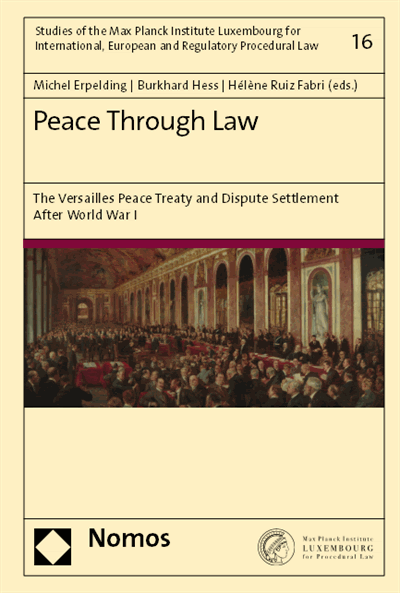
Peace Through Law
The Versailles Peace Treaty and Dispute Settlement After World War I- Editors:
- | |
- Series:
- Studies of the Max Planck Institute Luxembourg for International, European and Regulatory Procedural Law, Volume 16
- Publisher:
- 2019
Summary
With the benefit of hindsight, presenting the Treaty of Versailles as an example of ‘peace through law’ might seem like a provocation. And yet, the extreme variety and innovativeness of international procedural and substantial ‘experiments’ attempted as a result of the Treaty of Versailles and the other Paris Peace Treaties of 1919–1920 remain striking even today. While many of these ‘experiments’ had a lasting impact on international law and dispute settlement after the Second World War, and considerably broadened the very idea of ‘peace through law’, they have often disappeared from collective memories.
Relying on both legal and historical research, this book provides a global overview of how the Paris Peace Treaties impacted on dispute resolution in the interwar period, both substantially and procedurally. The book’s accounts of several all-but-forgotten international tribunals and their case law include references to archival records and photographic illustrations.
Keywords
Search publication
Bibliographic data
- Edition
- 1/2019
- Copyright Year
- 2019
- ISBN-Print
- 978-3-8487-5754-1
- ISBN-Online
- 978-3-8452-9916-7
- Publisher
- Nomos, Baden-Baden
- Series
- Studies of the Max Planck Institute Luxembourg for International, European and Regulatory Procedural Law
- Volume
- 16
- Language
- English
- Pages
- 354
- Product Type
- Edited Book
Table of contents
- Titelei/InhaltsverzeichnisPages 1 - 10 Download chapter (PDF)
- Authors:Download chapter (PDF)
- 1. Peace Through Law?Authors:
- 2. The Establishment of a New International Order of PeaceAuthors:
- 3. The Emergence of International Economic LawAuthors:
- 4. The Institutionalization of International AdjudicationAuthors:
- 5. Beyond ‘Peace Through Law’: The Use of Law and Its Records as Vehicles of Resistance and ChangeAuthors:
- Authors:Download chapter (PDF)
- 1. Prologue: Noël, 1913Authors:
- 2. A Dramatic GestureAuthors:
- 3. The Dramatis Personae and the Actors: Dynamics and IndeterminacyAuthors:
- 4. The Agon of the PersonaeAuthors:
- 5. Dramatic AnomaliesAuthors:
- 6. Destructive ParodyAuthors:
- 7. No Exit?Authors:
- 8. The ‘Art of Justice’ and the ‘Smoking Crater’Authors:
- 9. Conclusion … or Not?Authors:
- Authors:Download chapter (PDF)
- 1. IntroductionAuthors:
- 2. Sovereign Equality Emerging—But not EntrenchedAuthors:
- 3. Admission, Voting, and Sovereign Equality in the LeagueAuthors:
- 4. Other Aspects of ParticipationAuthors:
- 5. ConclusionAuthors:
- Chapter 3 Preventing a Repetition of the Great War: Responding to International Terrorism in the 1930sPages 85 - 98Authors:Download chapter (PDF)
- Authors: |Download chapter (PDF)
- 1. IntroductionAuthors: |
- Authors: |
- 2.1. The Principle of Non-Annexation of Territories Upon Military VictoryAuthors: |
- 2.2. The Internationalization of the Treatment of Certain Colonial PopulationsAuthors: |
- 2.3. The Institutionalization of a Droit de Regard with Respect to the Treatment of Certain Colonial PopulationsAuthors: |
- Authors: |
- 3.1. The Mandates System as a Formalization of the Interests of Colonial PowersAuthors: |
- 3.2. The Reliance of the Mandates System on the Right of CivilizationAuthors: |
- 3.3. The Mandates System as an Entrenchment of Colonial DominationAuthors: |
- 4. ConclusionAuthors: |
- Authors:Download chapter (PDF)
- 1. IntroductionAuthors:
- Authors:
- 2.1. Wartime Mistreatment of MinoritiesAuthors:
- 2.2. The Allies’ War Aims and National MinoritiesAuthors:
- 2.3. Woodrow Wilson’s Fourteen Points and Self-DeterminationAuthors:
- Authors:
- 3.1. Wilson’s Equal Treatment ClausesAuthors:
- 3.2. Japan’s Racial Equality ClauseAuthors:
- 3.3. Equality in the Polish Treaty: Defining MomentsAuthors:
- 4. Concluding remarksAuthors:
- Authors:Download chapter (PDF)
- 1. IntroductionAuthors:
- 2. From Revolution to ReformAuthors:
- 3. Legal Proceduralism versus RevolutionAuthors:
- 4. Law and Morality: Towards Responsive LawAuthors:
- 5. Law and/as ExpertiseAuthors:
- 6. ConclusionAuthors:
- Authors:Download chapter (PDF)
- 1. Introduction: Terminology and the Historical ContextAuthors:
- Authors:
- 2.1. The Institutional FrameworkAuthors:
- 2.2. The Work Programme, and the IndividualsAuthors:
- 2.3. 1937: Not the End, but a Transition into the UnknownAuthors:
- Authors:
- 3.1. Political BackgroundAuthors:
- 3.2. The 1923 Protocol on Arbitration ClausesAuthors:
- 3.3. The 1927 Convention on the Execution of Foreign Arbitral AwardsAuthors:
- 3.4 Overall AssessmentAuthors:
- 4. ConclusionAuthors:
- Authors:Download chapter (PDF)
- Authors:
- 1.1 An American IdeaAuthors:
- 1.2 A British EnlargementAuthors:
- 1.3 An Inter-Allied CompromiseAuthors:
- 1.4 The Reparation Commission as a New DealAuthors:
- Authors:
- 2.1 The Ambiguous Status of the Reparation CommissionAuthors:
- 2.2 The Obstacles for Transforming the Reparation Commission into an Independent TribunalAuthors:
- 2.3 The Turning Point of 1922Authors:
- Authors:Download chapter (PDF)
- 1. Morality, Law, and the EconomistsAuthors:
- 2. The Magnitude of the German Reparation DebtAuthors:
- 3. The Ruhr Crisis and the Dawes PlanAuthors:
- 4. The Young Plan and Its AftermathAuthors:
- 5. The Versailles Reparations in PerspectiveAuthors:
- Authors:Download chapter (PDF)
- 1. IntroductionAuthors:
- Authors:
- 2.1. A World Court at LastAuthors:
- 2.2. A World Court with a Modest BriefAuthors:
- Authors:
- 3.1. Sticking to the Brief: the Court as a Dispute SettlerAuthors:
- 3.2. ‘Gradually Moulding International Law’: the Court as an Agent of Legal DevelopmentAuthors:
- 4. Concluding ThoughtsAuthors:
- Authors: |Download chapter (PDF)
- Authors: |
- Authors: |
- 1.1.1. War Measures Against the Property of ‘Ennemis Nationaux’Authors: |
- 1.1.2. Private Rights and Interests in the Peace TreatiesAuthors: |
- Authors: |
- 1.2.1. The Pertinent Provisions in the Peace TreatiesAuthors: |
- 1.2.2. The Competences of the MATsAuthors: |
- 1.2.3. The German–US Peace Treaty of 1922Authors: |
- Authors: |
- Authors: |
- 2.1.1. A New Model for the Settlement of International DisputesAuthors: |
- 2.1.2. Statistical DataAuthors: |
- Authors: |
- 2.2.1. The Judges and the SecretariatsAuthors: |
- 2.2.2. The State AgentsAuthors: |
- 2.2.3. The Position of the Individual ClaimantsAuthors: |
- 2.3. The Procedures AppliedAuthors: |
- Authors: |
- 2.4.1. The Basic RegimeAuthors: |
- 2.4.2. Concurrent Pending Jurisdiction in National CourtsAuthors: |
- 2.4.3. Finality and EnforceabilityAuthors: |
- Authors: |
- Authors: |
- 3.1.1. National or International TribunalsAuthors: |
- 3.1.2. General/Special JurisdictionAuthors: |
- 3.2. Modern ParallelsAuthors: |
- Authors: |
- 4.1. Nationality and StandingAuthors: |
- Authors: |
- 4.2.1. The Debate Among ScholarsAuthors: |
- 4.2.2. The Case Law of the MATsAuthors: |
- Authors: |
- 5.1. A Preferred Way of Dispute Settlement in the 1920sAuthors: |
- 5.2. A Practical Drawback: The Fragmentation of the Case LawAuthors: |
- 5.3. Are There Lessons to be Learned?Authors: |
- Authors:Download chapter (PDF)
- 1. Introduction: Mitigating the Side-Effects of Self-DeterminationAuthors:
- Authors:
- 2.1. Direct Individual Claims for CompensationAuthors:
- 2.2. Indirect Individual ClaimsAuthors:
- 2.3. Evocation ProcedureAuthors:
- 2.4. Power to Create General Binding PrecedentAuthors:
- Authors:
- 3.1. Setting Up the TribunalAuthors:
- 3.2. Engaging with the Local PopulationAuthors:
- 3.3. Dealing with the States PartiesAuthors:
- 4. Defending the Tribunal’s LegacyAuthors:
- 5. Conclusion: From Upper Silesia to Luxembourg?Authors:
- Authors:Download chapter (PDF)
- Authors:
- 1.1. Article 43 of the Annex to the 1907 Hague ConventionAuthors:
- Authors:
- 1.2.1. The Majority’s InterpretationAuthors:
- 1.2.2. The Interpretation of de Ryckère and Benoidt.Authors:
- 1.2.3. ‘Whereas the Independence of the Belgian Courts Has Been Infringed...’Authors:
- Authors:
- 2.1. Categories of Possible EffectsAuthors:
- Authors:
- 2.2.1. Criminal LawAuthors:
- 2.2.2. Contract LawAuthors:
- 2.2.3. International Private Law (Outside Occupied Belgium)Authors:
- 3. EpilogueAuthors:
- Authors: | |Download chapter (PDF)
- 1. IntroductionAuthors: | |
- 2. Translating Foundational MomentsAuthors: | |
- 3. Ottoman Courts-MartialAuthors: | |
- 4. Art as a Means of Making VisibleAuthors: | |
- 5. Flowers of WarAuthors: | |
- 6. Peace Through Law: ConclusionAuthors: | |