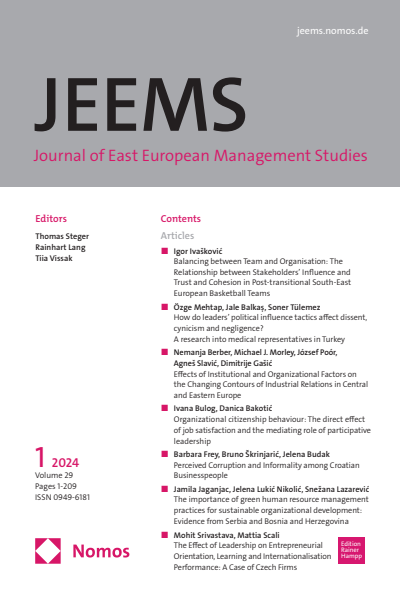
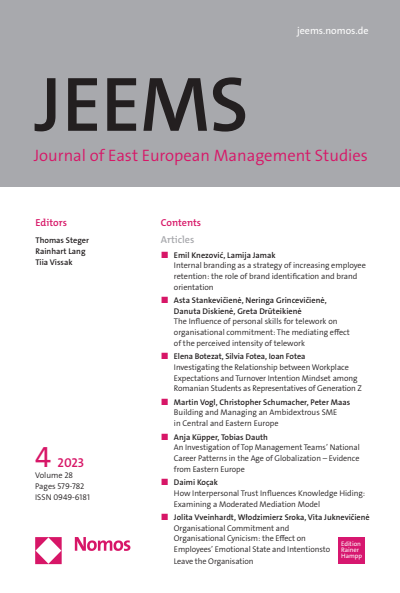
The Journal of East European Management Studies aims to promote dialogue and cooperation among scholars seeking to examine,explore and explain the behaviour and practices of management within the transforming societies of Central and Eastern Europe. The theoretical interests of the journal are organisational and management change, Central and East European societies (including those on the fringes of Europe) undergoing processes of transition or transformation, and scientific issues of business, management and organisation that arise in such contexts. The JEEMS aims to attract social scientific contributions from scholars of any nation and region, but particularly wishes to encourageauthors from those countries directly experiencing transformational change. Its potential readership is international, comprising academicsand practitioners with an involvement or interest in the management of change in transforming societies in Central and Eastern Europe.
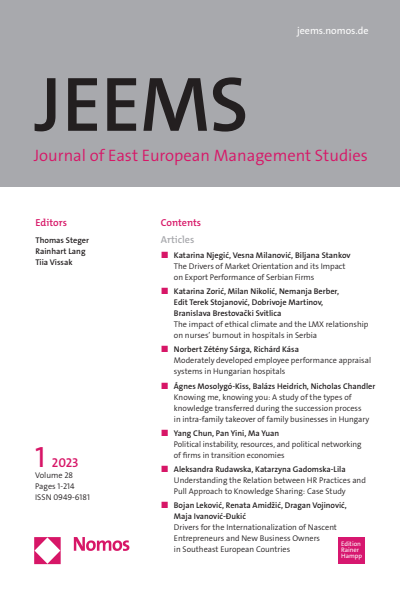
In the field of international business, examination of the link between a market orientation (MO) and an export performance (EP) is quite popular. However, mechanisms through which MO affects EP have not been sufficiently investigated. The aim of...
Burnout contributes to the emergence of numerous negative organisational phenomena. Nurses are exposed to high stress working conditions every day, making it important to study burnout among nurses in health care systems. The aim of the paper is to...
The aim of the study is to assess and present the structure of the performance management system and the practice of performance appraisal in Hungarian state-run hospitals in the framework of an exploratory, descriptive research. Objective data may...
This study aims to examine the role of knowledge in ensuring the successor’s readiness for intra-family succession in Hungarian family businesses. The study investigates the research question: which types of knowledge shape the successor’s...
Firms engaging in political networking is a widely witnessed phenomenon in transition states where the economy shifts from central planning to market mechanism. In this article, we integrate the institutional-based and resource-based perspectives to...
The aim of this study is to identify the relationship between human resource (HR) practices, knowledge seeking and knowledge giving by applying the lenses of the motivation-opportunities-abilities framework in the context of the multinational...
This article investigates drivers for the internationalization of nascent entrepreneurs and new business owners during the age of the digital transformation of Southeast European countries (SEE). Empirical research conducted on a sample of 4,066...