Monograph Open Access Full access
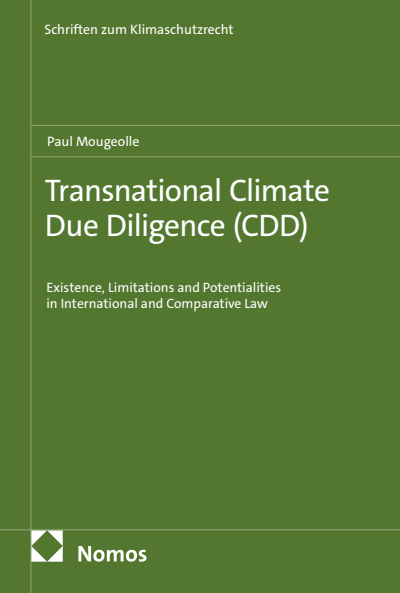
Transnational Climate Due Diligence (CDD)
Existence, Limitations and Potentialities in International and Comparative Law- Authors:
- Series:
- Schriften zum Klimaschutzrecht, Volume 7
- Publisher:
- 2026
Summary
This work explores the existence and boundaries of 'climate due diligence' (CDD) of States and corporate actors within the context of international, human rights and domestic law in Global North jurisdictions. It demonstrates that due diligence applies to global warming because it causes serious harm and because reducing greenhouse gases remains possible. Furthermore, the study shows that CDD requires the best possible efforts to mitigate global warming, in line with scientific and institutional consensus, and that this can be enforced by the courts. A historical analysis of compliance with CDD reveals past and ongoing breaches, which may result in legal responsibility. This title is also available as Open Access.
Keywords
Search publication
Bibliographic data
- Edition
- 1/2026
- Copyright Year
- 2026
- ISBN-Print
- 978-3-7560-3572-4
- ISBN-Online
- 978-3-7489-6631-9
- Publisher
- Nomos, Baden-Baden
- Series
- Schriften zum Klimaschutzrecht
- Volume
- 7
- Language
- German
- Pages
- 562
- Product Type
- Monograph
Table of contents
ChapterPages
- Foreword
- Abbreviations
- Abstract and executive summary
- 0.1 The PhD’s research question in a nutshell: Reinforcing climate action with due diligence?
- 0.2.1.1 Universal origins of State due diligence: no-harm principle
- 0.2.1.2 Functions and features of due diligence: a substantive obligation of means
- 0.2.1.3 The interrelationships between general due diligence and specific treaty obligations
- 0.2.2.1 Origins of HRDD: the universal no-harm principle
- 0.2.2.2 Functions and properties of corporate due diligence (HRDD): an obligation of conduct
- 0.2.2.3 The binding force of HRDD through case laws and specific legislations
- 0.2.3 Main hypothesis: due diligence, a pervasive concept requiring climate action?
- 0.3.1 The persisting non-alignment with the Paris Agreement’s target
- 0.3.2.1 The lack of a legally binding and effective international climate regime
- 0.3.2.2 The collective and cumulative nature of climate harm: a “drop in the ocean”?
- 0.3.2.3 The onerousness of the climate transition
- 0.3.2.4 The “free-riding” and “carbon leakage” issues vs the need to do its share
- 0.3.2.5 The higher responsibility of the “developed countries”
- 0.3.2.6 Private actors’ responsibilities, especially those of businesses
- 0.3.3 The research questions: CDD as a remedy to the above non-compliance factors?
- 0.4.1 Overview of general and specific CDD cases
- 0.4.2 The main critiques of CDD in the legal literature
- 0.4.3 The potentialities identified by other scholars
- 0.5.1 The reliance on climate science
- 0.5.2 The functional approach to find harmonisation or fragmentation
- 0.5.3 Considering “framework cases” against systemic public and private global North actors
- 0.5.4 The PhD structure
- 1.1.1.1 GHGs fulfilling the ILC Draft Articles on Prevention of Transboundary Harm from Hazardous Activities criteria
- 1.1.1.2 Transboundary criterion and compatibility with cumulative causation
- 1.1.2.1.1 The UNFCCC concretisation of general due diligence
- 1.1.2.1.2 The Paris Agreement’s due diligence character
- 1.1.2.2 The added value of general due diligence: a legal base linked to preexisting liability systems
- 1.1.2.3 The UNFCCC and the Paris Agreement do not derogate due diligence
- 1.1.3 CDD, towards jus cogens?
- 1.1.4 Provisional conclusion on the existence of international CDD
- 1.2.1.1 A core due diligence requirement to protect human rights
- 1.2.1.2 Human rights endangered by climate change
- 1.2.1.3 States’ duty to protect humans from climate change, including by regulating transnational corporations and value chains
- 1.2.2.1 General due diligence requirement to protect human rights, including in environmental-related cases
- 1.2.2.2 The applicable ECHR in the climate realm
- 1.2.3 Provisional conclusion on the existence of human rights CDD
- 1.3.1 CDD’s existence in Dutch law (overview)
- 1.3.2.1 The Roman law origins of due diligence in French tort law
- 1.3.2.2 The developments and functions of French liability law
- 1.3.2.3 French administrative rules on State liability include due diligence
- 1.3.2.4 The French general environmental duty of care and the possibility of seeking preventative measures through injunctive relief
- 1.3.2.5 The law on the Duty of Vigilance of parent and procuring companies in human rights and environmental matters
- 1.3.2.6 General due diligence certainly applicable to climate matters, including between private persons
- 1.3.3.1 Roman origins and basic structures of the German tort duty of care
- 1.3.3.2 State responsibility under the German Civil Code (Amtshaftung)
- 1.3.3.3 The possibility of seeking preventative enforcement of due diligence, including through injunctions
- 1.3.3.4 The Supply Chains Act and the case law on the liability of parent and procuring companies
- 1.3.3.5 General due diligence applicable to climate change, including between private persons
- 1.3.3.6 No wrongful conduct needed to enforce CDD?
- 1.3.4.1 The origins and basic functions of the duty of care in common law
- 1.3.4.2 The possibility of seeking preventative enforcement of due diligence through injunctions
- 1.3.4.3 The development of the duty of care of parent companies in the UK case law
- 1.3.4.4.1 In the UK
- 1.3.4.4.2 In the USA
- 1.3.4.4.3 In other common-law countries
- 1.3.4.4.4 Interim conclusion
- 1.3.4.5 Discussion of general CDD’s applicability based on the duty of care criteria
- 1.3.5 Provisional conclusion and comparative notes on the existence of CDD in the various domestic jurisdictions
- 1.4 Interim conclusion on CDD’s existence
- 2.1.1.1.1 The pioneering discussion in Massachusetts v EPA
- 2.1.1.1.2 Urgenda: Availability of the general human rights avenue to claim CDD
- 2.1.1.2.1 The particularisation requirement of the Court of Justice of the EU in Carvalho
- 2.1.1.2.2 The dismissal of climate-related human rights claims in Klimaseniorinnen by Swiss courts
- 2.1.2.1 The successful ultra vires case brought by Friends of the Irish Environment
- 2.1.2.2 The confirmation of the ultra vires avenue in the French Grande-Synthe case
- 2.1.2.3 The latest successful specific CDD case in the UK
- 2.1.3.1 The recognition of individual climate-related injuries in Juliana
- 2.1.3.2 The possibility of relying on the ecological injury in France to claim general due diligence
- 2.1.3.3 The admissible German constitutional complaint based on individual and collective rights
- 2.1.3.4 The findings of UN Human Rights Treaty Bodies (UN-HRTB)
- 2.1.3.5 The confirmation by the ECtHR of the ability of NGOs to claim climate-related risks
- 2.1.3.6 Potential injuries under general international law
- 2.1.4 Provisional conclusion on standing regarding injury
- 2.2.1.1 The foreseeability of man-made climate-related harms despite the scientific uncertainties
- 2.2.1.2 Judicially embracing the shared responsibility principles
- 2.2.2.1.1 The general State duty to regulate private actors and extraterritorial events
- 2.2.2.1.2 The borderless obligations of the Climate Conventions
- 2.2.2.2 The indirect emissions caused by corporations and their ability to reduce them
- 2.2.3 Provisional conclusion on causation
- 2.3.1.1.1 The pioneering redress in Massachusetts
- 2.3.1.1.2 Applying the lex specialis rule in American Electric Power Company v Connecticut
- 2.3.1.1.3 Limiting the judicial review of the Clean Air Act
- 2.3.1.2 The Irish Supreme Court’s enforcement of specific due diligence
- 2.3.1.3.1 An excessive deferral to the lawmakers’ will by the Supreme Court, hindering the enforcement of general CDD
- 2.3.1.3.2 Despite establishing a general CDD obligation, no breach finding in the Notre affaire à tous case
- 2.3.1.4.1 The failure of the first Plan B case due to the lack of consensual scientific elements
- 2.3.1.4.2 The failure of the Second Plan B case, given the merits of the specific UK legislation
- 2.3.1.4.3 The Friends of the Earth et al case, a successful specific CDD case
- 2.3.1.5 Intermediate conclusion
- 2.3.2.1 The enforceable target in Urgenda due to the scientific consensus and the State recognition of the necessity to reduce emissions by 25%
- 2.3.2.2 The dismissed Juliana v USA case due to justiciability concerns and non-consensual requests
- 2.3.2.3.1 A first court decision by the Berlin Administrative Court testing the Urgenda principles
- 2.3.2.3.2 The recognition and development of general CDD by the German Constitutional Court
- 2.3.2.4 The Brussels Courts’ enforcement of general and special due diligence
- 2.3.2.5.1 Preliminary assessment of the chances of success of the fair share argument
- 2.3.2.5.2 The ECtHR’s redress with a margin of appreciation in KlimaSeniorinnen
- 2.3.2.6 Intermediate conclusion
- 2.3.3.1.1 The redressability of a general corporate CDD duty
- 2.3.3.1.2 The level of consensus surrounding the claims, and the discretion left by them
- 2.3.3.1.3 The need to provide proportionate claims based on due diligence
- 2.3.3.2.1 The level of consensus surrounding the claims, and the discretion left by them
- 2.3.3.2.2 The adequacy and proportionality of the requests
- 2.3.3.3.1 A lack of consensus or discretion in the precise requests
- 2.3.3.3.2 Specific requests preempted by lex specialis according to the courts
- 2.3.3.4 Lex specialis and separation of powers issues in the USA
- 2.3.3.5 The redressability of the EU Corporate CDD 1.5°C transition plan obligation
- 2.3.4.1.1 On the UNGA and ICJ’s competencies concerning advisory opinions
- 2.3.4.1.2 No “compelling reason” to refrain from giving an advisory opinion
- 2.3.4.2.1 The ITLOS opinion on CDD’s existence
- 2.3.4.2.2 The ICJ confirmation of CDD’s existence and redressability
- 2.3.4.3 Intermediate conclusion
- 2.3.5 Provisional conclusion on redressability
- 2.4 Interim Conclusion on CDD’s enforceability and the corresponding obligations
- 3.1.1.1 CDD “in the making” until 1959-65
- 3.1.1.2 Procedural CDD applicability from 1965 onwards, especially in the USA
- 3.1.1.3 No evident CDD duty to manufacture electric vehicles by 1967
- 3.1.1.4 No CDD breach either from 1968 onwards
- 3.1.2.1 The Stockholm recognition of environmental due diligence and climate change as an issue
- 3.1.2.2.1 The birth of global sustainable development
- 3.1.2.2.2 Developing countries asserting their right to development and equity
- 3.1.3.1 Substantive CDD’s applicability in the making between 1975 – 1979
- 3.1.3.2 No evident CDD breach by the US fossil fuel industry in 1980
- 3.1.3.3 Potential first CDD breaches in the period 1980-88 by the USA
- 3.1.4 Provisional conclusion on CDD’s applicability and violations before 1990
- 3.2.1.1 The potential beginning of collective substantive CDD breaches
- 3.2.1.2.1 The WG I confirmation of the “natural greenhouse effect” and likely man-made global warming
- 3.2.1.2.2 The WG II potential findings on the climate impacts
- 3.2.1.2.3 The WG III findings on the need to transition
- 3.2.1.3 Despite the 1992 UNFCCC, individual CDD violations due to a lack of GHG reduction measures
- 3.2.2.1 The 1995 IPCC AR2 confirmation of CDD’s substantive applicability
- 3.2.2.2.1 The Kyoto Protocol’s main provisions and discussion on its sufficiency
- 3.2.2.2.2 The opposition of US public and private actors to the Kyoto Protocol
- 3.2.2.2.3 The non-compliance of the developed countries with general CDD, despite formal compliance with the KP
- 3.2.2.3 The 2001 IPCC AR3 Report showing the need for technological development while highlighting the costs of short-term aggressive mitigation
- 3.2.3.1 The 2007 AR4 “Bali-box”, pointing to a CDD duty to limit global warming to 2°C
- 3.2.3.2 The precise AR4 indications on 2°C pathways taken up politically by States, specifying CDD requirements
- 3.2.3.3 The 2012 refusal of numerous developed countries to recommit under the Doha Amendment
- 3.2.4 Provisional conclusion on CDD’s historical shortcomings between 1988 and 2015
- 3.3.1 The 2014 IPCC AR5 laying out high risks if the 2°C threshold is overstepped
- 3.3.2.1 The absence of alignment with the PA’s objectives, potentially constituting substantive CDD violations
- 3.3.2.2 The PA’s mitigation provisions and the insufficient commitments
- 3.3.2.3 The PA’s provisions on adaptation, loss and damage and the resulting questions on State responsibility
- 3.3.2.4 The PA’s finance provisions and the insufficient commitments
- 3.3.2.5 The PA’s soft compliance mechanisms, insufficient as such
- 3.3.2.6 Provisional conclusion concerning the PA’s sufficiency with respect to CDD
- 3.3.3.1 The SR1.5: a COP request resulting in procedural CDD compliance but in deeper substantive gaps
- 3.3.3.2 The diplomatic reception of the SR1.5, only leading to procedural compliance
- 3.3.4 The insufficient progress achieved by COP 26 – 28
- 3.3.5 Provisional conclusion on CDD’s violations after 2015
- 3.4.1.1 Increasing climate mitigation by considering historical responsibilities
- 3.4.1.2 Financially supporting emission reductions overseas
- 3.4.2 The secondary obligations to provide monetary compensation in case of loss and damage
- 4.1 Reflection on the adequacy of the comparative methodology
- 4.2 Reflection on the usefulness of CDD
- 4.3 Overall conclusion and outlook
- BibliographyPages 517 - 512 Download chapter (PDF)
- Glossary of core conceptsPages 513 - 554 Download chapter (PDF)
- IndexPages 555 - 562 Download chapter (PDF)